

Influencer marketing can deliver incredible ROI when you partner with creators who have genuine, engaged audiences. But there's a massive problem lurking beneath the surface of follower counts and engagement rates.
Fake engagement is everywhere, and it's costing businesses serious money.
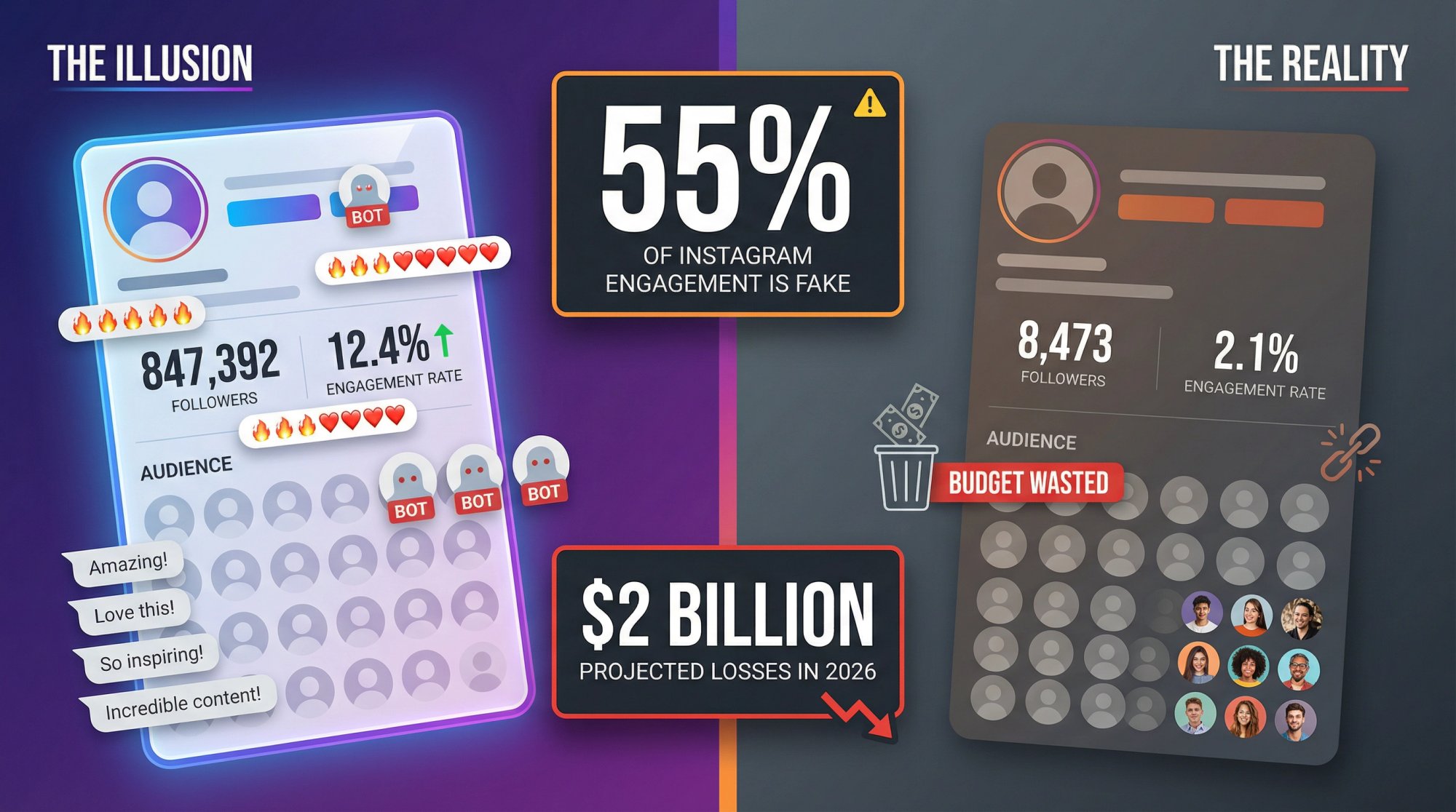
Over 55% of influencer engagement on Instagram was found to be fake in 2024, and brands are projected to lose over $2 billion in 2026 due to influencer fraud. These aren't just vanity metrics problems. When you pay for fake followers and bot-generated likes, you're burning budget on audience attention that simply doesn't exist.
The challenge? Spotting fake engagement isn't as simple as checking a follower count. Fraudsters have gotten sophisticated. Bot networks, engagement pods, purchased likes, and fake followers all work together to create the illusion of influence. If you don't know what to look for, you'll waste thousands on partnerships that deliver zero real results.
This guide will show you exactly how to identify fake engagement before you commit to an influencer partnership. You'll learn the red flags that scream "fraud," the tools we use to verify authenticity, and a practical vetting system you can apply today. By the end, you'll be able to separate genuine influencers from the fakes with confidence.
Why Fake Engagement Destroys Your Marketing ROI
When we talk about fake engagement, we're talking about artificial inflation of social metrics through purchased followers, bot-generated comments, or coordinated manipulation schemes. And the impact goes far beyond wasted ad spend.
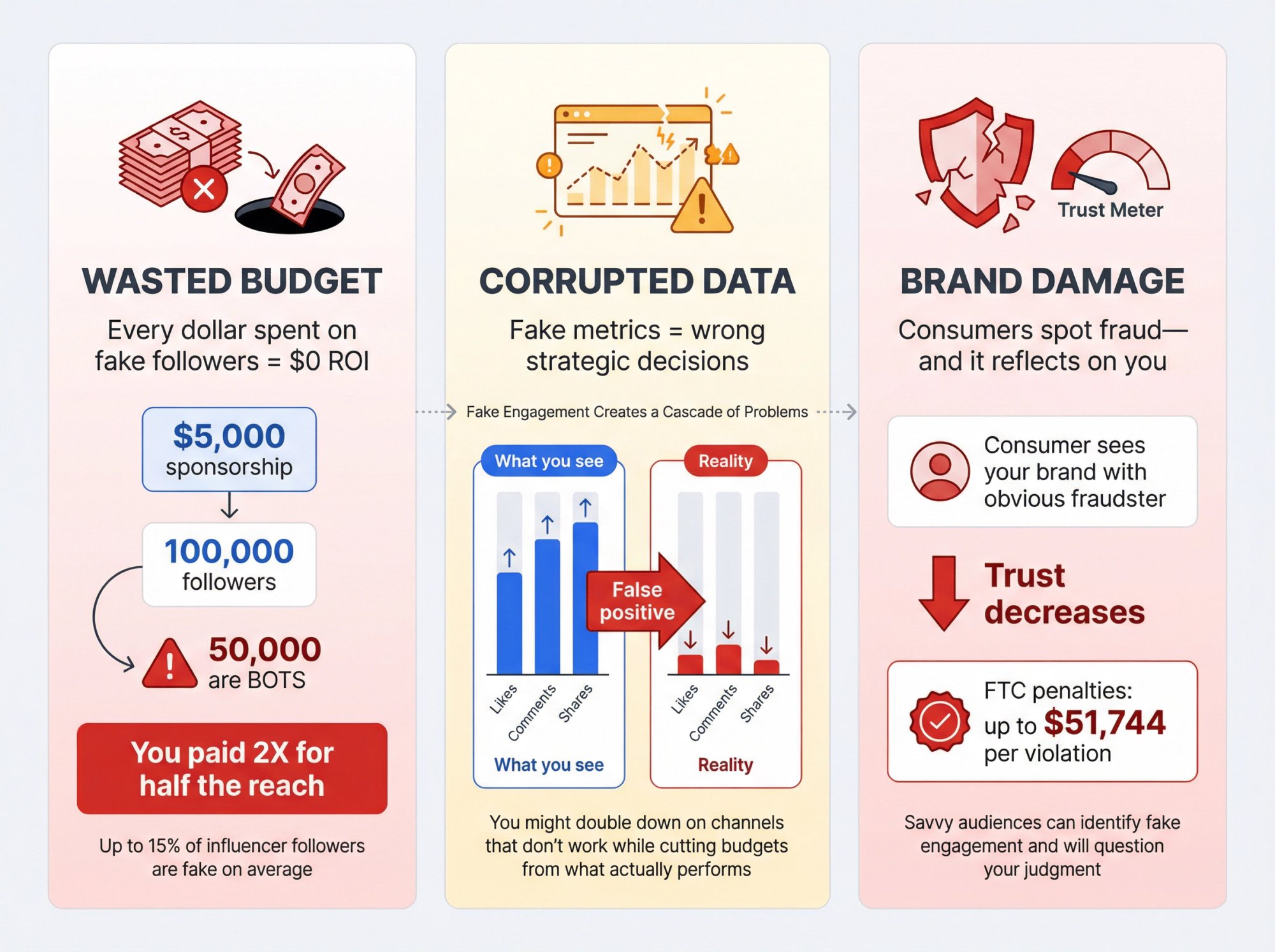
Critical Reality: Fake engagement damages your business in three interconnected ways: budget disappears into thin air, your data becomes worthless, and your brand reputation takes a hit.
How Fake Followers Waste Your Marketing Budget
Every dollar you spend on a fake follower is a dollar that never reaches an actual human who could buy your product. Research shows that up to 15% of an influencer's followers are fake on average, and in some cases, entire accounts are nearly fraudulent. When you base partnership decisions on inflated numbers, you're essentially paying premium rates for zero reach.
Think about it this way: if you pay an influencer $5,000 for a sponsored post expecting to reach 100,000 people, but 50,000 of those "followers" are bots, you just paid double what you should have for half the reach.
Why Fake Engagement Corrupts Your Campaign Data
Marketing teams live and die by data. But fake followers distort your campaign metrics, making it impossible to understand what actually works. You might see impressive engagement rates and assume your campaign succeeded, when in reality you reached almost nobody.
This corrupted data leads to terrible strategic decisions. You might double down on influencer marketing when it's not working, cut budgets from channels that actually perform, or misunderstand your audience entirely.
How Fake Influencers Damage Your Brand Reputation
When you collaborate with fraudulent influencers, you're not just wasting money. You're potentially damaging trust with real customers. Savvy consumers can spot fake engagement, and when they see your brand partnering with obvious fraudsters, it reflects poorly on you.
Plus, there are real regulatory risks. The FTC has started enforcing rules around fake social media indicators, with penalties up to $51,744 per violation for fake reviews and misleading influence metrics.
Fake engagement isn't a harmless vanity play. It's a serious business risk that requires proactive vetting.
Understanding Fake Engagement Tactics in 2026
Before we look at detection tactics, it's worth understanding why fake engagement is so hard to spot and what you're actually looking for.
The Proxy Problem: Why Metrics Don't Tell the Whole Story
You don't actually want "likes" or "comments." What you really want is human attention from a specific audience that's likely to take action (remember your brand, click through, make a purchase, subscribe).
But attention is hard to measure directly, so we use proxy metrics:
• Views
• Likes
• Comments
• Followers
• Shares
When these metrics become targets, they stop being useful measures (this is called Goodhart's Law). Creators and agencies learn to game the proxies instead of building genuine influence.
How Platforms Fight Fake Engagement (And Why It's Not Enough)
The major platforms know fake engagement is a problem and they're actively fighting it:
TikTok prohibits fake engagement services and reports large-scale enforcement against fake accounts and engagement manipulation.
Meta (Instagram/Facebook) downranks coordinated fake engagement and regularly removes massive volumes of fake pages and impersonator profiles.
YouTube has a fake engagement policy that explicitly prohibits artificially inflating metrics like views, likes, and subscribers.
But enforcement is an arms race. Detection must be pattern-based, not a single magic number.
Two Types of Fake Engagement You Need to Watch For
It helps to think about fake engagement in two categories:
Inauthentic engagement (clearly fake):
• Bought followers, likes, comments, views
• Bot networks and automated engagement
• Hijacked accounts used for manipulation
• Click farms and coordinated schemes
Low-intent engagement (real humans, wrong signal):
• Giveaway hunters who engage only for prizes
• Engagement pods (real humans coordinating to boost each other's metrics)
• Viral content that attracts spectators but not buyers
• Bait tactics like "comment 'link' and I'll DM you"
The first category is clearly fraudulent. The second is more nuanced but can be just as damaging to your ROI. Both types will waste your budget if you don't catch them.
6 Red Flags That Scream Fake Engagement
When you're vetting potential influencer partners, certain patterns should immediately raise suspicion. Real audiences behave in consistent (if chaotic) ways. Fake engagement creates weird contradictions that are visible if you know where to look.
1. Sudden Follower Spikes Without Any Explanation
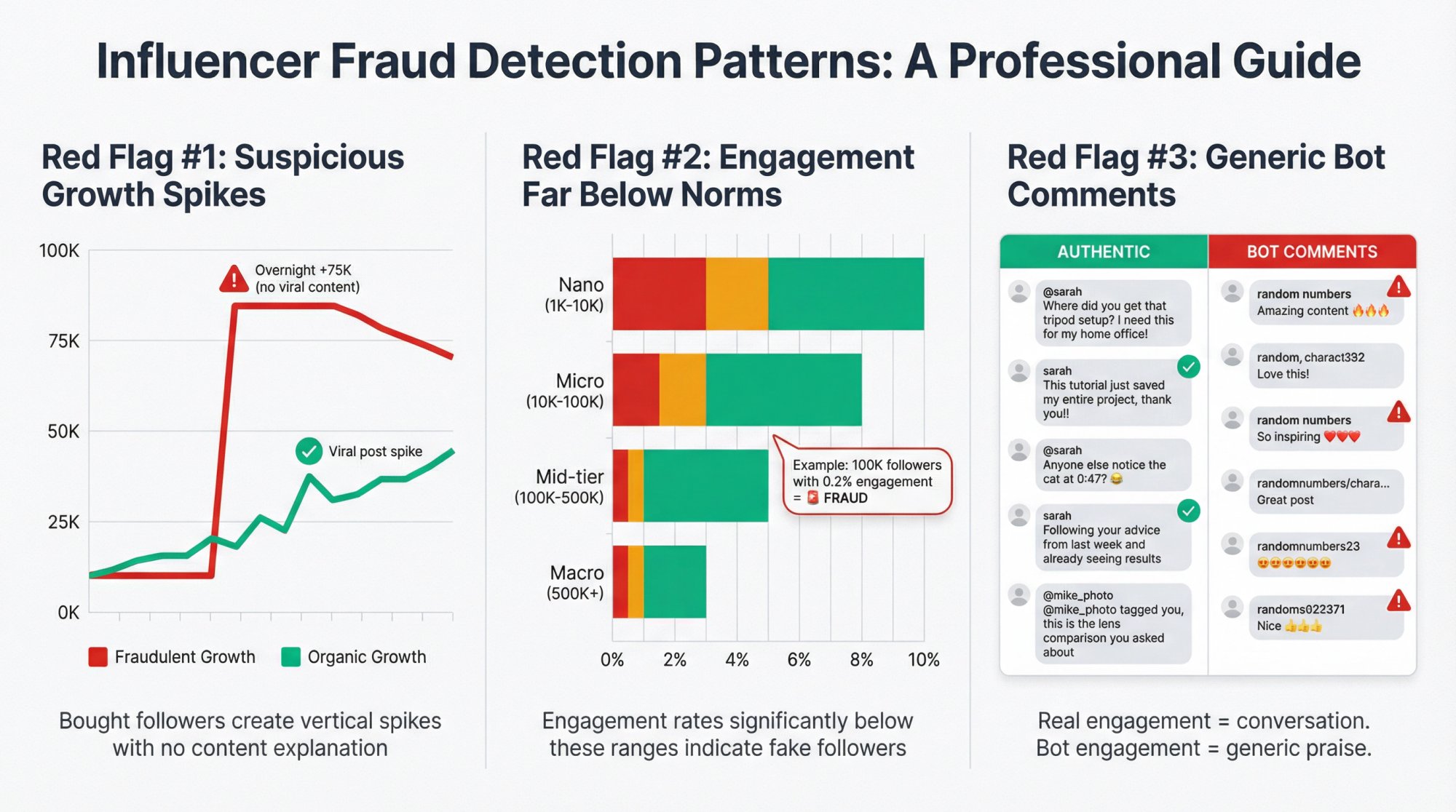
Real audience growth tends to be gradual with occasional bumps tied to specific events. When you see an influencer's follower count jump dramatically overnight, you need to investigate.
What normal growth looks like:
Steady upward trend with small variations, punctuated by occasional spikes that correspond to:
• A viral post or video
• A collaboration with a larger creator
• Press coverage or media features
• Being featured by the platform algorithm
What suspicious growth looks like:
• Massive overnight jump (think 10,000+ followers) with no corresponding viral content
• Repeated pattern of spikes and crashes
• Flat growth followed by sudden vertical leap
• Big jumps followed by immediate plateau
Influencer tracking tools can show you follower growth over time. If you spot an unexplained spike, ask the influencer directly what caused it. Legitimate creators will have a story. Fraudsters won't.
One thing to watch for after suspicious spikes: follower purges. Bought followers are often low-quality accounts that platforms eventually detect and remove. If you see a big spike followed by a gradual decline, that's a sign the followers weren't real.
2. High Follower Count But Low Engagement Rate
This is probably the most common and obvious red flag. An influencer with 100,000 followers getting only 200 likes per post? That's a 0.2% engagement rate, which screams fake followers.
Typical engagement rate benchmarks (as of 2026):
| Influencer Size | Expected Engagement Rate |
|---|---|
| Nano (1K-10K) | 5-10% |
| Micro (10K-100K) | 3-8% |
| Mid-tier (100K-500K) | 1-5% |
| Macro (500K+) | 1-3% |
These are rough guidelines. Rates vary by platform and niche. But if someone's engagement is significantly below these ranges with no explanation, their audience is likely hollow.
Quick Formula: Engagement Rate = (Total Likes + Comments) ÷ Follower Count × 100
Do this for their last 10-15 posts and look at the average. One low-performing post doesn't mean much. A consistent pattern of anemic engagement? That's a problem.
Remember: fake followers don't buy products. If the engagement isn't there, the audience isn't real, and your campaign will flop.
3. Suspiciously High Engagement With Generic Bot Comments
On the flip side, some influencers try to boost their engagement artificially through purchased likes, comment pods, or engagement services. The result? High engagement rates but terrible engagement quality.
Warning signs of fake engagement:
Generic praise that could apply to anything:
• "Love this!"
• "Amazing content ???"
• "So inspiring"
• "Great post"
Repetitive patterns:
Multiple accounts posting nearly identical comments, especially if they hit right after publication.
Emoji spam with no substance:
Rows of ??? or ??? with no actual commentary on the content.
Comments that don't match the content:
Video about product features getting comments like "You're beautiful" or completely unrelated promotional spam.
Weird language mismatches:
English-language content getting mass comments in unrelated languages (not from a genuine international audience, but from bot farms).
Actually read the comments on 3-5 recent posts. Not just the top comments. Scroll down and check out who's engaging.
Real engagement looks like conversation. Fans ask questions, tag friends, share personal stories, debate points in the content. Bot engagement looks like a stage set, full of generic applause signifying nothing.
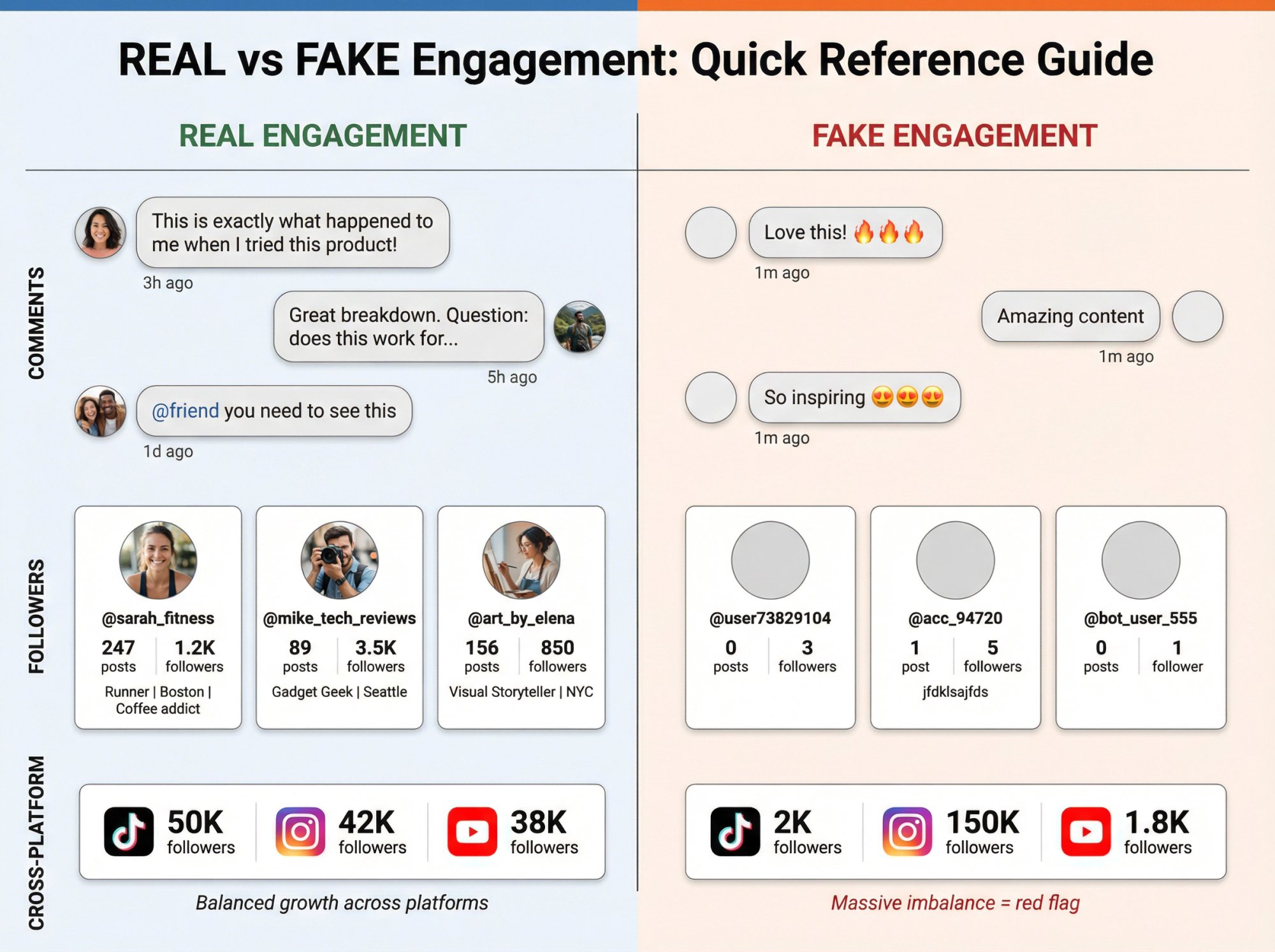
Also check the accounts leaving comments. Click on a few profiles. Do they look like real people with normal posting history? Or are they empty profiles with no posts, no profile pictures, and random usernames like @user73829104?
If the comment section feels hollow or manufactured, trust that instinct.
4. How to Identify Bot Followers and Ghost Accounts
Sometimes you need to go deeper than engagement rates and look at who is actually following the influencer.
Signs of a low-quality (fake) audience:
Ghost followers:
Accounts with no profile photo, zero posts, bizarre usernames (often just numbers), or clearly abandoned profiles. These are classic bot accounts created in bulk.
Geographic mismatches:
A U.S.-based fitness influencer whose audience is 60% from random overseas countries with no connection to their content. Real audiences cluster around logical geographies.
For example, if a skincare influencer based in California somehow has 50% of their followers from countries that don't speak their language and have no cultural overlap with their content? That's suspect. It suggests they bought bulk followers from click farms.
Demographic disconnects:
The audience demographics don't match the content. A tech gadget reviewer whose followers are 80% teenage girls? Doesn't add up.
How to check audience quality manually:
Go to the influencer's profile and click through to their follower list (if public). Randomly sample 15-20 followers. What percentage look like ghost accounts or spam profiles?
If you're hitting suspicious accounts left and right, you know the follower base is artificially inflated.
Tools for deeper audience analysis:
Advanced analytics platforms can analyze an influencer's audience authenticity and flag what percentage of followers appear to be fake, bots, or inactive accounts. These tools save you time and catch patterns you might miss manually.
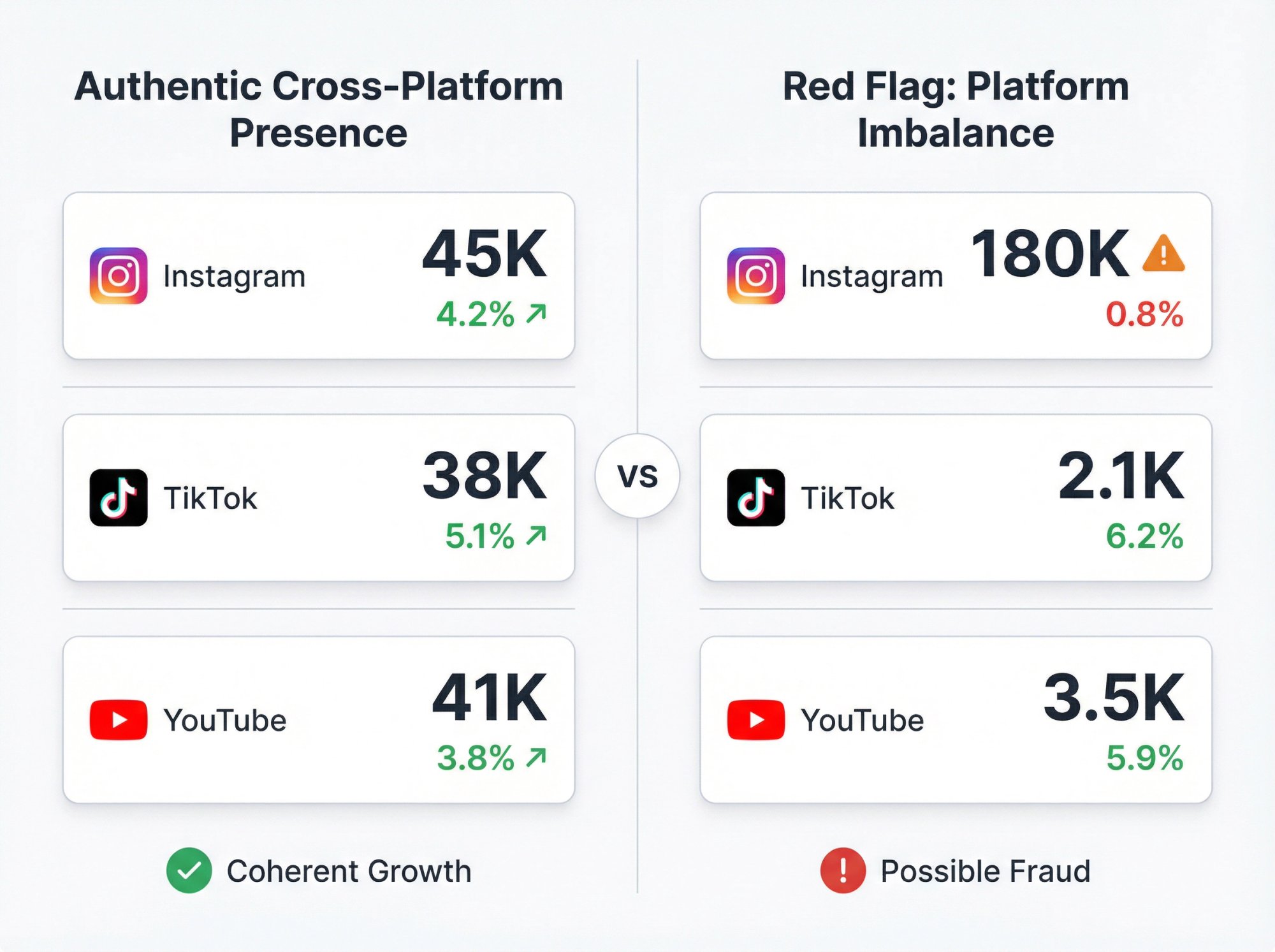
5. Inconsistent Performance Across Different Platforms
Real influence tends to carry across platforms to some degree. Not perfectly (someone might focus primarily on TikTok), but there should be some coherence.
Red flags in cross-platform analysis:
Massive imbalance without explanation:
1 million Instagram followers but only 2,000 on TikTok or YouTube despite posting regularly? That could be legitimate if they just started on the other platforms. Or it could mean the 1 million was purchased.
One platform looks inflated, others look normal:
Strong engagement on Instagram but dead engagement on YouTube with similar follower counts? The inflated one is suspicious.
Instagram Stories vs feed engagement:
This is a particularly telling metric. Instagram Stories are harder to fake than feed posts. You can't easily buy Story views, and Stories engagement (views, poll votes, Q&A responses) comes only from active followers.
If an influencer has 100K followers but only a few hundred Story views per post, that's a massive red flag. It means the active audience is tiny because most followers are fake or inactive.
What to do:
Check their presence across TikTok, Instagram, YouTube, and any other relevant platforms. Look for coherence in their influence. If you see extreme disparities that don't make sense, dig deeper or request first-party analytics to verify their actual reach.
At Shortimize, we built our tracking specifically for this cross-platform problem. You can monitor any public account's performance across TikTok, Instagram Reels, and YouTube Shorts in one dashboard, making it easy to spot inconsistencies and verify that an influencer's reach is legitimate across channels.
6. Irregular Engagement Patterns on Sponsored Content
Some marketers miss this subtle one: the engagement pattern changes dramatically on sponsored posts compared to organic content.
What's normal:
Sponsored posts usually get slightly lower engagement than organic content. People don't love ads. A 10-30% drop in engagement on branded content is typical and expected.
What's suspicious:
Sponsored posts get artificially boosted:
The influencer's organic posts get 2% engagement, but the moment they do a #ad, engagement spikes to 5% and the comment section fills with generic praise from new accounts.
Why does this happen? Some influencers use engagement pods or buy likes specifically on branded content to make campaign metrics look good to the client. It's fraud designed to secure future partnerships.
Sponsored posts completely collapse:
Organic content performs well with genuine comments, but every sponsored post dies with barely any engagement and the few comments that exist are generic or bot-like.
This suggests the organic engagement might be manipulated too, but the influencer can't maintain the facade for branded content. Or it means their audience actively dislikes ads to an extreme degree (which isn't great for you either).
How to check:
Pull up the influencer's last 3-5 sponsored posts (look for #ad, #sponsored, or brand tags). Compare engagement to their organic content from the same time period.
• Are the ratios similar?
• Does the quality of comments shift?
• Do you see different types of accounts engaging?
If sponsored content shows weird patterns (either artificially boosted or completely dead), that's a sign something isn't right with their audience.
Tools and Techniques for Detecting Fake Engagement
Manual vetting is important, but you can't scale it if you're evaluating dozens of potential partners. You need tools that can surface fraud signals quickly and help you make data-driven decisions.
Best Analytics Platforms for Fraud Detection
Several platforms specialize in influencer vetting and audience authenticity. These influencer analytics tools offer similar fraud detection capabilities, analyzing follower authenticity, engagement quality, and demographic coherence. Many offer free trials where you can audit a few profiles before committing.
What these tools do well:
They process huge datasets and apply statistical models to spot patterns that humans would miss. They can flag things like bot networks, engagement velocity anomalies, and suspicious growth.
What they can't do:
Provide 100% certainty. Use them as a filter, not a final verdict.
How to Use Cross-Platform Tracking to Spot Fraud
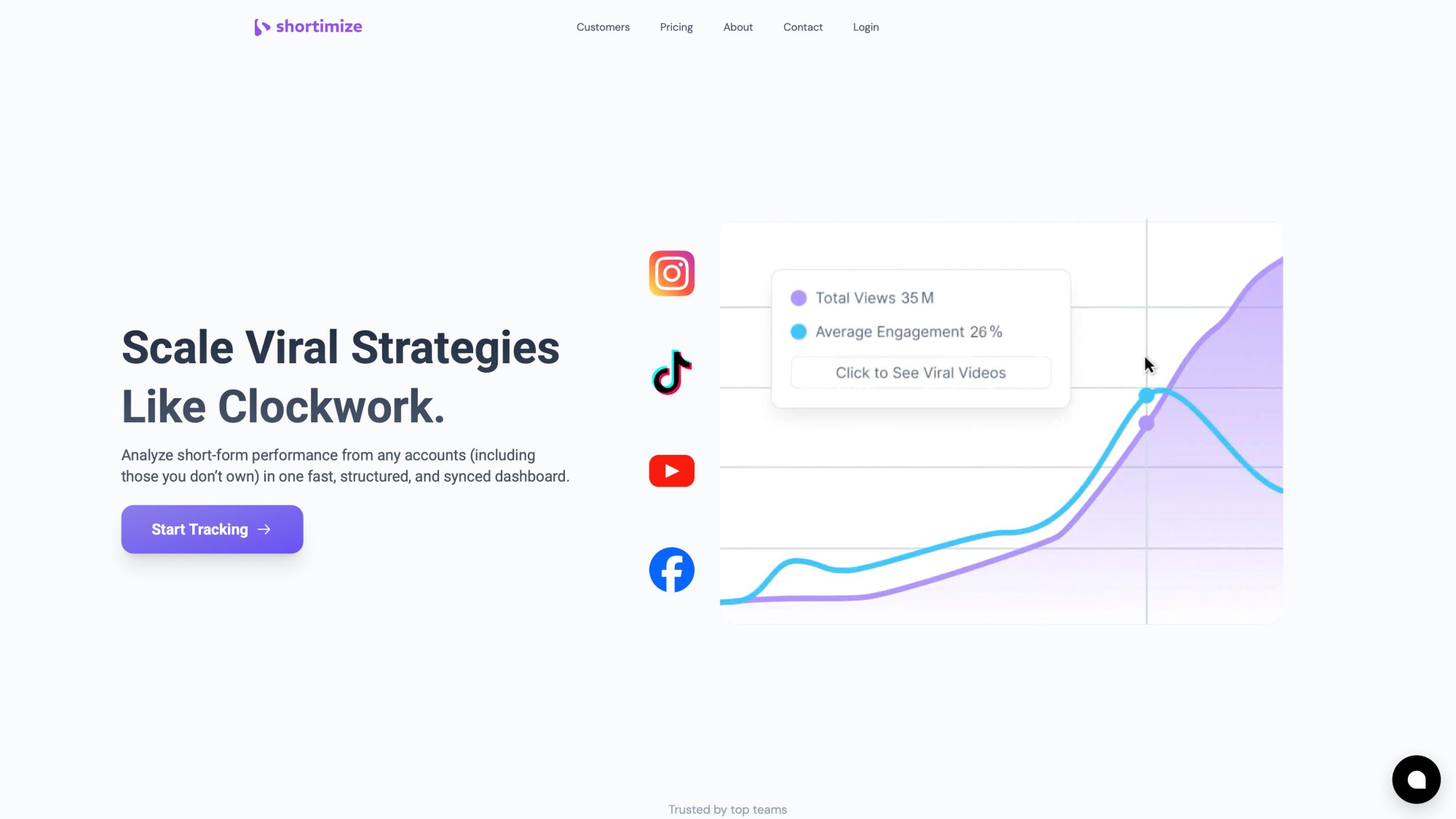
If you're vetting influencers who operate across TikTok, Instagram Reels, and YouTube Shorts, you need a way to compare performance across all three platforms efficiently.
This is exactly what we built Shortimize to do. Our platform lets you:
Track any public account's videos across platforms
Just paste a URL or handle. Shortimize automatically collects and updates performance data for that creator.
See median metrics and outlier detection
Instead of just looking at raw follower counts, you see median performance, engagement distributions, and which videos are statistical outliers. This helps you understand the creator's baseline reality versus anomalies.
Compare performance across TikTok, Reels, and Shorts side-by-side
If an influencer's TikTok engagement rate is 3× their Instagram rate, or they have vastly different follower counts without explanation, you'll see it immediately in one unified analytics dashboard.
Organize vetted creators into Collections
As you build your approved influencer list, you can create Collections to track performance and compare similar creators systematically.
Export data for analysis
Pull all the metrics into spreadsheets to apply your own fraud scoring models or share with stakeholders.
This cross-platform view is critical because, as we mentioned earlier, fake engagement often shows inconsistencies across platforms. Being able to track and analyze in one place makes vetting faster and more reliable.
How to Request First-Party Analytics from Influencers
Don't forget the most powerful tool: asking the influencer directly for their backend analytics.
Legitimate creators are happy to share screenshots or screen recordings showing:
• Top countries and cities (verify geographic coherence)
• Age and gender split (confirm demographic fit)
• Profile visits and reach (see actual reach beyond follower count)
• Story views and engagement (hard-to-fake metrics)
• Link clicks and website traffic (proof of action-driving ability)
If an influencer hesitates or refuses to share basic first-party data, that's a red flag in itself.
Why Manual Spot-Checks Still Matter
Even with all these tools, take 10-15 minutes to manually review:
• Scroll their follower list for obvious fake accounts
• Read comments in detail on several posts
• Check if the influencer actually engages with their audience (replies to comments, posts Q&As, etc.)
• Look at the ratio of likes to comments (10,000 likes but 5 comments suggests bought likes)
These manual checks catch things automated tools might miss and give you a gut sense of whether the community feels real.
How to Build a Scalable Influencer Vetting Process
If you're running influencer campaigns at scale, you need a repeatable system that balances thoroughness with efficiency.
Here's a practical 3-layer vetting framework:
Layer 1: Quick Sanity Check (2-5 Minutes Per Creator)
Goal: Reject obvious fraud fast.
What to check:
✓ Calculate engagement rate for last 10 posts
✓ Spot-check follower growth curve for suspicious spikes
✓ Read comments on 2-3 recent posts for bot texture
✓ Check cross-platform presence for major red flags
Outcome: If they pass this layer, move to Layer 2. If they fail, reject immediately.
Layer 2: Pattern Audit (15-30 Minutes Per Creator)
Goal: Detect manipulation that looks "normal" at first glance.
What to check:
✓ Pull last 30-60 posts and look at median metrics, not just averages
✓ Analyze engagement distribution (too smooth is suspicious)
✓ Compare performance across platforms systematically
✓ Check for "unique audience" signals vs. repetitive engagement
✓ Verify sponsored post performance vs. organic content
Outcome: If patterns look healthy, move to Layer 3. If you see contradictions, reject or request proof.
Layer 3: Proof-of-Influence (Campaign-Grade Confidence)
Goal: Validate with first-party data or controlled tests.
What to request:
✓ First-party analytics screenshots (demographics, reach, Story views)
✓ Examples of past brand partnerships and results
✓ Willingness to use UTM links or unique discount codes
✓ Consider running a small test campaign before committing large budget
Outcome: Only proceed to contract negotiation if they provide satisfactory proof.
Most teams only do Layer 1, which is why they get burned. The magic is in Layers 2 and 3.
A Practical Fraud Risk Scoring Model
Here's a simple scoring system you can apply consistently across your team:
Score each category 0, 1, or 2:
• 0 = looks normal
• 1 = unclear, needs more proof
• 2 = strong red flags
| Category | Score |
|---|---|
| Ratio coherence (views, likes, comments) | 0-2 |
| Comment authenticity (specific vs. generic) | 0-2 |
| Performance distribution (natural variance vs. suspicious uniformity) | 0-2 |
| Growth story (explained spikes vs. unexplained jumps) | 0-2 |
| Sponsored vs. organic performance | 0-2 |
| Audience plausibility (real profiles vs. ghost accounts) | 0-2 |
| Cross-platform coherence | 0-2 |
| Cooperation with proof requests | 0-2 |
| Total Risk Score | 0-16 |
Interpretation:
• 0-5: Low risk, proceed
• 6-10: Medium risk, require proof test before investing heavily
• 11-16: High risk, walk away unless there's a strategic reason
This scoring model gives you objective criteria and makes it easier to explain decisions to stakeholders.
Best Practices for Avoiding Fake Influencer Traps
Beyond vetting individual creators, there are strategic practices that reduce your exposure to fraud across your entire influencer program.
Why Quality Beats Quantity in Influencer Marketing
It's better to partner with a micro-influencer who has 20,000 genuinely engaged followers than a macro-influencer with 200,000 followers where 150,000 are fake.
Micro-influencers (10K-100K followers) often have more authentic engagement and haven't felt the pressure to inflate their stats. Their audiences are more tight-knit and trust them more.
Don't be seduced by big numbers. Look at engagement quality and audience fit first.
How to Test Influencers Before Big Commitments
Instead of jumping into a six-figure partnership, start with a single post or Story series.
During this test, track:
• Referral traffic to your website
• Unique promo code usage
• Actual conversions or sign-ups
• Comment quality and sentiment
This real-world performance data is hard to fake. If the test flops despite "great engagement," you know something is off. If it exceeds expectations, you have confidence to scale up.
Set Clear KPIs Beyond Vanity Metrics
When you kick off a partnership, establish upfront what success looks like:
• X number of link clicks
• Y conversions or sales
• Z qualified leads
• Specific engagement actions (save rate, share rate, poll participation)
By focusing on outcomes rather than just "impressions" or "likes," you make it harder for influencers to game the system and you protect yourself from wasting money on hollow engagement.
Why Continuous Monitoring Matters for Influencer Partnerships
Fraud detection isn't a one-time audit. Keep tracking influencer performance throughout your partnership.
If you notice:
• Sudden follower spikes during your campaign (potential fraud to impress you)
• Dramatic shifts in engagement patterns
• Story views that don't match follower counts
• Comments that suddenly turn spammy
These are signals that something changed. Address it immediately.
Shortimize's social media monitoring lets you track multiple creators' accounts continuously with automated data updates, so you catch issues as they develop rather than discovering them after you've already paid.
How to Use Trusted Marketplaces and Agencies
One way to sidestep fraud is to source creators through platforms that pre-vet influencers. Agencies often verify creator data and screen for fake engagement before listing them.
While you should still do your own due diligence, starting with a pool of vetted candidates saves time and reduces risk.
Why Suspiciously Low Pricing Is a Red Flag
If an influencer with a substantial following is offering suspiciously low rates, ask why.
Someone with 500,000 real, engaged followers isn't going to do a post for $100. Unrealistically cheap rates often signal that the creator knows their engagement is fake and they can't command normal pricing.
Conversely, very high rates should be justified with proven past performance and ROI data.
Common False Positives (Don't Get Tricked)
As you put this vetting process into practice, be aware that some patterns look suspicious but are actually normal:
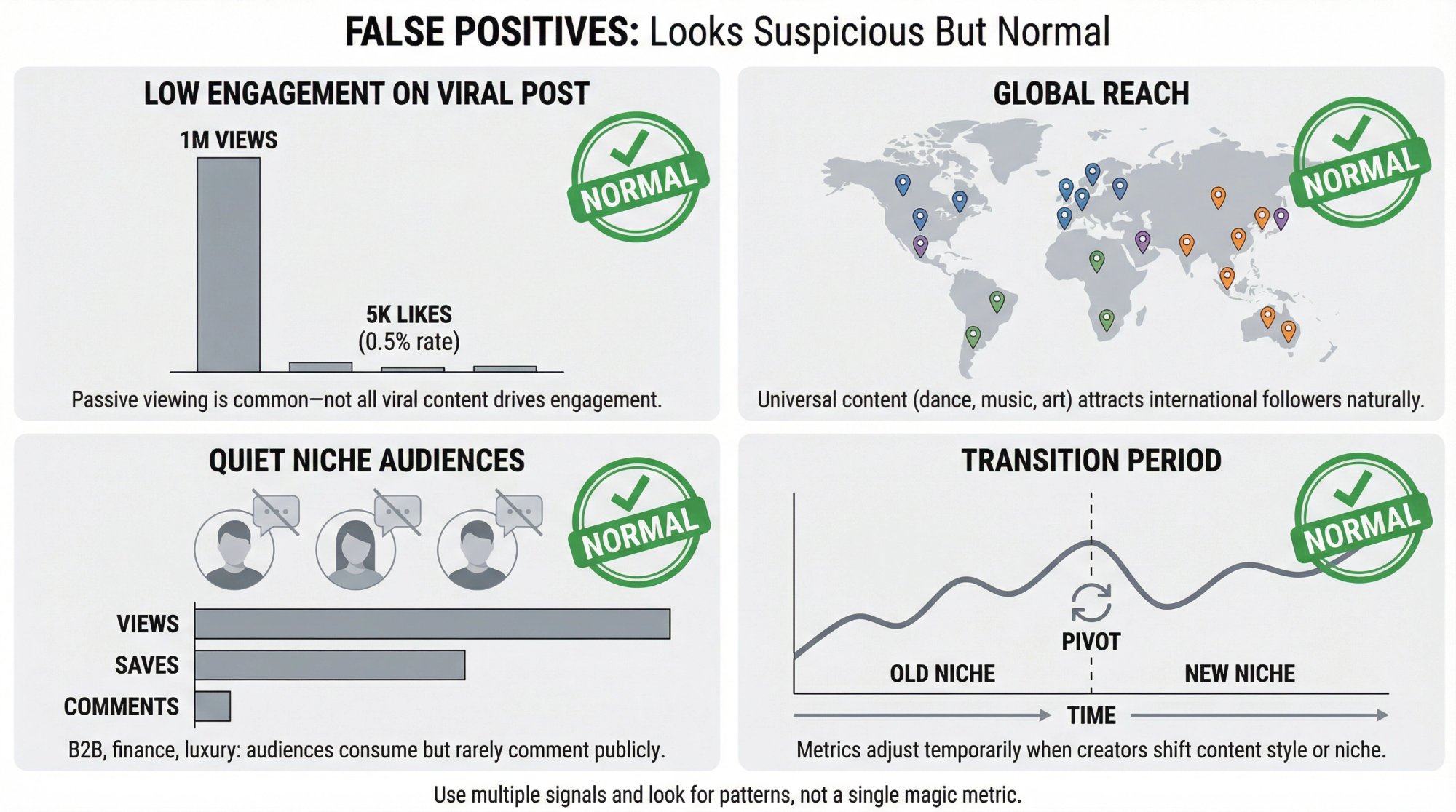
Low engagement on a viral post:
Short-form video platforms can generate passive views cheaply. A video with 1 million views but only 5,000 likes (0.5%) isn't necessarily fake. It just didn't resonate enough for people to engage beyond watching.
Global reach with diverse geographies:
Some creators genuinely have international audiences. Language overlap or culturally universal content (dance, music, visual art) can attract followers from everywhere.
Quiet audiences that don't comment:
Some niches (finance, B2B, luxury goods) have audiences that consume content but rarely comment publicly. Low comment counts don't always equal fake followers if other metrics are healthy.
Transition periods:
If a creator recently changed their content style or niche, metrics might look weird temporarily as their audience adjusts.
This is why you use multiple signals and look for patterns, not a single magic metric.
The Legal and Ethical Stakes of Fake Engagement
Fake engagement isn't just a marketing efficiency problem. There are real legal and reputational consequences.
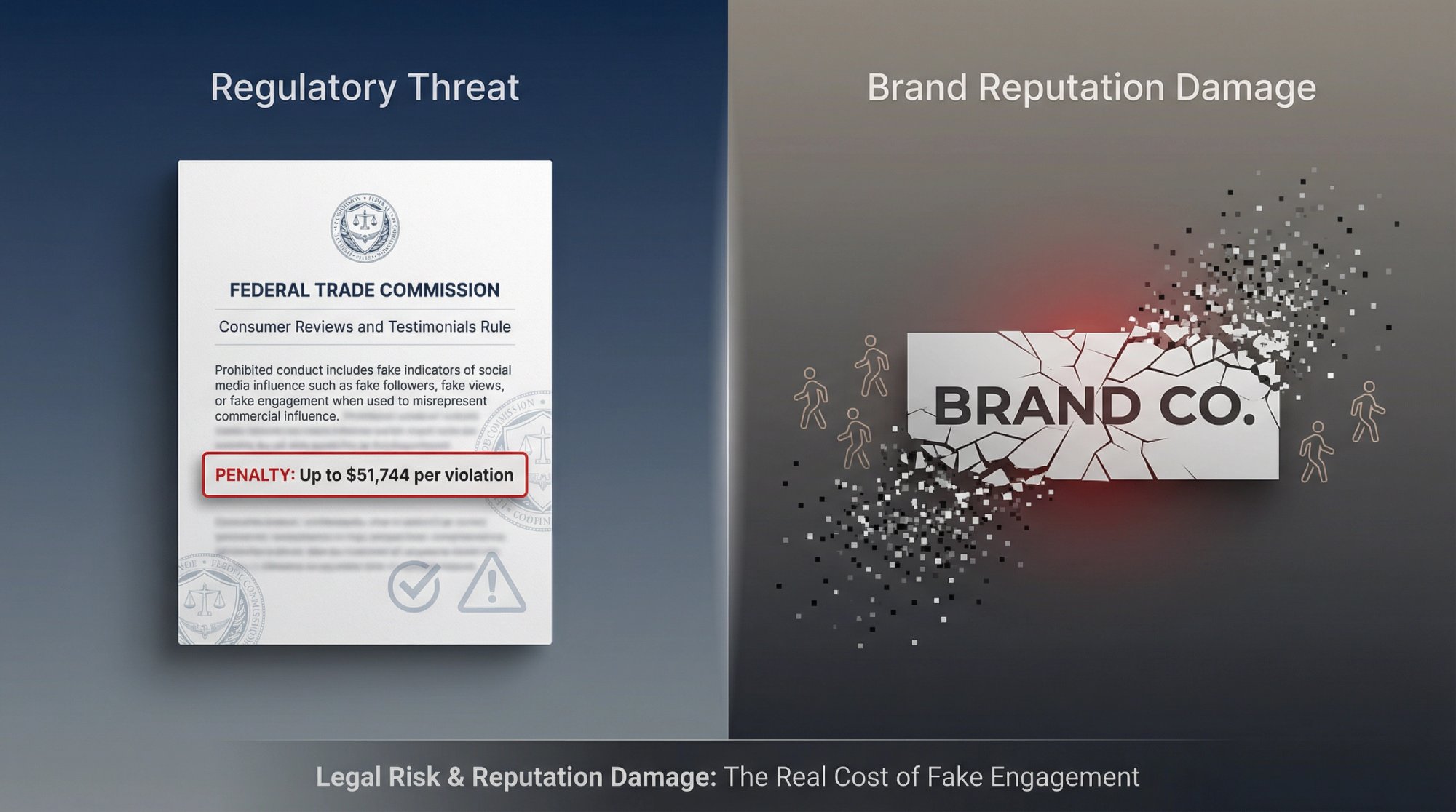
As of October 21, 2024, the FTC's rule targeting fake reviews and testimonials includes fake indicators of social media influence (like fake followers or views) as prohibited conduct when used to misrepresent influence for commercial purposes.
Legal Reality: Penalties can reach up to $51,744 per violation.
If you knowingly partner with fraudulent influencers, you're potentially exposing your company to regulatory action.
Beyond legal risk, there's brand safety. Consumers are increasingly savvy about spotting fake engagement. When they see your brand partnering with obvious fraudsters, it damages your credibility and trustworthiness.
Protecting against fake engagement isn't just about ROI. It's about ethics, compliance, and brand integrity.
Final Thoughts: Real Influence Delivers Real Results
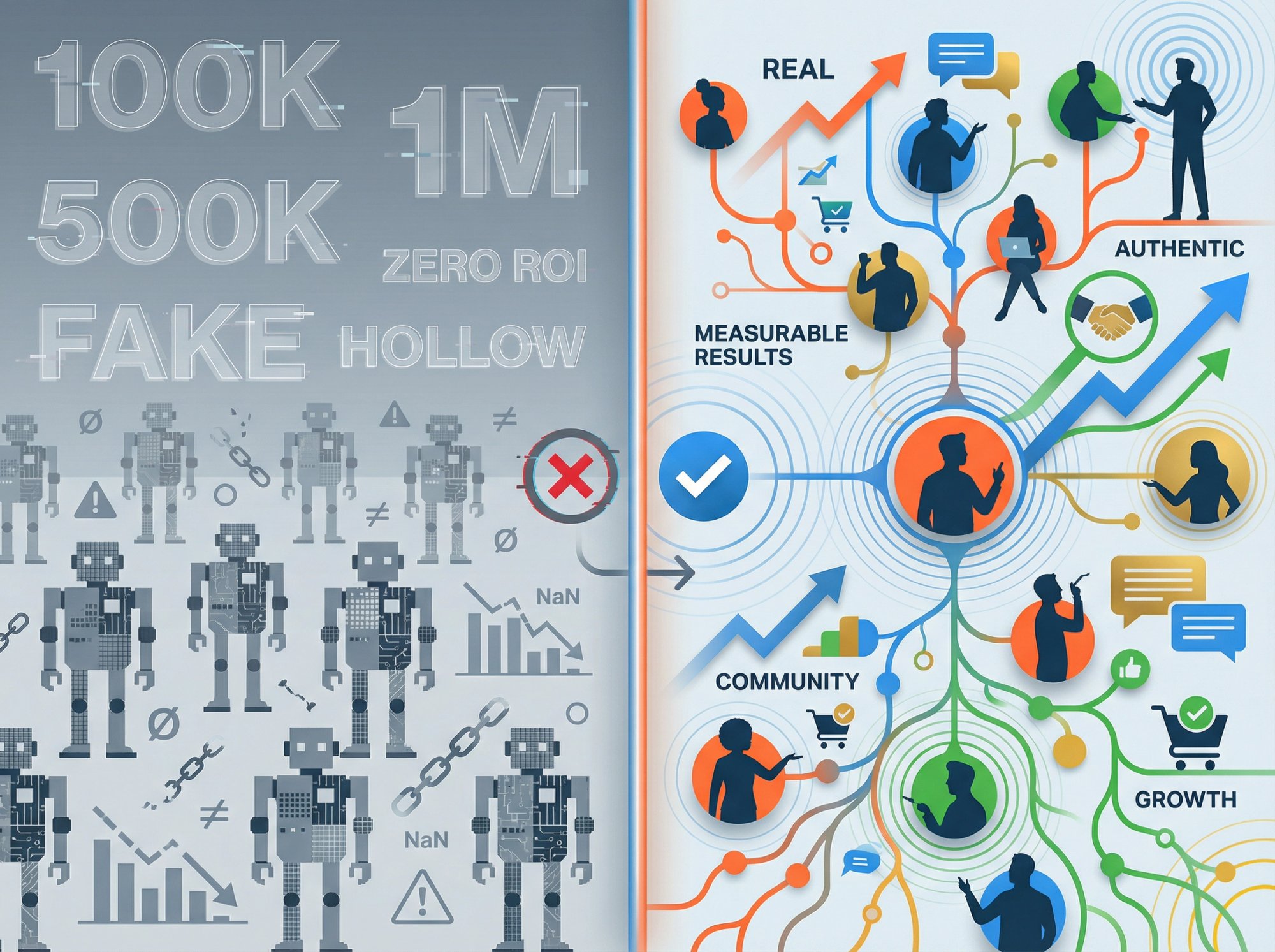
Fake engagement has become sophisticated, but it's still detectable if you know what patterns to look for and use the right combination of tools and analysis.
True influence sparks action. A million bot-generated likes won't increase your sales by a single dollar. But a few thousand genuinely engaged fans can transform your business.
As you build your influencer vetting process, focus on:
✓ Multiple layers of verification (public metrics, pattern analysis, proof tests)
✓ Quality of engagement over quantity of followers
✓ Cross-platform consistency and coherence
✓ First-party data validation
✓ Continuous monitoring, not one-time audits
At Shortimize, we built our platform specifically to help teams track and verify influencer performance at scale across TikTok, Instagram, and YouTube. Instead of manually checking 50 creator profiles, you can pull all their data into one dashboard, spot outliers and anomalies instantly, and make confident decisions backed by real data.
Whether you use our tracking tools or build your own process, the investment in proper vetting will pay for itself many times over by protecting you from wasted budget and fraudulent partnerships.
In an era where social proof can be purchased, the real winners are marketers who look beyond vanity metrics and partner with creators who have earned their following through genuine connection. Those are the partnerships that drive meaningful engagement, build brand awareness, and deliver actual ROI.
Don't settle for fake influence. Your marketing budget deserves better.


