

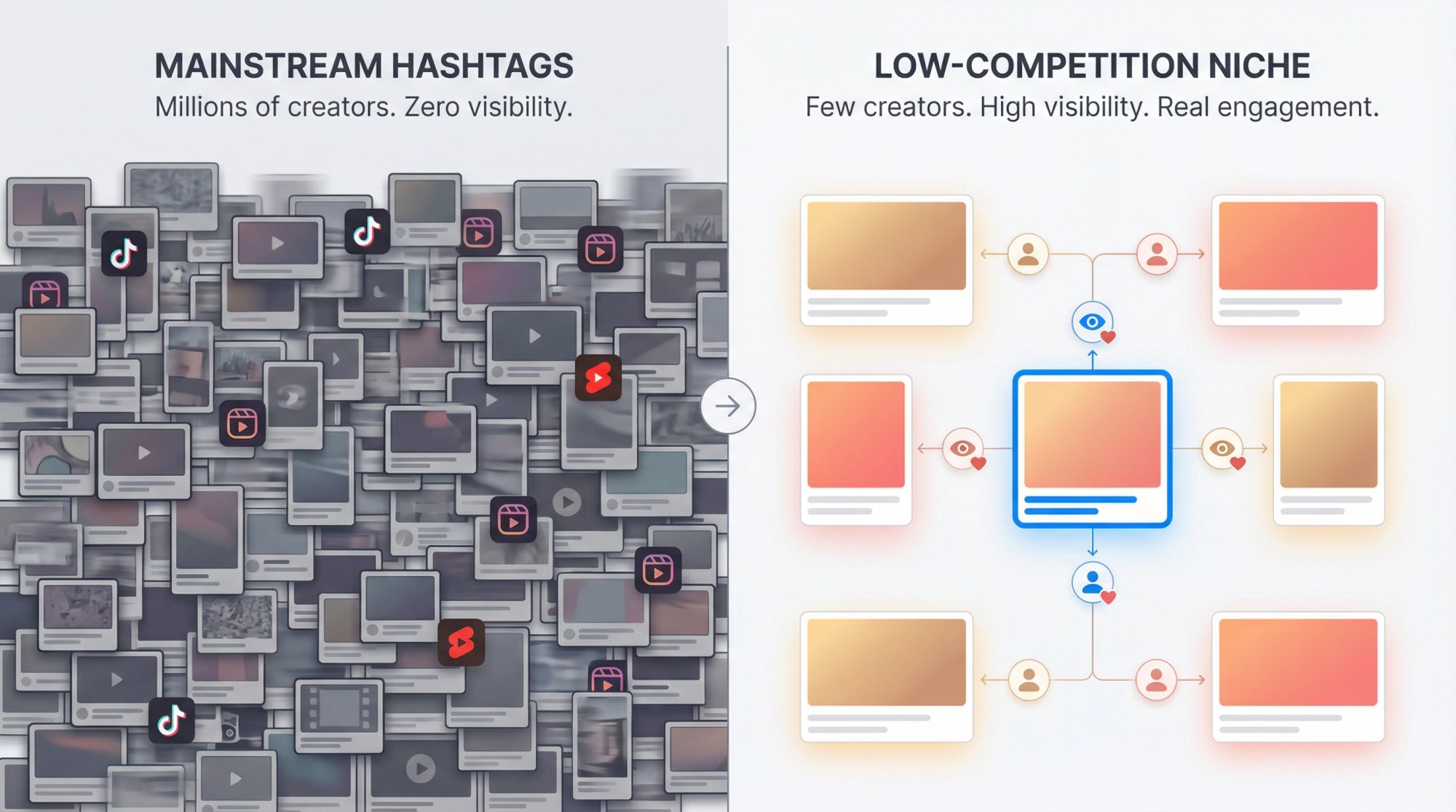
TikTok, Instagram Reels, and YouTube Shorts are crowded. You already know this. Scroll through any mainstream hashtag and you'll find thousands of creators doing essentially the same thing: dancing, lip-syncing, chasing whatever trend went viral yesterday. Breaking through that noise feels impossible.
Most people miss something important, though: the crowded spaces are a choice, not a requirement.
Faceless accounts (those that deliver content without showing a personality on camera) have exploded in popularity precisely because they sidestep the personal branding arms race. No lighting setups. No "perfect" on-camera presence. Just content that delivers value. And when you pair a faceless approach with a low-competition niche, you're no longer fighting millions of creators for attention. You're building something in a space where people are hungry for content but almost nobody is serving them.
This guide walks through a systematic process for finding those underserved niches. Not theory. Not vague advice. A step-by-step framework you can use to identify where opportunity actually exists, validate that real demand is there, and position your faceless account to win.
Why Are Low-Competition Niches Better for Faceless Creators?
Choosing a niche with fewer competitors isn't just a preference. It's a strategic advantage that compounds over time.
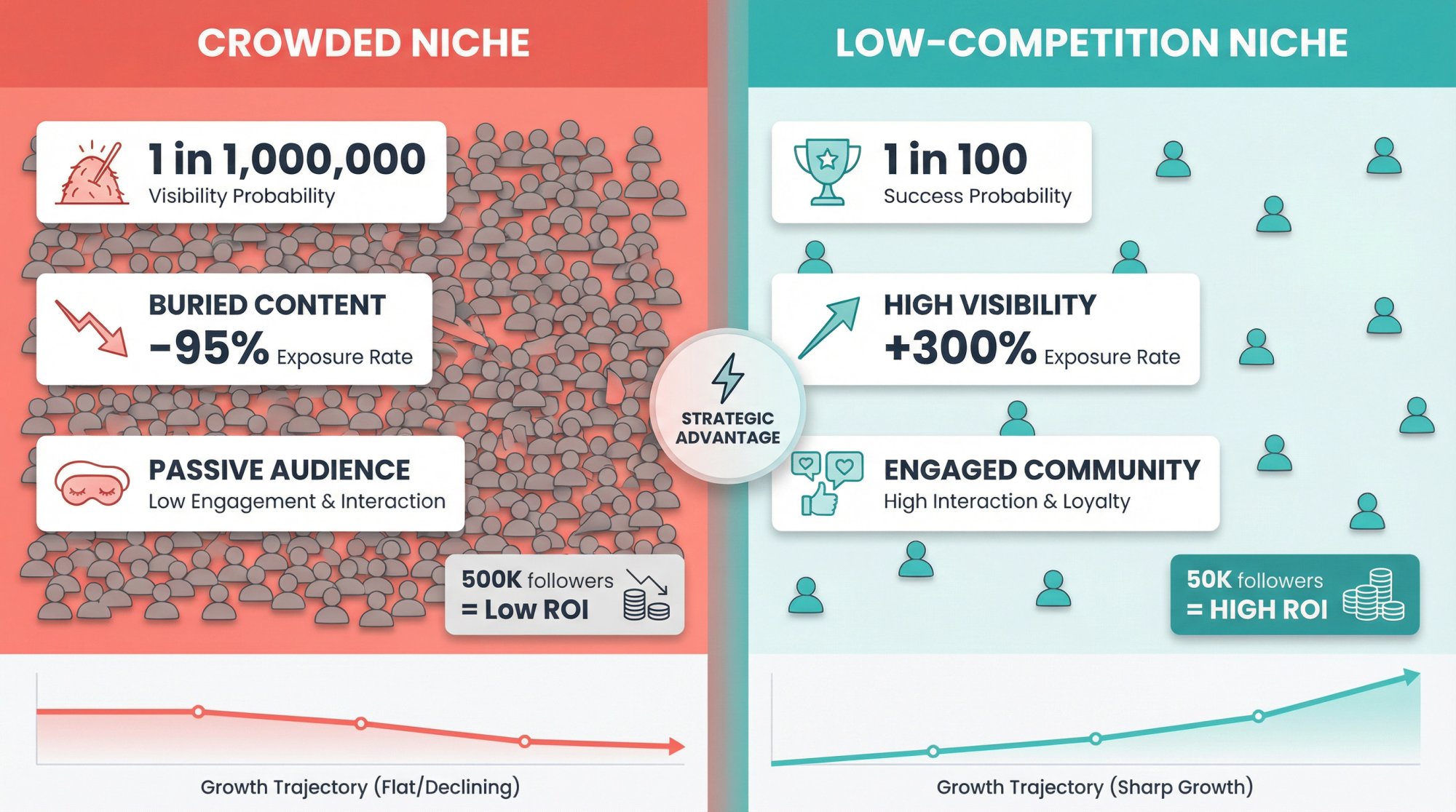
You actually get seen. In oversaturated categories like generic fitness or cooking content, your videos compete against millions of posts. Your work gets buried before anyone notices it. But in a niche that isn't already flooded, standing out becomes dramatically easier. The math is simple: fewer competitors means more opportunity for your content to surface.
Consider the difference between targeting "fitness content" versus something like "fitness for seniors with joint pain." The first puts you against everyone. The second creates a unique space where your content can actually shine because you're addressing something specific that few others cover.
Your community builds faster (and deeper). When you address a specific interest that few creators cover, the people who care about that topic will find you. And they won't just follow. They'll engage, comment, share, and come back because you're solving their problem. Viewers who care about a niche flock to creators who address it and engage more deeply than audiences in broad categories.
The money is often better. This might sound counterintuitive, but smaller niches can be more lucrative. Advertisers pay premium rates to reach dedicated niche audiences because those viewers are genuinely interested and more likely to take action. A niche audience of 50,000 engaged followers often monetizes better than 500,000 passive ones.
Your content stays relevant longer. Trending content has a shelf life measured in days. Niche content tends to be more evergreen, meaning videos you create today can continue attracting views for months or years. That compounds your growth in ways trend-chasing never can.
And for faceless creators specifically, there's one more advantage that matters:
The content becomes the star, not you. In niche spaces, audiences value the information, entertainment, or utility you provide far more than who's delivering it. Faceless niches are content-centric, which means you can build a following without ever appearing on camera.
This lets you stay anonymous, scale content production, and even run multiple accounts as a business rather than a personality-driven brand.
What Is a Low-Competition Niche and How Do You Identify One?
A low-competition niche is a specific content area where audience interest exists but relatively few creators are addressing it. Demand outpaces supply. For now.
Instead of the broad "tech gadgets" space (which is flooded), a low-competition version might be something like DIY repairs for vintage electronics. Same general interest area, but a more specialized segment with a passionate audience and almost no one making content for them.
How to Tell if a Niche Has Low Competition
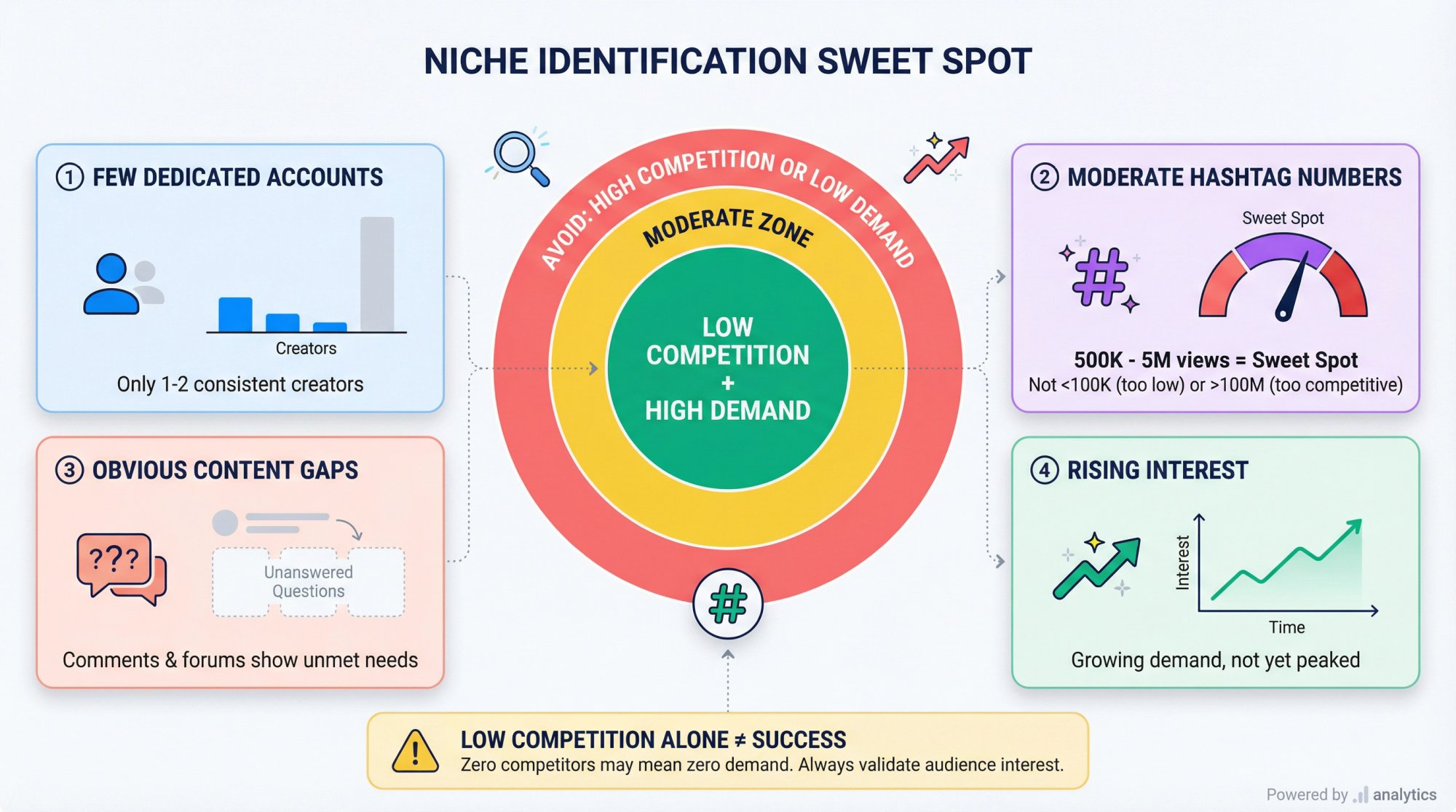
① Few dedicated accounts.
Search relevant keywords and hashtags on TikTok, Reels, and Shorts. If you can only find one or two notable creators posting consistently in that exact niche (or none at all), that's a strong signal.
② Moderate hashtag numbers.
The niche's main hashtags should show some views (indicating people watch this content) but not billions. A hashtag with 500K or 5M views suggests interest without total saturation. If everything you search has under 100K views, interest might be too low. If every tag shows hundreds of millions, you're looking at a broader (and more competitive) space than you realized.
③ Obvious content gaps.
Pay attention to comments, forum discussions, and questions people ask that existing videos don't answer. Those unanswered needs represent opportunity.
④ Rising interest.
Topics that show upward trends but haven't peaked yet are gold. Being early to a rising trend means lower competition now and growing demand to ride as you establish yourself. Tracking these emerging trends gives you a significant head start.
Why Low Competition Alone Is Not Enough
Low competition alone isn't enough. A niche with zero competitors could simply mean nobody cares about it. The sweet spot is low competition combined with high or growing demand. You want a specific angle people are genuinely interested in where you can become one of the first (or few) creators consistently serving that interest.
This balance is what separates strategic niche selection from accidentally creating content for an audience that doesn't exist.
Do Faceless Accounts Work Better in Niche Markets?
Faceless short-form accounts have a natural advantage in niche content. The reason comes down to how audiences in specific niches consume content.
In most niches, viewers care more about the knowledge, entertainment, or utility of videos than the personality behind them. If you're delivering quick tutorials, interesting facts, or useful information, people will follow you for what you provide, not who you are. That's the foundation faceless accounts are built on.
Why Faceless Content Thrives in Specific Niches
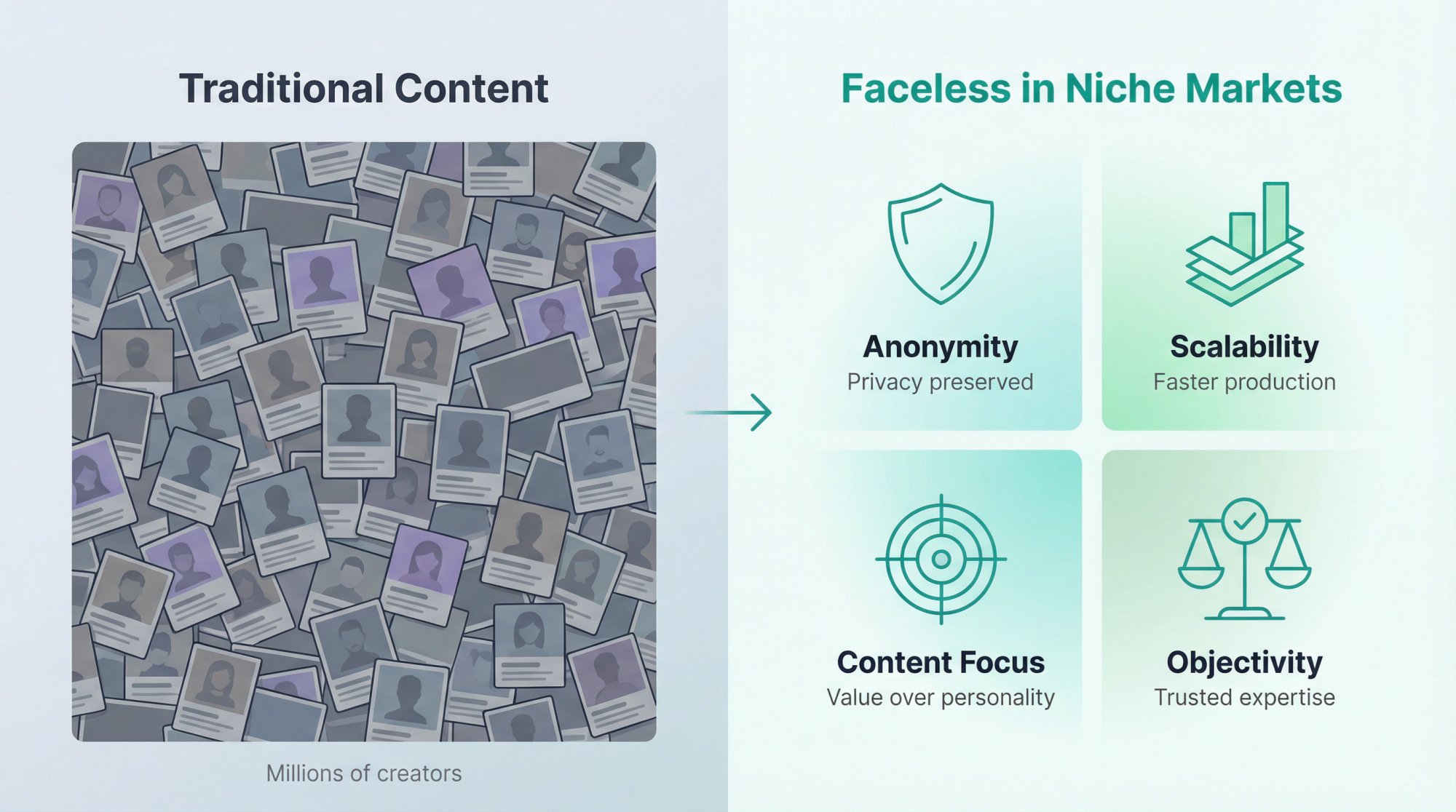
→ Anonymity for the creator
You preserve your privacy and avoid the pressures of personal branding. If you're camera-shy, running the account as a side business, or simply don't want your face attached to content, faceless makes this possible.
→ Scalability
Faceless content is often faster to produce. Using voiceovers, text overlays, stock footage, or animation eliminates the setup time that comes with filming yourself. This means you can post more frequently and cover more ground in your niche.
→ Intense focus on content quality
Without a face, the focus stays entirely on the value you deliver. Viewers come back for your tips, insights, or entertainment. This forces you (in a good way) to make the substance exceptional. In a niche, delivering high-quality, specialized information builds your authority quickly.
→ Perceived objectivity
Some audiences actually trust faceless content to be more objective. A faceless tech review, for example, can feel less like self-promotion and more like an unbiased take. In data-driven niches or educational content, this objectivity becomes an asset.
The strategy has been proven by successful accounts across tech, education, DIY, and more. These are areas where what you show is more important than who you are.
7 Steps to Find Your Perfect Low-Competition Niche
Finding the right niche requires both creative thinking and data-driven validation. This is the systematic process that actually works.
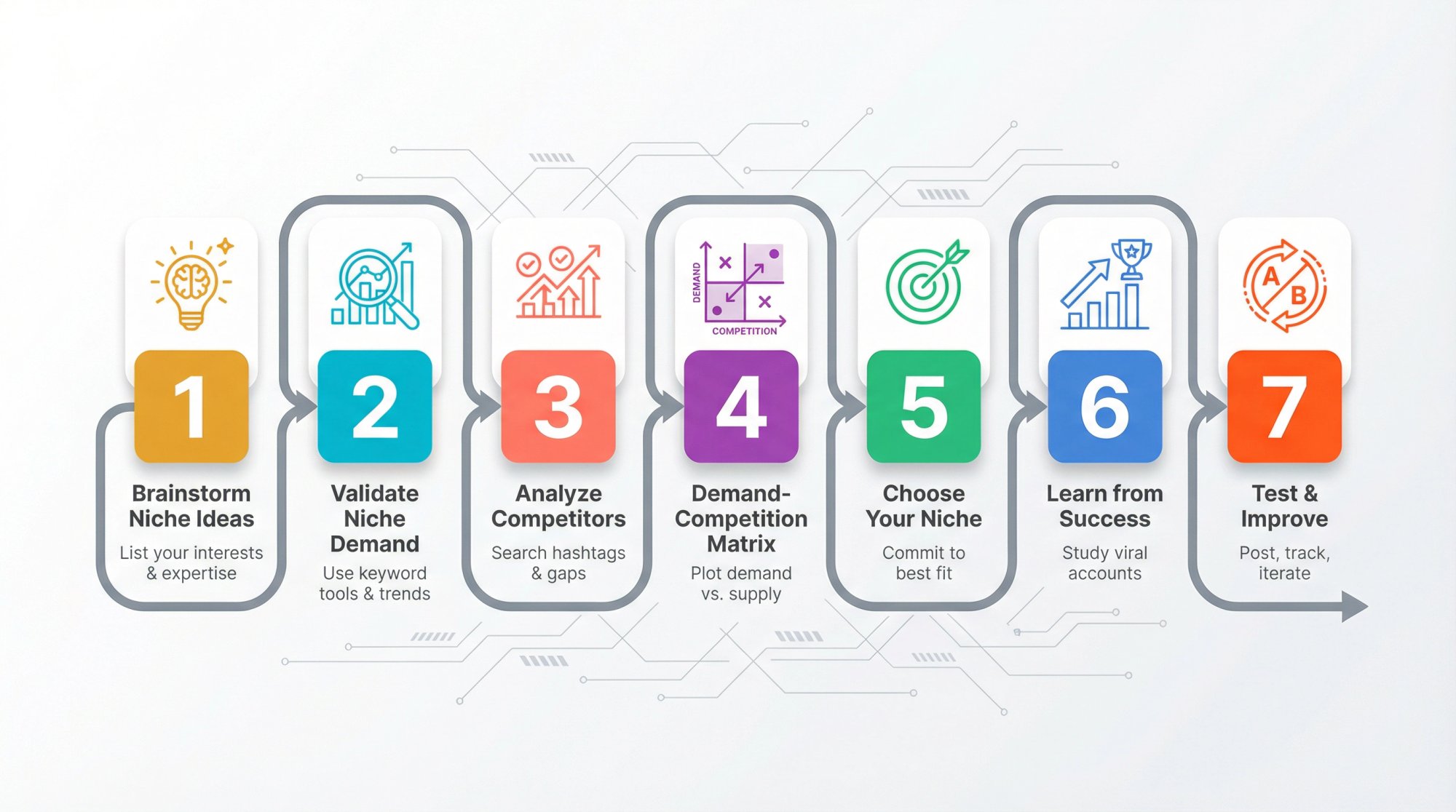
Step 1: How to Brainstorm Niche Ideas Based on Your Interests
Begin by listing topics you're genuinely passionate or knowledgeable about. This matters more than people realize.
Creating faceless content still takes work. If you pick a niche solely because it's low-competition but you have zero interest in it, you'll struggle to stay consistent. The best niche is one you enjoy diving into because building an audience requires creating dozens or potentially hundreds of videos. Your genuine interest sustains long-term creativity in ways pure strategy can't.
How to brainstorm effectively:
Start broad, then go specific. List your hobbies, professional expertise, or personal interests. Then break each down into subtopics and angles.
-
Broad interest: Fitness
- Sub-niches: desk workouts for office workers, postnatal exercise, fitness for gamers
-
Broad interest: Food
- Sub-niches: gluten-free baking on a budget, cooking with solar ovens, ingredient substitutions for allergies
-
Broad interest: Tech
- Sub-niches: restoring vintage gadgets, privacy-focused app reviews, explaining software concepts visually
Don't filter yourself too aggressively at this stage. Write down everything. The goal is to find potential niches that align with your interests and could be underserved in the market.
Step 2: How to Validate Niche Demand with Keywords and Trends
Once you have niche ideas, you need to confirm people actually care about them. This is where research tools earn their keep.
Google Trends
Start here. Compare the relative interest in your niche ideas over the past 12 months. An upward trend or consistent interest is a good sign. A flat line near zero means interest might be too low to build on.
Keyword Research Tools
Tools like Google Keyword Planner, SEMrush, Ahrefs, or Ubersuggest reveal how many people search for terms related to your niche. High search volume can signal high interest (but also potentially high competition). What you really want are long-tail keywords: longer, specific phrases with moderate volume but lower competition. For example, "easy keto desserts for beginners" might have lower volume than "keto recipes," but far fewer people are creating content for that specific need.
TikTok's Search Bar
This is underrated. Type your niche keywords and watch the autocomplete suggestions. If TikTok suggests phrases like "desk workout stretches" or "desk workout for back pain," it means people actively search for those terms. Write them down.
Hashtag Metrics
TikTok and Instagram show view counts for hashtags. Check a variety of tags related to your niche. You're looking for a middle ground: evidence of interest (millions of views) but not total saturation (tens of billions).
Trend Discovery Tools
-
TikTok Creative Center shows trending hashtags, sounds, and topics by region. Look for rising trends in categories related to your niche idea. A trend that's just climbing could be an opportunity to establish yourself before everyone else notices.
-
Social media monitoring tools track rising interest in various areas. If you find an emerging topic that fits faceless content (like a sudden spike in "AI-generated art tutorials"), you might have a fresh niche idea.
Pro tip: If you're seeing massive search volume or huge trending hashtags, try narrowing further. "Home gardening" might be too competitive, but "hydroponic herb garden setups" could work if you find moderate interest there. Focusing on a specific segment of a popular category can instantly lower competition.
Step 3: How to Analyze Competitors in Your Target Niche
Now evaluate how much content already exists in your potential niche across TikTok, Reels, and Shorts.
Do manual searches. Search your niche keywords and hashtags on each platform. Note:
-
How many videos appear and their view counts
-
Are there creators dedicated to this topic, or just occasional posts?
-
The quality of existing content (well-produced or basic? If existing videos are low-effort, that's your opportunity)
-
When the top videos were posted (old content with no updates = chance for fresh takes; very recent viral content = competition heating up)

Look for gaps. Pay attention to what isn't there. As we've covered in our competitor analysis guide, if all your competitors are doing X but none are doing Y, that gap is your chance to shine. For example, maybe existing "budget travel tips for students" videos cover packing and flights but completely ignore visa hacks or travel safety. Those gaps are content opportunities.
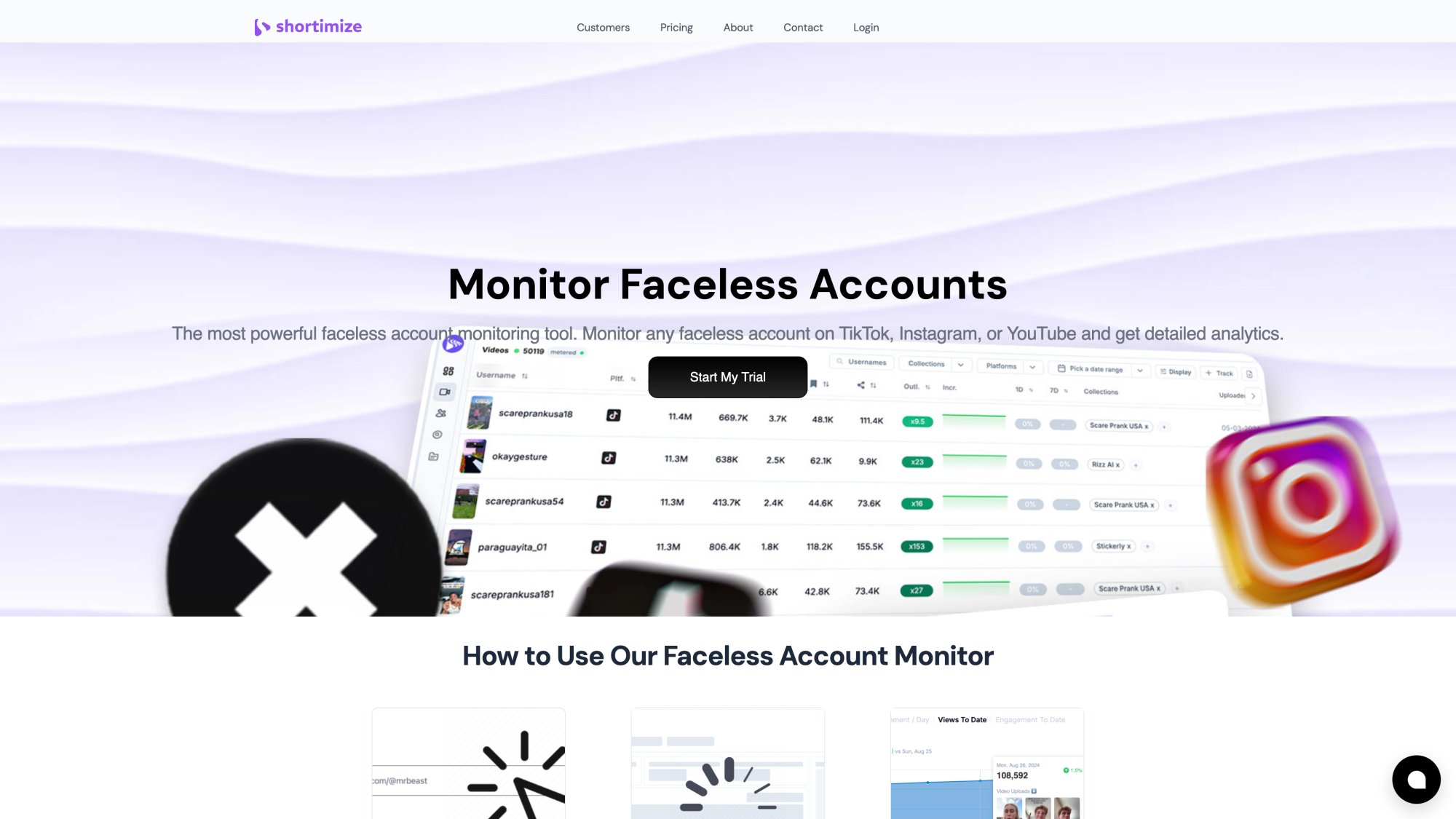
Use analytics for deeper insights. At Shortimize, we built our faceless account monitor to help with exactly this. You can plug in the usernames of TikTok accounts posting in your niche and see detailed performance metrics: which videos went viral, what their median performance looks like, and whether they're actually growing or stagnating. This helps you gauge:
-
Are those niche accounts gaining followers or flat?
-
Do a few videos go viral while others flop? (That signals certain topics within the niche have high demand)
-
How often are they posting, and does consistency correlate with views?
Consider cross-platform presence. Maybe TikTok has a couple players in your niche but YouTube Shorts has none, or vice versa. Starting on the platform with least competition gives you a better chance to establish yourself first.
Step 4: How to Use the Demand-Competition Matrix
By now you should have data on both demand (interest/trends) and supply (existing content/competitors). This is how to put it together:
| Scenario | What It Means | Your Move |
|---|---|---|
| High Demand + Low Competition | The ideal. Solid audience interest with only a handful of mediocre videos or creators in the space. | Jump in. This is a greenfield opportunity to dominate with consistent, quality content. |
| Moderate Demand + Low Competition | Stable but smaller audience, almost no competition. Growth might be slower but steady. | Good opportunity if the niche aligns with your interests. The engaged audience can still monetize well. |
| High Demand + Some Competition | Interest has attracted creators, but competition isn't overwhelming yet. | Enter with a clear differentiator. Bring a unique angle, better quality, or cover subtopics others ignore. |
| Low Demand + Low Competition | Almost nobody searching for or watching this content. | Red flag. The lack of competition might simply mean no audience exists. Skip unless you have strong evidence demand will grow. |
You might want to set personal thresholds. For example: "I want at least 100K total hashtag views and no more than 5 notable creators in this niche" or "At least 1,000 monthly searches for the main keyword and fewer than 50 videos on the topic." These aren't absolute rules, but they keep your evaluation objective.
Don't forget monetization potential. Some niches naturally lend themselves to affiliate links, sponsorships, or product sales. A faceless gadget review niche could earn from affiliate revenue. A meditation niche might sell digital courses later. If income matters to you, ensure the niche aligns with products or services people actually spend money on.
Step 5: How to Choose the Best Niche for Your Faceless Account
If you started with several ideas, one or two should now clearly rise to the top. Time to choose.
Weigh these factors:
-
Which niche are you most excited about? Genuine interest fuels consistency.
-
Which had the best ratio of demand to competition? Decent audience size with minimal existing content is ideal.
-
Where do you see long-term potential? Ideally you want something that can grow or sustain interest for at least a year. An emerging trend is great (you ride the wave early), but make sure it has legs beyond a fleeting fad. Use trend monitoring tools to track whether interest is growing or fading.
-
Does it fit the faceless format? Educational, informative, how-to, and aesthetically-focused content works great without showing a face. If your niche idea relies heavily on personal connection, faceless might handicap you there.
Once you decide, commit. It's fine to pivot later if something isn't working, but give your chosen niche a real try. Many successful creators start ultra-niche, gain a foothold, then broaden out later. You might begin with "budget eco-friendly cooking" and expand into general sustainable living once you have an audience.
Step 6: What Can You Learn from Successful Faceless Accounts?
Before creating content, study what works. Look at the best faceless short-form accounts out there (even if they're in completely different niches).
What to observe:
-
Hooks: How do they grab viewers in the first 3 seconds? Many faceless videos use catchy text overlays or compelling visuals immediately since there's no face to establish personality.
-
Formats: Top faceless accounts often use listicles, mini-lectures with kinetic text, satisfying visual demonstrations, or stock footage with narration.
-
Engagement tactics: How do they encourage interaction without appearing on screen? Look for voiceover prompts, on-screen text like "Comment your favorite tip," or "Guess what happens next."
Take notes on techniques you could apply to your niche. The combination of a low-competition niche plus high-performing content tactics is what creates real advantages.
At Shortimize, you can monitor any faceless account and quickly see which of their videos went viral and why. Track a popular faceless DIY account and you might notice that step-by-step instructional videos consistently outperform their other content. That's a clue about what works for faceless formats that you can apply to your niche.
Quick case study: A creator wanted to start a faceless TikTok account in the home decor niche. She noticed most home decor content featured creators talking to the camera (high competition in personality-driven content). So she found a low-competition angle: faceless DIY decor hacks focusing only on hands doing the craft with text instructions.
Using Shortimize's analytics tools, she tracked a few existing DIY craft accounts and discovered that process videos (showing the how-to step-by-step) had the highest shares, compared to before-and-after montages. She adopted that style.

Within a few months, her faceless DIY account grew to 50,000 followers. The combination of low competition (few were doing pure process videos) plus attention to content style made it work.
Step 7: How to Test and Improve Your Niche Content Strategy
Once you've chosen your niche, it's time to create content and test what works.
Post consistently. Give the algorithm enough content to understand your niche and give viewers enough chances to find you. After 10-20 videos, you'll start seeing which topics or formats get the best response.
Vary your approach early. Within your niche, try a mix of content styles. If your niche is "eco-friendly living tips," create:
-
List videos ("5 ways to save water at home")
-
How-to content ("DIY compost bin tutorial")
-
Myth-busting videos ("Debunking 3 recycling myths")
All can be faceless. See what resonates most with your specific audience. Your research might have predicted one type would work best, but real feedback comes from actual viewers.
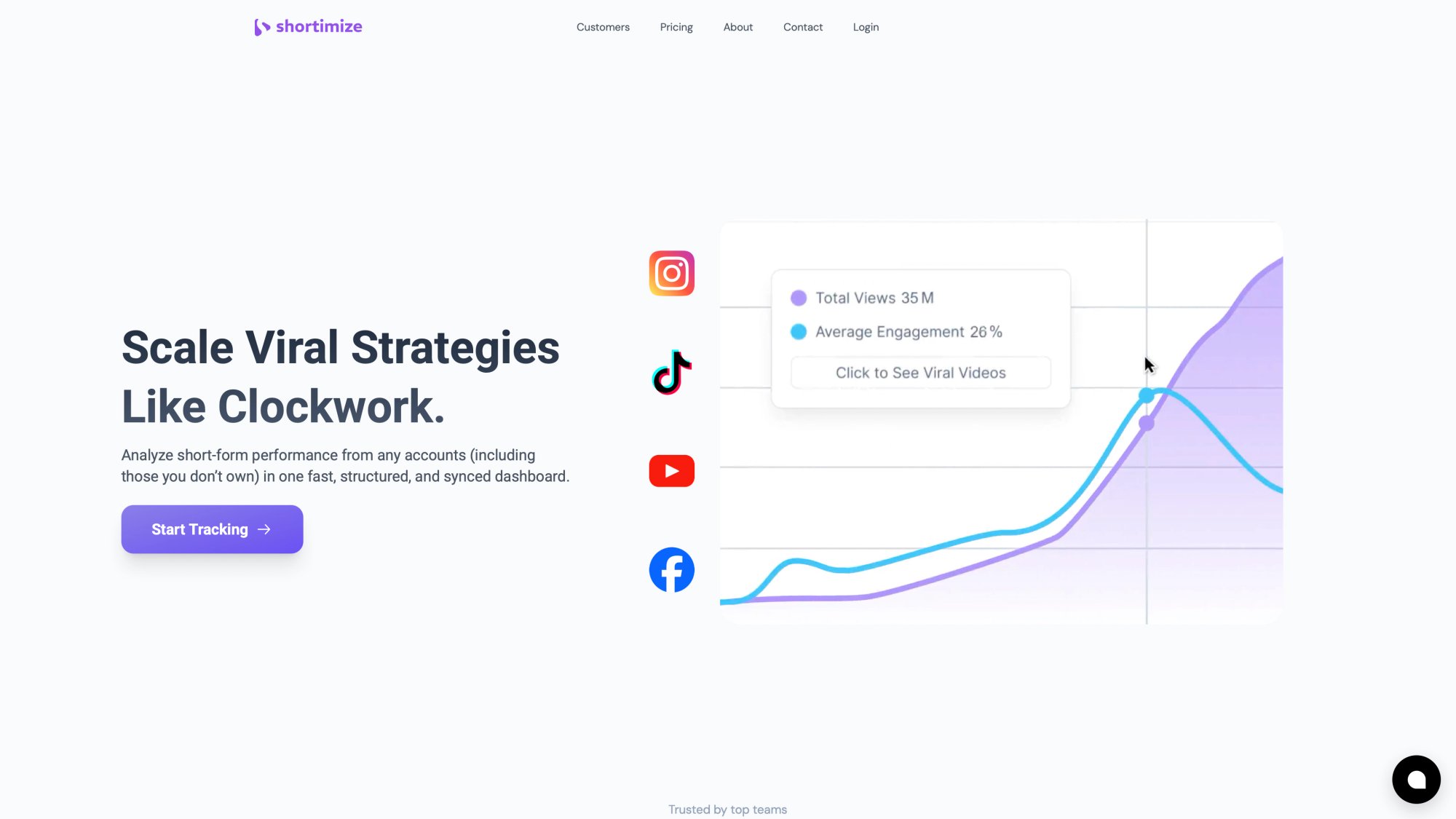
Use analytics to double down. Data-informed iteration is key to dominating a niche. Which videos got above-average views or engagement? What topic or hashtag did you use? Did that series of quick tips outperform longer explainers? Did posting at a certain time yield more interactions? At Shortimize, you can monitor your own account just like you would a competitor, tracking performance metrics over time to refine your strategy.
Stay alert to trends. Being in a small niche doesn't mean ignoring broader trends. If you're facelessly covering "home office organization" and a new trend like #DeskTok starts taking off, adapt it to your style. Jumping on relevant trends can explode your reach while staying true to your audience.
Engage with your community. Even while faceless, interact in comments. Ask for suggestions ("What do you want to see next?"). This boosts engagement (good for algorithms) and gives you content ideas. Smaller niches often have a sense of community where creators can support each other rather than purely compete.
Know when to adjust. If a few months pass and you're not seeing traction despite trying different approaches, revisit your niche choice. Demand might not have been there as expected, or the platform isn't picking it up. Tweaking your niche (broadening slightly or pivoting to something related) is fine. The research process is iterative.
Best Tools for Finding Low-Competition Niches in 2025
A quick rundown of what can help you through this process:
| Tool | Best For | Why It Helps |
|---|---|---|
| Shortimize | Competitor tracking & trend monitoring | Track any public account across TikTok, Reels, and Shorts. See which videos perform best, analyze growth trends, and use AI-powered discovery to find viral content patterns. |
| Google Trends | Gauging interest over time | Free and straightforward. Compare multiple niche ideas side by side to see which has sustained or growing interest. |
| Keyword Research Tools | Search volume data | Google Keyword Planner, Ahrefs, SEMrush, and Ubersuggest provide hard numbers on what people search for. |
| TikTok Creative Center | Trending insights | TikTok's official tool for rising hashtags, challenges, and sounds. Filter by region and category. |
| Forums & Communities | Audience understanding | Reddit, Quora, and niche-specific forums reveal common questions and subtopics that have few videos addressing them. |
Additional resources worth bookmarking:
-
Competitor Analysis Guides: Detailed frameworks for evaluating other accounts and finding white space in any niche.
-
AI Video Tools Directory: Our curated directory of 75+ AI video tools for faceless content creation, from long-to-short video converters to AI voiceover generators.
-
Social Media Monitoring: Track how often a topic is mentioned across platforms and gauge whether interest in your potential niche is growing or declining.
Tools inform your intuition, but they don't replace it. Use data to validate or reject niche ideas, and trust your sense of where you can provide unique value.
Start Finding Your Faceless Niche Today

Finding a low-competition niche for a faceless short-form account is detective work meets creative strategy. You investigate the digital landscape for clues (trends, gaps, underserved audiences), then position your content to fill the void. This upfront work pays off because you're not becoming just another creator chasing oversaturated hashtags and hoping to get lucky.
A few things to remember as you move forward:
"Low competition" is often temporary. If the niche is valuable, others will eventually notice. That's okay. By the time they do, you'll be the authority and reference point, especially if you've been consistently providing quality. Keep innovating and deepening your expertise to stay ahead.
Evolution is natural. Many creators start hyper-specific then broaden out. A faceless channel about French baking techniques might later expand to European baking once it gains a foothold. Your niche can evolve with your audience's interests.
Value is everything. Low competition creates opportunity, but it doesn't guarantee success. What guarantees success is consistently delivering genuine value (educating, inspiring, solving problems, or entertaining in a unique way). Do that, and your faceless account can thrive without the usual personal-brand approach.
The systematic process works: research, validate, analyze, test, iterate. Now apply it. Find your low-competition niche, start creating content that serves that audience, and with consistency and smart analysis, you might be surprised how quickly you become the go-to source in your chosen space.
Ready to start analyzing competitors and tracking your niche performance? Try Shortimize free for 7 days and see exactly what's working in your target niche.
Your niche is out there. Go find it.


