

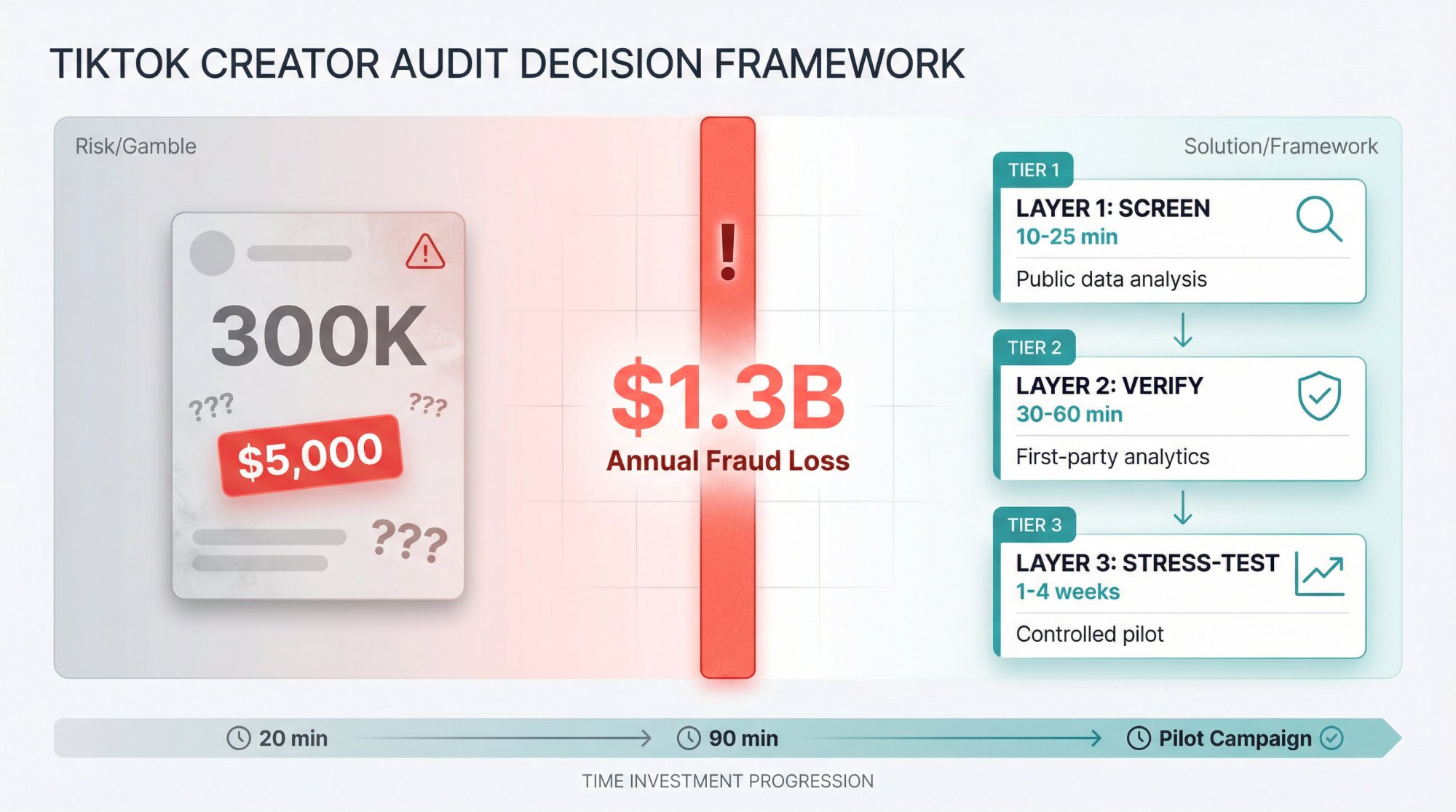
You've found a TikTok creator with 300,000 followers and decent engagement. They've quoted you $5,000 for a sponsored post. The numbers look good on paper. But smart marketers lose sleep over this: on TikTok, you're not buying followers. You're buying a probability distribution.
You're paying for the chance that this creator can repeatedly earn attention from the right people, in a way that's safe for your brand and measurable for your business.
The influencer industry hit $21 billion in 2025, and with that growth came sophisticated fraud. 67% of marketers now cite fake followers as their biggest concern in influencer campaigns. The global cost of influencer fraud? Over $1.3 billion annually according to industry research.
This guide gives you a rigorous, repeatable process you can run in 20 minutes for a quick screen or 90 minutes for real diligence. Then we'll show you how to scale this across dozens or hundreds of creators with Shortimize.
Not fluffy "check engagement rate" advice. A first-principles approach that actually works.
Why Audit TikTok Accounts Before Partnership?
When someone needs to audit a TikTok account before partnering, they're really trying to achieve three specific outcomes:
Outcome A: Don't waste money
You want to avoid partnering with creators who have:
Fake followers bought from bot farms
Inflated engagement from pods or purchased likes
One-hit-wonder viral videos they can't replicate
A history of ghosting brands, missing deadlines, or posting sloppy sponsored content
Outcome B: Don't take brand risk
You need to filter out creators who bring:
Controversy and brand safety issues (past or brewing)
Regulatory exposure from undisclosed ads or improper labeling
Music and copyright problems that get posts muted or taken down
Technical limitations that prevent the campaign type you need (Spark Ads, whitelisting, link-in-bio)
Outcome C: Predict results well enough to price and plan
You want honest answers to:
"What's a realistic range of views for a sponsored post from this account?"
"Will this audience actually match our target market?"
"How do we measure if this partnership worked?"
If your audit process answers these questions with high confidence, you win. If it doesn't, you're gambling.
The 3-Layer TikTok Audit Framework
Most brands do only Layer 1 and then act surprised when reality hits. The pros use all three.
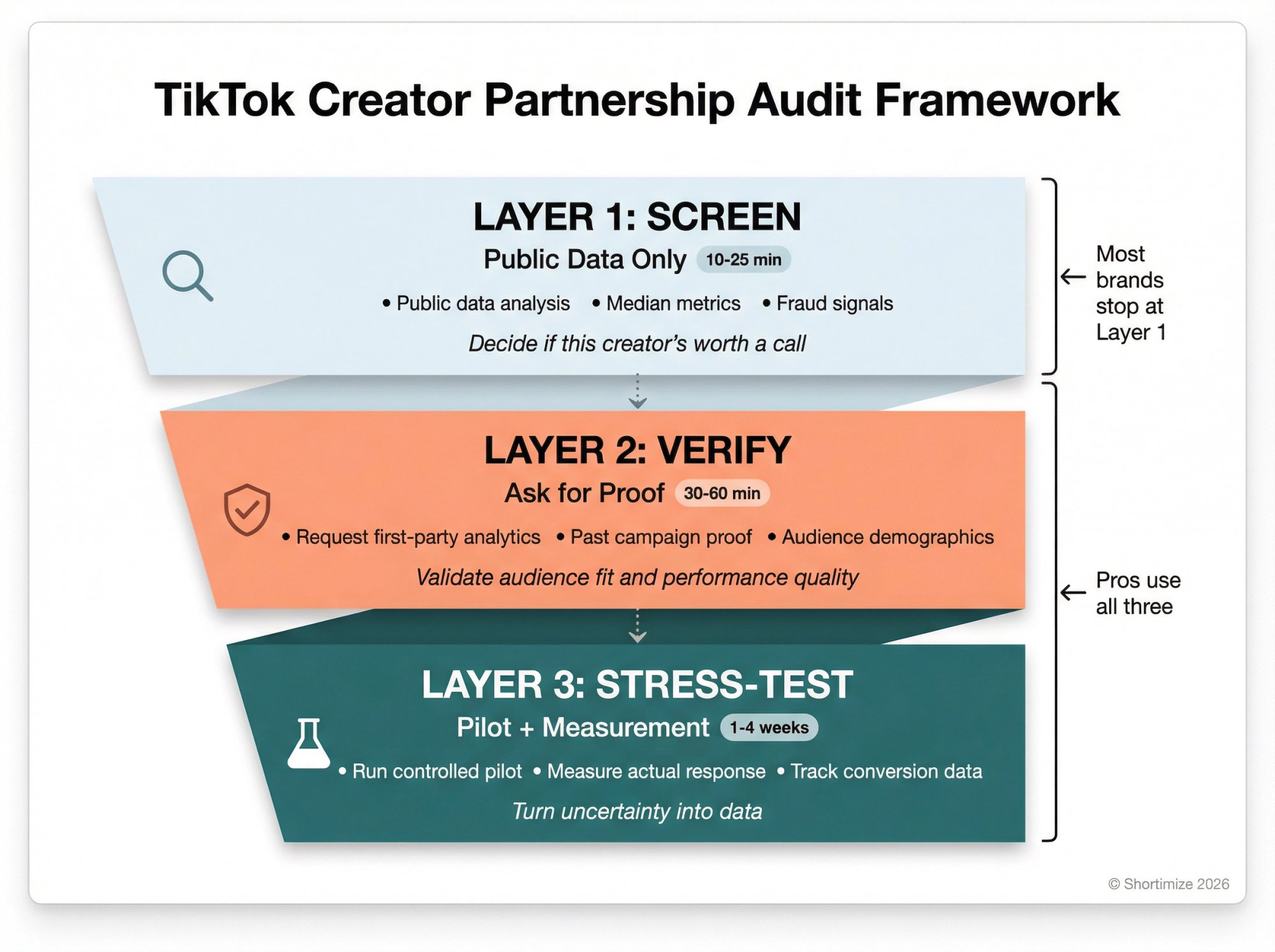
| Layer | Goal | Time Required | Key Actions |
|---|---|---|---|
| Layer 1: Screen | Decide if this creator's worth a call | 10-25 minutes | Public data analysis, median metrics, fraud signals |
| Layer 2: Verify | Validate audience fit and performance quality | 30-60 minutes | Request first-party analytics, past campaign proof |
| Layer 3: Stress-test | Turn uncertainty into data | 1-4 weeks | Run controlled pilot, measure actual response |
Layer 1: Screen (public data only)
Goal: Decide if this creator's worth a call.
Time: 10 to 25 minutes.
You can do this using public TikTok data. Shortimize's TikTok account analyzer is designed exactly for this kind of "public-only, first-pass" evaluation. You paste a handle or link, and it pulls every video, aggregate stats, posting schedules, and export options.
Layer 2: Verify (ask for proof)
Goal: Validate audience fit and performance quality using first-party analytics.
Time: 30 to 60 minutes.
This requires the creator to provide screenshots or exports from TikTok Analytics. Sometimes they'll share past campaign results if they have them. You're looking for proof, not promises.
Layer 3: Stress-test (pilot + measurement design)
Goal: Turn uncertainty into data by running a small controlled test.
Time: 1 to 4 weeks depending on your cycle.
If you're spending real money, this layer separates pros from gamblers. A small pilot tells you everything you need to know about how this creator's audience actually responds to your brand.
Step-by-Step TikTok Creator Audit Process
Step 0: Define What Success Means (Before You Look at Creators)
This sounds obvious. Almost nobody does it.
First principles: A creator partnership is an input into a funnel. If you don't know which part of the funnel you're buying, you can't judge the creator.
Pick one primary objective:
→ Awareness: Maximize qualified reach and memorability
→ Demand capture: Drive clicks, installs, signups, sales
→ Trust: Social proof and credibility in competitive markets
→ Creative production: You mainly want UGC content to reuse as ads
Write down your KPI (views, CTR, installs, revenue), the audience constraints (country, language, age), and your "must not" list for brand safety.
Now you can audit creators against a target, not vibes.
Step 1: How to Verify TikTok Account Ownership
This is boring until it saves you from fraud.
What can go wrong:
An impersonator copies a creator's content and tries to close deals
A manager claims to represent someone but can't prove account access
The creator's account was compromised and they don't realize it yet
Fast verification moves:
① Ask them to DM you from the TikTok account you're considering (not just email from a random Gmail)
② Request a short selfie video saying a unique phrase you provide (unlisted is fine)
③ If you're paying significant money, do a 5-minute video call
If they resist basic verification, treat it as a signal and walk away.
Step 2: How to Assess TikTok Content Fit
First principles: A view isn't just a view. A view is attention inside a story. If the creator's story is wrong for your product, conversion will be bad even if views are high.
Audit their themes:
What does this creator stand for?
What recurring topics do they hit?
What "character" do they play in their content?
What audience promises are implicit in their videos?
Practical checks:
Watch their last 15 to 30 videos straight through
Read the comments on their top 5 recent videos
Scan captions and pinned posts for patterns
Brand safety isn't just "no hate speech." It includes:
Extreme political takes that could alienate your customers
Misinformation patterns or dangerous advice
Bullying or harassment-style content
Risky medical or financial claims
The golden rule: If you'd feel uncomfortable seeing your brand logo on-screen during their worst video, walk away. That video will resurface eventually.
Step 3: How to Verify TikTok Audience Demographics
Public TikTok doesn't reliably expose full demographics, so you need a two-stage approach.
Stage A: Public inference
Look for language used on-screen and in captions, cultural references and country-specific slang, time-of-day posting patterns, and comment language mix.
This can quickly tell you "US English vs India Hinglish vs LATAM Spanish" even without analytics.
Stage B: First-party confirmation
For any paid partnership, request screenshots of:
Top territories (by follower and by views)
Age distribution
Gender distribution
Follower activity times
If they can't provide this, you're partnering blind. Don't do it.
Step 4: How to Analyze TikTok Performance Metrics
TikTok has heavy-tailed outcomes, which creates a trap. One viral video can dominate an account's "average." Brands price off that average and then get median results.
You need a distribution-first audit.
What to calculate
Pick the last 30 posts (or last 60 if the creator posts daily).
Compute these metrics:
| Metric | What It Tells You |
|---|---|
| Median views (50th percentile) | Your baseline expectation |
| 25th percentile views | A realistic "low but normal" outcome |
| 75th percentile views | A realistic "good" outcome |
| Outlier ratio = 90th percentile / median | Shows dependency on rare spikes |
Why median matters: It's robust to outliers. It tells you what happens on a typical post, not a lucky one.
What good looks like
Median views are stable or trending up over time
The account has occasional spikes but doesn't rely on them
Engagement isn't just likes, but real comments and shares (where visible)
What "looks good but is risky"
One or two massive videos and a flat baseline everywhere else
Long gaps in posting followed by sudden spikes
Engagement that's high but feels generic (comment pods, bots)
Shortimize's influencer tracking explicitly focuses on median and virality metrics because averages are easily distorted. When you track an account with Shortimize, you see distribution-based performance, not vanity averages.
Step 5: How to Check TikTok Engagement Quality
Engagement rate is useful, but it's not sacred. It's a derived number that gets abused.
There are multiple legitimate engagement rate formulas (by reach, by followers, etc.). Your team needs a shared definition.
First principles: Engagement rate is meaningful only if:
Your denominator matches your goal (reach vs followers)
You compare against relevant peers, not global averages
Industry benchmarks can give rough context, but treat them as "weather," not "physics." For example, TikTok engagement rates average around 3.70% in 2026 data (defined as engagement per post by followers, including likes, comments, shares, and saves where available).
Use benchmarks to sanity-check, but don't pick creators just because they're above a benchmark. Pick them because their audience and content match your funnel.
A better engagement check: Engagement per view
If you can get likes, comments, and shares on posts, compute:
Engagement per view = (likes + comments + shares) / views
Why: TikTok distributes beyond followers. Views are closer to actual exposure. A creator with 300k followers and 50k median views isn't "underperforming." That might be normal for their niche. The question is: What do viewers do after they see it?
Step 6: How to Detect Fake TikTok Followers and Engagement
Influencer fraud has gotten more sophisticated. You can't "spot it" with one metric. Detecting influencer fraud requires systematic analysis and manual verification signals.
So what matters most before you pay?
1) Follower growth shape
Red flags:
→ Huge follower jumps that don't align with viral posts
→ Multiple sharp jumps in short windows
→ Follower growth spikes with flat or declining views
What it can mean: Bought followers, mass follow/unfollow tactics, or inorganic boosts.
2) View distribution vs posting cadence
Red flags:
→ Many posts with near-identical view counts (looks botted)
→ Sudden "new baseline" that appears overnight without content change
What it can mean: Artificial view inflation or algorithmic penalty followed by purchased views to hide it.
3) Comment quality audit (manual, but high signal)
Pick 5 recent posts. Read the top 30 comments on each. Click into 10 random commenter profiles.
Red flags:
Repetitive comments, generic emojis, "nice video" style spam
Commenter accounts with zero posts, random usernames, no followers
Lots of comments that don't match the video topic at all
Green flags:
Inside jokes and references to past videos
Questions about details in the content
Disagreement and discussion (real communities argue)
4) Audience mismatch tells
If the creator is "US beauty" but comments are heavily in languages that don't match, or their content references one region but engagement suggests another, ask for analytics proof.
By the way, research shows that 89% of consumers say authenticity is important in influencer content, and 92% trust influencers' recommendations over traditional ads. That trust evaporates if the audience isn't real.
TikTok Partnership Compliance and Legal Requirements
This section is where many partnerships fail without anyone realizing why.
TikTok Disclosure Rules: Content Disclosure Setting Is Not Optional
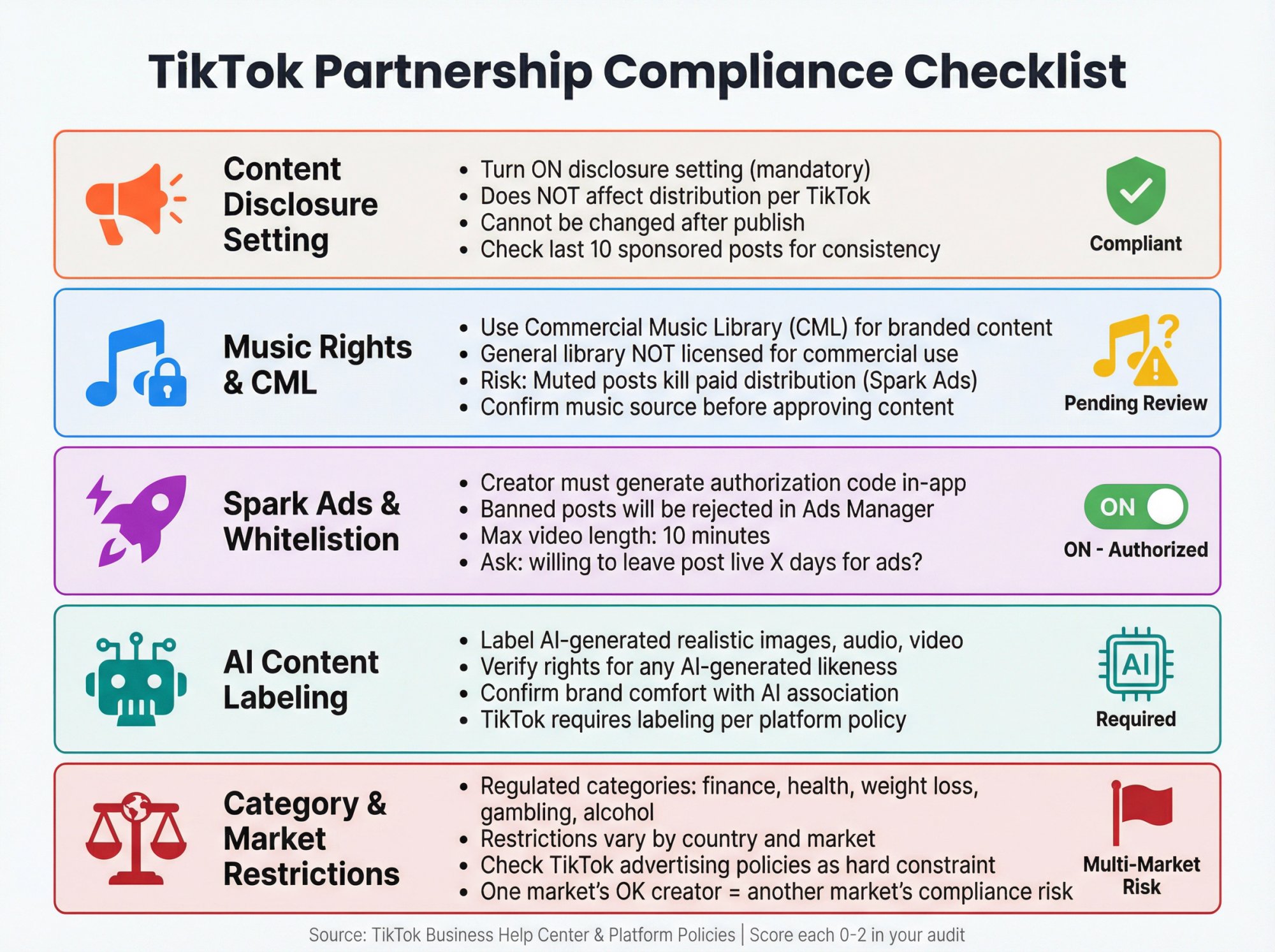
TikTok explicitly states that when posting content promoting a brand, product, or service, creators must turn on the content disclosure setting. Failing to properly disclose may lead TikTok to remove or restrict the post.
TikTok also clarifies something creators often argue about: Turning on the content disclosure setting does not affect distribution in feeds. So if a creator claims "paid partnership kills reach," that's not what TikTok says.
Also, once the post is published with the label, it can't be changed. If they disclosed incorrectly, they may need to remove and repost.
Audit implication: Check their last 10 sponsored posts (if any). Do they use "Paid partnership" labeling consistently? If not, your brand takes regulatory risk.
Reality check: Disclosure failure is common
The UK ASA's 2024 disclosure monitoring report (published May 2025) analyzed 50,000+ pieces of content and found only about 57% of influencer ads complied with disclosure rules, with 34% showing no disclosure at all.
Even if you're not UK-based, the lesson is universal: You can't assume creators disclose correctly. You must operationalize it in your contracts and approval process.
Music Rights: The Post Can Get Muted, and Your Paid Distribution Dies
If you plan to run Spark Ads, whitelist creator content, or reuse the video elsewhere, music becomes a legal and practical problem.
TikTok's Help Center recommends using music from its Commercial Music Library (CML) for content that promotes a brand, product, or service, because music outside CML may not be licensed for commercial use.
TikTok's Business Help Center is even more direct: Businesses cannot use the general music library for commercial usage, and should use the Commercial Music Library for commercial activities including organic branded content and ads.
TikTok also describes a "Music Usage Confirmation" flow when using original sound or music outside CML, effectively requiring confirmation you have the rights.
Audit implication: If your creator uses trending copyrighted audio in sponsored content, your brand is taking a muting or takedown risk, especially when you amplify.
Spark Ads and Whitelisting: Can You Actually Boost This Creator's Post?
Spark Ads let you use organic TikTok posts in ads, and TikTok states that engagement earned from boosting is attributed to the original post.
TikTok also notes practical constraints:
Organic posts that have been banned will be rejected in Ads Manager
There's a maximum video length that can be sparked (10 minutes)
Creators can generate an authorization code for Spark Ads inside the TikTok app from the specific post they want to authorize.
Audit implication: Before you sign, ask:
"Are you comfortable authorizing Spark Ads for this post?"
"Have you done this before?"
"Are you willing to leave the post live for X days so we can run ads?"
If the creator wants to delete posts quickly, Spark Ads becomes hard or impossible.
AI-Generated and Synthetic Content: Labeling Is Now Part of Diligence
If you're partnering with creators who use AI voice, face swaps, or realistic synthetic media, TikTok requires creators to label AI-generated content that contains realistic images, audio, or video.
Audit implication: If the creator uses AI faces or voices, confirm:
They label appropriately per TikTok requirements
They have rights and permissions for any likeness used
Your brand is comfortable being associated with that style
Category Restrictions and Market Differences
If you're in a regulated category (finance, health, weight loss, gambling, alcohol), you must treat TikTok's advertising policies as a hard constraint, not a suggestion. Restrictions vary across markets and content categories.
Audit implication: If you operate in multiple countries, a creator who's "fine" in one market can create compliance issues in another. Handle this early in vetting.
TikTok Creator Audit Scorecard (Template)
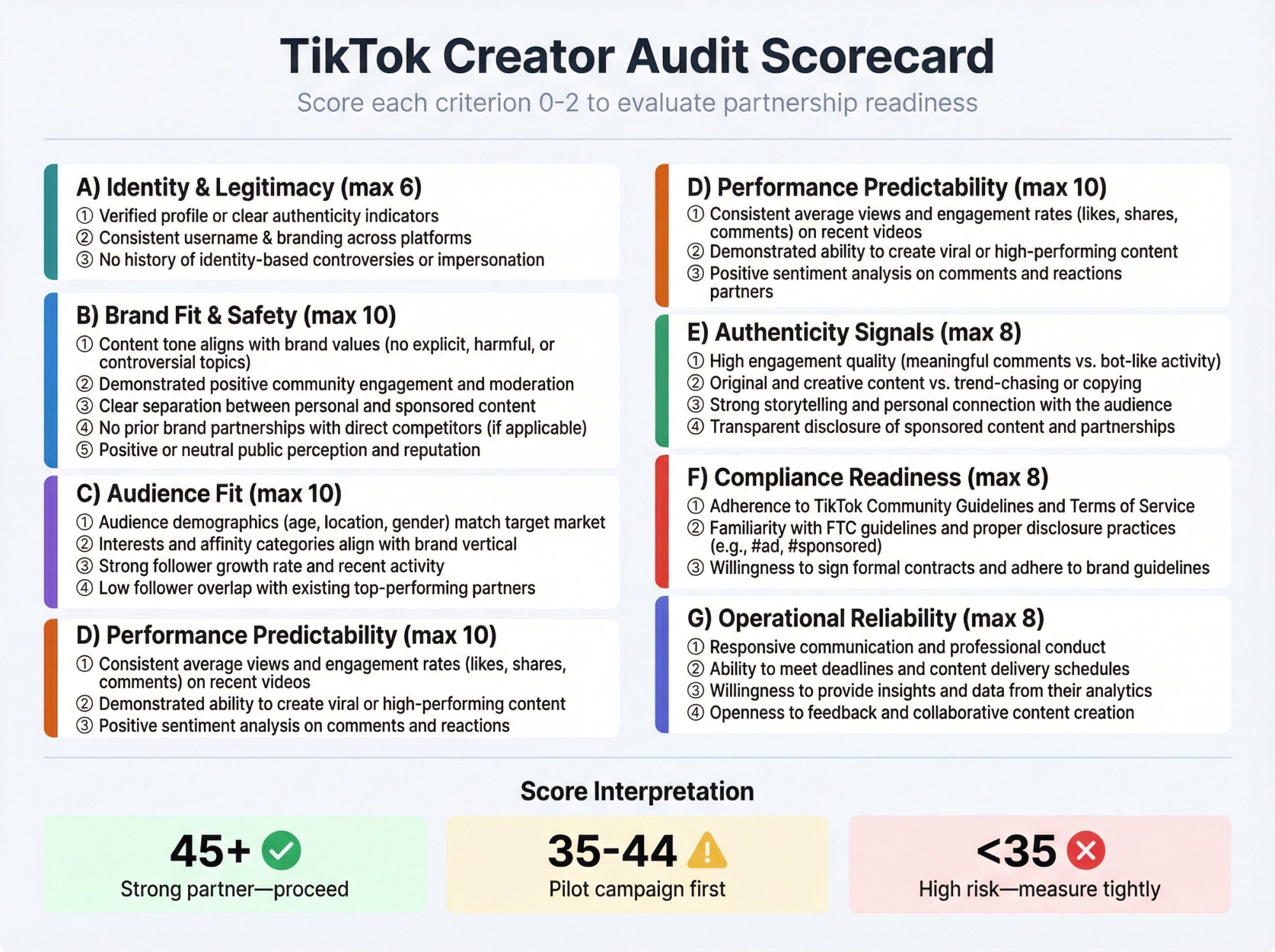
Copy this into a doc or spreadsheet. Score 0 to 2 for each item:
0 = fail or unknown
1 = acceptable but risky
2 = strong
A) Identity and Legitimacy (max 6)
① Ownership verified (DM or video proof)
② Contact channel matches account (no weird intermediaries)
③ Clean history (no obvious impersonation or reuploads)
B) Brand Fit and Safety (max 10)
④ Content values align with brand
⑤ No recurring high-risk topics for your category
⑥ Comment culture not toxic
⑦ No recent controversy patterns (last 90 days)
⑧ Past brand content feels authentic
C) Audience Fit (max 10)
⑨ Language and cultural fit
⑩ Geography fit (proof via analytics)
⑪ Age fit (proof via analytics)
⑫ The audience actually engages with the niche
D) Performance Predictability (max 10)
⑬ Median views are strong for your goals
⑭ View distribution not totally outlier-dependent
⑮ Posting cadence consistent
⑯ Recent trend stable or improving
⑰ Engagement per view looks real
E) Authenticity Signals (max 8)
⑱ Comments look human
⑲ Growth shape looks plausible
⑳ No obvious botted follower patterns
㉑ No repeated "too perfect" metrics
F) Compliance Readiness (max 8)
㉒ Uses TikTok disclosure properly on sponsored posts
㉓ Understands music rights constraints for commercial content
㉔ Willing to enable Spark Ads authorization if needed
㉕ Understands AI labeling if relevant
G) Operational Reliability (max 8)
㉖ Responds fast during negotiation
㉗ Has a clear creative process (brief, script, review)
㉘ Can hit deadlines
㉙ Professional invoicing and basic contract acceptance
Interpretation:
| Score Range | Recommendation |
|---|---|
| 45+ | Strong partner, proceed with confidence |
| 35-44 | Test with a pilot campaign first |
| Below 35 | Only proceed if there's a strategic reason and tight measurement |
What to Request from TikTok Creators Before Signing
If you want to stop guessing, request these items before signing:
TikTok analytics screenshots (last 28 days)
Top territories
Age distribution
Gender distribution
Follower activity times
Top videos and watch time (if they can share)
Past partnership proof (if they claim performance)
Example post links
What the brand's goal was
Any results they're allowed to share (even directional)
Operational details
Turnaround time for first draft
Revision policy (how many rounds)
Posting window flexibility
Paid media and usage rights
Are they willing to authorize Spark Ads?
How long can the post stay live?
Can you reuse the video on your channels and in ads?
Any exclusivity conflicts with competitors
Compliance confirmation
They will use TikTok's content disclosure setting for sponsored content
They will use commercially safe music (CML or cleared)
How to Run This Audit Fast with Shortimize
If you're doing this once, you can do most of Layer 1 manually.
If you're doing this every week, manual work becomes the bottleneck. Shortimize is built for exactly this kind of pre-partnership diligence.
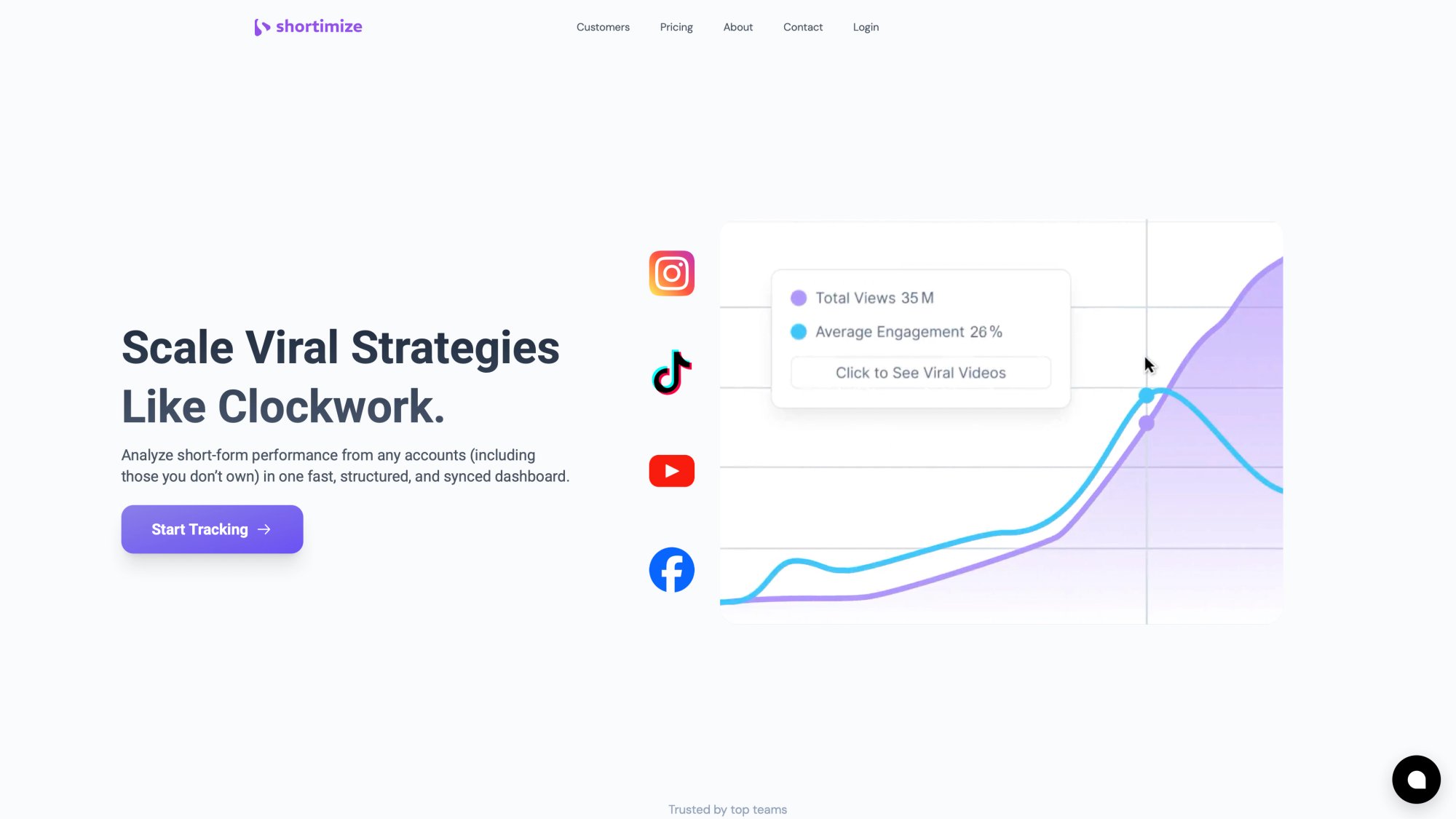
Your workflow with Shortimize:
① Pull the full video history and export it
Shortimize's TikTok Account Analyzer can retrieve every video for a public account, show charts and posting schedules, and export tables.
That export is what you need to compute median views, view distribution, cadence, and trend direction.
② Use median and virality metrics to avoid getting fooled by outliers
Shortimize's influencer tracking emphasizes median and virality metrics so you can see the creator's "typical" performance, not just their best day.
③ Compare creators side-by-side, not one at a time
Shortimize lets you track accounts across TikTok, Reels, and Shorts if you care about cross-platform presence.
This matters because a creator is never "good" in isolation. They're good relative to your budget, your niche, and other creators you could partner with instead.
You can use Collections in Shortimize to organize candidate creators and compare performance metrics directly. Think of it as a vetting shortlist that updates automatically.
④ Monitor after you sign (because partnerships aren't set-and-forget)
A creator can change behavior fast: new content style, audience shifts, sudden performance drops.
Ongoing monitoring with Shortimize is how you catch issues early instead of doing post-mortems. If their median views suddenly drop 40% or their comment quality tanks, you know before the next campaign starts.
TikTok Creator Audit: Frequently Asked Questions
"Does enabling Paid Partnership reduce reach?"
TikTok explicitly says turning on the content disclosure setting does not affect distribution in feeds. So if a creator refuses disclosure because they think it hurts reach, you have a compliance problem, not a performance problem.
"Is engagement rate enough?"
No. Engagement rate is a lens, not a verdict. Use it with the right denominator and peer group. For TikTok, understanding view metrics and engagement per view is often more predictive than engagement per follower.
"What if the creator has low followers but high views?"
That can be normal on TikTok because distribution isn't follower-gated. Judge them on median views, audience fit, and conversion proof (if you need performance).
"What if the creator's videos use trending music?"
That can be a legal and practical issue for commercial content. TikTok's Business Help Center states businesses should use the Commercial Music Library for commercial activities, including ads and branded content.
"How do I check if a creator can do Spark Ads?"
Ask if they can generate Spark authorization codes for their posts. TikTok documents that creators can generate codes from the post's ad settings.
Make Data-Driven TikTok Partnership Decisions
If you take one thing from this guide, take this:
Stop treating creator partnerships like lottery tickets.
Run the audit in layers:
① Screen with public distributions (median, not averages). Shortimize makes this fast
② Verify with first-party analytics. Request screenshots and proof
③ Stress-test with a measured pilot. Turn uncertainty into data
When you do this, your "influencer marketing" stops being a vibe-driven budget leak and becomes a controllable growth channel.
And if you want to do this at scale across TikTok, Reels, and Shorts without drowning in spreadsheets, build your creator shortlists and tracking around a single source of truth like Shortimize. We're built for teams that need to vet, compare, and monitor dozens or hundreds of creators efficiently.
The alternative is continuing to guess. And guessing with a $5,000 budget per creator adds up fast.


