Your TikTok niche probably feels like it's moving faster than you can keep up with. One day, everyone's doing reaction videos. The next, it's all POV skits. Then suddenly, green screen tutorials are everywhere and you're scrambling to catch up.
But what if you could skip the guessing game and just know what's working?
Finding the top-performing videos in your niche isn't about spending hours scrolling through TikTok hoping to stumble on gold. It's a system. And when you have that system, you'll know exactly which formats are printing views, which hooks stop the scroll, and which creative patterns are dominating your space right now (not last month, not "generally," but right now).
This guide shows you how to find the best-performing TikTok videos in any niche using a repeatable process that works whether you're in fitness, B2B SaaS, meal prep, skincare, or underwater basket weaving.
What "Top-Performing" Actually Means (4 Different Signals)
Before you start hunting for viral videos, you need to be clear about what you're actually looking for. "Top-performing" isn't one thing. It's at least four different signals, and each tells you something different about your niche.
1. Absolute Hits (The Raw View Leaders)
These are the videos with massive view counts. They show you the ceiling of what's possible in your niche and reveal broad creative trends that resonate.
Useful? Yes. But also misleading if that's all you look at.
2. Relative Outliers (The Real Gold)
These are videos that dramatically outperform a creator's normal baseline. Maybe their average video gets 50K views, but one hit 2 million. That's your signal.
Why? Because relative outliers reveal the true "why it worked" moment. They're compared against a stable control (the creator's typical performance), so you can isolate what made this specific video different.
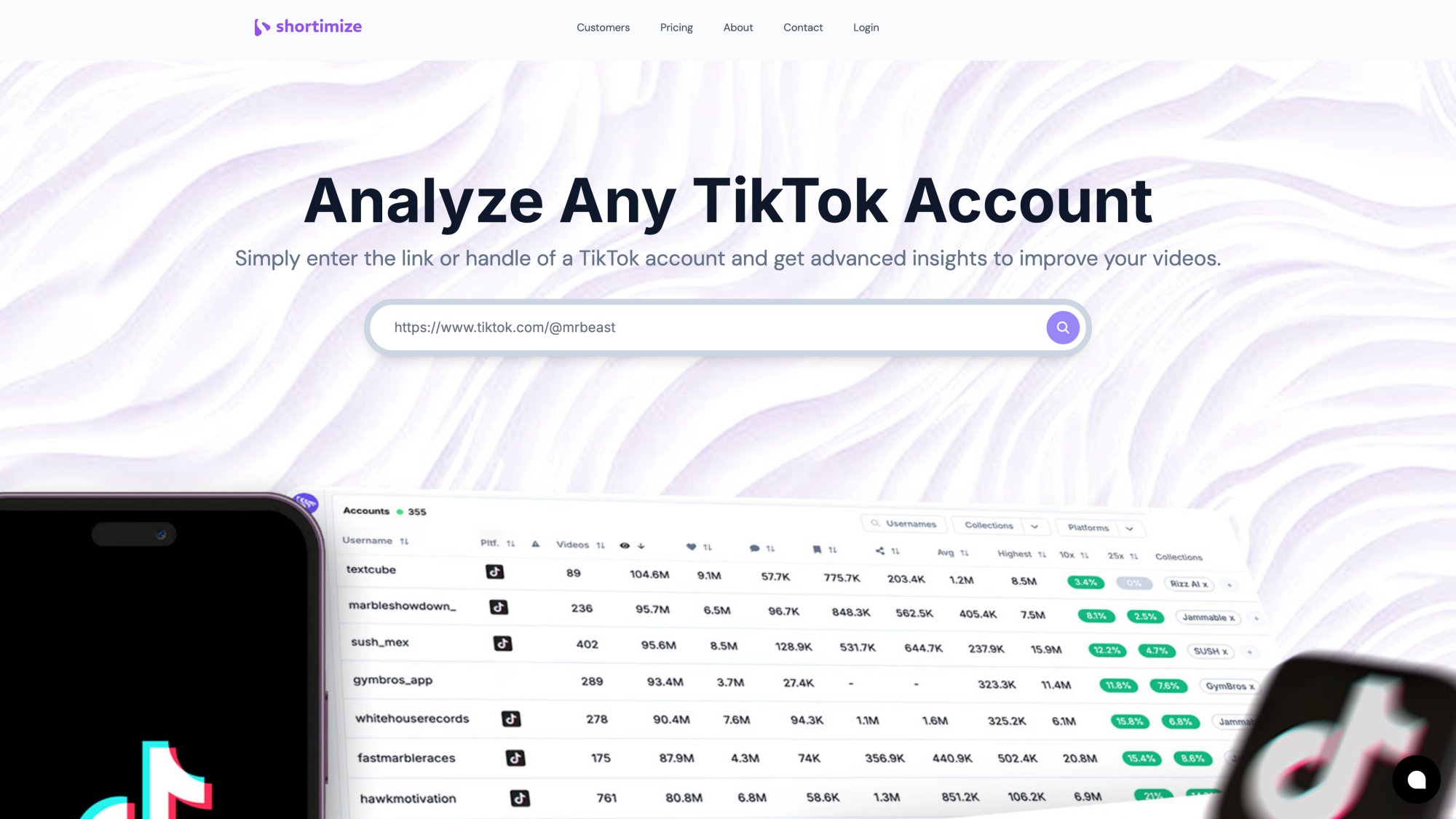
This is why good analytics tools show medians and outliers, not just totals. With Shortimize's TikTok account analysis, you want tools that highlight which videos significantly exceeded a profile's typical performance.
3. Velocity Winners (The Rising Stars)
These are videos taking off right now. Their views per day or views per hour are spiking.
These give you "catch it early" opportunities. You can jump on a format while it's still fresh instead of showing up three weeks late to a trend that's already played out.
4. Search Winners (The Long-Term Players)
TikTok is increasingly a search engine. Studies show that nearly 40% of young consumers use TikTok to search the way they'd use Google. Some videos rank because they match what people are actively searching for, not because they rode a viral wave.
These tend to have longer shelf lives than trend-based hits.
So when you're looking for "top-performing videos," ask yourself: Which of these four am I actually trying to find?
The answer changes your research approach entirely.
How to Define Your TikTok Niche (The Formula That Works)
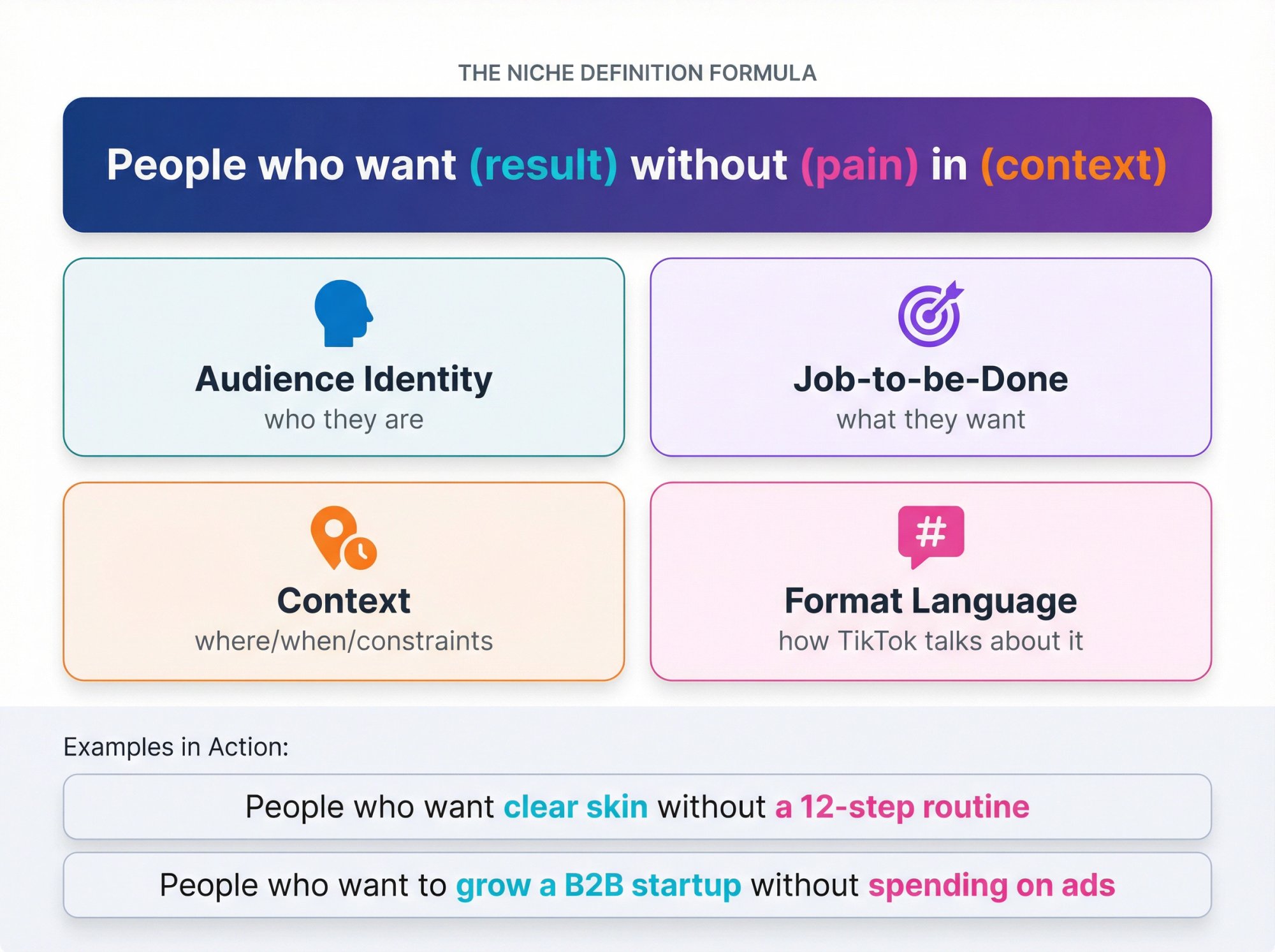
A "niche" on TikTok isn't just "fitness" or "cooking." It's more specific than that. It's a combination of:
→ Audience identity (who they are)
→ Job-to-be-done (what they want)
→ Context (where/when/constraints)
→ Format language (how TikTok talks about it)
Use this formula to nail your niche definition:
**"People who want (result) without (pain) in (context)."**
Examples:
• "People who want clear skin without a 12-step routine"
• "People who want meal prep without cooking every day"
• "People who want to grow a B2B startup without spending on ads"
• "People who want to learn Spanish without feeling embarrassed"
That definition gives you searchable language and keeps your research tight. You're not just looking at "fitness content." You're looking at "quick home workouts for busy parents" or "gym motivation for beginners who feel intimidated."
Specificity matters because the top-performing videos in "fitness" are completely different from the top-performing videos in "postpartum fitness recovery."
How to Build Your Niche Keyword Map (Stop Random Scrolling)
You need a list of 20-80 phrases that real TikTok users search, comment with, and put in captions. This becomes your research foundation.
A. Use TikTok Creator Search Insights
TikTok's Creator Search Insights shows you what people are actually searching for on the platform. It even includes a Content Gap filter to find high-demand, low-supply topics.
How to access it:
• Tap Search in the TikTok app
• Search "creator search insights"
• Tap "View" at the top of results
Inside, you'll find:
→ Content gap filter (opportunity hunting)
→ Searches by followers (if you have 1,000+ followers)
→ Related searches for any topic you explore
This tool is designed specifically to help creators find content gaps and understand search behavior. It's not just for SEO. It's a niche discovery engine.
B. Use TikTok Creative Center Trend Discovery
TikTok's Creative Center is a free web tool that shows trending hashtags, songs, creators, and videos by region and industry.
The Trends section displays what's breaking out across different categories. You can filter by:
• Country/region
• Industry (when available)
• Popularity vs. Breakout status
Where Trend Discovery helps:
✓ You don't rely on your personal For You Page bias
✓ You can spot breakout items early (especially songs)
✓ You see region-specific trends
For example, the Songs tab shows Popular and Breakout tracks, with filters like "New to top 100" and "Approved for business use."
The Hashtags tab shows ranking hashtags with industry filters and "New to top 100" options.
C. Create Your Keyword Map Output
Your goal is a categorized list:
| Category | Examples |
|---|---|
| Core topics (10-20) | "meal prep," "high protein," "quick dinner" |
| Pain + fix phrases (20-40) | "what I eat in a day," "lazy meal prep," "low calorie high protein" |
| Format phrases (10-20) | "3 mistakes," "things I wish I knew," "POV," "don't do this" |
| Product phrases (10-40) | "protein powder," "air fryer," "retinol" (if relevant) |
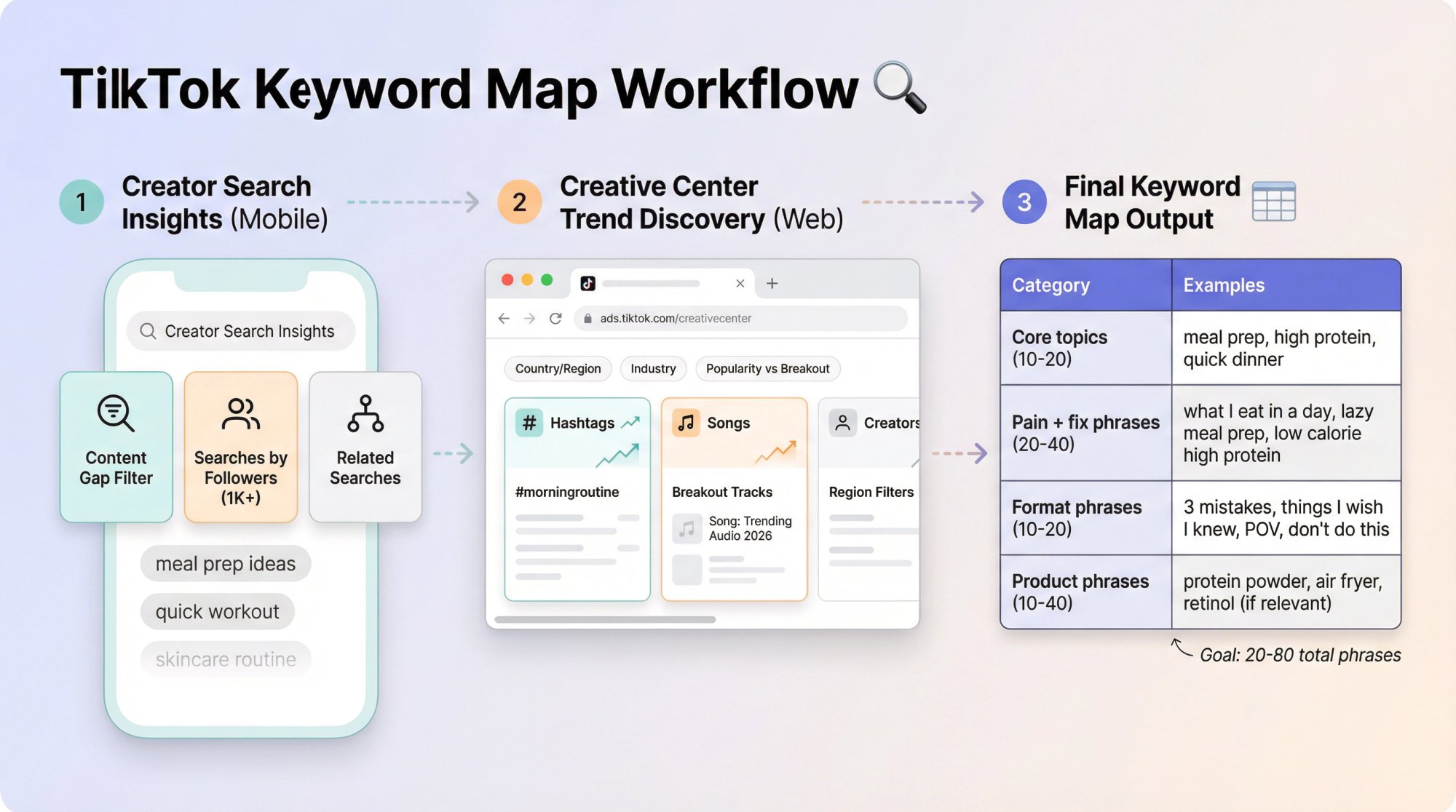
This map becomes your research radar. Every time you want to check what's working in your niche, you run these phrases through TikTok's search and analytics tools.
How to Find the Accounts That Define Your Niche
Your research quality depends entirely on picking the right creator set. If you pick the wrong accounts, all your analysis will be skewed.
Here's the rule:
Pick 20-50 creators who post in your niche at least weekly.
Don't optimize for fame. Optimize for "they constantly ship niche content."
A creator with 200K followers who posts daily in your niche is more valuable for research than a 5M follower celebrity who posted one viral video in your category six months ago.
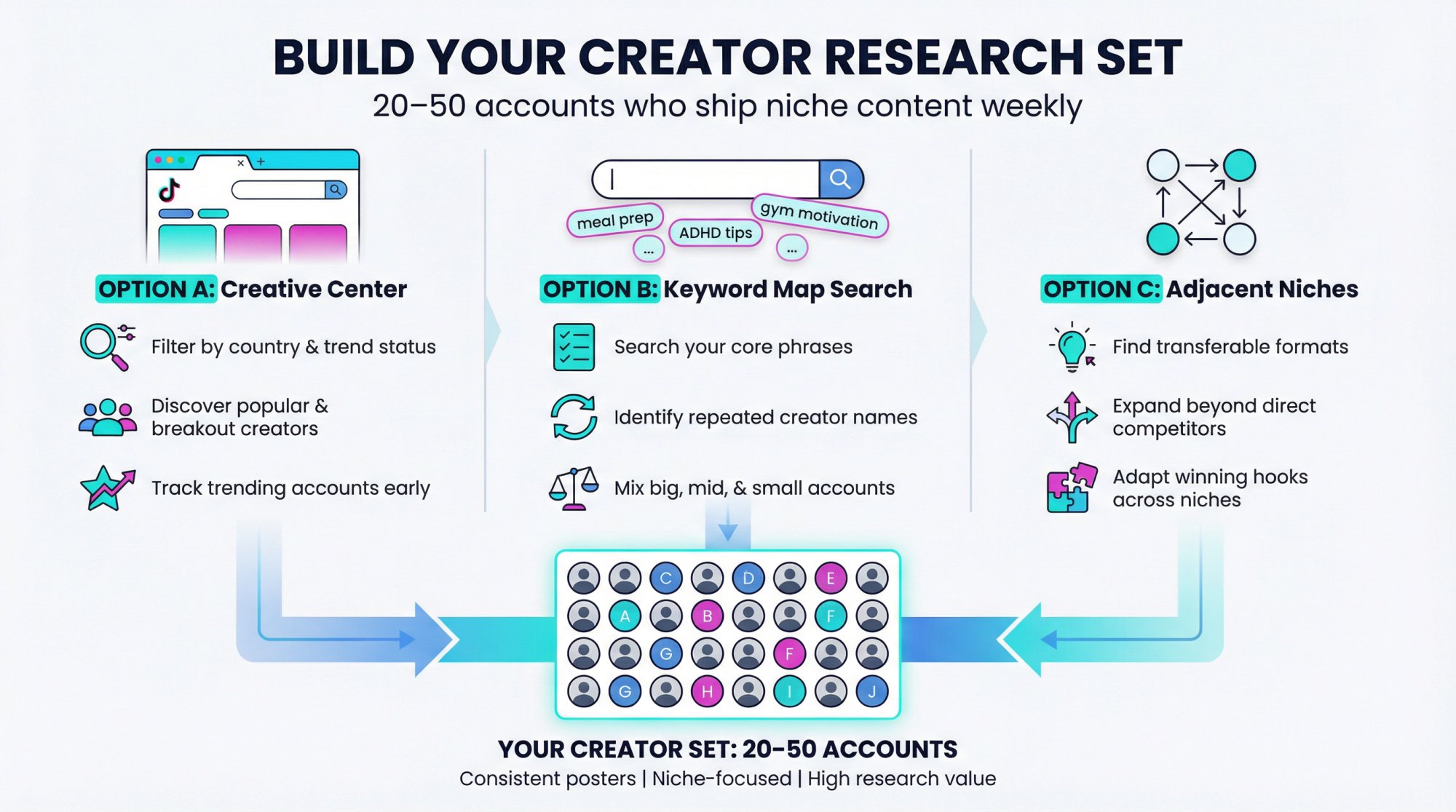
Option A: Use Creative Center's Trending Creators
The Creators section in Trend Discovery lets you discover popular creators and filter by country and trends.
Option B: Use Your Keyword Map in TikTok Search
Search your core phrases, then:
1. Identify repeated creator names
2. Favor creators who post consistently (check their profile)
3. Mix it up: big creators + niche mid-tier + small creators with high engagement
Option C: Include Adjacent Niches
This is how you find transferable patterns.
If your niche is "AI study tools," adjacent niches might be:
→ Productivity creators
→ Student creators
→ Career & interview creators
→ Notetaking system creators
→ ADHD productivity creators
Many of the strongest formats transfer across adjacent niches. A hook that works in productivity will often work in study tips. A format that wins in career advice can be adapted for entrepreneurship.
Smart research looks beyond direct competitors.
How to Collect Videos in Time Windows (Not Random Scrolling)
The most common failure mode in niche research: people only look at the last 10 posts, or they grab random "viral" videos with no context.
Instead, collect videos in strategic time windows:
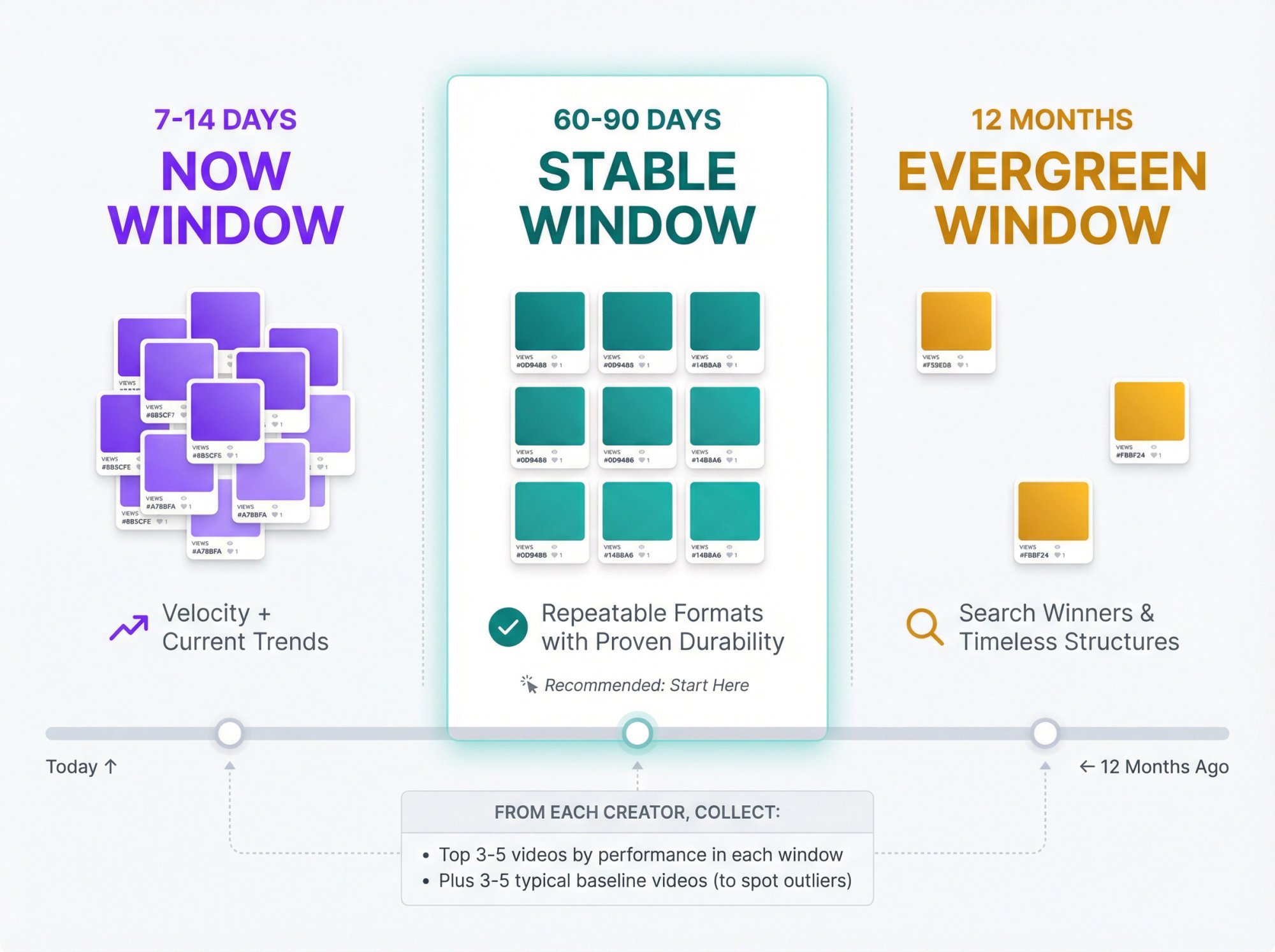
→ Now window (last 7-14 days)
Purpose: Velocity + current trends
→ Stable window (last 60-90 days)
Purpose: Repeatable formats that have proven durability
→ Evergreen window (last 12 months)
Purpose: Search winners and timeless structures
From each creator, pull:
• Top 3-5 videos by performance in each window
• Plus 3-5 "typical baseline" videos (so you can spot outliers)
If you can only do one window: do the 60-90 day window. It balances relevance and sample size.
How to Rank TikTok Videos Correctly (Stop Using Views Alone)
Raw view count is the worst ranking method because it overweights:
✗ Huge accounts
✗ Old posts with years of accumulation
✗ Platform-wide trends unrelated to your niche
Instead, use a composite performance score.
The 3 Most Useful Public Metrics
You can compute these from public data on any TikTok video:
1. Views Velocity
Views / Days since published
This approximates "how fast it's moving." A video with 500K views in 3 days has much stronger velocity than one with 500K views over 6 months.
2. Engagement Rate by View
(Likes + Comments + Shares) / Views
This tells you "how compelling it is per view." A 20% engagement rate is exceptional. A 5% rate is mediocre.
3. Share Rate (optional but powerful)
Shares / Views
Shares are often the best public proxy for "this is worth distributing." People don't share content lightly.
Add One Qualitative Metric: Relevance Fit
Score each video 1-5:
• 1 = unrelated to your niche or audience intent
• 5 = perfectly aligned with your niche and your product/customer
Suggested Composite Score
Weight the metrics like this:
| Metric | Weight |
|---|---|
| Views velocity | 40% |
| Engagement rate | 30% |
| Share rate | 20% |
| Relevance fit | 10% |
You can adjust based on your goals:
→ Optimizing for trend-jacking? Increase velocity weight.
→ Optimizing for evergreen content? Increase relevance + engagement.
This scoring system lets you compare a 50K follower account's best video against a 500K follower account's best video fairly. You're not just looking at raw scale. You're looking at efficiency, momentum, and fit.
How to Reverse-Engineer What Made It Win
Once you've ranked the top 20-50 videos in your niche, you need to turn them into actionable learnings your team can ship.
For each top video, capture:
A. Hook Mechanics (First 1-2 Seconds)
The hook determines whether viewers scroll or stay. Watch how each video opens:
→ Curiosity gap: "I tried X for 30 days and here's what happened…"
→ Contrarian: "Stop doing X. Here's why…"
→ Pain-first: "If you struggle with X, this will change everything…"
→ Proof-first: "Here's the result I got from…"
→ Stakes: "This is why you're stuck at…"
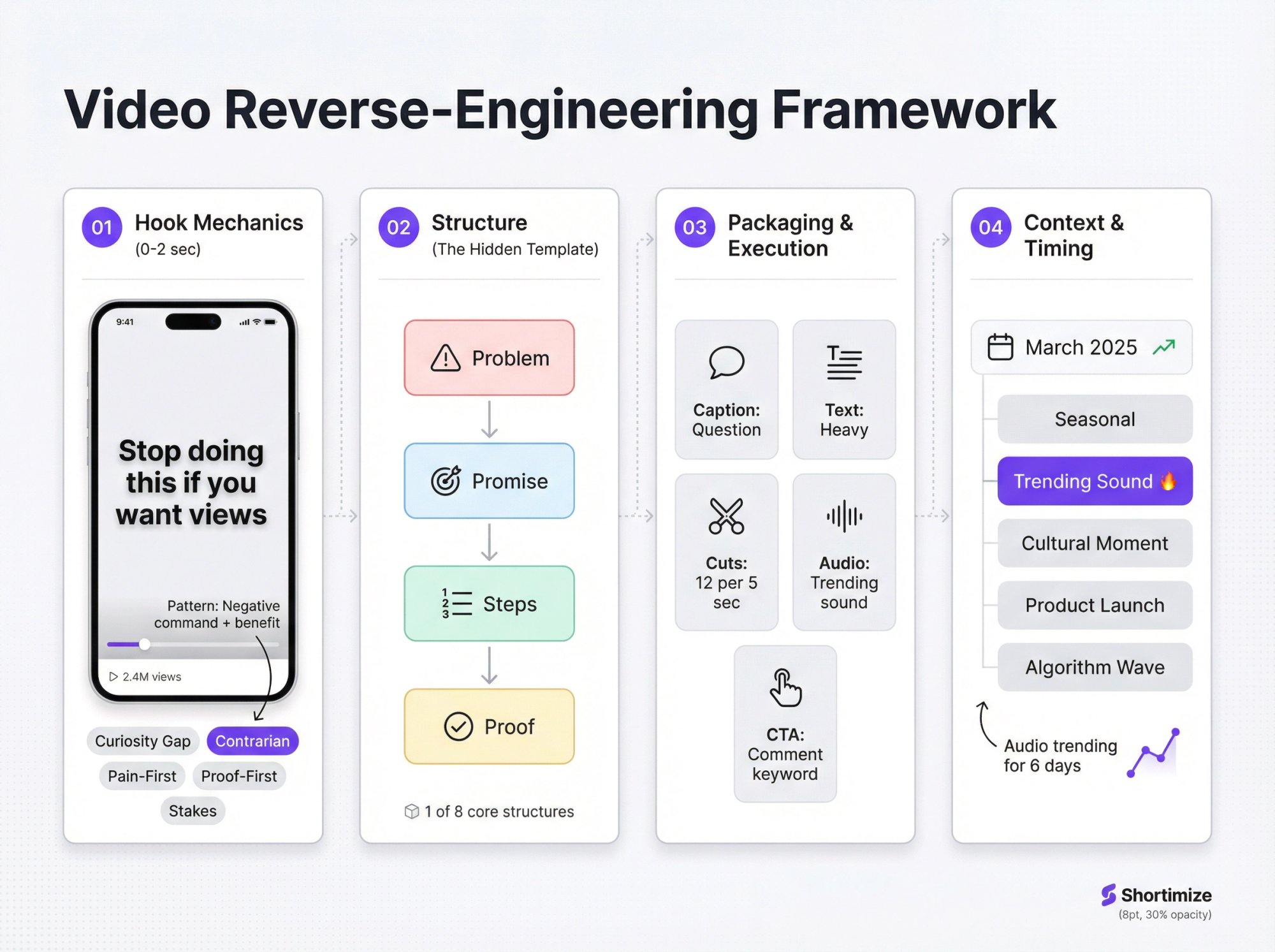
B. Structure (The Hidden Template)
Most viral niche videos follow one of ~8 core structures:
| Structure Type | Pattern |
|---|---|
| Problem-Solution | Problem → Promise → Steps → Proof |
| Myth-Busting | Myth → Reality → Why → What to do |
| Transformation | Before → After → How |
| Listicle | 3 things… + pattern interrupt |
| Storytime | Narrative with payoff |
| Reaction | Reaction + explanation |
| Demo | Demo + objection handling |
| Comparison | Comparison + verdict |
Identify which structure each top video uses. After analyzing 20-30 videos, you'll see which structures dominate your niche.
C. Packaging Elements
Caption style: Question vs statement vs CTA?
On-screen text density: Minimal vs heavily captioned?
Visual pacing: Cuts per 5 seconds?
Audio strategy: Trending sound vs original voiceover vs no audio?
CTA style: Comment keyword, "follow for part 2," "save this," or no CTA?
D. "Why Now?" Context
Tie each video to one of:
→ Seasonal moment
→ Trending sound/format
→ Cultural moment
→ Product cycle or news
→ Algorithmic "community wave"
TikTok for Business emphasizes this "listen, adapt, transform" approach in its trend forecasting. Understanding the cultural and timing context of a video's success helps you replicate the conditions.
How to Turn Insights into a Weekly System (Not One-Time Research)
One-time research dies in two weeks. You need a recurring system.
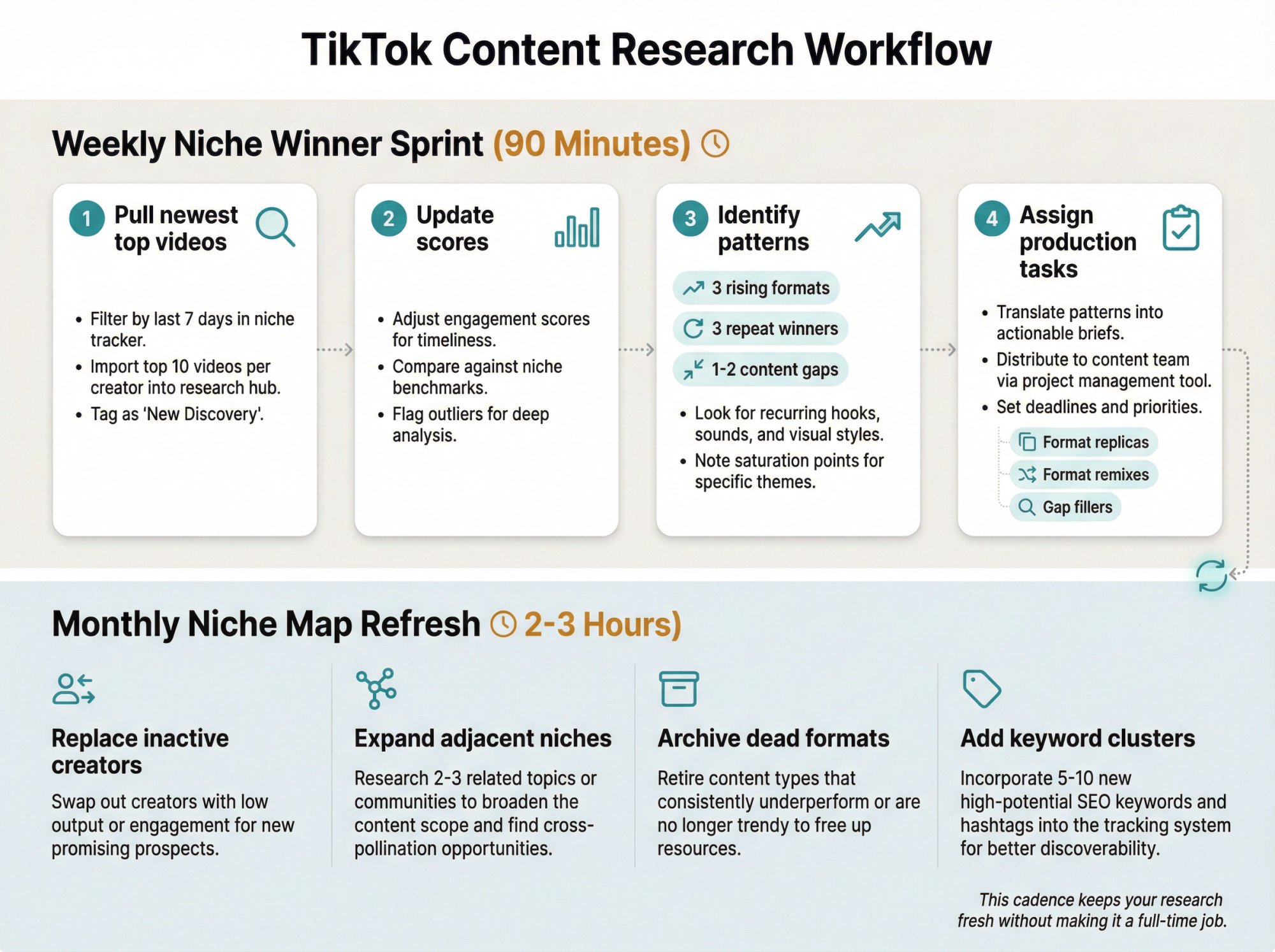
Weekly "Niche Winner Sprint" (90 Minutes)
1. Pull the newest top videos from your tracked creators (last 7-14 days)
2. Update velocity and engagement scores
3. Identify:
→ 3 rising formats
→ 3 repeat winners (formats showing up consistently)
→ 1-2 content gap opportunities (from Creator Search Insights)
4. Assign production tasks:
→ 3 "format replicas" (same structure, different topic)
→ 3 "format remixes" (same structure, different POV)
→ 3 "gap fillers" (search-driven topics with low supply)
Monthly "Niche Map Refresh" (2-3 Hours)
• Replace creators who stopped posting in the niche
• Expand into adjacent niches
• Archive formats that no longer work
• Add new keyword clusters
This cadence keeps your research fresh without making it a full-time job.
Where to Find Top TikTok Videos Right Now (3 Best Places)
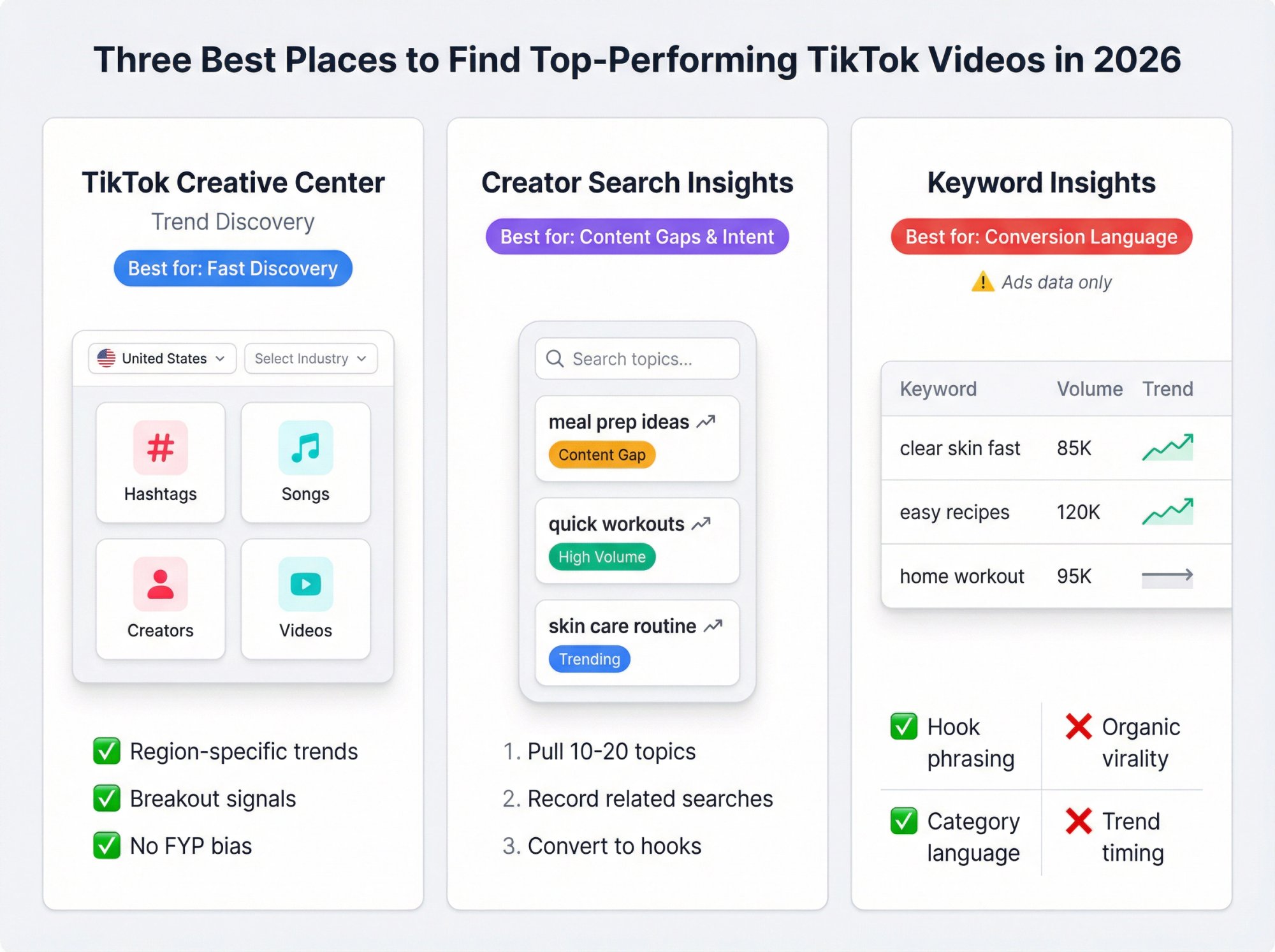
1. TikTok Creative Center Trend Discovery
Best for: Fast discovery across regions and categories
Creative Center is explicitly positioned as a free, public hub for trends and creative resources.
How to use it for niche research:
→ Set your region
→ Choose industry when available
→ Start with:
• Hashtags (find the language of the niche)
• Songs → check Breakout for early signals
• Creators → build your creator set
• TikTok Videos → pull examples for teardown
When it's most valuable:
✓ You need fresh inspiration fast
✓ You're launching into a new niche
✓ You want region-specific trends without FYP bias
2. Creator Search Insights
Best for: Understanding searcher intent and finding content gaps
TikTok describes Creator Search Insights as providing personalized info on what people are searching for, with explicit support for browsing topics that are "lacking in content."
How to use it:
1. Pull 10-20 topics in your niche
2. Screenshot or record the "related searches"
3. Convert each topic into:
→ A hook
→ A 30-45 second script outline
→ A "part 2" follow-up idea
Bonus: It includes Search Analytics so you can evaluate how your own posts perform in search and choose date ranges (7 days, 14 days, custom).
3. TikTok Creative Center Keyword Insights
Best for: Understanding conversion language (with caveats)
Keyword Insights highlights top keywords and phrases from TikTok ads (not organic content). TikTok explicitly notes it does not include organic-only posts.
Use it for:
→ Phrasing hooks in language that converts (especially direct-response niches)
→ Finding "category language" you might miss organically
Don't use it for:
✗ Judging organic virality
✗ Deciding what's "trending" organically
Where Most "Find Top TikTok Videos" Guides Fail
Most guides do one of these:
✗ List generic trending hashtags (not niche-specific)
✗ Say "check Creative Center" but don't give a system
✗ Ignore normalization (views vs. audience size)
✗ Don't translate findings into a weekly process
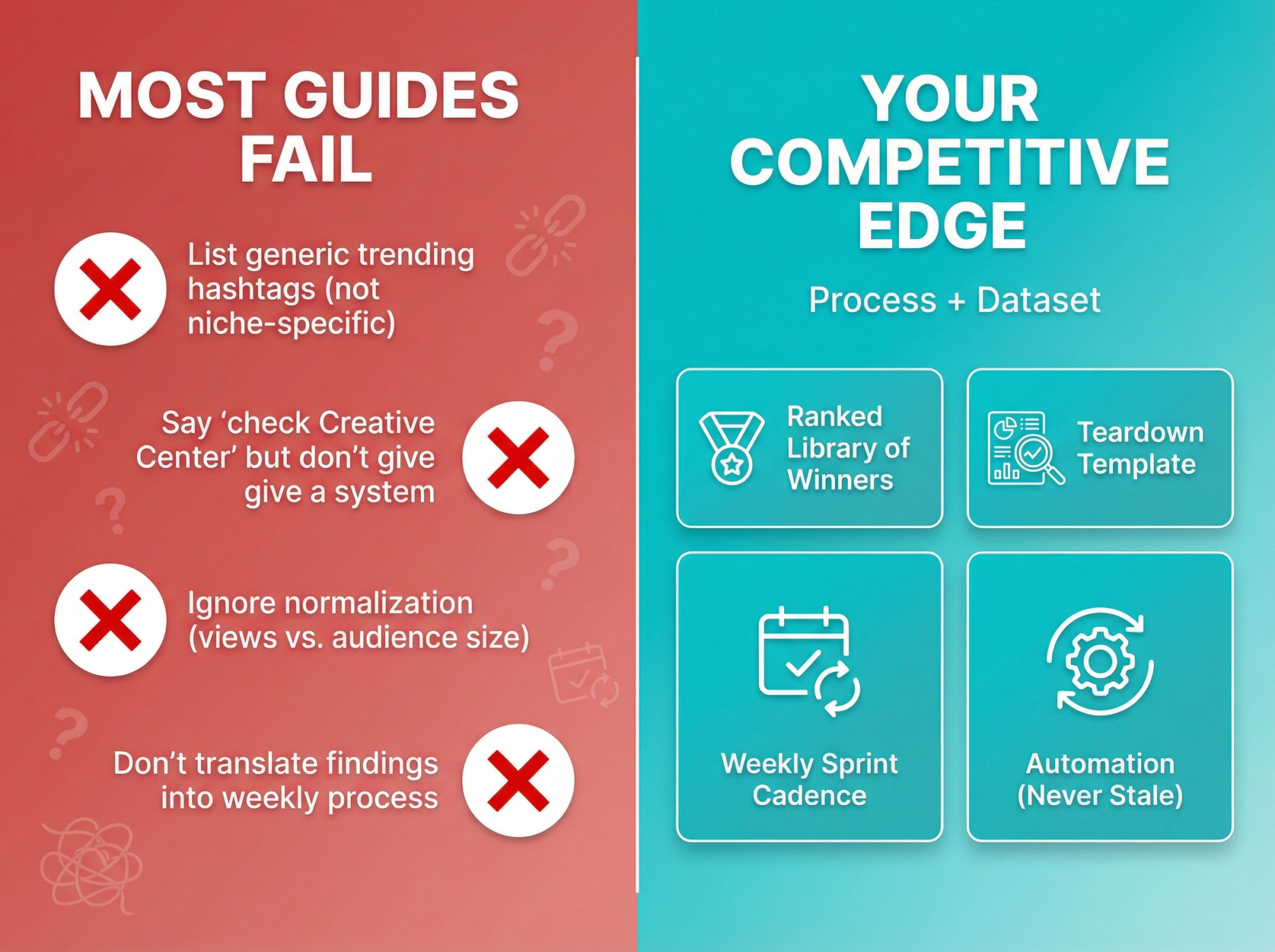
Your competitive advantage is process + dataset:
→ A ranked library of winners
→ A teardown template
→ A weekly sprint cadence
→ Automation so it's never stale
Automate the Whole Workflow with Shortimize
Manual research works until you manage multiple accounts, creators, or niches. Then it breaks.
Shortimize is built for this exact problem: tracking and analyzing short-form videos across TikTok, Instagram, and YouTube in one place.
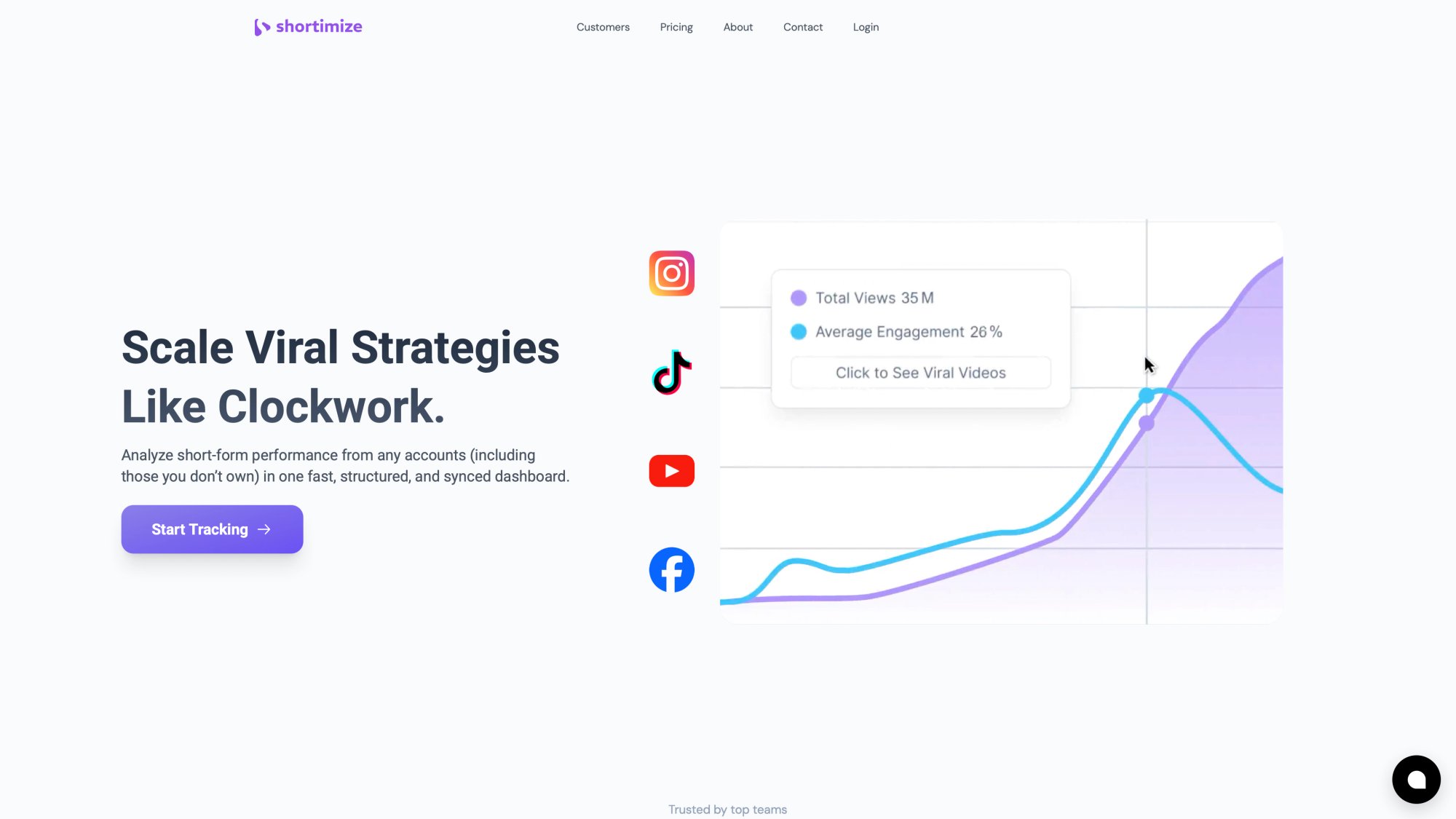
1. Track Niche Creators and Surface Outliers Instantly
Our TikTok account analysis gives you a complete list of videos with median and virality metrics, so you can quickly identify which videos massively exceeded the account's typical performance.
That directly supports "relative outliers," which we established earlier as the most useful definition of top-performing.
How it works:
→ Enter any TikTok account handle
→ We fetch all their videos with full metrics
→ Sort by views, engagement, or our virality score
→ See which videos are 3x, 5x, or 10x above their baseline
No more manual scrolling through profiles. The outliers rise to the top instantly.
2. Build a Niche Swipe File as a Collection
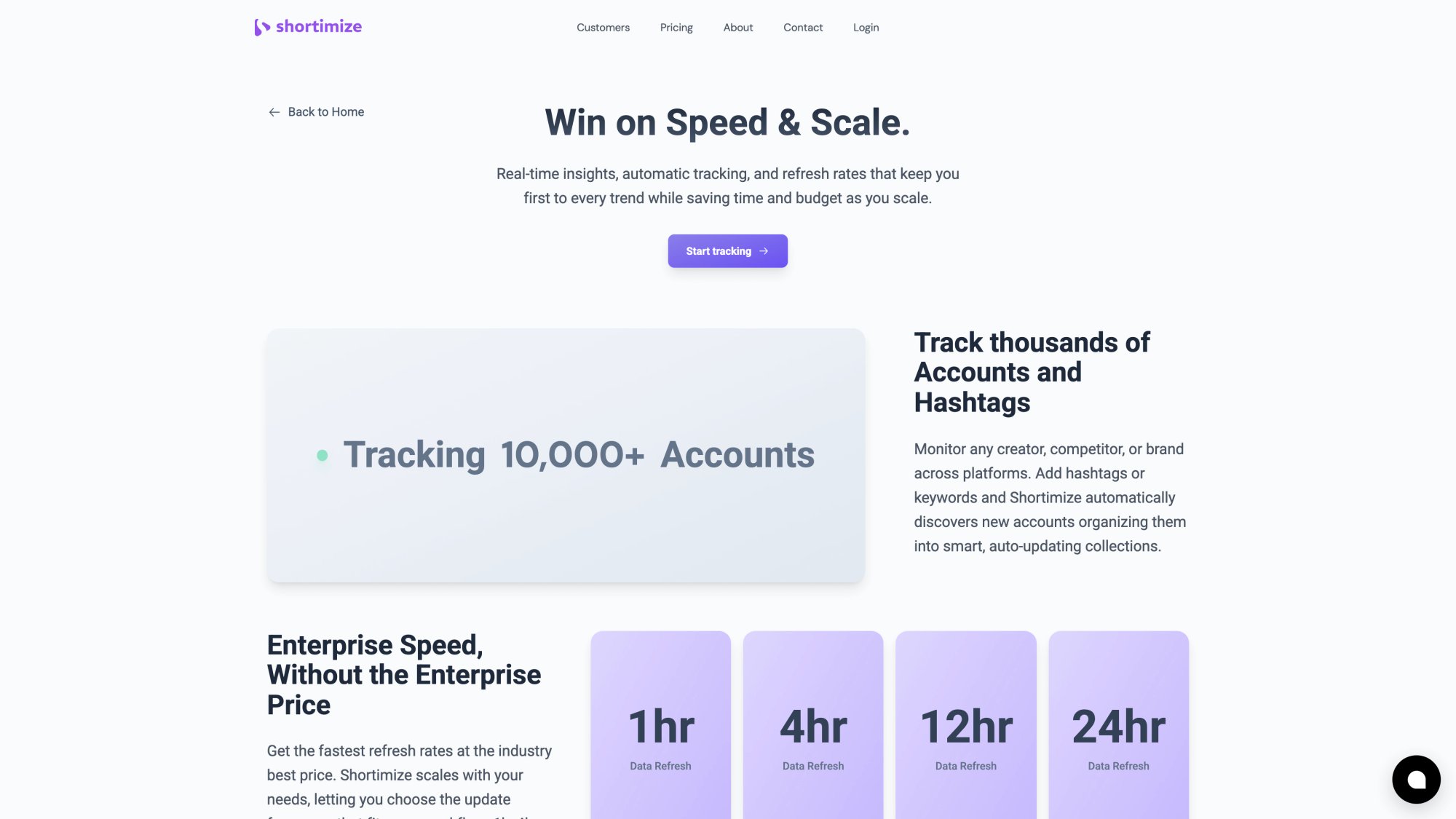
Shortimize Collections let you organize accounts for campaigns, competitors, or clients. Collections can be shared publicly or password-protected.
Learn more about influencer tracking and collections in our analytics guide.
Use Cases:
• Track 30 competitors in one Collection
• Build a "Top Formats This Month" Collection
• Share winning examples with your team
3. Discover Winners Without Already Knowing Who to Track
We offer AI-powered viral video discovery where you can explore millions of viral videos and find similar accounts based on content.
You can search by:
→ Hook language ("Stop doing…," "3 mistakes…," "I wish I knew…")
→ Context objects (screen recording, gym, before/after)
→ Format signals (caption patterns, audio style)
This is huge for "any niche" research because you're not limited to accounts you already know. You can discover breakout content across TikTok by theme, format, or hook pattern.
4. Monitor and Get Alerts When Videos Spike
Our platform includes social media monitoring capabilities with Slack and Discord notifications for viral videos.
How it helps:
→ Stop missing early winners
→ Get notified when a tracked video spikes
→ Catch trends while they're still fresh
Current Pricing (as of December 2025)
According to our pricing page:
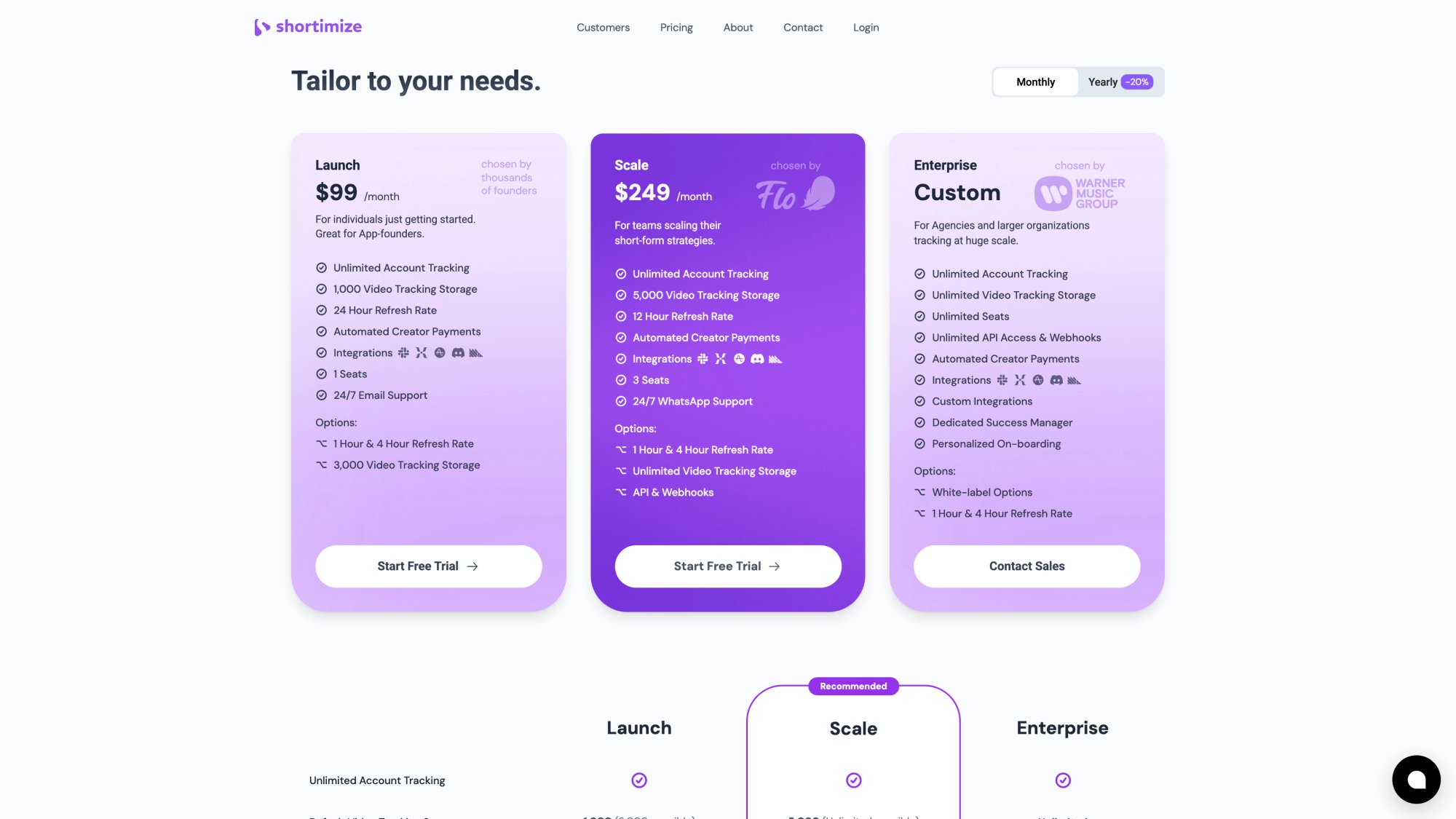
| Plan | Price | Key Features |
|---|---|---|
| Launch | $99/month | 1 seat, 1,000 video storage, 24-hour refresh (upgrade options: faster refresh, more storage) |
| Scale | $249/month | 3 seats, 5,000 video storage, 12-hour refresh (upgrade options: 1-hour refresh, API/webhooks) |
| Enterprise | Custom | Unlimited seats/videos, custom integrations, whitelabeling |
Prices and features can change, so always check the current pricing when you sign up.
The "Niche Viral Library" Template (Copy/Paste)
Use this as your internal tracking schema (spreadsheet or database):
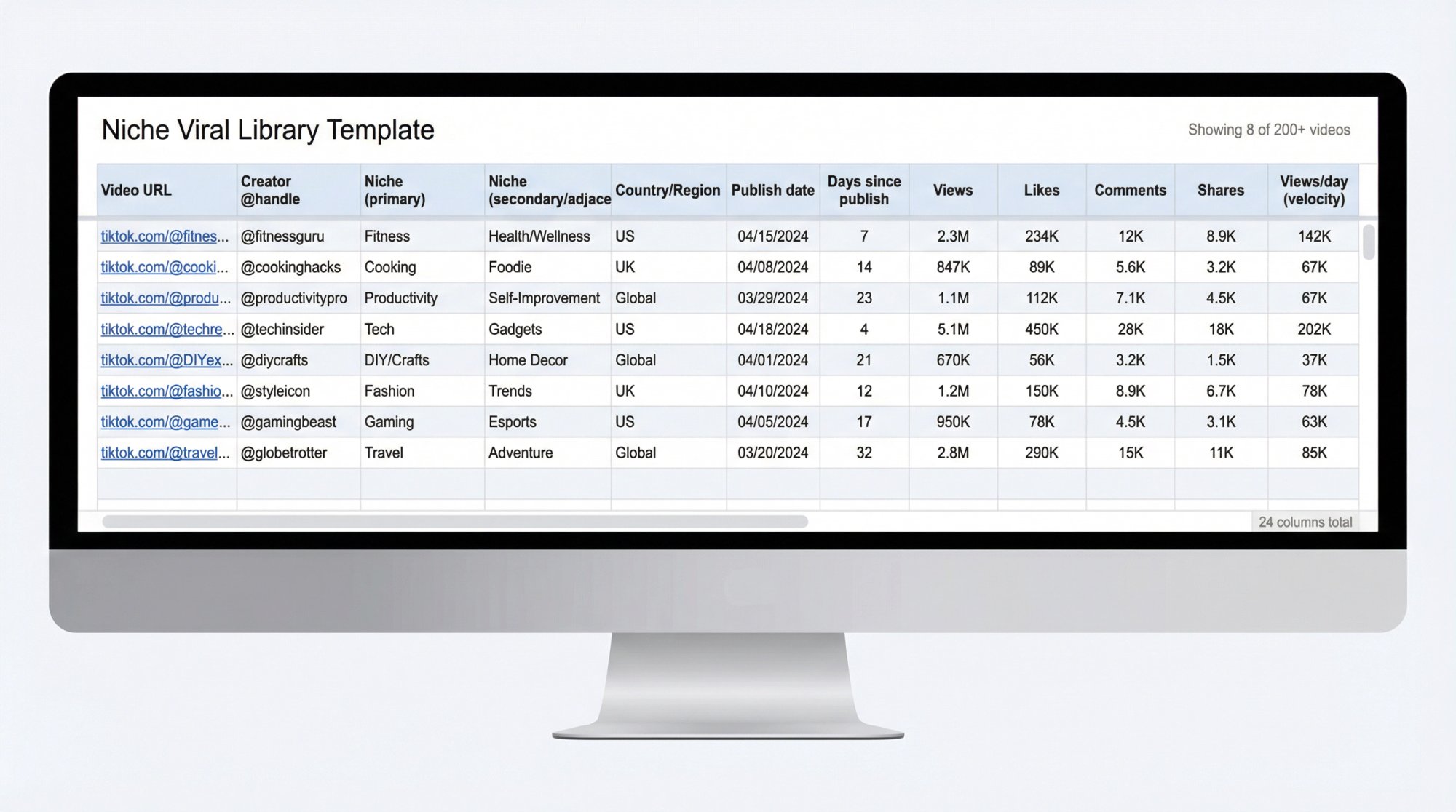
Video URL
Creator @handle
Niche (primary)
Niche (secondary/adjacent)
Country/Region
Publish date
Days since publish
Views
Likes
Comments
Shares
Views/day (velocity)
Engagement/view
Shares/view
Video length (sec)
Hook text (exact on-screen text)
Hook type (curiosity / contrarian / pain / proof / stakes)
Structure (problem-solution / list / story / demo / reaction / comparison)
Audio type (original / trending / voiceover)
Caption keywords
Hashtags
CTA type (comment / follow / save / link / none)
Notes: why it worked (your hypothesis)
Replication idea (your adaptation)
If you build this for 200-500 videos in your niche, you'll have an unfair advantage for months.
Common Mistakes That Silently Kill Niche Research
① Only looking at huge accounts
You'll learn "celebrity gravity," not repeatable niche formats. A creator with 5M followers can post mediocre content and still get 500K views. That's not a format signal. That's an audience signal.
② Ranking by views only
You'll overfit to scale and ignore velocity and efficiency. A video with 2M views over 6 months isn't necessarily better than one with 400K views in 3 days.
③ Confusing trend content with niche content
Trend Discovery is powerful, but your job is to translate trends into your niche's language. Don't just copy trending sounds. Adapt them to your audience.
④ Copying instead of adapting
Copying gets you sameness. Adapting gets you "this feels native, but new." The best creators use trend structures but add their unique angle.
⑤ Not turning research into a weekly system
A PDF swipe file is dead in 2 weeks. You need a recurring workflow that keeps your research fresh.
FAQ
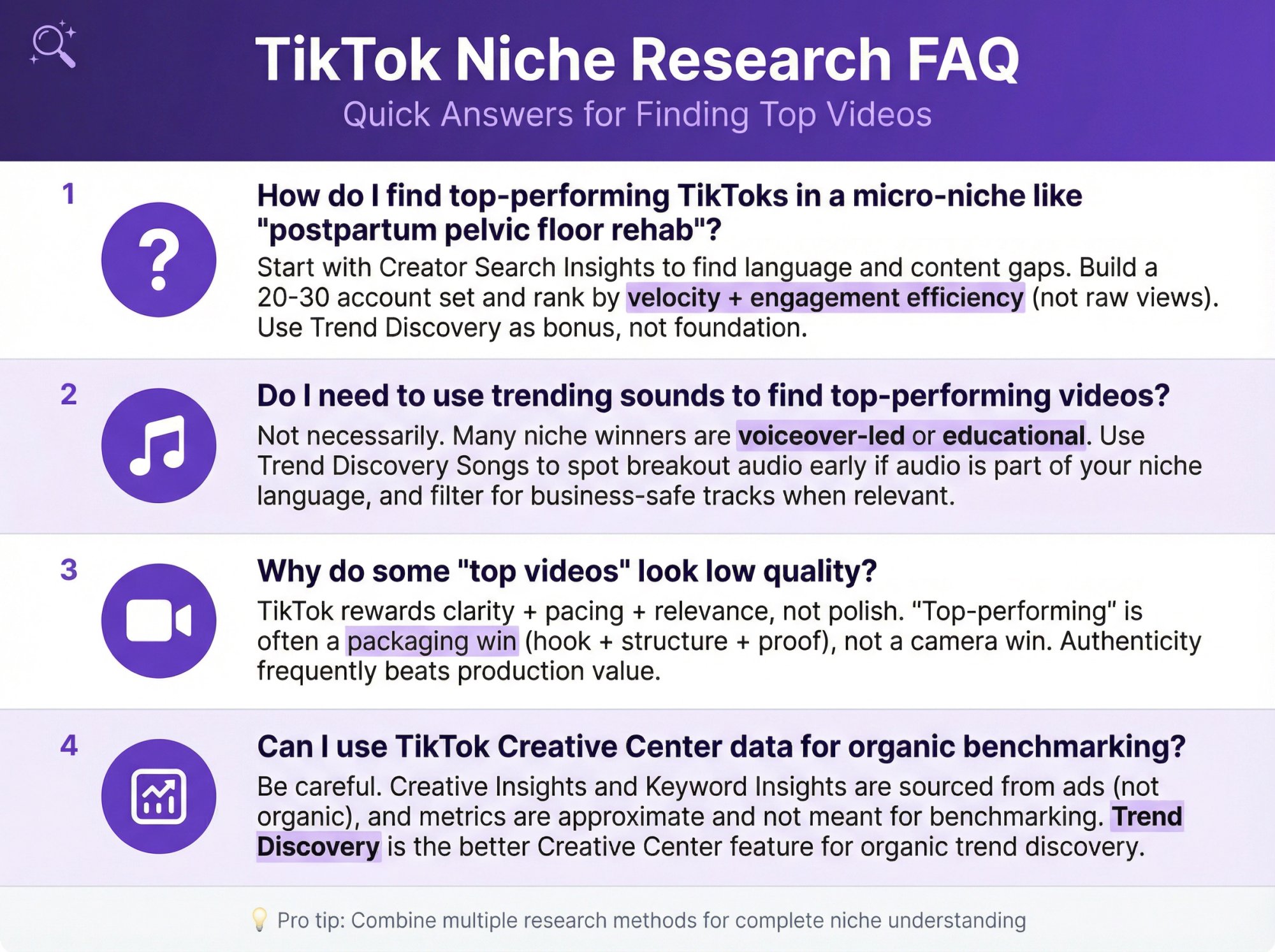
Q: How do I find top-performing TikToks in a micro-niche like "postpartum pelvic floor rehab"?
Start with Creator Search Insights to find the language and content gaps. Then build a 20-30 account set and rank videos by velocity + engagement efficiency (not raw views). Use Trend Discovery as a bonus, not the foundation.
Q: Do I need to use trending sounds to find top-performing videos?
Not necessarily. Many niche winners are voiceover-led or educational. Use Trend Discovery Songs to spot breakout audio early if audio is part of your niche language, and filter for business-safe tracks when relevant.
Q: Why do some "top videos" look low quality?
Because TikTok rewards clarity + pacing + relevance, not polish. "Top-performing" is often a packaging win (hook + structure + proof), not a camera win. Authenticity frequently beats production value.
Q: Can I use TikTok Creative Center data for organic benchmarking?
Be careful. TikTok explicitly notes that Creative Insights and Keyword Insights are sourced from ads (not organic), and Creative Insights metrics are approximate and not meant for benchmarking projected performance. Trend Discovery is the better Creative Center feature for organic trend discovery.
What to Do Next
If you're doing this manually:
-
Define your niche using the formula above
-
Build your keyword map (20-80 phrases)
-
Identify 20-50 key creators
-
Collect videos in time windows
-
Rank using the composite score
-
Reverse-engineer the patterns
-
Build your weekly sprint system
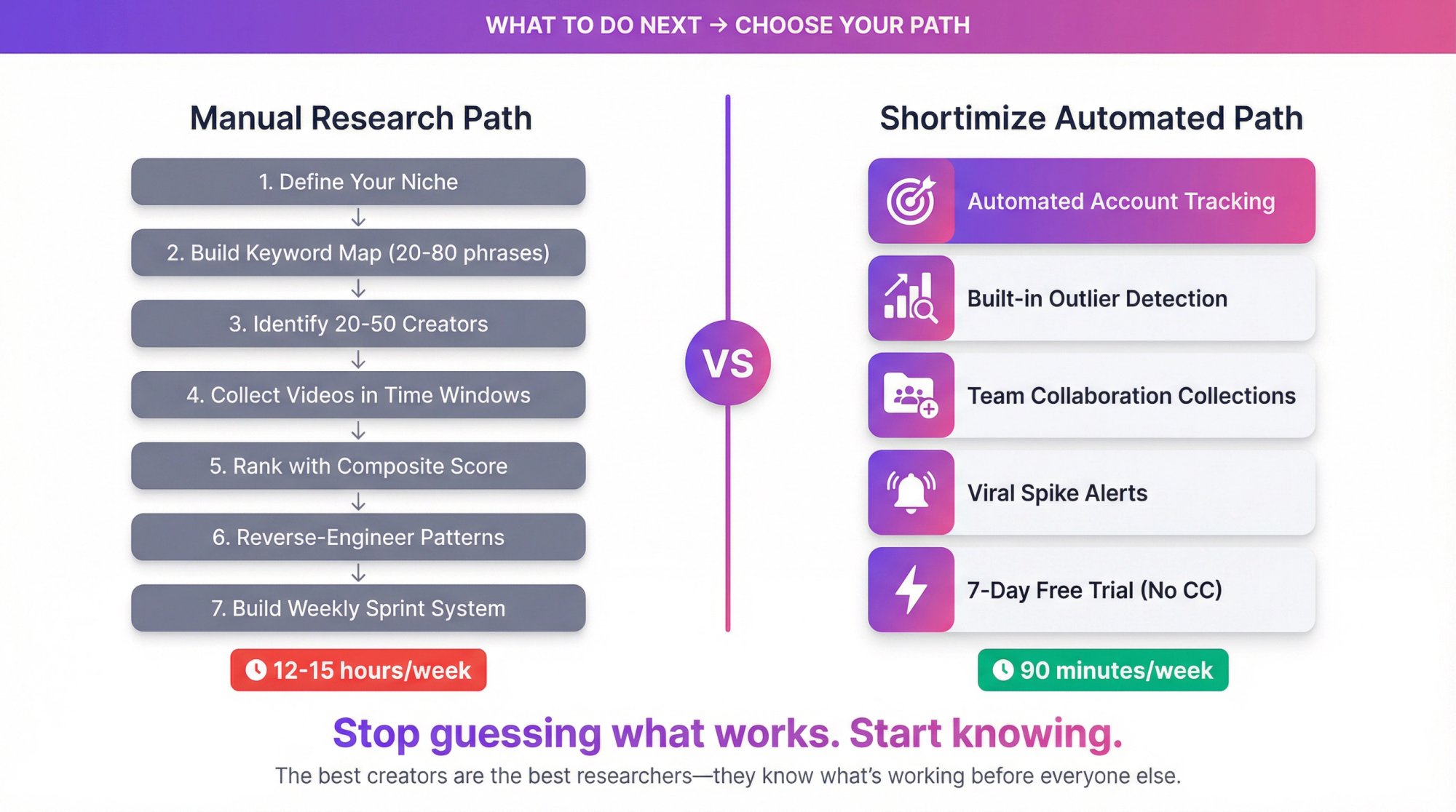
If you want to automate it:
→ Try Shortimize free for 7 days (no credit card required)
→ Track your niche creators automatically with automated account tracking
→ Get built-in outlier detection for viral opportunities
→ Build Collections of winning content with team collaboration tools
→ Set up viral alerts and monitoring for spike notifications
Either way, the goal is the same: stop guessing what works in your niche and start knowing.
The best content creators aren't the most creative. They're the best researchers. They know what's working before everyone else does, and they ship faster.
Now you have the system to do exactly that.