You just hit 500,000 views on a video. You pull up your Creator Rewards dashboard expecting to see earnings on 500K views. Instead, TikTok shows you 175,000 qualified views. The other 325,000 views? They exist, but TikTok won't pay you for them.
This isn't a glitch. It's how the Creator Rewards Program actually works.
The gap between total views and qualified views confuses nearly every creator who joins the program. And that confusion costs real money, because once you understand what makes a view "qualified," you can start engineering your content to maximize the views that actually pay. Total views might feel good, but qualified views are what put dollars in your account.
Here's exactly what's happening, why TikTok built the system this way, and what you can do about it.
Total Views vs Qualified Views: The Key Difference
Total views represent every time your video plays. TikTok counts views extremely generously: if someone scrolls past your video and it auto-plays for half a second, that's a view. If the same person loops your video five times, that's five views. If someone visits your profile and watches the first frame, view. The total view counter you see publicly is a vanity metric.
Qualified views are something different entirely. These are the views TikTok actually uses to calculate your earnings. TikTok's official documentation defines qualified views as "legitimate views" on an eligible video that comply with all the program's terms.
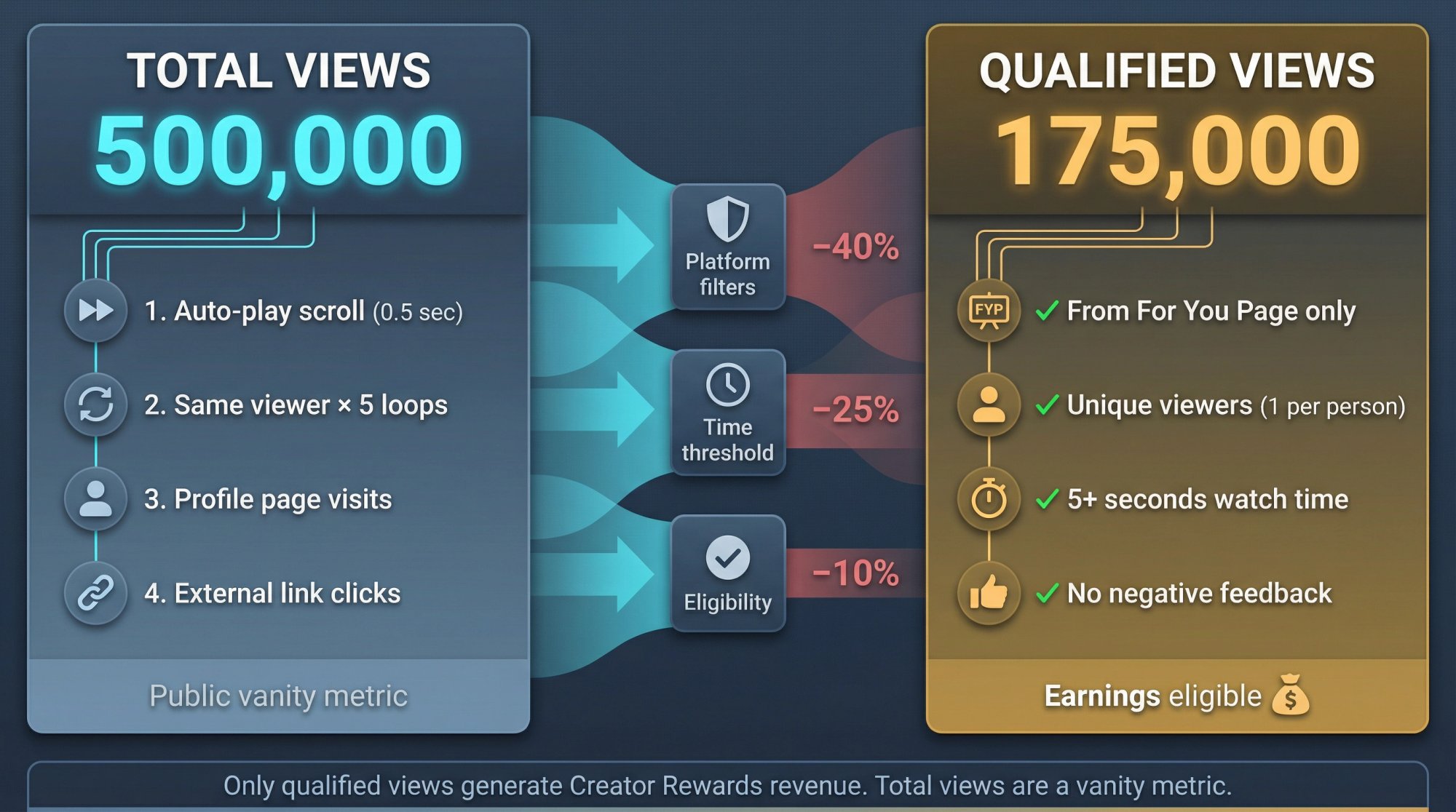
Think of it this way: total views are what everyone sees when they visit your video. Qualified views are what TikTok's payment system sees. And the payment system is much pickier.
The reason your numbers look so different is that TikTok filters out a significant chunk of views that don't meet strict criteria. Views from outside the For You Page? Filtered. Views where someone watched for three seconds then swiped? Filtered. The same fan watching your video four times? Three of those views get filtered.
Only qualified views generate revenue. Everything else is just a number on a screen.
6 Requirements for a Qualified View on TikTok
Not every play of your video counts toward your earnings. TikTok applies multiple filters to determine which views qualify for monetization. Here's what your views need to pass:
Views Must Come from the For You Page
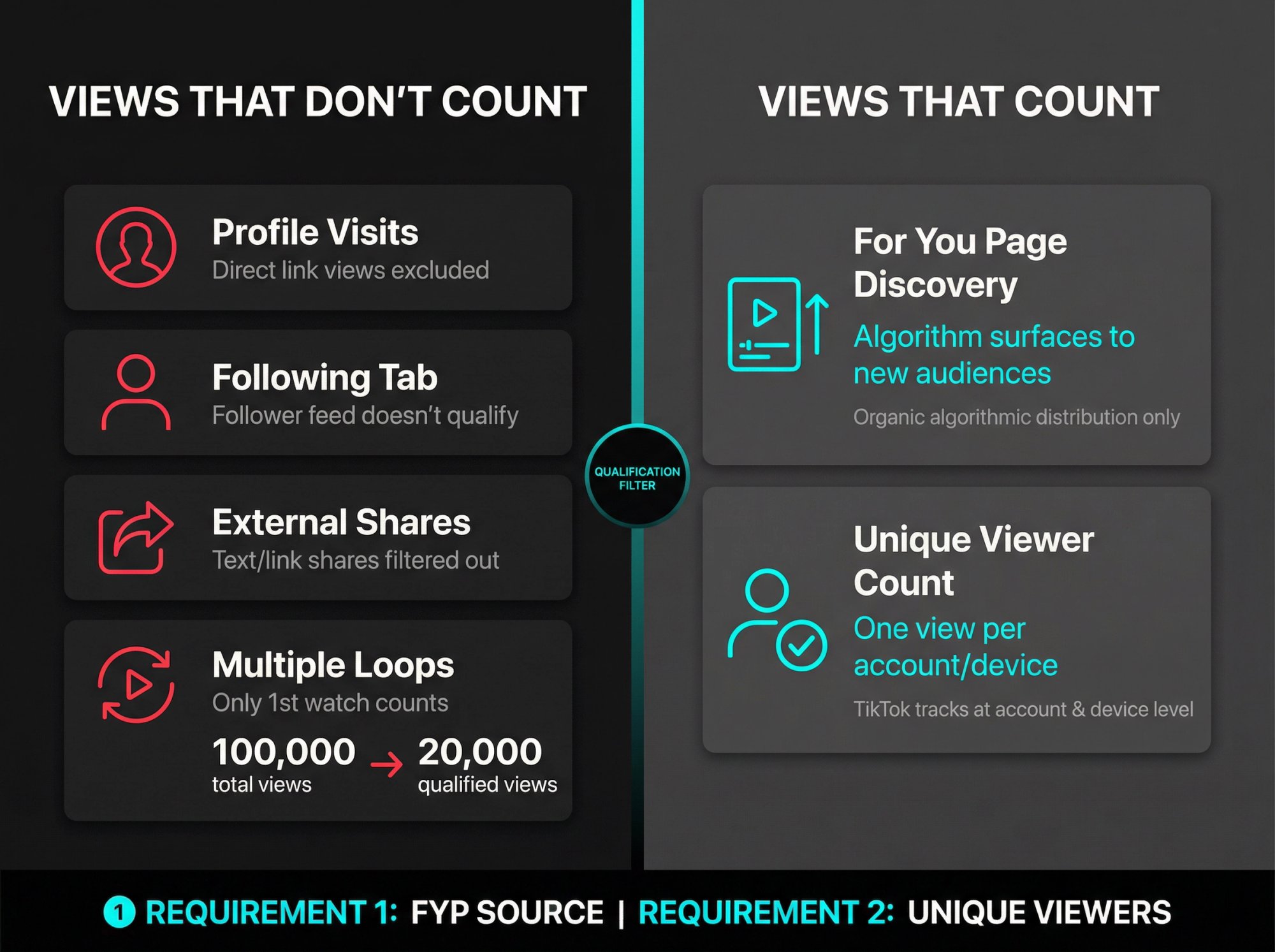
This is the big one. Views from profile visits, the Following tab, direct shares, or embedded links don't count. TikTok only pays for views that came through organic algorithmic discovery. If someone finds your video because a friend texted them a link, that view won't qualify. If your followers watch from their Following feed rather than stumbling on it through FYP, those views won't qualify either.
TikTok wants to reward content that their algorithm surfaces to new audiences. External traffic and follower views don't fit that model.
Only One View per Unique Viewer Counts
TikTok tracks views at the account and device level. If the same person watches your video ten times, you get one qualified view from that person. Your total view count might show 10, but your qualified count shows 1.
This hits creators with "looping" content especially hard. A satisfying 15-second loop might rack up 100,000 total views, but if that's really just 20,000 people watching an average of five times each, you've got 20,000 qualified views. The loops inflate your public number without adding to your earnings.
The 5-Second Watch Time Requirement
Five seconds is the threshold. If someone scrolls past your video after watching for four seconds, that view is gone from your qualified count. It still adds to your total views, but TikTok's payment system ignores it.
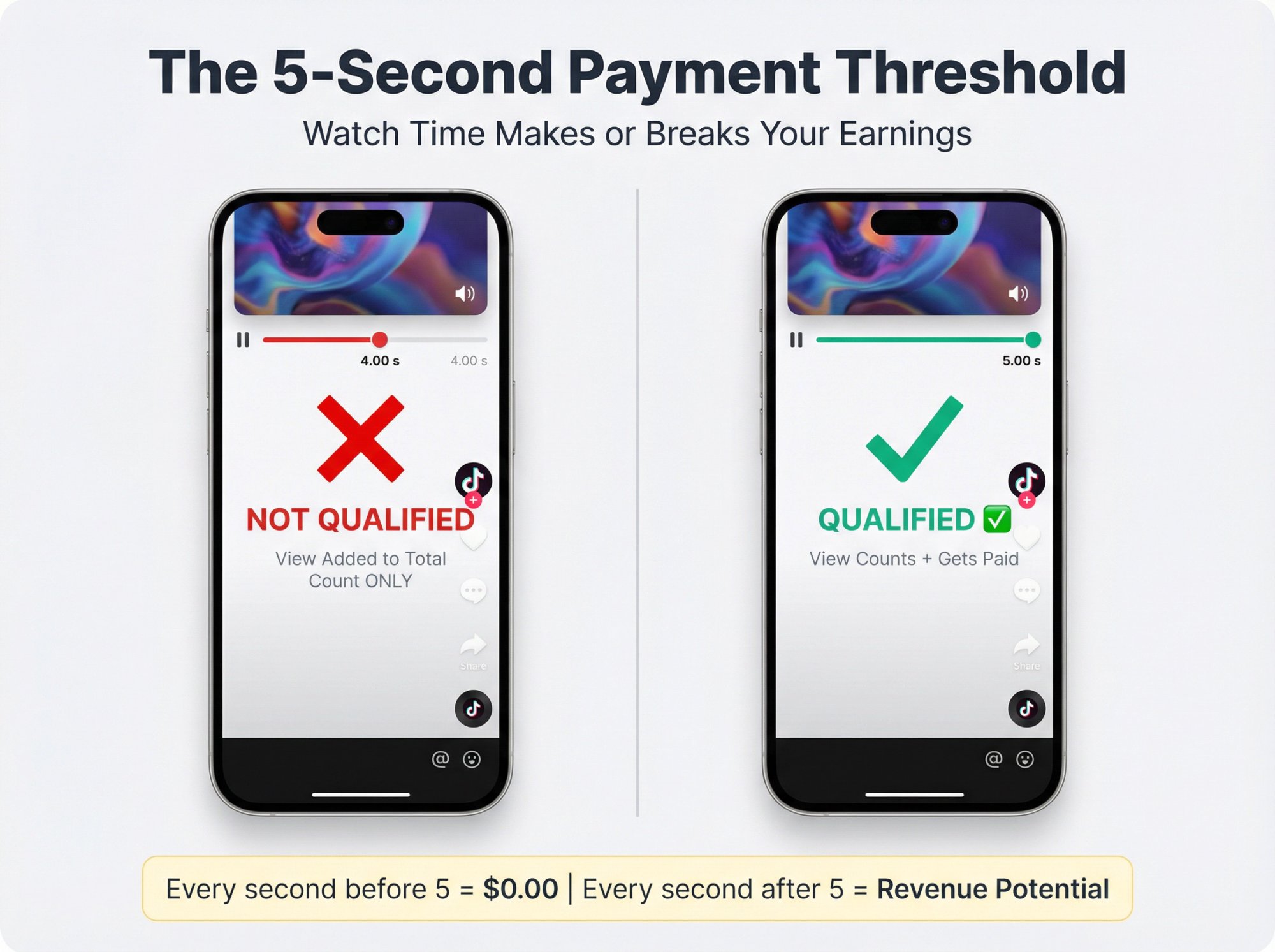
This requirement exists because TikTok wants to ensure the viewer was actually interested and not just scrolling past. A view where someone watched for 2 seconds isn't really engagement with your content. The first five seconds of every video are literally the difference between getting paid and getting nothing.
How Negative Feedback Disqualifies Views
If a viewer quickly hits "Not Interested" or reports your video, that view gets excluded. TikTok filters out views from people who actively rejected the content. They're not going to pay you for viewers who hated what they saw.
This generally isn't a major issue for most creators unless you're making controversial or clickbait content that gets a lot of negative reactions. But it's worth knowing.
Why Bots and Paid Views Don't Count
Fraudulent views don't count. TikTok automatically excludes bot traffic, spam refreshes, click farms, and any attempts to game the system. If you used TikTok's "Promote" feature to boost your video, those paid views also don't qualify. TikTok won't pay you for views you paid them to obtain.
And there's one more requirement that's less about the viewer and more about your content itself:
Video Eligibility Requirements for Creator Rewards
Videos must be original, high-quality, and at least 60 seconds long according to TikTok's Creator Rewards Program requirements. They also need to be posted after you joined the Creator Rewards Program. A 45-second video will show zero qualified views no matter how viral it goes. Duets and stitches don't qualify. Repurposed content with visible watermarks from other platforms won't qualify.
TikTok's official definition: "Qualified views are unique video views from the For You feed and exclude fraudulent views, paid views, disliked views, views with less than 5 seconds watched, promoted views, and artificial views."
If a view passes all these filters, congratulations: it counts toward your earnings. If it fails even one, TikTok pretends it doesn't exist when calculating your payout.
Why TikTok Doesn't Pay for All Your Views
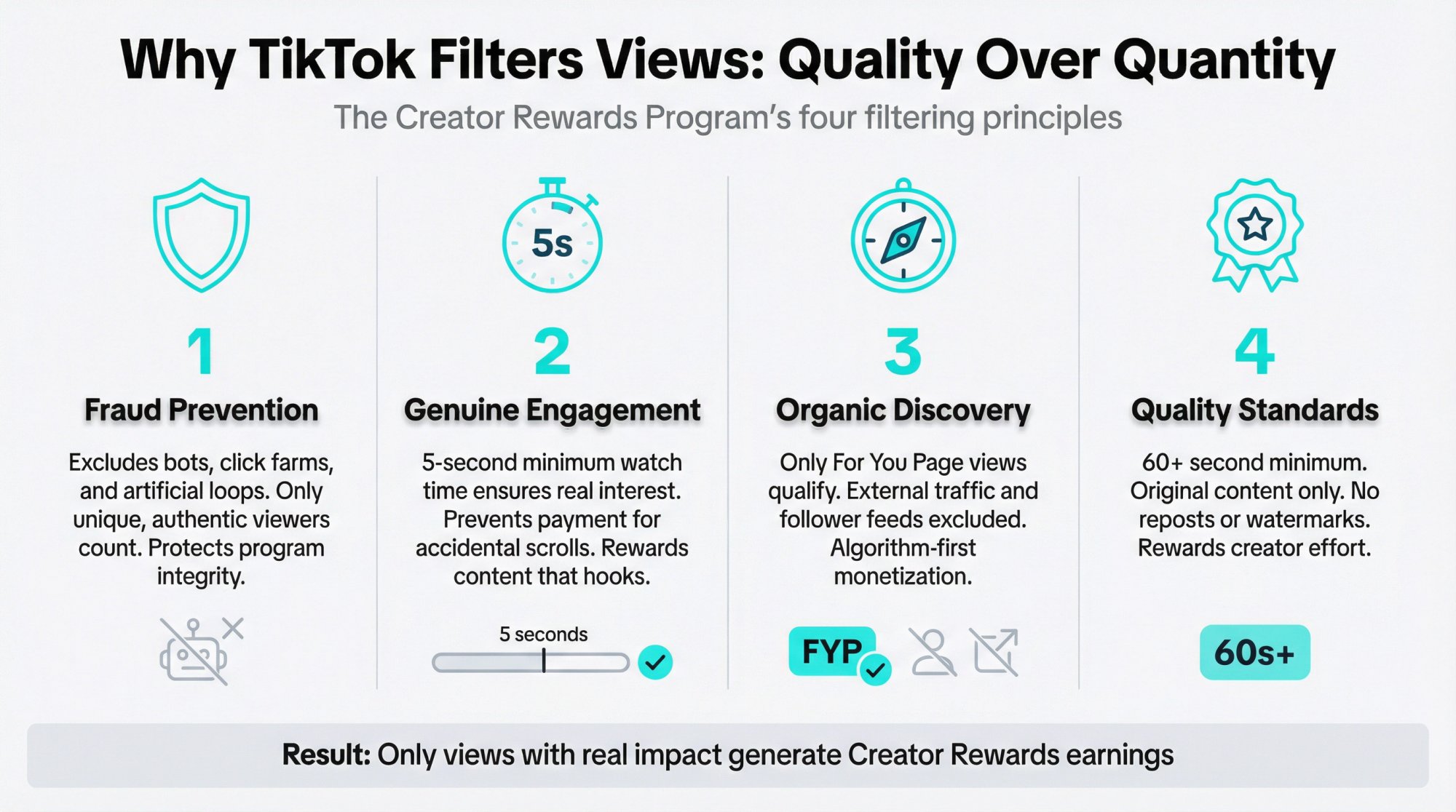
You might be wondering why TikTok bothers with all this filtering. The old Creator Fund (which preceded Creator Rewards) was criticized for paying very little per view, partly because it treated all views equally. The Creator Rewards Program takes a different approach: quality over quantity.
Here's the reasoning behind each filter:
Fraud prevention. By requiring unique viewers and authentic traffic, TikTok avoids paying for bots, loops, or click farms. A creator can't just reload their own video a thousand times or buy fake views and expect payment. This protects the program's integrity and ensures advertiser money goes toward real reach.
Rewarding genuine engagement. The 5-second threshold means TikTok only pays for viewers who were actually hooked for a moment. Anyone can get someone to see the first frame of a video. Keeping them past five seconds means the content resonated. This pushes creators to focus on strong openings and real value rather than pure clickbait.
Prioritizing organic discovery. By counting mainly FYP views, TikTok incentivizes creators to make algorithm-friendly content. If you could earn from external traffic, creators might focus more on driving views from websites or messaging apps rather than making content TikTok's system wants to promote. The FYP requirement keeps everyone optimizing for the platform itself.
Quality content requirements. The 60-second minimum and originality requirements exist to improve overall content quality. TikTok doesn't want to pay for low-effort clips or recycled memes. Longer videos (60+ seconds) also give more opportunity for ads and deeper engagement. By limiting monetization to longer, original content, TikTok ensures the payout pool goes to creators putting in real effort.
The short version: TikTok only pays for views that likely had real impact. A real person found your video through the algorithm, watched a meaningful chunk, and didn't hate it. Views that don't meet those standards are considered noise.
How TikTok Calculates Creator Rewards Earnings
Qualified views get you in the door. But the actual money you earn depends on a second factor: RPM (Revenue Per Mille, where mille means 1,000).
TikTok's payout formula is straightforward:
(Qualified Views / 1,000) x RPM = Your Earnings
So if you have 100,000 qualified views and an RPM of $0.80, you earn $80.
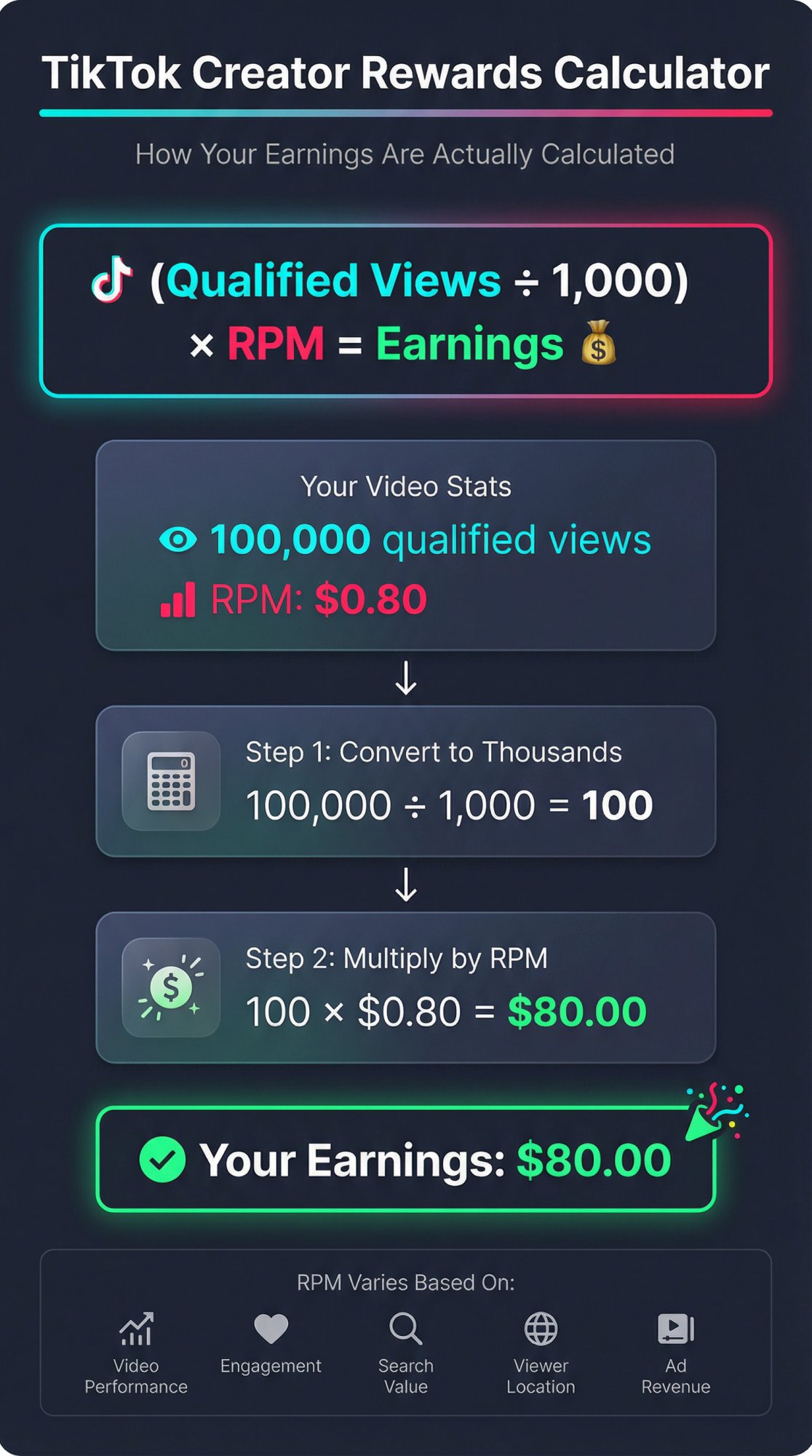
The catch is that RPM isn't fixed. TikTok assigns a different RPM to each video (and it can change over time) based on several factors:
-
Video performance: How well your video keeps people watching (average watch time, completion rate)
-
Engagement: Likes, comments, shares signal that the content is valuable
-
Search value: Whether your content attracts views via TikTok's search (indicating lasting interest)
-
Viewer location: U.S. audiences typically generate higher RPM than viewers in many other regions
-
Advertising value: How much ad revenue your viewers generate by watching ads between videos
TikTok RPM Ranges: What to Expect
RPM varies wildly from video to video and creator to creator. Here's a rough breakdown:
| RPM Range | Typical Scenario |
|---|---|
| $0.40 – $1.00 | Average for most creators |
| $1.00 – $2.00 | Strong engagement + mostly U.S. audience |
| $2.00 – $4.00+ | Premium niches (finance, tech, business) with high watch time |
| Below $0.40 | Low-value regions or poor retention |
Some creators in lucrative niches with very high engagement have reported RPMs of $3-4 or even higher. On the flip side, creators have shared experiences of RPMs dropping to just a few cents during slow months or with non-U.S. audiences.
Real Earnings Example: 500K Views Breakdown
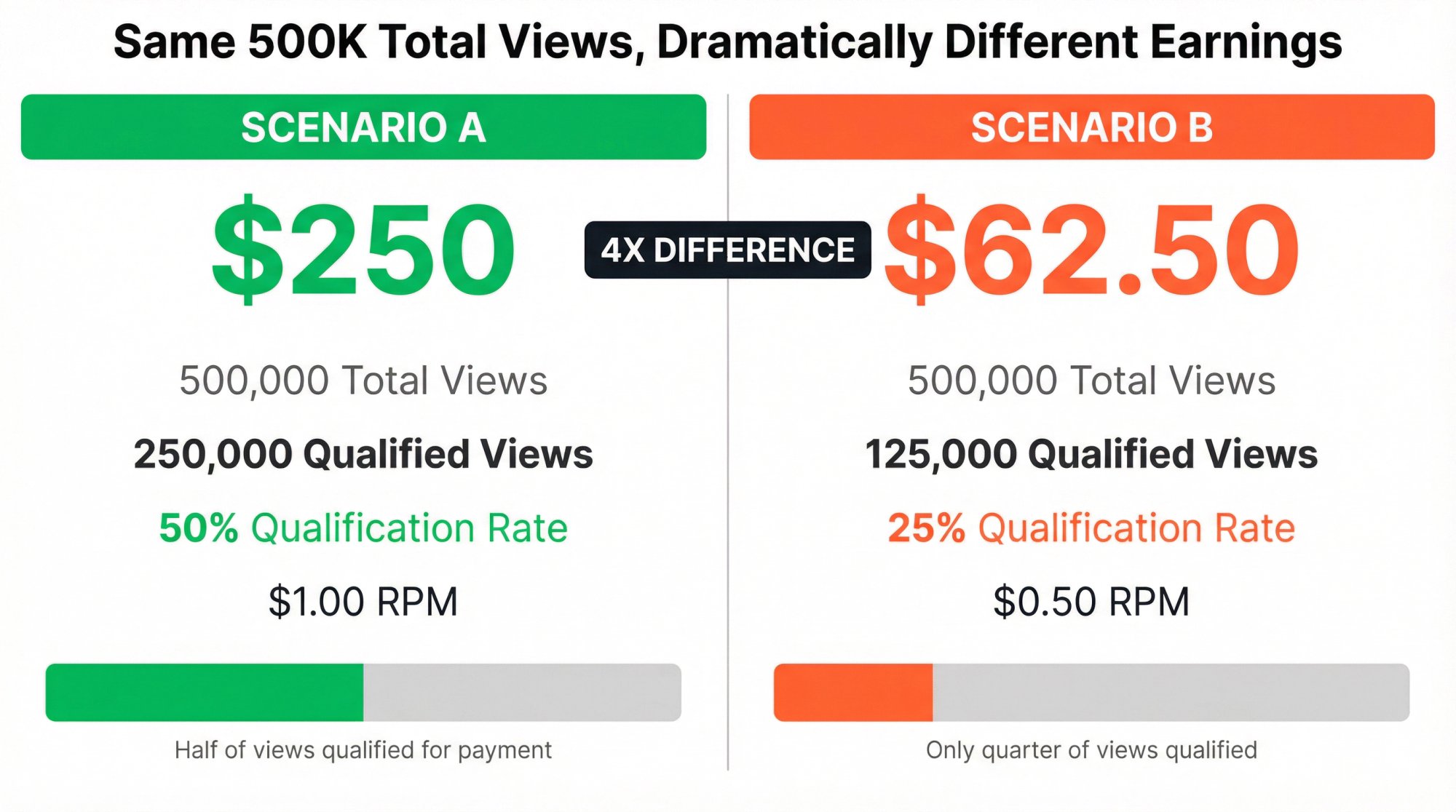
Say you have a video with 500,000 total views. How much do you actually earn?
Scenario A:
-
50% qualification rate = 250,000 qualified views
-
RPM of $1.00
-
Earnings: $250
Scenario B:
-
25% qualification rate = 125,000 qualified views
-
RPM of $0.50
-
Earnings: $62.50
Same video, same total views, but a 4x difference in earnings based on qualification rate and RPM. This is why understanding qualified views matters so much. Two creators could both hit 1 million total views, but if one converts more of those into qualified views with a higher RPM, the payout difference is massive.
What Percentage of TikTok Views Actually Qualify?
If you're seeing a big gap between total and qualified views, you're not alone. Only a fraction of total views typically qualify, and that fraction varies depending on your content and traffic sources.
Based on industry observations in 2024-2025:
-> Typical/average videos: Roughly 30-60% of total views end up as qualified views
-> High-performing content: 50-70%+ qualification rate for very engaging videos with strong hooks
-> Low-performing content: Under 20% qualification rate when retention is poor or traffic comes from wrong sources

So if you're seeing 40% of your views qualify, you're actually doing fine. That's within the normal range. If you're seeing 60%+, you're doing exceptionally well. If you're under 20%, something needs to change.
Factors That Affect Your Qualified View Rate
First 5 seconds retention is everything. If 50% of your viewers bail before the 5-second mark, roughly half your views won't qualify. The strength of your hook literally determines whether views convert to money. A weak opening bleeds qualified views.
Traffic source matters enormously. If a large portion of your views came from profile visits, the Following tab, or external shares, your qualified percentage will tank. Those views inflate your total count but don't earn you anything. Videos that get picked up by the algorithm and pushed to new audiences on FYP will have much higher qualification rates.
Loops hurt more than you'd think. If your content encourages people to watch multiple times (satisfying loops, "wait for it" reveals), those extra loops don't add qualified views. They triple your total view count while your qualified count barely budges. A video with 100K total views from 20K people looping 5x each has only 20K qualified views.

Negative reactions filter out views. If your content causes viewers to hit "Not Interested" or report it, those views vanish from your qualified count. Controversial or polarizing content might get lots of views but fewer qualified ones.
How to Get More Qualified Views on TikTok
Since qualified views are the gateway to getting paid, increasing your qualification rate directly boosts earnings. Here's how to convert more of your total views into qualified views:
Hook Viewers in the First 5 Seconds
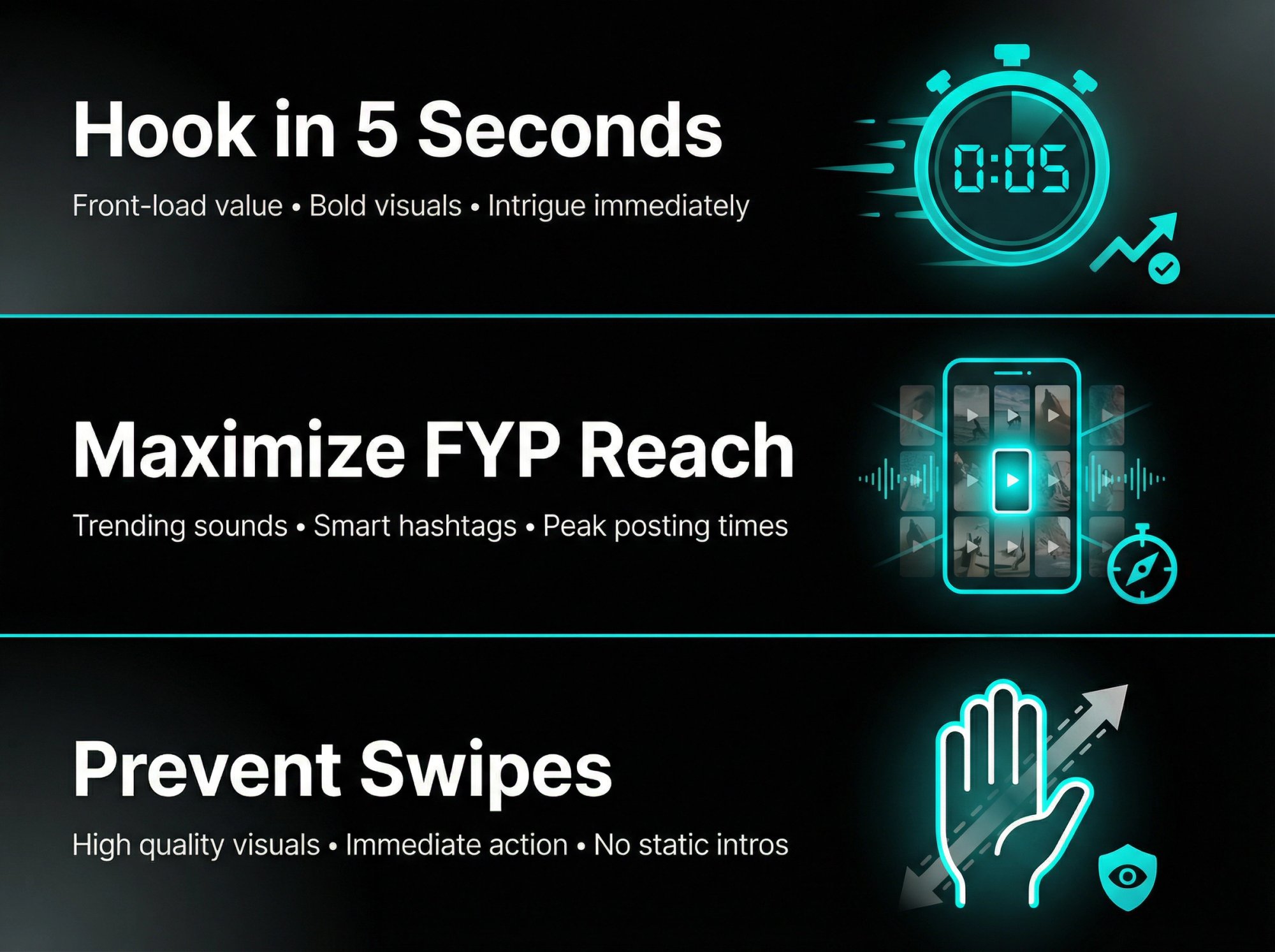
Your hook needs to stop the scroll and keep viewers past that crucial threshold. Intriguing questions, bold visuals, or a quick preview of what's coming can buy you those five seconds. Front-load value or intrigue so viewers don't swipe before the clock runs out.
If you're losing viewers at 4 seconds, you're losing money. Period.
How to Maximize For You Page Reach
The more your video gets fed to new audiences on FYP, the more views will qualify. Use trending sounds when appropriate. Pick hashtags that match your content. Post when your audience is most active. Create content that TikTok's algorithm loves: high completion rate and strong engagement.
Don't rely solely on followers or external shares. Those views won't help your Creator Rewards payout.
Stop Viewers from Swiping Away
Long static intros, low-quality visuals, or overly salesy openings cause viewers to scroll before 5 seconds. Make sure your video immediately delivers: 1080p or higher resolution, clear visuals, and something happening from frame one.
TikTok even suggests high-quality production as a factor for additional bonus rewards.
Why New Viewers Matter More than Loops
If your strategy has been getting the same people to watch multiple times, shift gears. Loops won't boost qualified views beyond the first watch per person. Instead, focus on creating share-worthy content that reaches new unique viewers. One new viewer watching once is worth more than one existing fan watching ten times.

How to Keep Your Videos Eligible for Payment
This sounds obvious, but double-check that your videos meet the requirements:
-
Original content only
-
At least 60 seconds long
-
No watermarks from other platforms
-
Posted after you joined the program
An ineligible video shows zero qualified views no matter how viral it goes. Don't accidentally disqualify yourself.
How Engagement Boosts Your Earnings Indirectly
Likes, comments, and shares don't directly affect whether a view qualifies. A qualified view only requires watch time and uniqueness. But engagement does boost your video's RPM and algorithm reach. Strong engagement means more new viewers (more qualified views) and potentially higher pay per view.
How to Track Qualified Views Across All Your Content
TikTok's Creator Rewards dashboard shows qualified views for each video. But if you're managing multiple videos, tracking patterns across your catalog, or comparing performance across platforms, native analytics can get limiting fast.
Here's what you should actually be tracking:
-> Qualified view ratio per video: Which content types convert more views into qualified views?
-> First 5-second retention patterns: Are certain hooks performing better?
-> FYP vs other traffic sources: How much of your reach is actually monetizable?
-> Cross-video comparison: What do your highest-earning videos have in common?
At Shortimize, we built our platform specifically for creators and teams who need to track and analyze short-form video performance at scale. You can track any TikTok account or video with just a link, organize content into Collections, and identify which videos are actually driving results.
If you're also publishing to Instagram Reels or YouTube Shorts, Shortimize lets you compare performance across all three platforms in one dashboard. Instead of jumping between platform-native analytics, you get a single view of what's working and what isn't.
For creators serious about maximizing their earnings, tracking patterns in your qualified views is essential. When you can see that certain video formats, hooks, or topics consistently achieve higher qualification rates, you can double down on what works.
What Qualified Views Mean for Your TikTok Earnings

TikTok's Creator Rewards Program has made one thing clear: quality of views matters more than quantity.
Your total view count is a vanity metric. It reflects raw reach, but it doesn't put money in your account. Your qualified view count reflects paying reach: those are the views that passed TikTok's filters and actually generate revenue.
If you're serious about monetizing on TikTok, shift your mindset. Stop chasing pure virality (raw views) and start cultivating real viewer engagement. A million people scrolling past your video in three seconds earns you nothing. A smaller audience that actually watches for 5+ seconds and discovers you through FYP? That's where the money is.
In practice, this means:
-
Strong hooks that keep viewers past 5 seconds
-
Original content that's 60+ seconds long
-
Optimizing for FYP reach rather than external traffic or follower views
-
Focusing on new unique viewers rather than loops from the same fans
-
Tracking your qualified view percentage and RPM to understand what TikTok values
Two creators can both hit 1 million total views. One might earn $500 while the other earns $3,000, entirely based on how many of those views qualified and what RPM they achieved.
Total views win you bragging rights. Qualified views win you money.
When you understand this distinction and optimize for qualified views, you're better positioned to actually earn from the Creator Rewards Program in 2025 and beyond. Track your numbers, analyze your patterns (tools like Shortimize can help with this at scale), and focus on creating content that converts views into revenue.
The views that matter are the ones that count.