You've spent hours crafting the perfect YouTube Short. The hook is sharp, the editing is tight, and you're confident it'll resonate. But when you hit publish at 2 AM on a Sunday because that's when you finished editing, it barely gets any views.
Does posting time actually matter for YouTube Shorts?
Yes. Timing can make the difference between a Short that plateaus at a few hundred views and one that breaks into thousands or even millions. While content quality is still king, strategic timing gives your Shorts the best shot at early momentum. And on a platform where the algorithm decides your fate in the first few hours, that initial boost matters.
In this guide, we'll show you when to post YouTube Shorts for maximum reach, backed by 2024-2025 data across millions of videos. You'll learn the best times that work for most creators, how to find YOUR channel's sweet spots, and how to use analytics to keep improving. No guesswork, no myths. Just data-driven strategy you can use today.
Why Does Posting Time Matter for YouTube Shorts?
Timing isn't some magic trick that turns bad content into viral hits. But it's also not irrelevant. Here's what actually happens when you post at the right time:
Your audience is online and ready to engage.
People have routines. They check YouTube during lunch breaks, on commutes, while winding down at night. If you post when your core viewers are actively browsing, they're more likely to see your Short immediately instead of hours later when it's buried.
The algorithm tests your Short with early viewers.
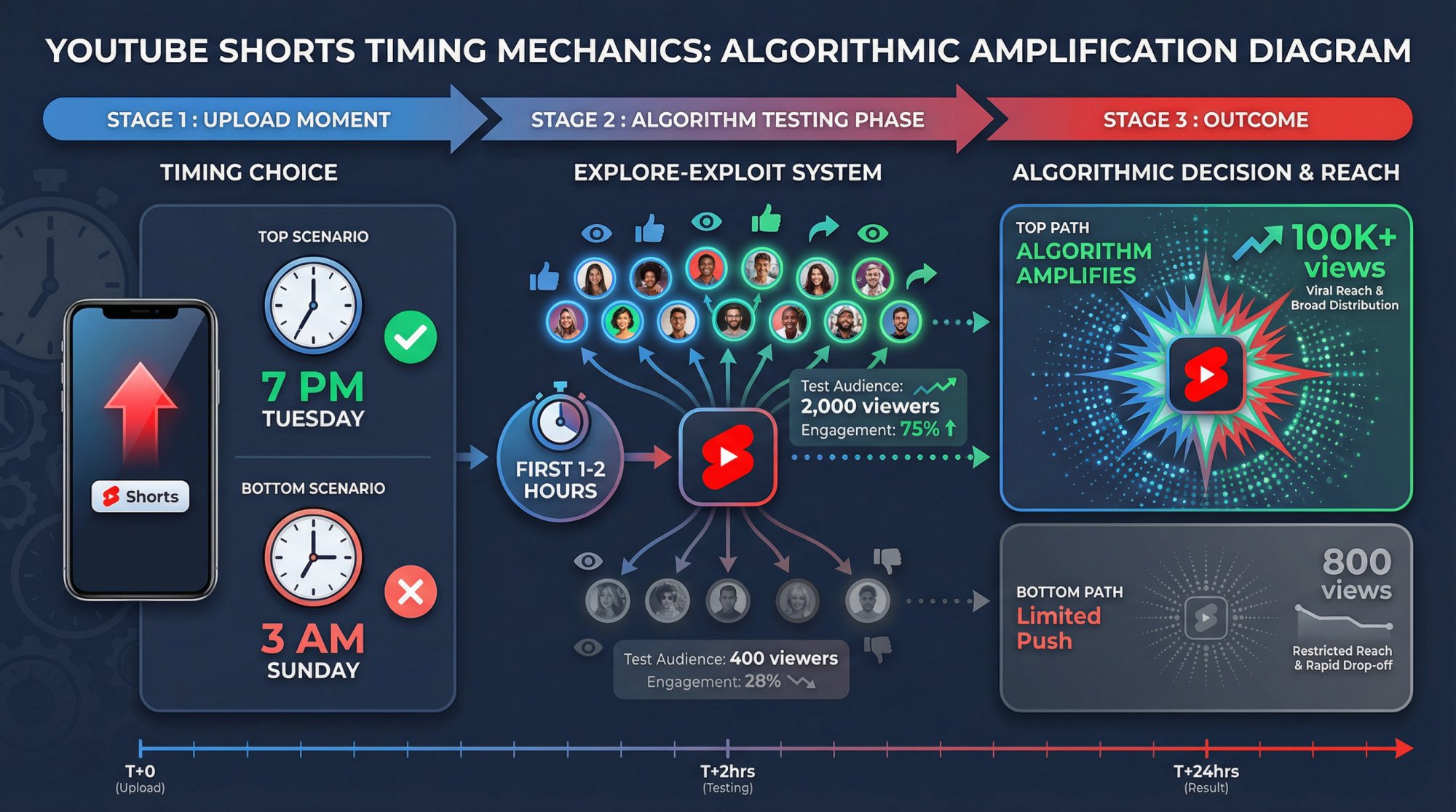
YouTube Shorts uses an "explore-exploit" system. When you upload, the algorithm shows your Short to a small test audience first, usually a few hundred to a few thousand people. If those early viewers watch it all the way through, rewatch it, like it, or share it, YouTube interprets that as a signal to explode your Short to a much wider audience. Post when engaged viewers are online, and you stack the odds in your favor for that crucial first impression.
Shorts have a short shelf life in the feed.
Sure, some Shorts blow up weeks after posting. But most Shorts get the majority of their views in the first 24-48 hours. If you post at 3 AM when nobody's watching, you're starting from a disadvantage. Your Short might still recover if it's exceptional, but you've lost valuable early momentum.
Viewer habits create windows of opportunity.
People binge Shorts during specific parts of the day. Coffee breaks. Lunch. Commutes. Right before bed. Aligning your upload with these "scroll sessions" means your content appears exactly when users are hungry for quick videos.
Keep this in mind: Content quality beats timing every single time. A compelling Short can succeed at any hour. A boring one won't save itself by posting at 6 PM on a Tuesday. Think of timing as the accelerant, not the fire. Great content is the fire. Timing just helps it spread faster.
When Are YouTube Users Most Active? (2024-2025 Data)
Before we get into your specific audience, it helps to understand when YouTube users are most active in general. Researchers have crunched data from millions of videos to find patterns. Here's what the numbers show:
Late afternoons and evenings on weekdays dominate.
Recent analysis found that engagement peaks around 6-7 PM on Tuesdays and Wednesdays. This makes sense. People finish work or school, settle in at home, and open YouTube. Studies show 3 PM to 5 PM as a consistently strong window across most days of the week.
Mid-week is king.
If you only remember one thing, remember this: Tuesday and Wednesday are the best days to post YouTube Shorts. Audiences are fully engaged with online content mid-week. They've shaken off Monday sluggishness and haven't mentally checked out for the weekend yet. In fact, Wednesday at 4 PM specifically stands out as one of the highest-performing time slots across platforms.
Fridays and Saturdays are solid but different.
Friday afternoons work well because people are in weekend mode and more relaxed. Saturday engagement spreads across late morning and afternoon rather than concentrating in one peak. People are more likely to browse casually throughout the day rather than during fixed work breaks.
Sundays and overnight hours are dead zones.
Sunday is consistently the worst day for YouTube engagement. Viewers are busy with family, errands, or prepping for the week ahead. Similarly, the early morning hours from roughly 3 AM to 5 AM see the lowest activity because, well, most people are asleep. Posting during these windows puts you at an immediate disadvantage.
Best Times to Post YouTube Shorts (Quick Reference)
To summarize the research into actionable slots, here's a quick reference table:
| Category | Details |
|---|---|
| Peak Days | Tuesdays and Wednesdays consistently deliver the highest viewership |
| Peak Times | Late afternoon to early evening (3 PM – 7 PM) is the safest bet for high activity |
| Other Good Slots | Monday around 12 PM (lunch), Friday afternoons, weekday mornings 7-9 AM (commutes) |
| Low-Engagement Times | Late nights and early mornings (11 PM – 7 AM), all day Sunday |
These benchmarks give you a solid starting point if you have no idea when to post. But they're averages across millions of creators. The real best time for your channel depends on your specific audience, and we'll get to that next.
How to Find the Best Time for YOUR Specific Audience
Generic best practices are useful, but they won't beat a strategy customized to your actual viewers. Every channel has a unique audience with unique habits. Here's how to tailor timing to yours:
Start with who your audience actually is.
If your channel targets high school students, they're probably watching Shorts after school gets out (say, 3-5 PM) and late at night (9 PM-midnight). They might even binge on weekends. But if you're making content for working professionals, your sweet spot could be lunchtime (12-1 PM) or early evening (6-8 PM) when they've finished work. A fitness channel might crush it at 6 AM when people are gearing up for workouts, while a parenting channel could thrive around 9 PM after kids are in bed and parents finally have a moment to scroll.
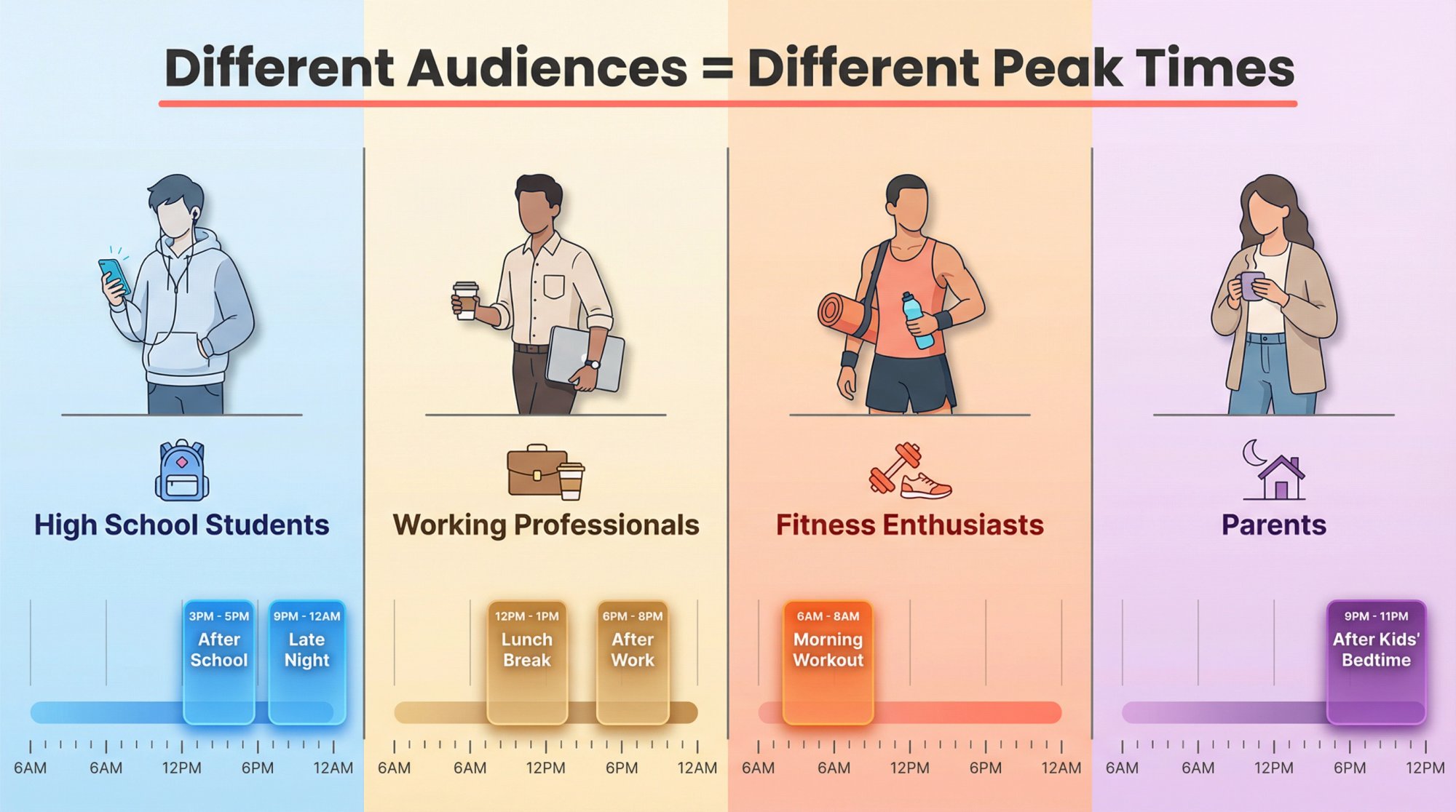
Think about your audience's daily rhythm and post accordingly.
Time zones matter more than you think.
If most of your viewers live in one geographic region, use that local time as your guide. Identify where the majority of your audience is located and schedule around their peak hours. For example, if 80% of your subscribers are on the U.S. East Coast, posting at 7 PM Eastern makes sense even if you personally live in California.
But what if your audience is split across multiple time zones? You have options. One approach is to alternate posting times throughout the week. Post one Short at 7 PM GMT to hit Europe's evening and the U.S. afternoon. Then post your next Short at 7 PM EST to prioritize U.S. evening viewers. Over a week or month, both groups get content during their prime hours.
Another strategy is finding overlap windows. Early morning U.S. time (like 8 AM EST) is early afternoon in Europe, so both audiences are awake and browsing. It's not peak for either, but it's decent for both. Experiment with these compromises and track which works better.
Niche patterns can override general trends.
A finance channel or news channel might see spikes on weekday mornings when people check the markets and headlines. A comedy or entertainment channel could explode on Friday nights when viewers are looking for fun. Gaming channels might peak late at night or on weekends. Consider when your topic is most in-demand, not just when YouTube is busiest overall.
Also pay attention to seasonal shifts. If you create content about education, summer might be slow when students are offline. Holiday seasons affect viewing habits across niches. Adapt your schedule as these patterns emerge.
Bottom line: Use the global benchmarks as your baseline, but customize based on your audience's location, age, lifestyle, and interests. A one-size-fits-all approach won't beat a data-driven schedule tailored to your viewers.
How to Use YouTube Analytics to Find Your Peak Times
You don't have to guess when your audience is online. YouTube gives you a powerful tool to figure this out: the "When your viewers are on YouTube" report.
Here's how to access it:
① Log into YouTube Studio (desktop version works best)
② Navigate to Analytics > Audience
③ Scroll down until you see a purple graph titled "When your viewers are online"
This chart shows you days of the week and hours of the day, with darker bars indicating when more of your subscribers are active on YouTube. It's essentially a heatmap of your audience's viewing habits.

Identify your peak windows.
Look for the darkest blocks. Maybe your audience spikes on weekdays around 8-9 PM, with a smaller peak at noon. Or perhaps Saturday late morning lights up bright. These are your prime posting candidates. Don't just glance at it. Study the pattern. If your graph shows Tuesday and Thursday evenings are consistently strong but Friday is weak, that tells you something about your viewers' routines.
Post just before your peak starts.
If you notice 8 PM Wednesday is a hot spot, schedule your Short for around 7:45 PM. This way your video is live as people start coming online, and it builds momentum during the peak instead of after it's already winding down. Posting 15-30 minutes early gives you that head start.
Mind the day-to-day variations.
The graph might reveal surprising patterns. Maybe Sundays at 11 AM show an unexpected spike (perhaps your fans have a Sunday brunch video habit). Use these nuances. Your biggest peaks deserve your best content, but secondary peaks can be great slots for experimental or supplementary Shorts.
Check viewer geographies to understand time zones.
The Audience tab also shows your top countries and cities. If the "viewers online" graph seems odd (like active at 3 AM your time), it could be because a large chunk of your audience lives overseas. Always interpret the graph in light of where your viewers actually live. What looks like 3 AM for you might be 3 PM for half your audience in another region.
What if your channel is new?
If you don't have much data yet, you won't see a rich "viewers online" graph. That's okay. Start with the global best practices we covered earlier (weekday late afternoons, Tuesday-Thursday focus). As your audience grows, revisit Analytics after a few weeks to see if your channel develops unique patterns. Then adjust accordingly.
This report is gold because it's based on your actual viewers, not industry averages. Use it.
Does the YouTube Shorts Algorithm Care About Posting Time?
You've probably heard conflicting advice. Some people say "timing doesn't matter for Shorts because the algorithm will find your audience eventually." Others swear by posting at exact optimal hours. What's actually true?
Here's the reality: YouTube Shorts doesn't use a strictly chronological feed. It's not like Twitter or Instagram where new posts push older ones down in a timeline. According to YouTube's own statements, there's no built-in boost just for posting at a certain hour. The algorithm cares about engagement metrics (watch time, likes, shares), not timestamps.
Even better: Shorts can blow up days or weeks after you post them. If your Short starts resonating with new viewers or a trend picks up, YouTube might suddenly push it hard even if it's been sitting there for a month. Many creators have seen this. A Short stalls, then inexplicably surges later when it finds the right audience.
So does that mean timing is irrelevant?
Not quite. What it means is that timing won't save a bad Short, and a great Short isn't doomed if you post at 2 AM. Content quality is still the primary driver. But timing influences the initial performance, which can influence the algorithm's decision to push your video.
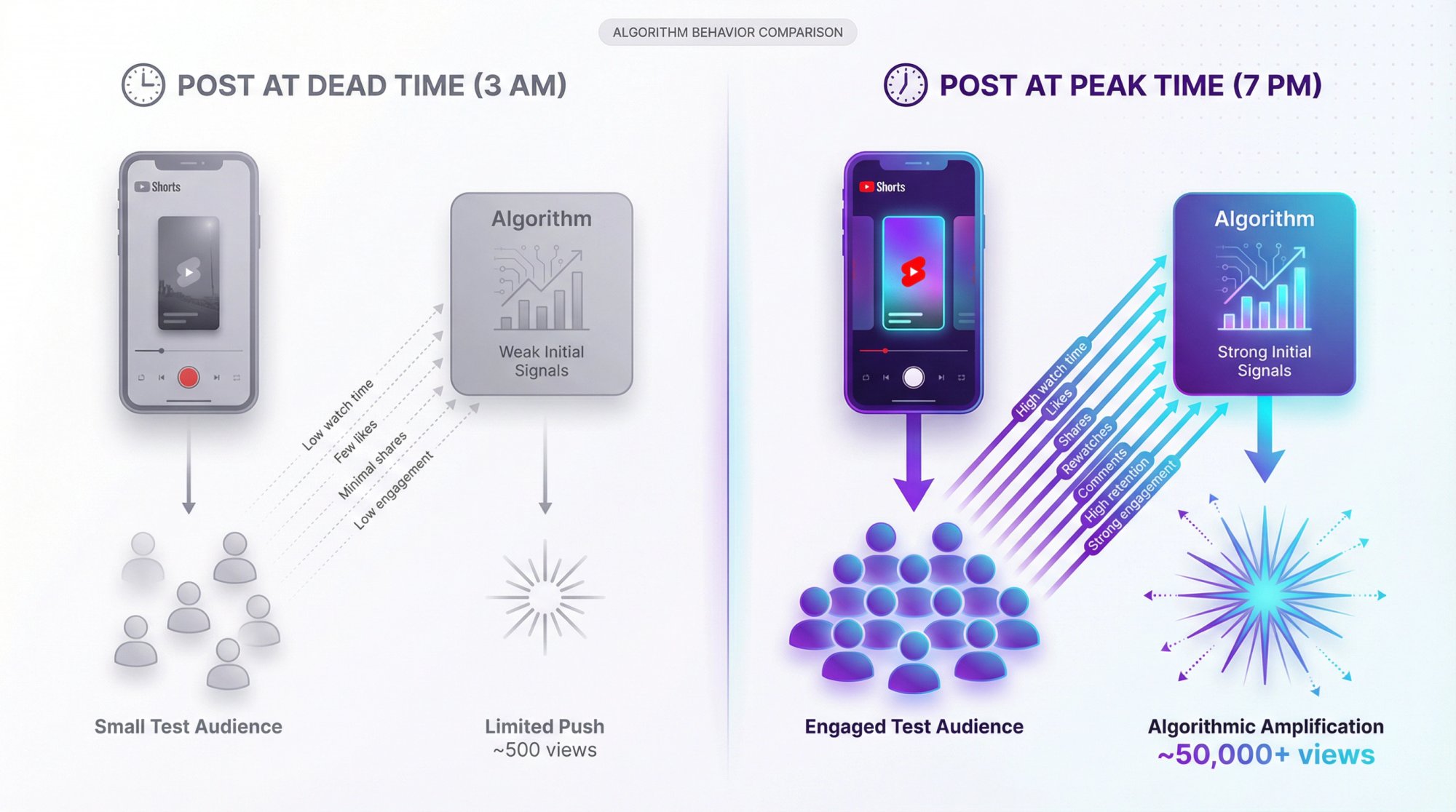
Remember that algorithm test we mentioned earlier? When you upload, YouTube shows your Short to a small test batch of viewers. Those people are often some combination of your subscribers, viewers with similar interests, and users browsing at that moment. If those early viewers engage strongly, the algorithm escalates your Short to a broader audience. That's the "exploit" phase after the "explore" phase.
Now, if you post when your core audience is active, who's likely in that initial test group? Probably people who actually like your content. Your subscribers. Viewers who've engaged with similar Shorts before. They're online, they see it, they watch it fully, maybe they like it. That signals to YouTube: "This is good. Show it to more people."
On the other hand, if you post at a dead time, the test audience might be smaller or less engaged with your niche. Your video might not get the same enthusiastic response, and the algorithm may decide it's not worth pushing further. It could still recover later if the content is amazing, but you've made it harder on yourself.
In short: There's no magical upload hour that guarantees success. A great Short can succeed at various times, and a weak one will flop even at peak hour. But posting when engaged viewers are around maximizes your chance of strong initial engagement, which helps in the algorithm's decision to amplify your Short. Think of timing as a head start in a race. It won't run the whole race for you, but it gets you out of the blocks faster.
How to Post YouTube Shorts Consistently
Timing isn't just about the day and hour. It's also about regularity. Audiences respond to consistency. If you post randomly (Tuesday at noon one week, Friday at 11 PM the next, then nothing for two weeks), viewers can't anticipate your content. But if you establish a rhythm (say, new Shorts every Monday, Wednesday, and Friday at 7 PM), your subscribers start to expect and look for them.
Consistently posting at the same times each week can effectively "train" your audience to be ready when you drop new content. This habit-forming boosts early views and engagement, which (as we've covered) helps your Shorts perform better overall.
Consistency also helps you gather cleaner data. If you post sporadically at random times, it's hard to compare results. But if you stick to a schedule, you can more easily spot patterns. You might notice every Wednesday 7 PM Short outperforms every Friday 11 AM Short. That insight lets you double down on what works.
Of course, life happens. Not everyone can post like clockwork. But you can use tools to make consistency easier:
→ YouTube's native scheduling feature
You can upload a Short as "Unlisted" and schedule it to go Public at a specific time. This means you don't have to be at your computer at 9 PM hitting "Publish." You can batch-upload Shorts earlier in the day or week and let YouTube release them at your chosen times. This ensures you never miss a peak window due to meetings, travel, or just being busy.
→ Third-party scheduling tools
If you manage content across multiple platforms, apps like Shortimize let you schedule YouTube Shorts alongside TikTok and Instagram posts. This way you can coordinate a cross-platform drop at optimal times without manual effort. Just double-check that scheduled posts go live with the correct settings (public visibility, proper audio, etc.).
→ Batch and buffer your content
Creating Shorts in batches makes it easier to maintain consistent timing. You could script, film, and edit 5 Shorts in one sitting, then queue them up to publish throughout the week or month. Many successful Shorts creators do this. It prevents gaps in your schedule when you're swamped with other work, and your queue keeps feeding content to your audience at the times that work best.
Also worth noting: the Shorts algorithm rewards active channels. While posting time isn't a direct ranking factor, posting regularly keeps you in the game. If you only upload once in a blue moon, you're missing chances to learn, iterate, and potentially land a hit. Many experts suggest a cadence of 3-5 Shorts per week to stay relevant and maximize visibility when your audience is most active.
How to Track and Improve Your YouTube Shorts Timing
The "best time" to post isn't set in stone. As your channel grows, you might attract new audience segments in different time zones. Viewer habits shift seasonally. What worked in January might look different by July. That's why you should treat your posting strategy as an ongoing experiment.
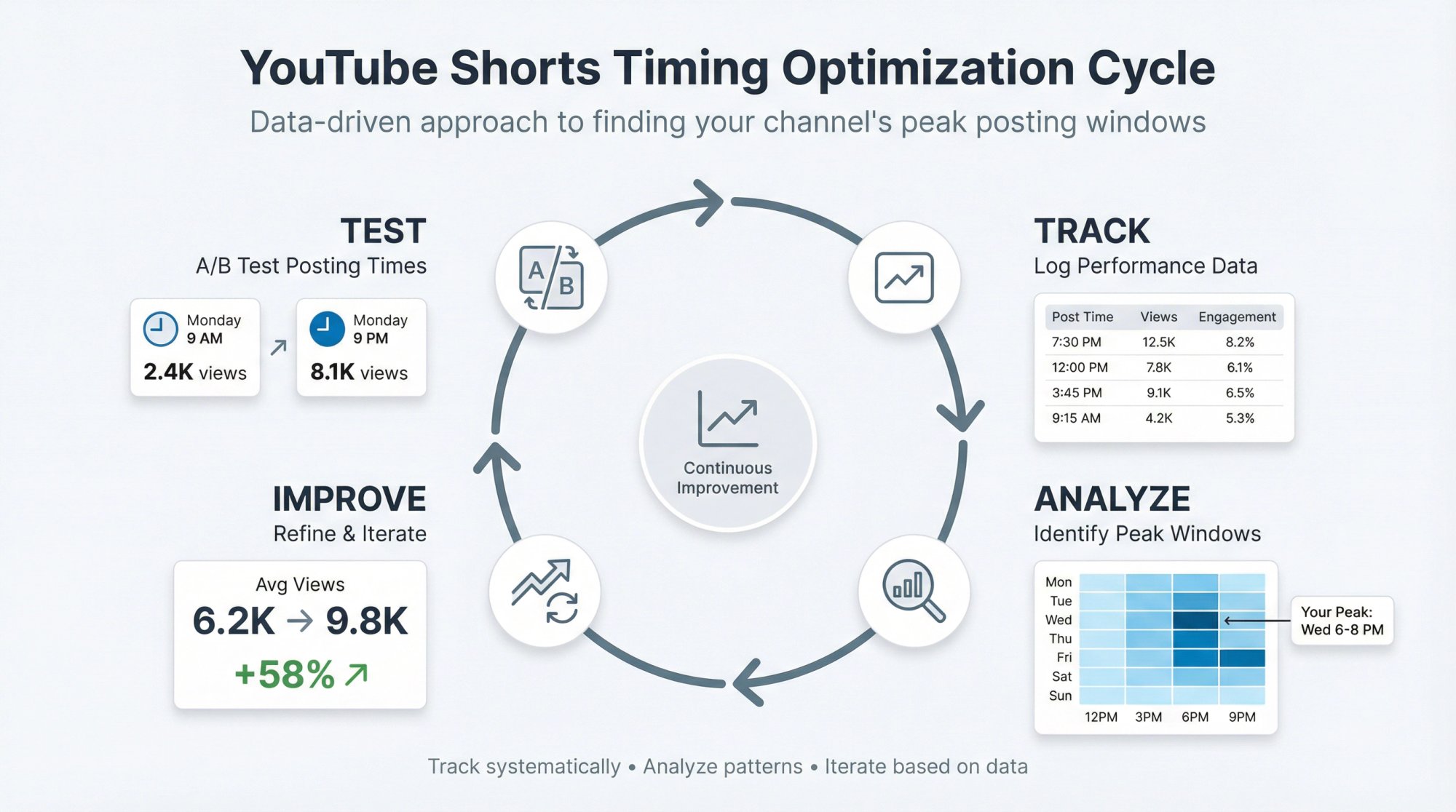
Run A/B tests on posting times.
Take two similar Shorts (comparable topic, quality, length). Post one on Monday at 9 AM and another the next week on Monday at 9 PM. Keep other variables constant. Then compare: which got more views in the first 24 hours? Higher watch time? More likes or shares? Do this over several iterations. You might find that your evening posts consistently outperform morning posts by 30-40% in views. That's actionable insight.
You can also test across different days. Post a Short on Wednesday evening and another on Friday evening. Track which performs better. Over time, these experiments reveal clear patterns about your channel's optimal slots.
Track results systematically.
Manually logging every video's post time and performance in a spreadsheet gets tedious fast. This is where analytics tools come in handy. Shortimize specializes in tracking short-form video performance across TikTok, Instagram/Facebook Reels, and YouTube Shorts. It automatically records when you posted each Short and correlates that with views, engagement, and other metrics over time.
For example, Shortimize might reveal that your Shorts posted at 7:30 PM average 40% more views than those posted around noon. It can identify specific sweet spots, like "Wednesdays at 6-8 PM and Fridays around 7 PM have been your gold mine." That level of specificity is powerful because it's tailored 100% to your content and followers, not generic industry averages.
If you manage multiple channels or work with clients, a tool like Shortimize keeps each account's optimal schedule straight without drowning you in spreadsheets. You can see at a glance which times are working for each channel and adjust your strategy accordingly.
Stay updated on platform changes.
YouTube occasionally tweaks how the Shorts algorithm works. A change in how quickly Shorts get tested, or how they surface in the feed, could slightly alter the importance of timing. Keep an eye on official YouTube Creator Insider updates or credible industry blogs. Being informed helps you adapt proactively instead of reacting after your metrics drop.
Revisit your analytics quarterly.
Make it a habit every few months to check your YouTube Analytics for shifts. As your subscriber count grows or your content focus evolves, audience behavior might change. Maybe you gained a bunch of international subscribers recently, and now you see new spikes at odd hours. Or maybe your audience skewed older, and they're watching earlier in the evening than your initial teen audience did. Regular check-ins ensure you're not stuck following an outdated posting schedule.
Don't overthink it to the point of paralysis.
Yes, use data to guide you. But remember: it's better to post consistently at a decent time than to delay content for weeks hunting for the mythical "perfect" hour. Use the insights to optimize, not to freeze up. A great Short posted at a decent time will beat a mediocre Short posted at the perfect time. Timing is one piece of the puzzle, most effective when combined with quality content and genuine understanding of your audience.
When Should You Post Your Next YouTube Short?
Let's bring this all together into a clear action plan.
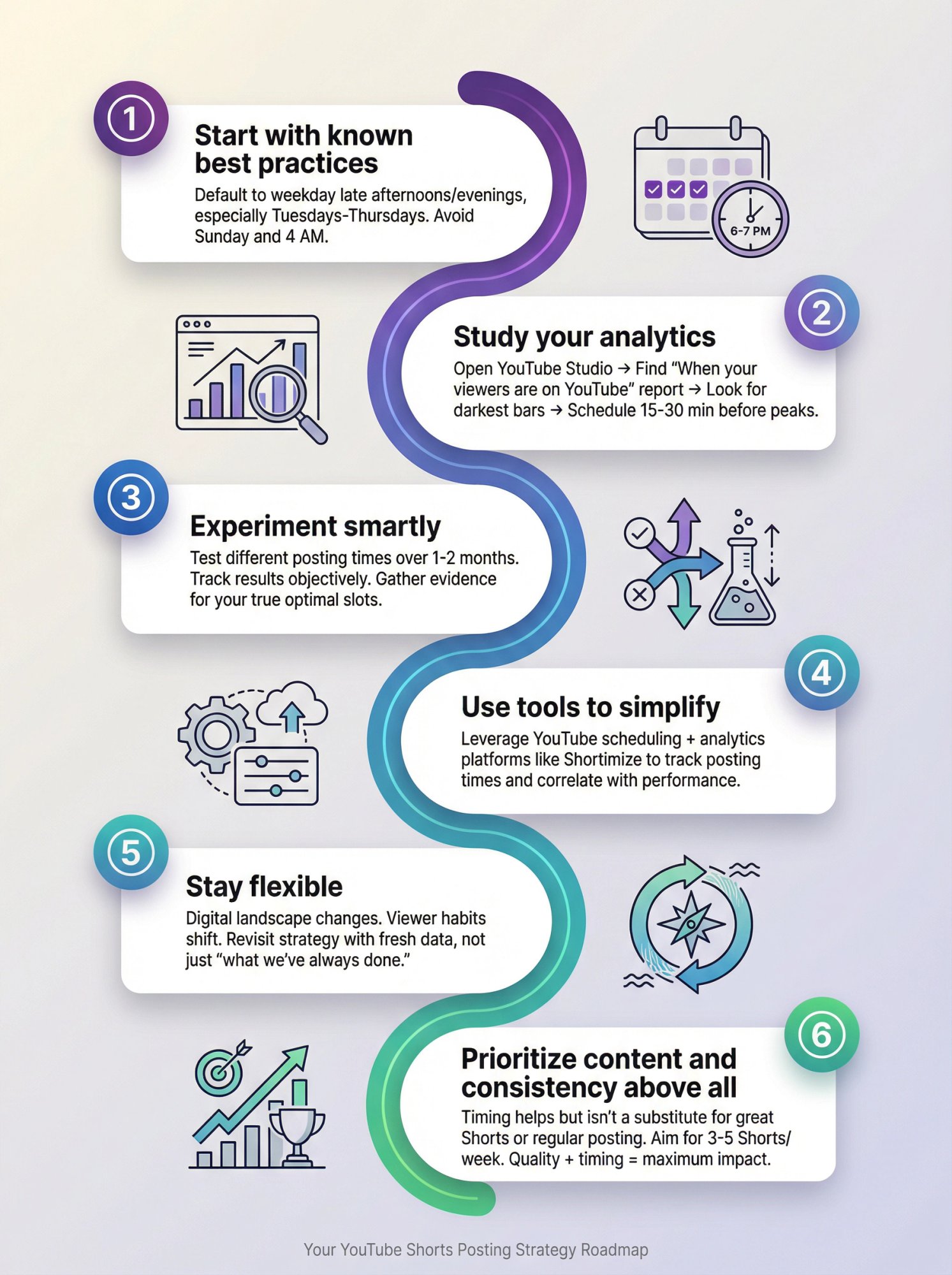
① Start with known best practices
If you're new or don't have strong analytics yet, default to weekday late afternoons or evenings, especially Tuesdays through Thursdays. These days consistently show high traffic. Avoid posting on Sunday or at 4 AM unless you have data proving those times work for your channel.
② Study your analytics
Open YouTube Studio and find the "When your viewers are on YouTube" report. Look for the darkest bars. That's when your specific audience is active. Schedule your Shorts to go live 15-30 minutes before those peaks to ride the wave of incoming viewers.
③ Experiment smartly
Don't just assume the first pattern you see is the final answer. Test different posting times over a month or two. Track results objectively. You'll gather enough evidence to determine your true optimal slots, which might differ from both global trends and your initial guesses.
④ Use tools to simplify
Leverage YouTube's scheduling feature so you can hit peak times reliably without being glued to your phone at 7 PM every day. Consider analytics platforms like Shortimize to automatically track posting times, correlate them with performance, and surface patterns you might miss manually.
⑤ Stay flexible
The digital landscape changes. Viewer habits shift. New subscribers join. What works in January might need adjustment by June. Be ready to revisit your strategy based on fresh data, not just stick with "what we've always done."
⑥ Prioritize content and consistency above all
Timing helps, but it's not a substitute for great Shorts or a regular posting cadence. Aim for a sustainable schedule (whether that's 3 Shorts a week or 5) and focus on making each one engaging. Strategic timing amplifies quality content. It doesn't create quality out of thin air.
In 2026, YouTube Shorts are more competitive than ever. But they're also full of opportunity. Nailing your posting schedule is one of the easiest wins you can get. It's a way to work with the algorithm and viewer behavior instead of against them. By blending general benchmarks with your own analytics, you can develop a posting strategy that maximizes your Shorts' exposure and gives each video the best shot at success.
Now that you have the data and the strategy, it's time to put it into action.
Check your schedule, pick your next upload time with intention, and hit publish (or schedule it). Great content plus smart timing equals maximum impact. Go make your next Short fly.