If you're Googling "what is UGC in influencer marketing" right now, you're probably trying to solve one of these problems: You need to understand what UGC actually means (because everyone defines it differently). You're deciding whether to work with UGC creators, traditional influencers, or both. You want to know where this content gets used (organic posts, ads, whitelisting, spark ads). Or you need a practical playbook for finding creators, writing briefs, handling rights, and measuring results.
This guide covers all of it. No fluff, no buzzwords. Just the operational reality of UGC in influencer marketing in 2026.
UGC Definition: What Does UGC Actually Mean?
UGC (user-generated content) is content made by real people, in a real-person style, that brands use to market their products.
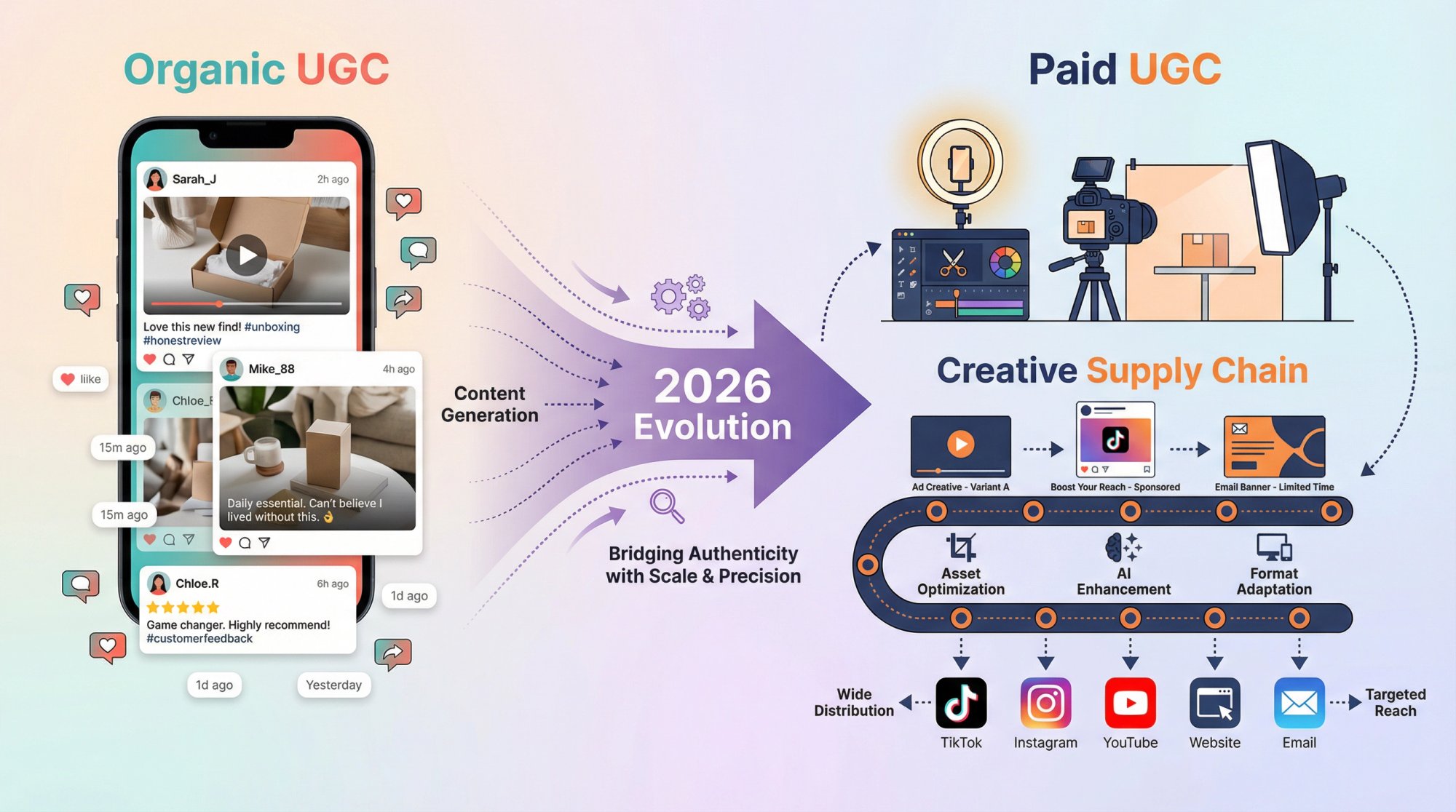
In influencer marketing, UGC typically means one of two things:
Organic UGC: Customers post about your product on their own because they genuinely want to (earned content).
Paid UGC: You pay creators to make "native-looking" content for your brand to use, often without them posting it to their own audience. This is why UGC in 2026 operates more like a creative supply chain than traditional influencer marketing.
The confusion around these terms is normal. Here's how to think about it clearly.
UGC vs Influencer Marketing: What's the Difference?
The clearest way to understand the difference:
Influencer marketing (classic): You're paying for distribution. You rent access to someone's audience plus the trust they've built with that audience.
UGC (modern usage): You're paying for creative assets. You buy content you can publish anywhere: your own channels, your ads, your landing pages, your emails.
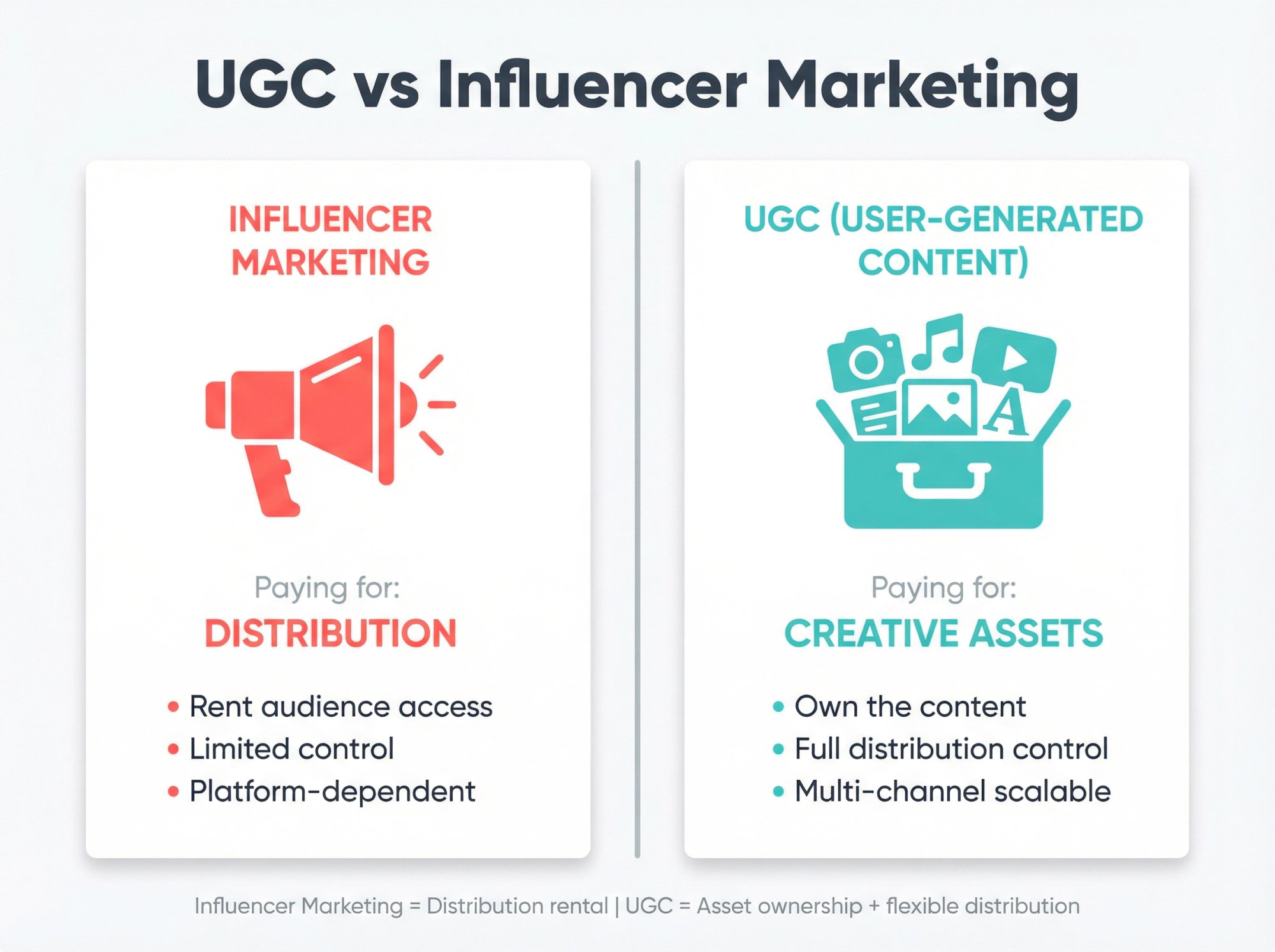
That's why UGC scales. Once you build a system that produces solid assets, you can push them through any distribution channel you want. The market is moving this direction fast. Industry data shows UGC campaigns continue to grow significantly while platform-specific campaigns fluctuate.
What Are the Types of UGC Content?
There are really four distinct buckets here:
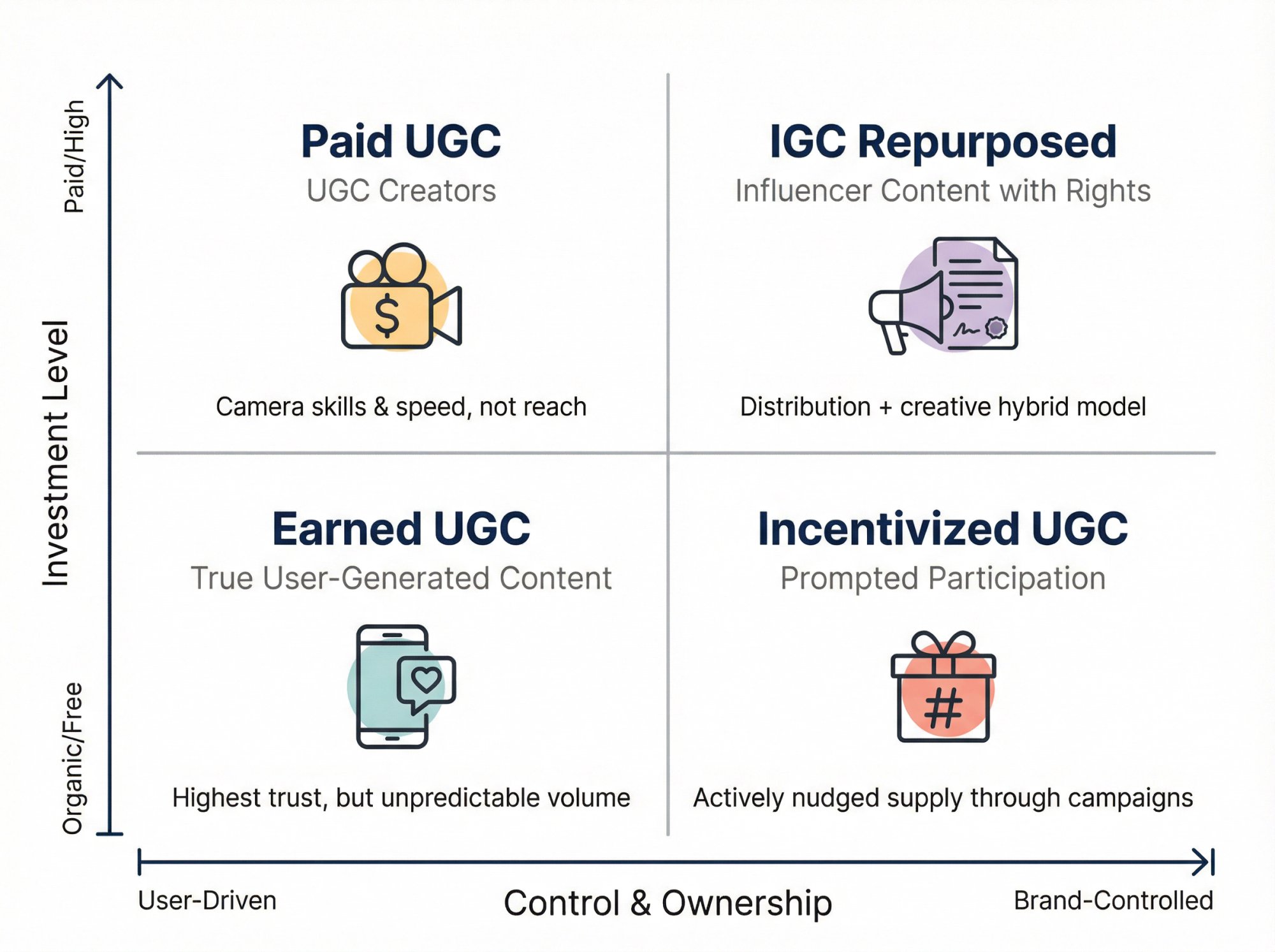
1. Earned UGC (True User-Generated Content)
Customers post reviews, unboxing videos, "day 1 vs. day 30" transformations, or just casual mentions of your product. You didn't commission any of it (though you still need permission to reuse most of it). When it works, it's the highest-trust content you'll ever get. But you can't control the volume or consistency.
2. Incentivized UGC
Giveaways, hashtag campaigns, "tag us to be featured" prompts, referral challenges. Still mostly user-driven, but you're actively nudging supply.
3. Paid UGC (UGC Creators)
Creators make content for your brand account or your ads. They might have tiny followings or no following at all. You're paying for their camera skills, persuasion ability, and speed, not their reach.
Top affordable tools for UGC video marketing can help you find and work with these creators efficiently.
4. Influencer-Generated Content (IGC) Repurposed as UGC
An influencer posts content to their audience, and you negotiate usage rights so you can boost the post as an ad or re-edit it for your own channels. This is the hybrid model: you're paying for both distribution and creative. When it hits, it's lethal.
Why Does UGC Work? (Real Reasons)
UGC works because it matches how people actually make decisions in social feeds.
It Buys Attention the "Native" Way
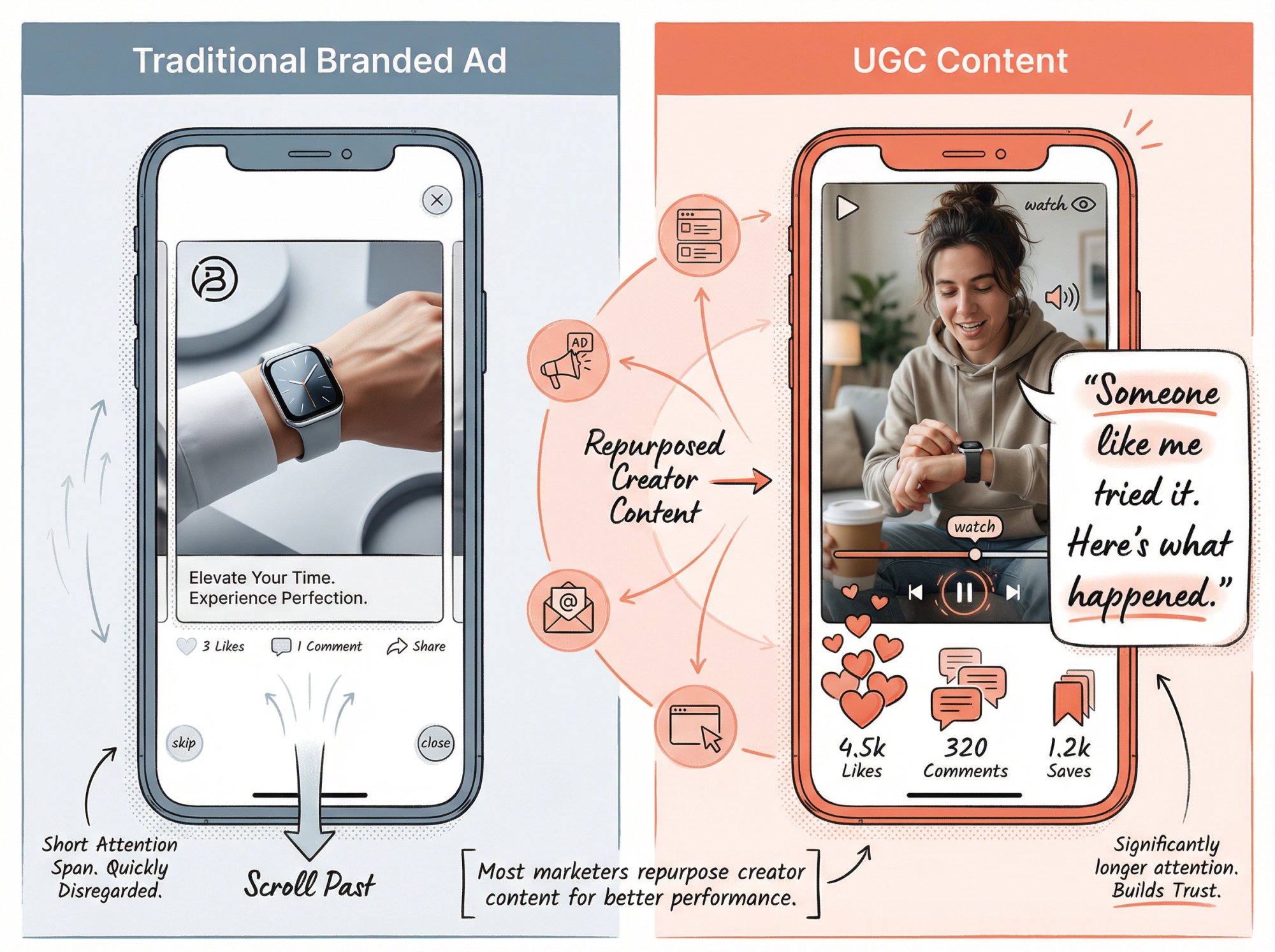
People scroll past obvious ads. They pause for content that feels like a friend showing them something. Research on creative effectiveness from 2025 found influencer content held attention significantly longer, with much longer average "skip time" compared to typical branded ads.
It Carries Social Proof in the Format People Trust
The core persuasion pattern is simple:
"Someone like me tried it. Here's what happened."
That's not a brand claim. It's a lived claim. Audiences recognize the difference instantly.
It Wins on Volume and Iteration
Most teams don't lose because they can't buy media. They lose because they can't produce enough good creative angles fast enough. That's why creator content gets repurposed everywhere. Research shows most marketers repurpose creator content across multiple channels: social, ads, email, website.
It's Measurable and Scalable
Money follows measurability. Industry projections show U.S. influencer marketing spend will grow 15.7% in 2026 to $11.62B, hitting $13.7B by 2027.
How to Use UGC Content: 3 Distribution Routes
Think of UGC as an asset that can be distributed through three main routes:
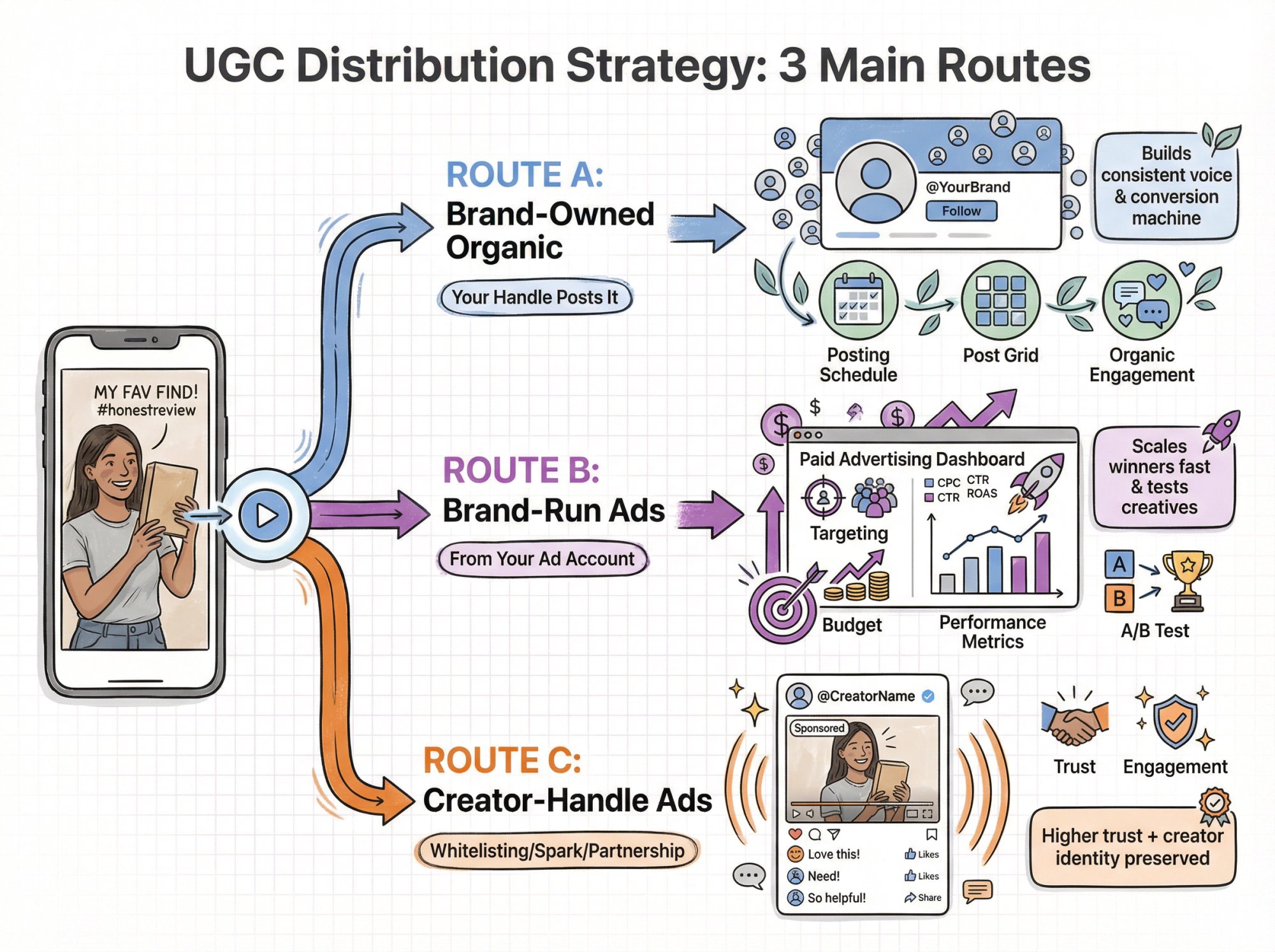
Route A: Brand-Owned Organic (Your Handle Posts It)
Best for:
• Building a consistent posting schedule
• Creating a "creator voice" on your brand channel
• Turning your page into a conversion machine over time
Key requirement: You need enough assets to post daily or weekly without running dry.
Route B: Brand-Run Ads (From Your Ad Account/Handle)
Best for:
• Scaling winners fast
• Creative testing (hooks, angles, offers)
• Performance marketing
This is where UGC becomes a paid growth engine.
Route C: Creator-Handle Ads (Whitelisting/Partnership/Spark)
Best for:
• Higher trust at the point of impression
• Preserving creator identity, comments, and social context
• Blending "ad" with "recommendation"
On TikTok this typically means spark ads or creator authorization flows. On Meta it's usually partnership ads.
How to Create a UGC Campaign: Step-by-Step Guide
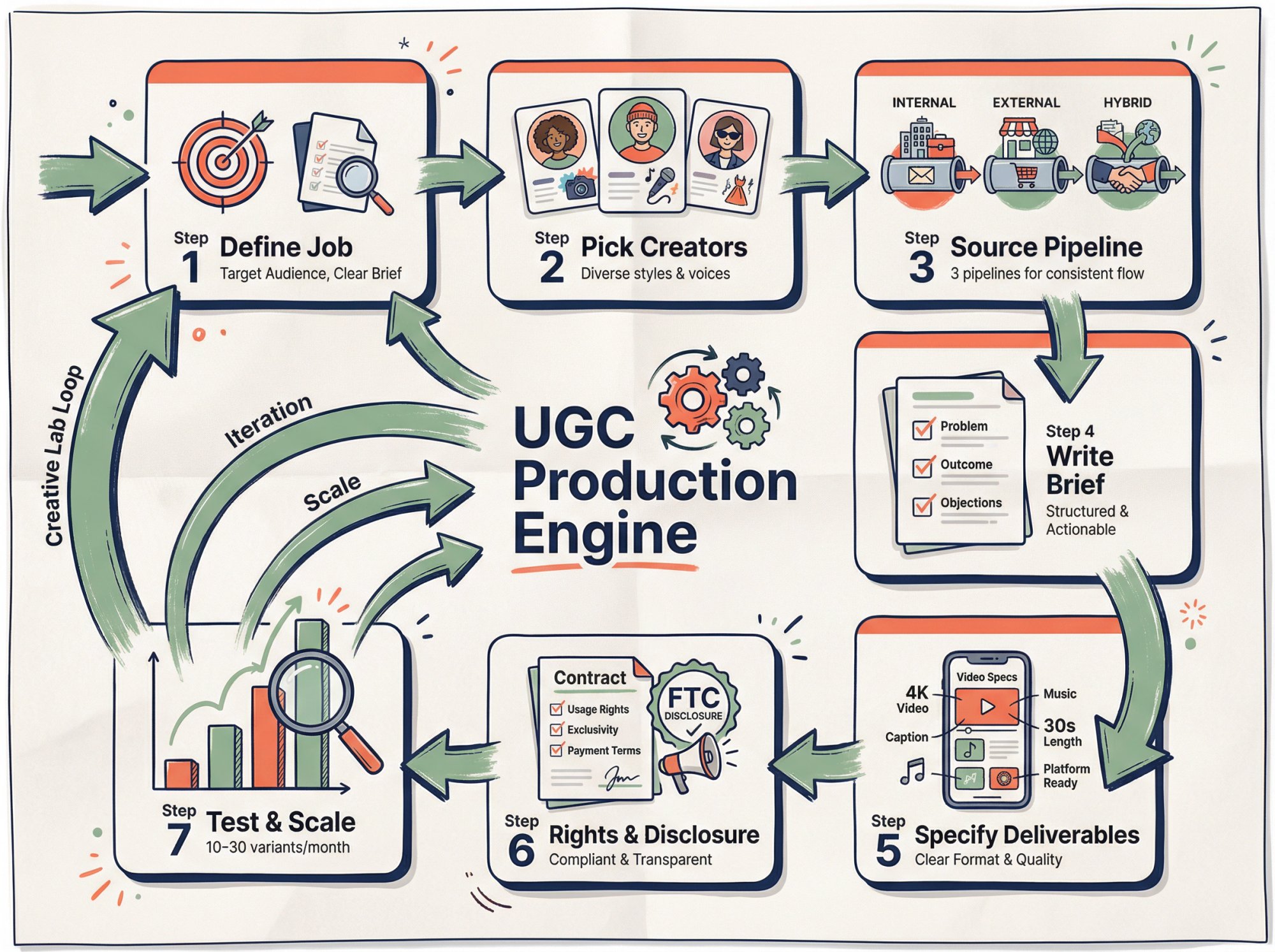
Step 1: Decide What You're Actually Buying
Before you source creators, define your "UGC job to be done":
→ Awareness: Make the product legible in 3 seconds
→ Consideration: Prove a claim (demo, comparison, results)
→ Conversion: Beat objections plus give a clear next step
→ Retention: Teach value (tips, workflows, setups)
→ UGC for ads: Produce testing volume (10-30 variants per month)
If you can't name the job, you'll end up with pretty videos that don't move numbers.
Step 2: Pick the Right Creator Type
| What You Need | Best Fit | Why |
|---|---|---|
| Reach plus credibility in a niche | Influencer posts | You're renting audience and trust |
| Lots of creative angles fast | UGC creators | You're buying production and iteration |
| High-performing ads with creator identity | Whitelisted/spark/partnership ads | Best of both worlds (when setup is clean) |
| Community flywheel | Earned plus incentivized UGC | Customers create proof at scale |
Understanding influencer tracking software and how to cross-analyze influencers on TikTok, Reels, and Shorts helps you identify the right creator types for your goals.
Step 3: Build a Creator Sourcing Engine
You want three pipelines running in parallel:
① Internal pipeline (customers and fans)
Post-purchase email: "Want to be featured?"
In-app prompt or insert card
Community Discord or group
② External pipeline (UGC creators)
Marketplaces and platforms
Creator keyword searches on TikTok, Instagram, and YouTube
Creator job boards
③ Hybrid pipeline (influencers you can repurpose)
Seed product to creators who already make relevant content
Convert the best performers into paid plus usage rights deals
Pro tip: Always track creator throughput, not just creator count. The winning system is Brief → Delivery → Publish/Test → Learn → Repeat (weekly).
Step 4: Write a UGC Brief That Doesn't Kill Authenticity
Most UGC briefs fail for one of two reasons: They're too vague ("make it authentic") or they're too controlling ("say these 12 lines exactly").
A brief should constrain outcome, not personality.
High-Performing UGC Brief Template
Product:
Target user (one sentence):
Problem (before):
Desired outcome (after):
Key claim(s) we can prove:
3 objections to address (e.g., price, effort, skepticism):
3 "must show" moments (visual proof beats words):
Do/don't list (brand safety, forbidden claims):
Call to action (one):
Deliverables (quantity plus format):
Usage plan (organic / paid / whitelisting):
Disclosure requirements (#ad etc.):
Deadline plus review process:
Six UGC Video Structures That Consistently Work
① "I didn't expect this to work…" (pattern break)
② "Here's what I wish I knew before…" (authority)
③ Problem → Demo → Result (clean)
④ "3 mistakes you're making with…" (educational)
⑤ Side-by-side comparison (decision)
⑥ "Day 1 / Day 7 / Day 30" (progress proof)
Understanding how to find viral video patterns in your niche can help you identify which video structures work best for your industry.
Step 5: Specify Deliverables Like an Operator
If you don't define specs, you'll waste cycles fixing basics.
Minimum spec sheet (short-form):
Aspect ratio: 9:16
Resolution: 1080×1920
Audio: Clean voice, no clipping
Lighting: Face visible, product visible
Safe areas: Keep text away from UI overlays
Captions: Either baked-in or delivered as SRT
Raw files: Yes/No
Variants: Hooks (3), endings (2), CTAs (2)
When creating content across platforms, consider the video length sweet spots for TikTok, Reels, and Shorts to optimize for each platform's algorithm.
Step 6: Handle Rights, Usage, and Disclosure
The Rule: If Money or Free Product Is Involved, Disclose
In the U.S., the FTC's principle is simple: if there's a material connection (payment, free products, affiliate commission), it must be clear and conspicuous. The FTC's endorsement guides were updated most recently in 2023.
Platform Disclosure Mechanics
TikTok: Use the content disclosure setting for commercial content. TikTok notes that using disclosure doesn't reduce distribution, referencing a marketing science analysis of around 2 million videos (last updated January 24, 2026).
YouTube: Creators are expected to disclose paid promotions. YouTube provides policy guidance on paid product placements, endorsements, and related disclosures.
Instagram/Meta: Typically use paid partnership labeling plus partnership permissions if running creator-handle ads.
A Rights Checklist
Your contract should cover:
Usage scope: Organic only vs. paid ads
Usage duration: 30/60/90 days or perpetuity
Channels: TikTok/IG/YouTube/paid social/website/email/app store
Whitelisting: Yes/no, duration, approval flow
Exclusivity: Category plus duration
Editing rights: Can you cut/subtitle/remix?
Raw footage and project files: Yes/no
Music: Who is responsible for licensing?
Deliverable acceptance plus revisions: How many rounds?
Content removal plus takedown obligations
Disclosure obligations plus compliance clause
If you want to pay fairly and avoid fights, separate:
Creation fee (making the asset)
Usage fee (how you monetize it)
Step 7: Distribution Plus Testing (The "Creative Lab" Loop)
UGC becomes a growth lever when you run it like a testing program:
① Publish 5-10 assets per week (or run them as ads)
② Measure hook, retention, and conversion proxies
③ Identify winners
④ Iterate winners into variants
⑤ Scale winners with paid spend
⑥ Archive losers with notes ("why it failed")
Don't optimize on likes. Optimize on:
Watch time / retention
Click intent (profile taps, link clicks, comments signaling intent)
Cost per action (if paid)
Conversion rate (site/app)
Learn how to track influencer campaign performance across TikTok and Instagram to measure these metrics effectively.
UGC Pricing: What Does UGC Content Cost in 2026?
Pricing is volatile, but we can anchor it with current marketplace data.
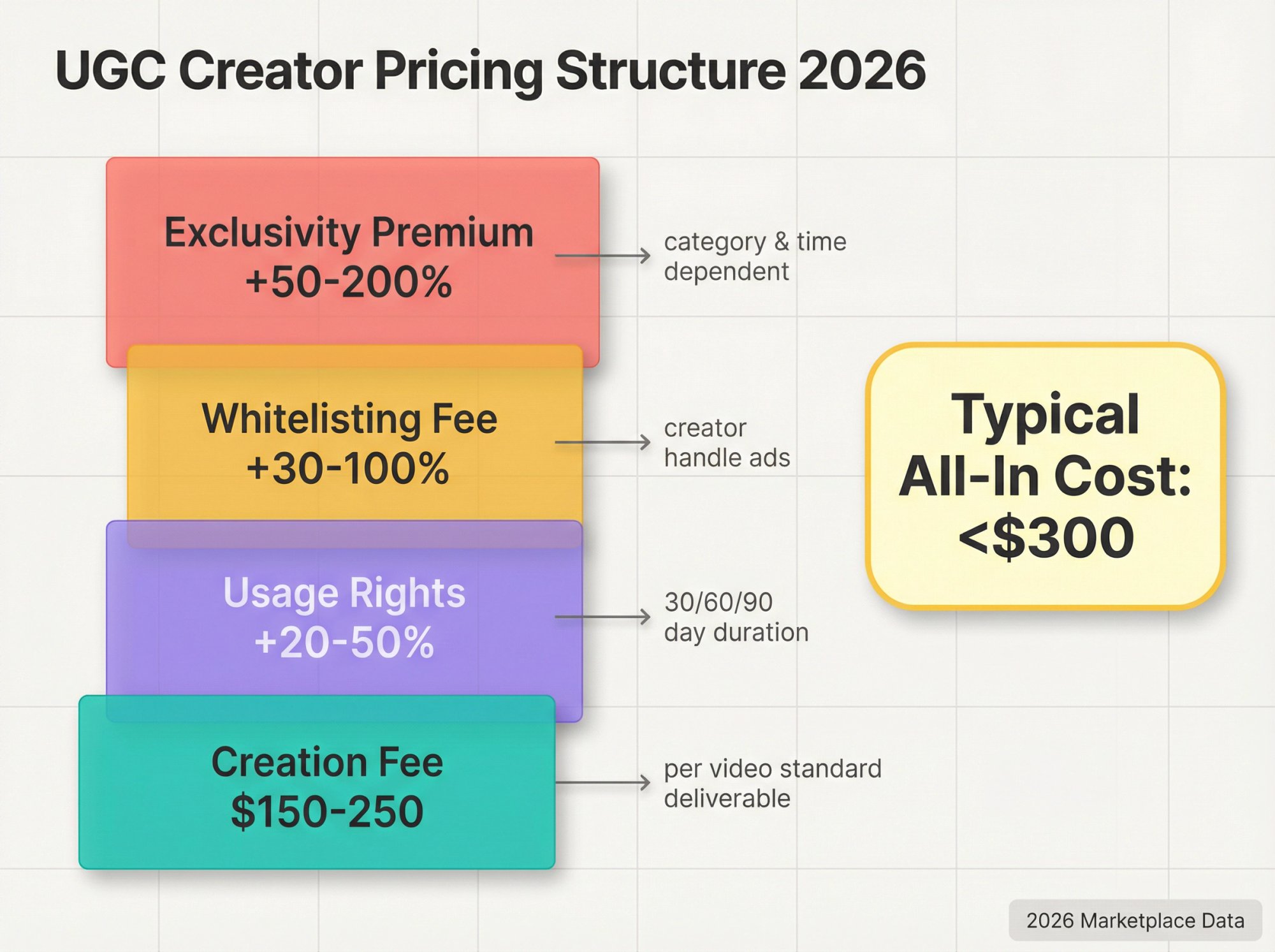
What Creators Charge vs. What Brands Actually Pay
| Category | Range | Notes |
|---|---|---|
| Creation fee (per video) | $150-250 | UGC creators, standard deliverable |
| Usage rights (paid ads) | +20-50% | Duration-dependent (30/60/90 days) |
| Whitelisting fee | +30-100% | If using creator handle for ads |
| Exclusivity premium | +50-200% | Category and duration matter |
| All-in cost (typical) | <$300 | Most brand collaborations land here |
Market research shows UGC creators typically charge between $150-250 per piece of content in 2026, with significant variation based on creator experience and deliverable complexity. Industry data shows most brand collaborations cost under $300, indicating where the mass market is trending.
A Practical Budget Model
Starter test: 10 videos per month
Scaling: 30-60 videos per month
Add 20-40% for usage plus paid rights if you're running performance ads
If you're a growth team, the right question isn't "what's the cheapest video?" It's:
"What's my cost per winning concept?"
How to Measure UGC Performance (The Right Way)
UGC performance is an asset-level problem, not a creator-level vanity problem.
Track Three Layers of Metrics
① Creative quality metrics (fast feedback)
Hook rate proxies (first 1-3 seconds retention)
Average watch time / completion
Saves/shares (signal value)
Understanding what is a good engagement rate on TikTok and what is a good view rate for TikTok helps you benchmark your UGC performance.
② Engagement quality metrics
Comments showing intent ("does this work for…", "where do I buy", "price?")
Click behaviors (profile taps, bio link clicks)
③ Business metrics
Conversions (purchase, install, signup)
CAC / CPA / ROAS (paid)
Lift (incrementality, if you can run tests)
Disclosure Doesn't Have to Hurt Performance
A common fear: "If we disclose, performance drops."
TikTok's own guidance says disclosed commercial content isn't disadvantaged in distribution, citing large-scale analysis. Research also suggests properly disclosed influencer content can sometimes outperform in certain contexts.
Translation: Be compliant and test like an adult.
How Shortimize Fits: Make UGC Measurable Across TikTok, Reels, and Shorts
UGC programs get messy because assets live across:
• Brand accounts
• Creator accounts (if whitelisted)
• Multiple platforms
• Multiple editors posting variants
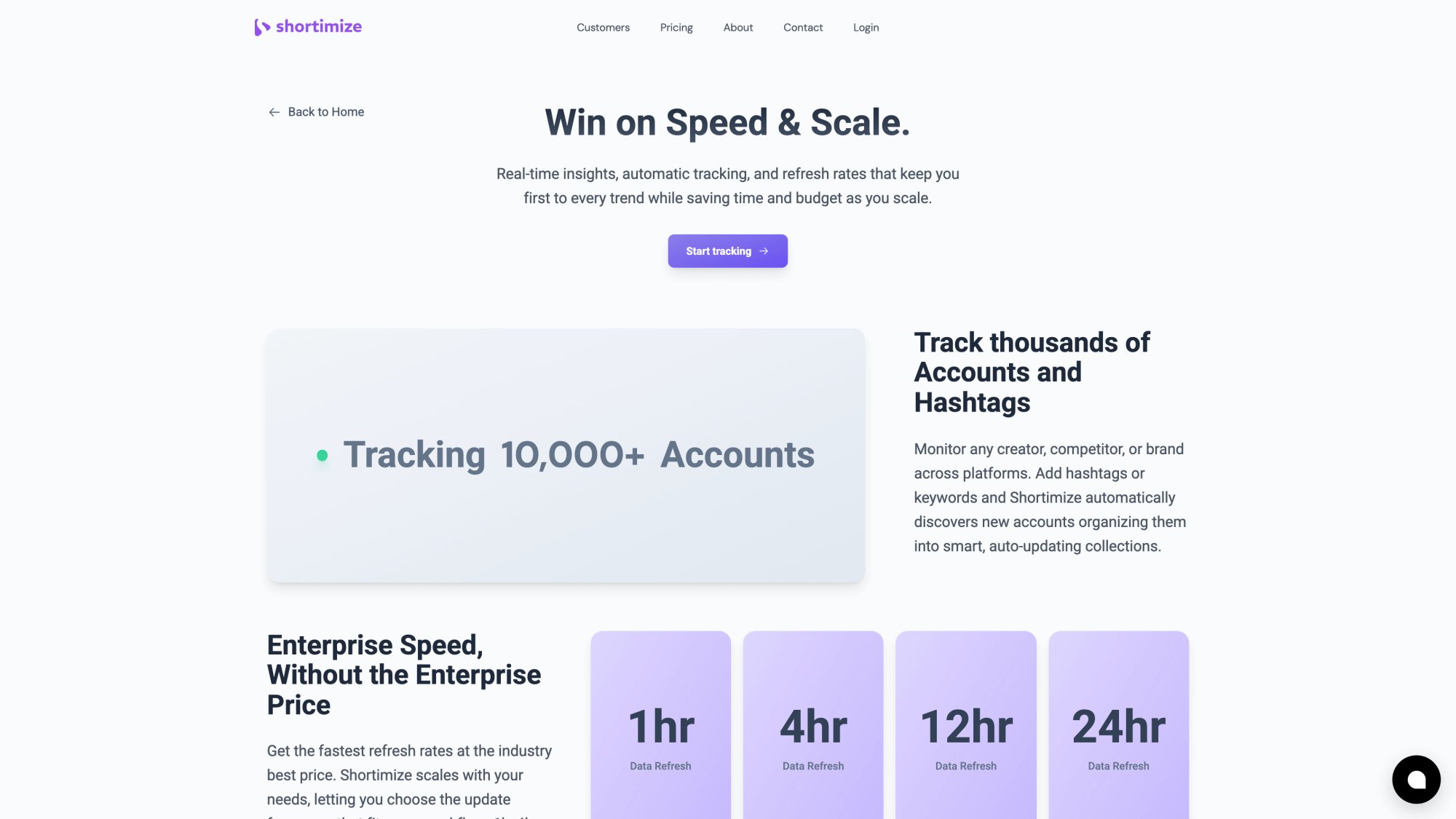
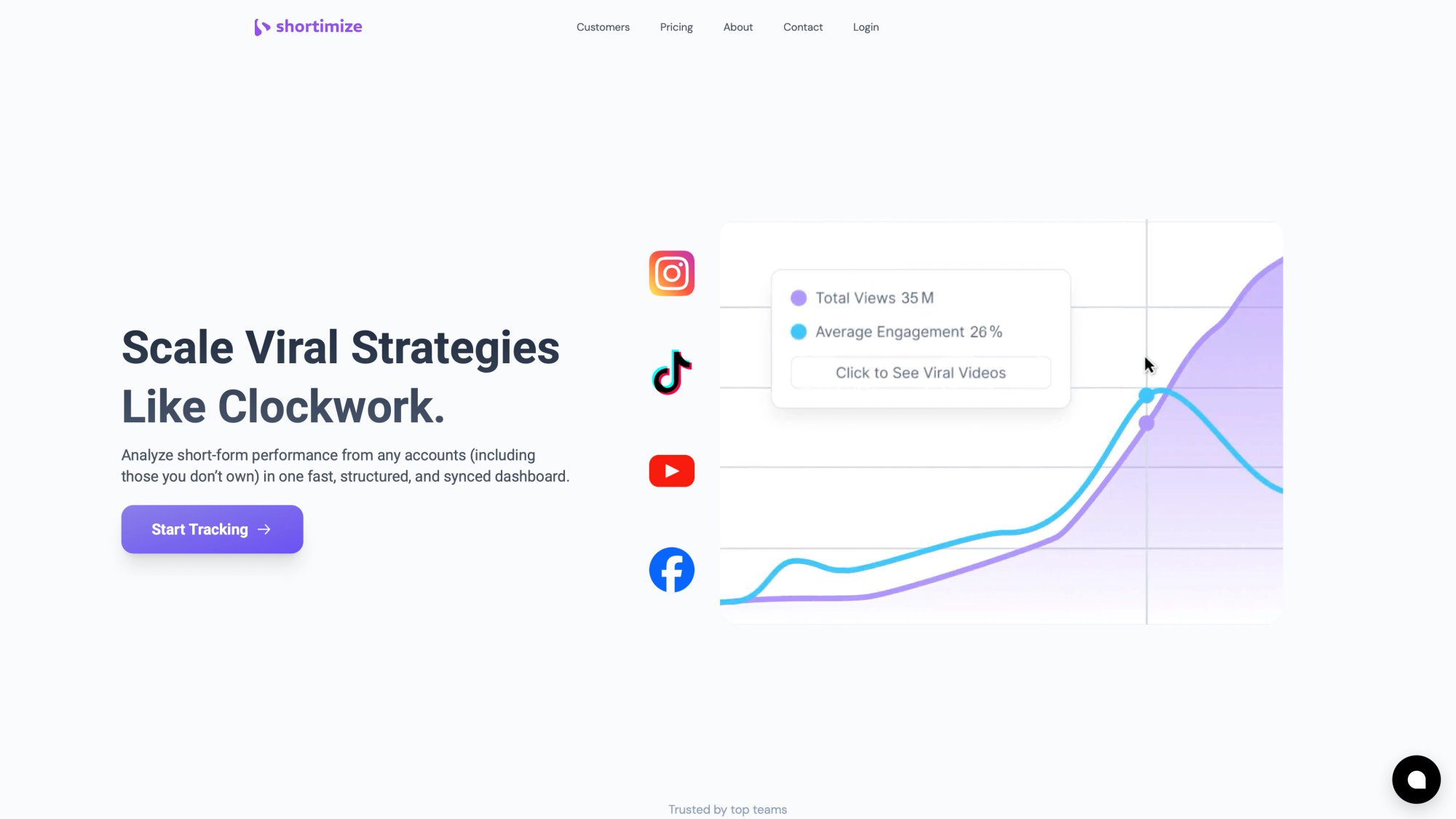
Shortimize is built for exactly that operational mess: tracking short-form performance cross-platform and turning it into a "single source of truth."
A clean workflow looks like this:
① Track every UGC post by URL (brand and creator handles)
Use Shortimize's tracking features to monitor performance across TikTok, Instagram Reels, and YouTube Shorts.
② Group posts into Collections by:
Creator
Hook angle
Offer
Persona
Platform (TikTok/Reels/Shorts)
③ Monitor:
Outliers (what's spiking)
Medians (what "normal" looks like)
Learn how to find and fix video captions that kill engagement using social media monitoring insights.
④ Export for reporting or trigger notifications when something goes viral
Shortimize's integrations with Amplitude, Mixpanel, and Posthog let you sync video performance data with your product analytics, plus Slack and Discord notifications for viral videos.
If you run UGC like a testing lab, you need a system that lets you answer:
"Which angle wins across platforms?"
"Which creator style produces repeatable winners?"
"Which hook templates should we double down on this week?"
That's the job. Start your free trial to see how Shortimize helps teams scale UGC programs.
Common UGC Mistakes to Avoid in 2026
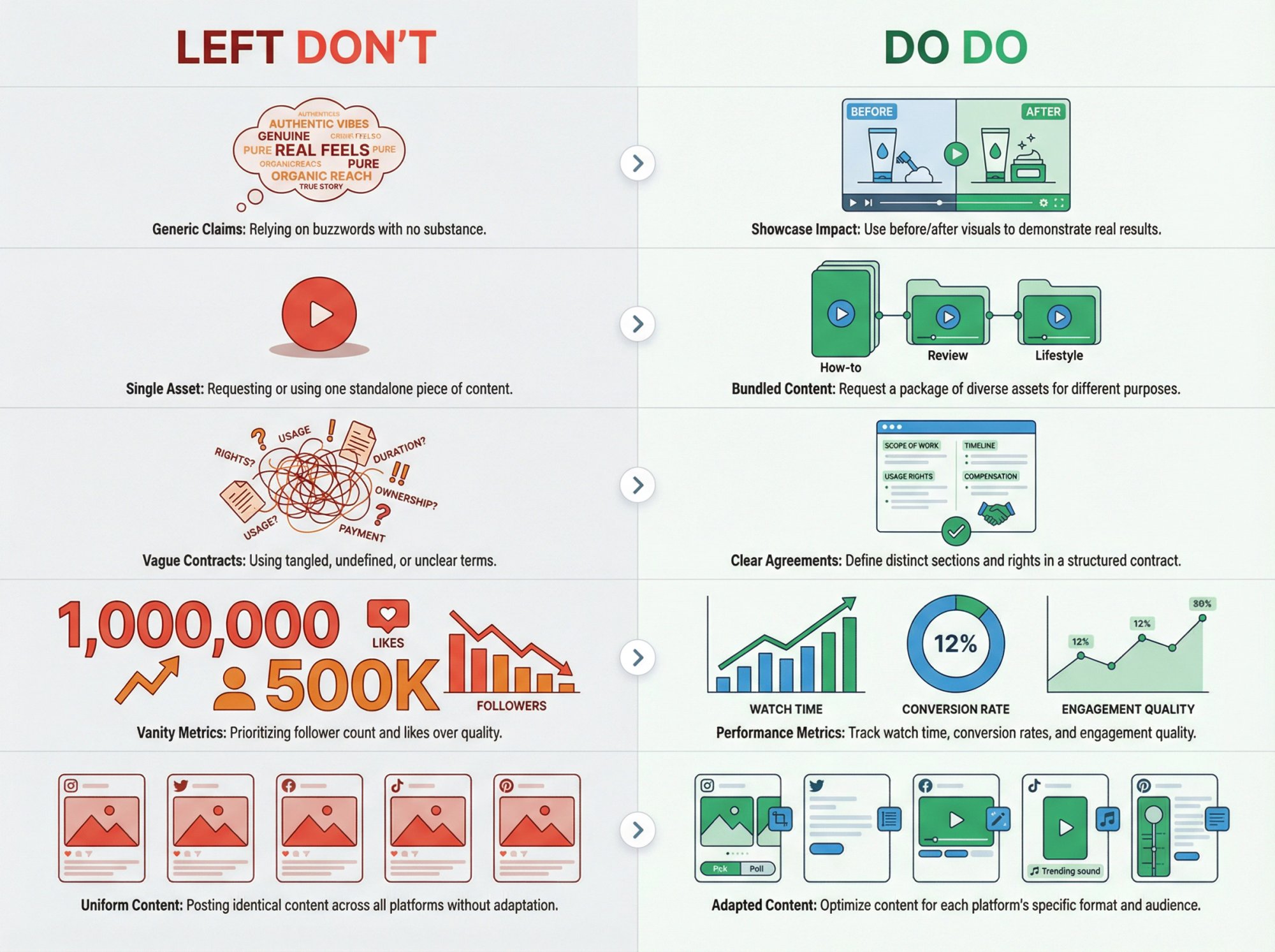
Mistake 1: Buying "Authenticity" Instead of "Proof"
Fix: Require at least one visual proof moment per video (demo, before/after, screen recording).
Mistake 2: One Video Per Creator
Fix: Buy packages (3-6 videos) so creators learn the product and you get iteration.
Mistake 3: No Rights Clarity
Fix: Separate creation vs. usage vs. whitelisting, in writing, every time.
Mistake 4: Measuring UGC Like Influencer Posts
Fix: Stop caring about follower count. Care about asset performance.
Learn how to tell if an influencer has fake engagement to avoid vanity metrics and focus on real performance indicators.
Mistake 5: Posting Cross-Platform Without Adapting
Fix: Small edits per platform (captions, pacing, on-screen text) can change outcomes massively.
Check out best time to post on Instagram Reels, best time to post Reels on Facebook, and best time to post YouTube Shorts for platform-specific optimization.
FAQ
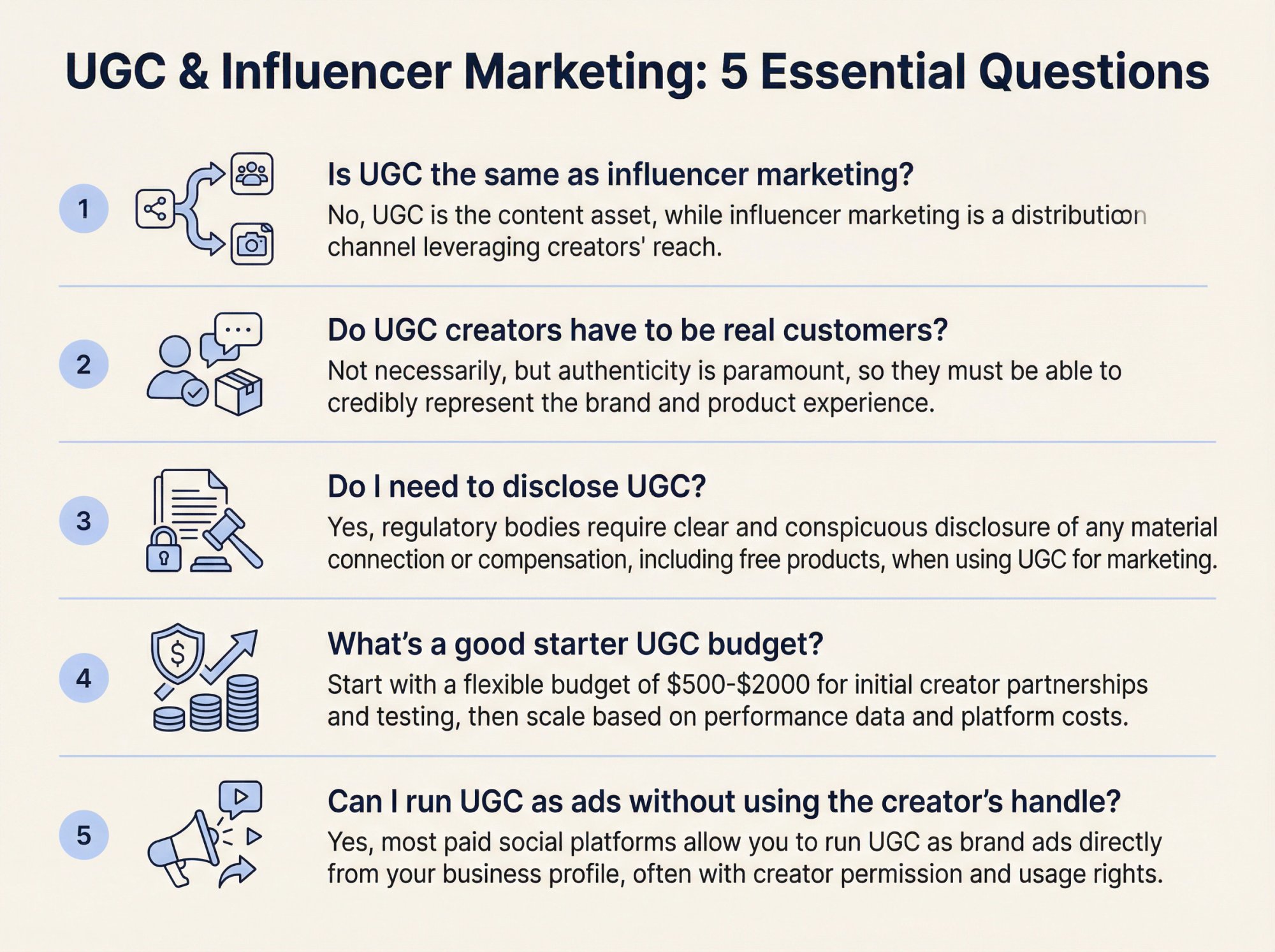
Is UGC the same as influencer marketing?
Not quite. Influencer marketing is primarily about distribution through a creator's audience. UGC is primarily about buying creative assets you can deploy anywhere.
Learn more about the differences in our guide on best influencer marketing tools.
Do UGC creators have to be real customers?
Not in modern marketing usage. "True" UGC is customer-made. "Paid UGC" is creator-made in a customer-like style.
Do I need to disclose UGC?
If there's a material connection (money, free product, affiliate), yes. FTC guidance requires clear disclosures, and platforms have their own tools/settings for commercial content.
What's a good starter UGC budget?
Enough to buy learning speed. A realistic starter is 10-20 videos per month for 1-2 months so you can find repeatable winners, then scale.
Can I run UGC as ads without using the creator's handle?
Absolutely. That's the standard "brand-run ads" route. Creator-handle ads (spark/partnership) are optional but powerful.
How to Win with UGC in Influencer Marketing (2026)
Treat UGC like a creative supply chain, not a one-off "influencer campaign."
Buy volume, learn fast, scale winners. Lock down rights and disclosure up front (don't be sloppy). Track assets across platforms so you know what's actually working.
The teams winning with UGC in 2026 aren't treating it like a marketing tactic. They're treating it like a production engine. They're sourcing creators weekly, testing angles constantly, and scaling what works ruthlessly.
If you're still thinking about UGC as "maybe we'll run a hashtag campaign once," you're already behind.
The future of influencer marketing isn't about finding the creator. It's about building the system that turns real voices into real growth.
Explore Shortimize's influencer tracking solutions and learn how to conduct TikTok competitor analysis to build your competitive advantage.
Start building yours now.