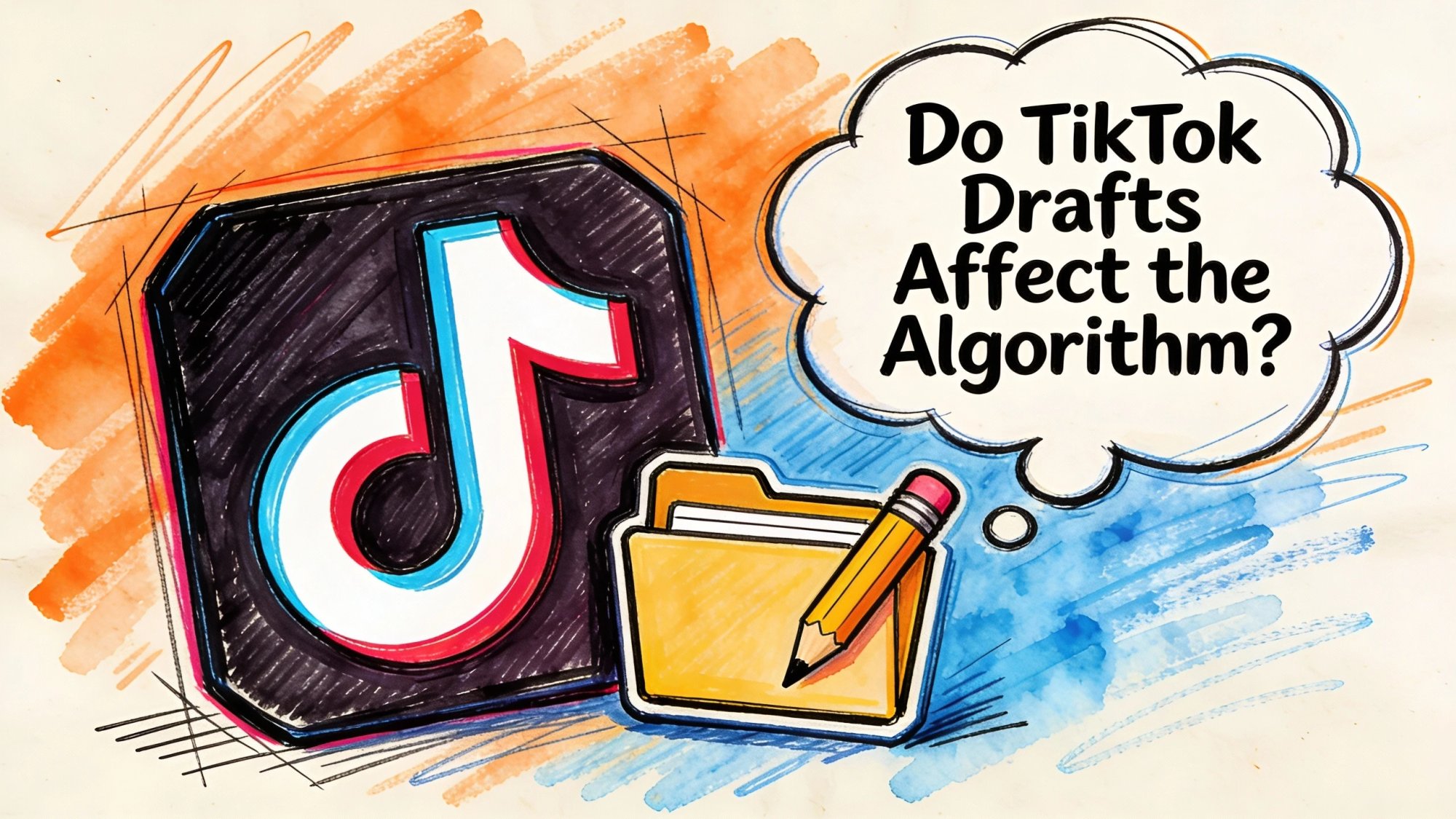
You've probably saved dozens (or hundreds) of videos to your TikTok drafts folder. Maybe you're batch-creating content for the week, or you're second-guessing whether that video is actually good enough to post. But then you hear it: "Posting from drafts kills your reach."
Is it true? Does TikTok's algorithm somehow penalize videos that sit in your drafts folder?
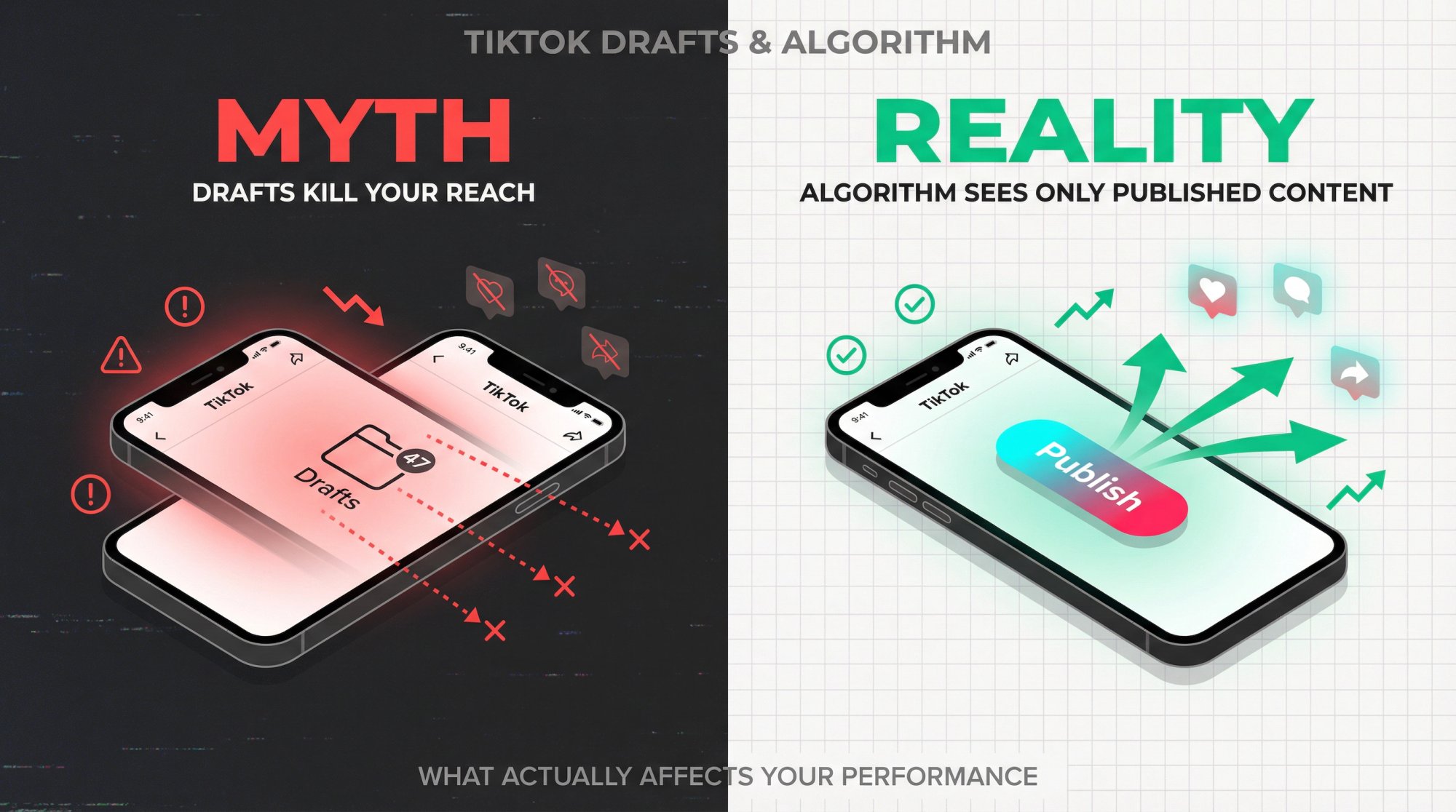
The straight answer: No, TikTok drafts do not directly affect the algorithm.
Drafts are private, local files that TikTok's recommendation system never sees until you hit publish. But (and this is important) how you use drafts can indirectly impact performance through timing, trend freshness, and posting habits.
Let's break down exactly what's happening, why the myths exist, and how to use drafts strategically without sabotaging your reach.
What Are TikTok Drafts and How Do They Work?
Before we can answer whether drafts affect the algorithm, we need to understand what drafts actually are from a technical standpoint.
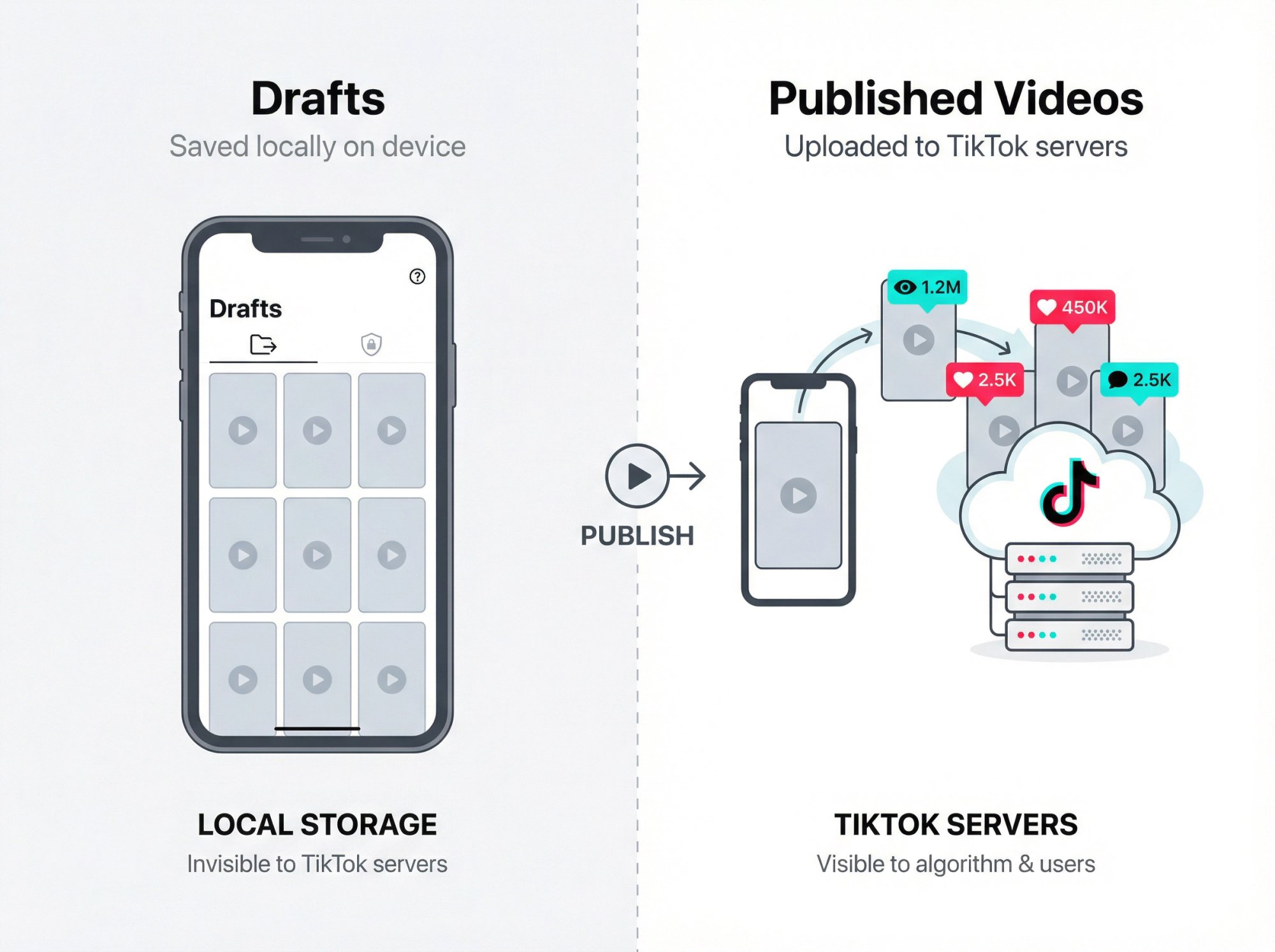
TikTok drafts are unpublished videos saved locally on your device. According to TikTok's official support documentation, drafts live in your Videos tab and are only available to others when you post them. TikTok warns that drafts may be removed if you uninstall the app, switch devices, or log out.
This tells us something important:
Drafts are not uploaded to TikTok's servers in any meaningful way. They're more like unsaved work-in-progress files sitting on your phone. Until you publish, a draft is invisible to everyone, including TikTok's algorithm.
Key facts about drafts:
• Storage location: Drafts are saved locally on your device, not in the cloud. If you delete the app or switch phones, they're gone (unless you've backed up your device).
• Privacy status: Draft videos generate zero views, zero engagement, and zero algorithmic signals. They don't exist in TikTok's recommendation system yet.
• No time limit: Drafts can sit forever. But (we'll get to this) sitting forever is where problems start.
• Editing freedom: You can keep tweaking drafts, changing captions, swapping sounds, adjusting effects. This is actually one of their biggest advantages.
Think of drafts like this: they're your creative workspace, completely separate from the public performance stage. TikTok's algorithm only cares about what happens on stage (after you post), not what's happening backstage in your drafts folder.
How Does TikTok's Algorithm Work?
To understand why drafts don't affect the algorithm, you need to understand what does affect it.
TikTok's recommendation system operates on a straightforward principle: show people more of what they engage with.
According to TikTok's official documentation on content recommendations, the algorithm looks at three main factor categories:
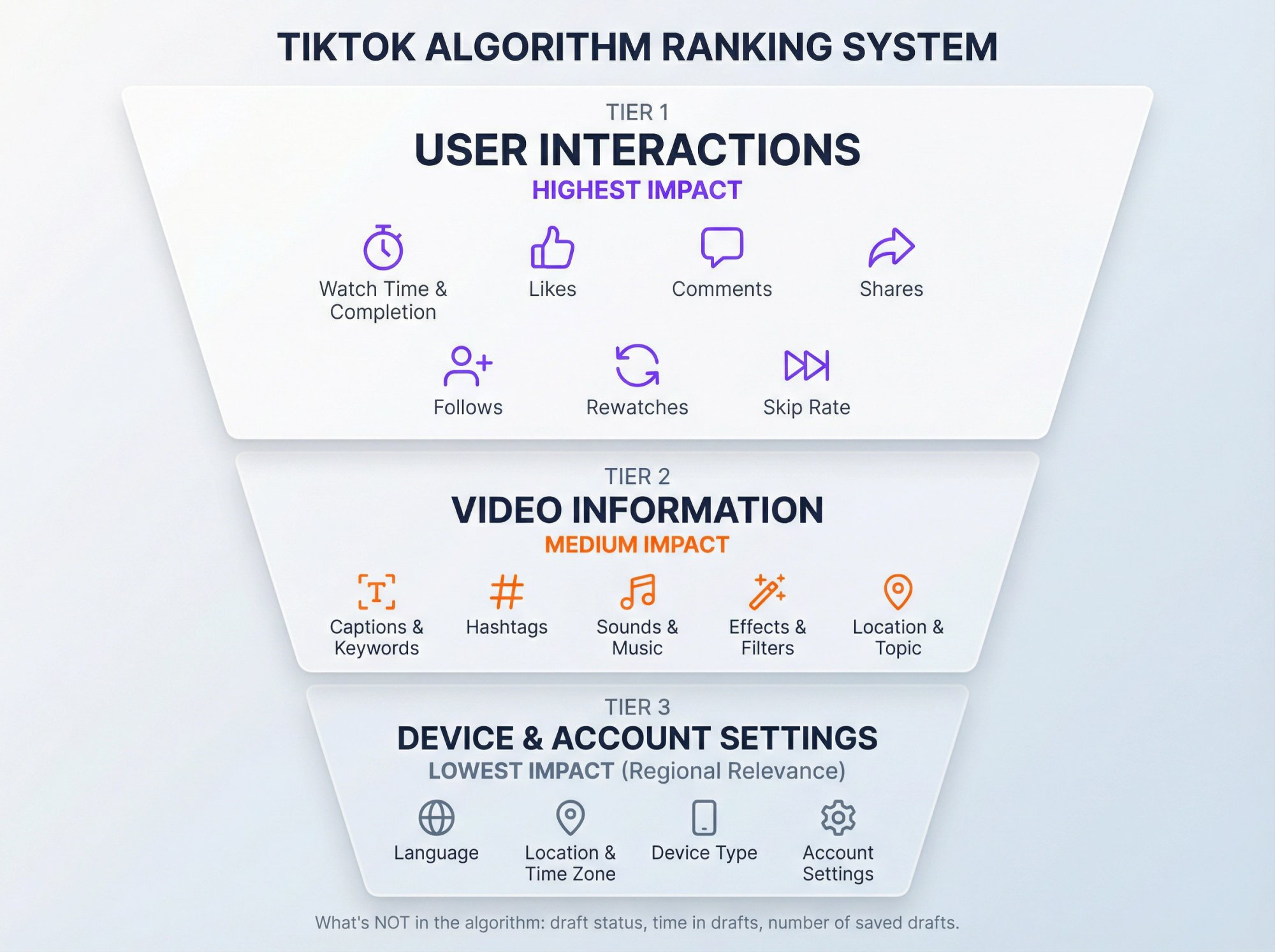
| Algorithm Factor | What It Measures | Impact Level |
|---|---|---|
| User Interactions | Watch time, completion rate, likes, comments, shares, follows, rewatches | Highest (most heavily weighted) |
| Video Information | Captions, hashtags, sounds, effects, location, topic | Medium (helps categorize and match) |
| Device & Account Settings | Language, location, time zone, device type | Lowest (regional relevance only) |
What Ranking Signals Does TikTok Prioritize Most?
User interactions carry the heaviest weight:
→ Watch time and completion rate
→ Likes, comments, shares
→ Follows and profile visits
→ Rewatches
→ Whether they skip past your video
Research shows the algorithm particularly rewards high engagement and longer watch time. When viewers watch your entire video and interact with it, TikTok interprets this as quality content worth showing to more people.
Video information helps TikTok understand your content:
• Captions and keywords
• Hashtags
• Sounds and music
• Effects and filters
• Video location and topic
These help TikTok figure out what your video is about and who might be interested in it.
Device and account settings have minimal influence:
① Language preference
② Location and time zone
③ Device type
④ Account settings
These ensure you see regionally relevant content but don't make or break individual video performance.
Here's what you won't find anywhere in TikTok's algorithm factors: whether you posted from drafts, how long the video sat in drafts, or how many drafts you have saved.
The algorithm judges content based on viewer behavior after posting, not on how you prepared it. A video posted immediately and a video posted from drafts enter the exact same recommendation system with the exact same starting conditions.
Why Do People Think Drafts Hurt TikTok Performance?
If drafts don't affect the algorithm, why do so many creators swear they do?
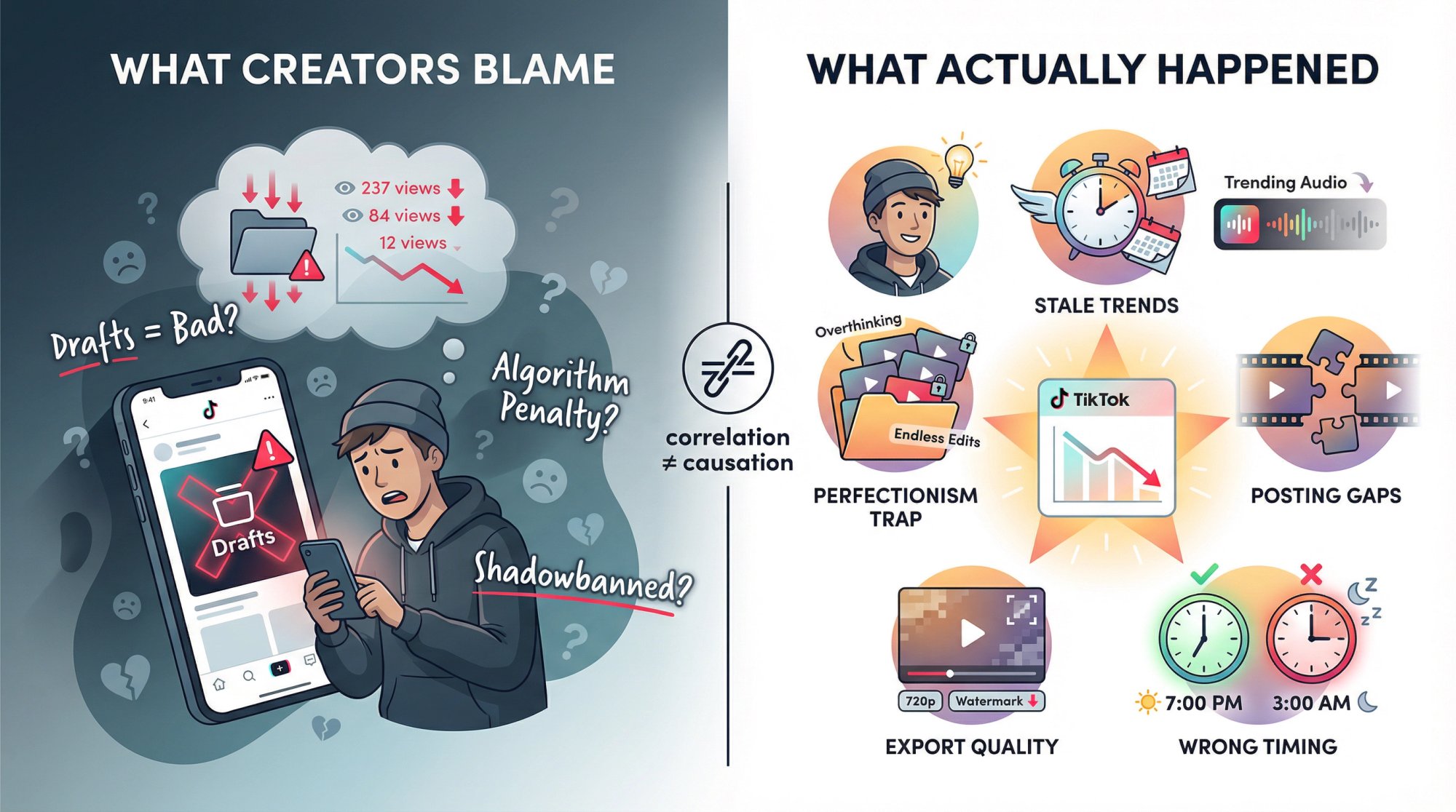
It comes down to confusing correlation with causation. When a draft-posted video underperforms, it's easy to blame the draft status. But usually, something else is actually responsible.
What Really Causes Poor Performance on Draft Posts?
Stale trends and expired sounds
This is the big one. Say you record a video using a trending sound on Monday, save it as a draft, then post it two weeks later. By then, the trend has cooled off completely.
TikTok's algorithm considers sounds and trending content as part of "video information." If you're jumping on a trend that's already passed, you've missed the moment when the algorithm was actively pushing that sound to new viewers.
Research on posting timing shows that taking too long to publish draft content can cause you to miss peak audience interest.
The draft didn't hurt you. The timing did.
Disrupted posting consistency
Let's say you normally post every day, building audience expectations and algorithmic momentum. Then you film five videos, save them all as drafts, and don't post anything for two weeks while they sit there.
TikTok's algorithm notices posting cadence. Your audience notices too. When you finally post again, your engagement might be lower simply because you've been absent.
Consistent posting schedules are recommended specifically because consistency keeps both your audience and the algorithm engaged with your account.
Again, the draft itself isn't the problem. Inconsistent posting habits are.
Different posting times mean different audience samples
TikTok includes time zone and timing as factors in recommendations. If you film a video at 7pm (your usual high-engagement time) but save it as a draft and post it at 3am instead, you're showing it to a completely different initial audience.
The algorithm tests your video with a small sample first. If that 3am sample is less engaged, your video gets lower initial velocity, which affects broader distribution.
You didn't get penalized for using drafts. You just posted at a worse time. Understanding optimal posting times for YouTube Shorts and other platforms can help you maximize this initial testing phase.
Export and reupload complications
Here's a workflow mistake that trips up creators constantly:
① Create video in TikTok
② Save to camera roll
③ Re-upload later from camera roll
When you export and re-upload, you often introduce:
→ Watermarks (TikTok typically deprioritizes content with visible watermarks from other platforms)
→ Compression artifacts (reduced quality from double-compression)
→ Lost audio attribution (the sound might not link back to the original trending audio)
Strategies for increasing TikTok views consistently show that watermarked reposts perform worse. This isn't about drafts. It's about creating a degraded reupload instead of posting cleanly from within the app.
The perfectionism trap
Some creators save videos as drafts because they're not confident about them. Over time, their drafts folder becomes a graveyard of "good enough but not perfect" content that never sees the light of day.
If you're constantly second-guessing and delaying posts, you're missing opportunities to learn from real audience feedback. The issue isn't that drafts hurt performance. It's that over-filtering prevents you from posting at all.
Do Drafts Affect TikTok Algorithm? The Evidence
Let's establish the facts clearly:
Drafts don't affect the TikTok algorithm because they aren't public content. The algorithm can only evaluate what viewers interact with. Until you post, a draft generates zero algorithmic signals.
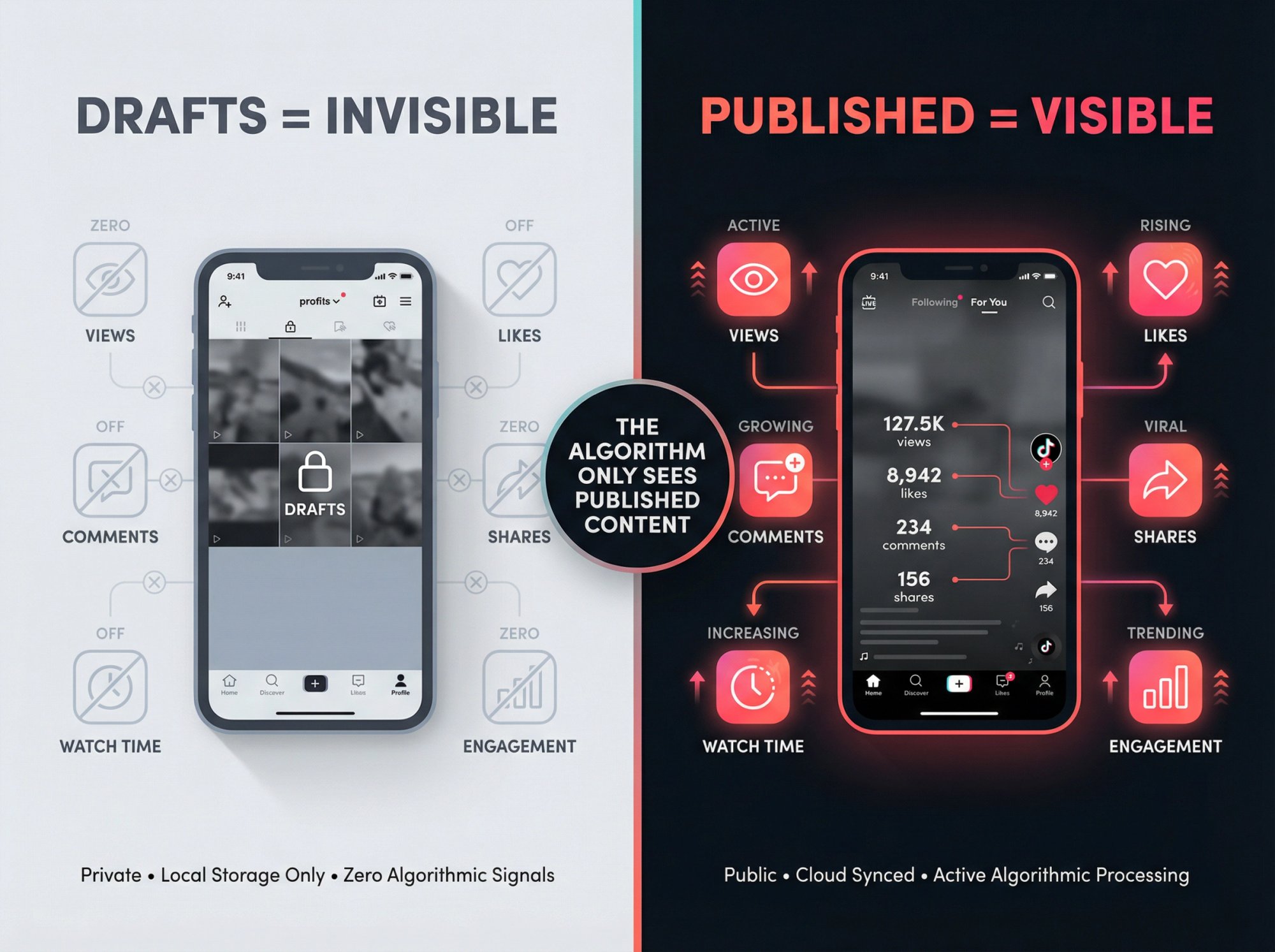
This isn't speculation. This is how recommendation systems work fundamentally. They need observable engagement data to make distribution decisions. Private drafts have no engagement data.
What drafts CAN affect (indirectly):
• When you post (timing and audience availability)
• What you post with (whether trends/sounds are still relevant)
• How you post (native upload vs. degraded reupload)
• Whether you post consistently (using drafts to maintain schedule vs. hoarding content)
What drafts CANNOT affect:
✗ Your account's algorithmic standing
✗ Your video's initial distribution potential
✗ TikTok's "opinion" of your content
✗ Some invisible draft penalty counter
Think of it this way: TikTok's algorithm is an optimization system, not a mood. It responds to measurable signals (views, watch time, engagement), not to invisible process variables like whether you used the drafts feature.
How to Use TikTok Drafts Without Hurting Performance
Drafts are actually a powerful tool when used correctly. Here's how to use them without the common pitfalls:
Use Drafts for Batch Content Creation and Consistency
Creating multiple videos in one session and saving them as drafts lets you maintain a consistent posting schedule even on busy days. This is excellent strategy.
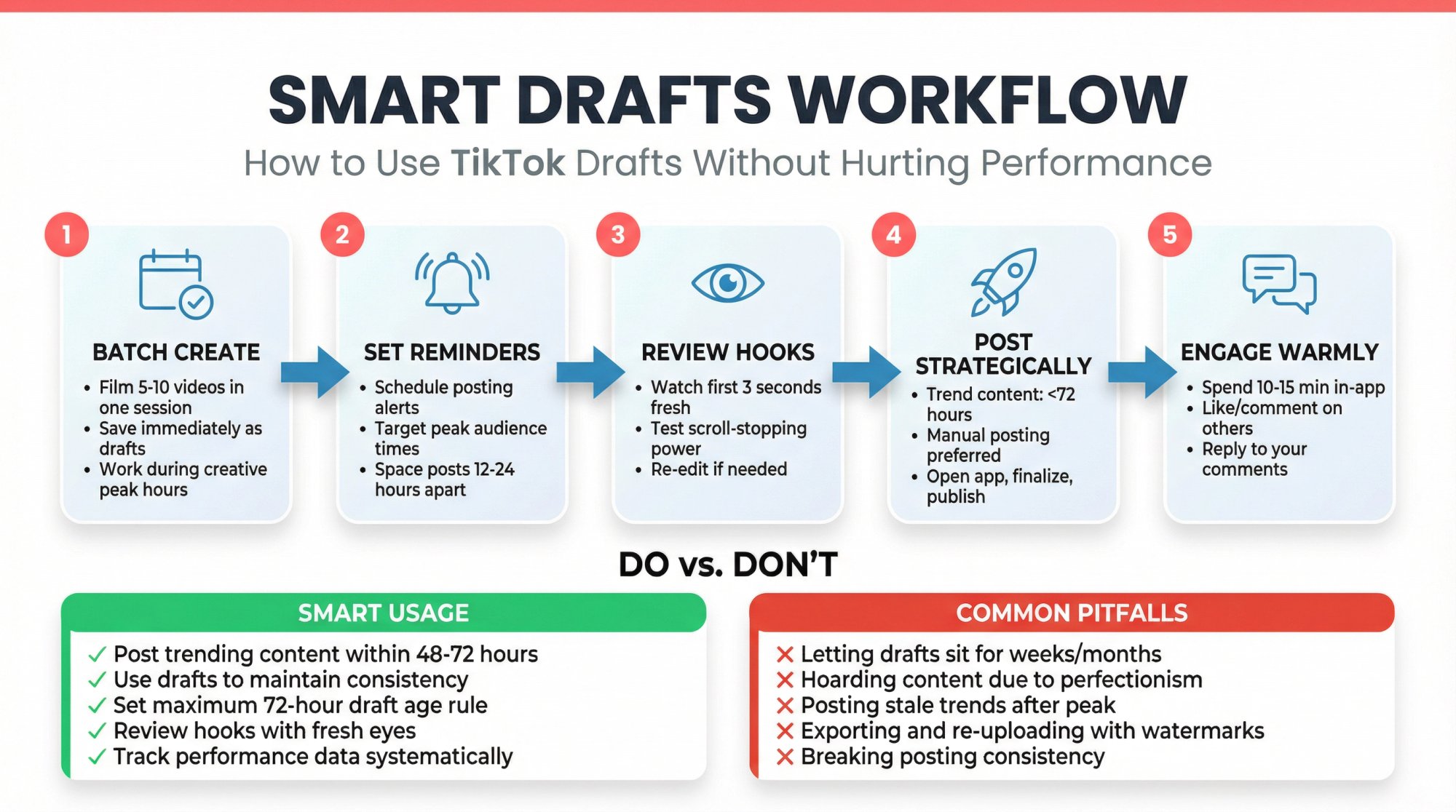
The key: Set reminders to actually post them. Batch create on Sunday, schedule reminders to post Monday, Wednesday, and Friday. Don't let them rot in your drafts folder for months.
Managing multiple TikTok accounts becomes much easier when you batch-create content and use drafts as a manual scheduling system. For teams tracking performance across multiple creators, influencer tracking tools can help you monitor which posting strategies work best at scale.
How to Perfect Your TikTok Hook Using Drafts
One legitimate advantage of drafts: you can review your video with fresh eyes.
Film your content, save as draft, walk away for an hour. Come back and watch the first three seconds. Is the hook compelling? Does it grab attention immediately? If not, re-edit before posting.
TikTok's algorithm heavily weights watch time and completion rate. A strong hook matters more than anything else for algorithmic performance. Analyzing viral content patterns can help you understand what hooks are working in your niche right now.
When to Post Trending Content From Drafts
If your draft references a trending sound, meme, or challenge, post it while the trend is still hot. Trends on TikTok move fast.
Practical rule: If you're using trending audio, aim to post within 48-72 hours of creating the draft. After that, consider swapping for more evergreen audio.
Understanding how many views constitute viral content can help you gauge whether a trend is still gaining momentum or already past its peak.
Best Way to Post From TikTok Drafts
Here's an interesting data point: Some marketers report that manually posting from drafts seems to perform better than using third-party scheduling tools.
The theory? TikTok's algorithm may give a small boost to posts made by real humans actively using the app, versus automated scheduled posts. While TikTok hasn't officially confirmed this, the anecdotal evidence is strong enough that many professional creators use this workflow:
→ Create content and save as draft
→ Set a phone reminder for your target posting time
→ Open TikTok, finalize the caption/hashtags
→ Post manually from drafts
→ Spend 10-15 minutes engaging with the app (like/comment on other videos, reply to your own comments)
This "warm engagement" around posting time might signal to TikTok that there's an active human behind the account, potentially improving initial distribution.
Again, not confirmed by TikTok, but worth testing.
How to Track If Drafts Affect Your TikTok Performance
Stop guessing whether drafts affect your performance. Test it with data.
Run this experiment:
| Test Variable | Method |
|---|---|
| Week 1 | Post 5 videos immediately after creating them (no drafts) |
| Week 2 | Post 5 videos after saving them as drafts for 24 hours |
| Control for | Same posting times, similar content types, same hashtag strategy |
| Measure | Views at 1 hour, 24 hours, and 7 days; engagement rate; watch time |
If you're managing multiple accounts or want deeper analytics, Shortimize lets you track any public TikTok account's performance metrics in one dashboard. You can compare how different posting methods affect your performance over time and identify real patterns versus random variance.
For comprehensive performance monitoring across platforms, social media monitoring tools help you track content performance on TikTok, Instagram Reels, and YouTube Shorts simultaneously. Perfect for testing whether posting behaviors affect results differently across platforms.
How to Avoid the Infinite TikTok Editing Loop
Don't let drafts become a procrastination tool. If you've edited a video three times and it's still sitting in drafts, the problem isn't the video anymore. It's perfectionism.
Set a rule for yourself: Videos can sit in drafts for a maximum of 72 hours. After that, either post it or delete it.
This forces you to ship content and learn from real feedback instead of endlessly theorizing.
TikTok Drafts: Frequently Asked Questions
Q: Does having hundreds of drafts hurt my account?
No. TikTok's algorithm doesn't track or care how many drafts you have. The only issue is opportunity cost: those are potentially dozens of videos that could be teaching you what works with your audience, but they're just sitting there collecting digital dust.
Q: Should I delete old drafts?
Only if they're cluttering your workflow. Deleting drafts doesn't improve your algorithm standing (because drafts never affected it in the first place). But if you've got 200 drafts from two years ago, cleaning them out might help you stay organized.
Q: Is it better to post immediately or save as draft first?
It depends on your goal:
→ If the content is time-sensitive (trending sound/challenge), post immediately
→ If you want to review the hook with fresh eyes, save as draft and review later
→ If you're batch-creating for the week, use drafts to maintain consistency
Neither method has an inherent algorithmic advantage. Pick what fits your workflow and content strategy.
Q: Why did my draft-posted video get fewer views than usual?
Check these factors first:
① Posting time: Did you post at a different time than usual? Consider checking optimal posting times for different platforms.
② Trend freshness: Has the audio/challenge cooled off?
③ Hook strength: Is the first 3 seconds compelling enough?
④ Content eligibility: Check if your video is eligible for the For You feed
⑤ Posting consistency: Have you been posting regularly, or did you take a long break?
Almost always, the answer is in one of these factors, not the draft status itself. Understanding why TikTok videos get zero views can help you troubleshoot performance issues systematically.
Q: Can TikTok see my drafts before I post them?
TikTok's documentation states that drafts are only available to others when you post them. The fact that drafts disappear when you uninstall the app suggests they're primarily stored locally on your device, not pre-analyzed on TikTok's servers.
Even if TikTok could technically access drafts, there's no evidence they use draft data for recommendation decisions. The algorithm works on public engagement signals, which drafts don't generate.
What Actually Matters for TikTok Algorithm Success
Instead of worrying about drafts, focus your energy on the factors TikTok's algorithm actually cares about:
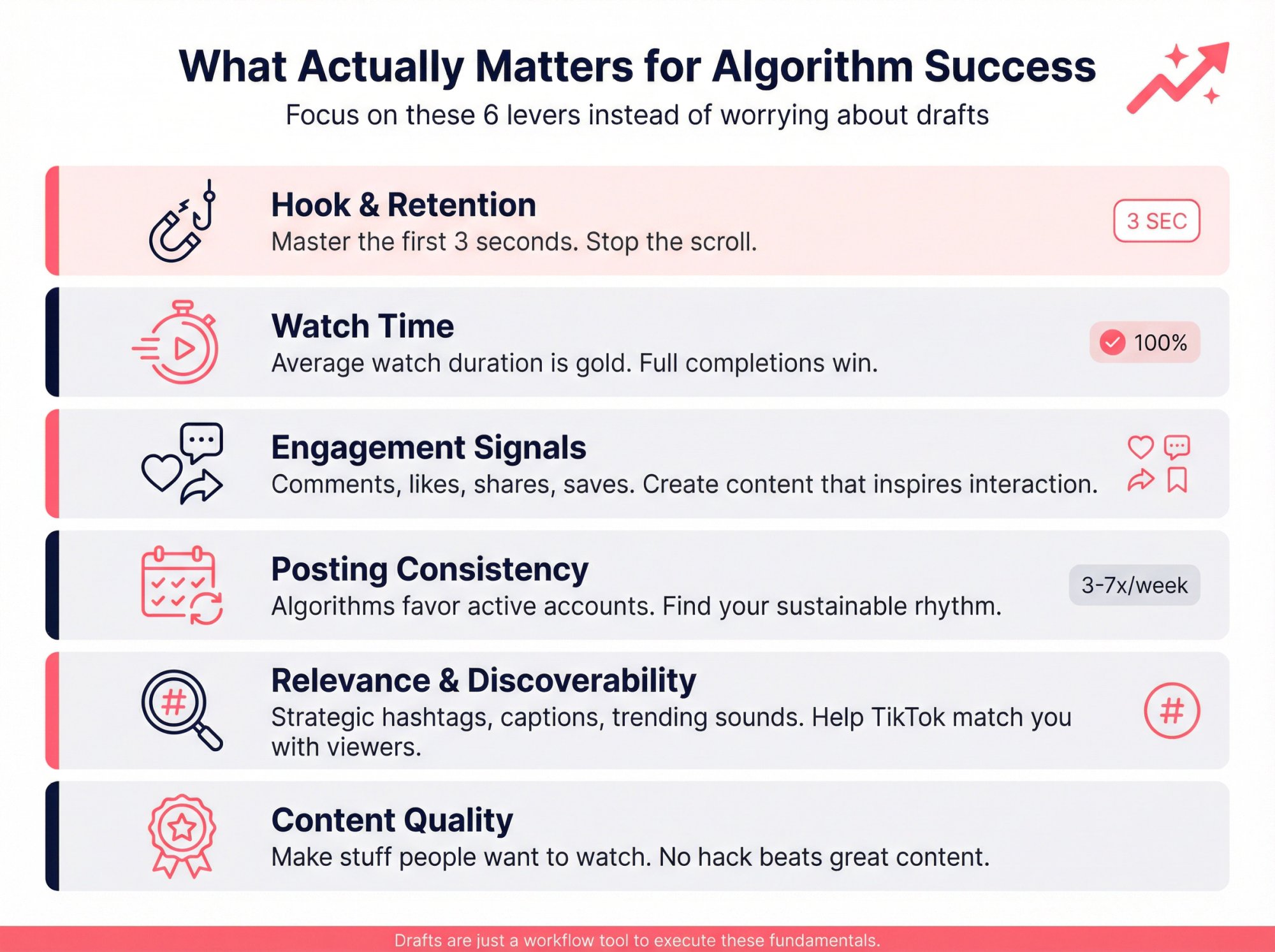
→ Hook and retention
Master the first 3 seconds. Can you stop the scroll?
→ Watch time
Average watch duration is gold. The algorithm heavily rewards engagement, especially full video completions.
→ Engagement signals
Comments, likes, shares, saves. Don't beg for them, but create content that naturally inspires interaction. Understanding what constitutes a good view rate helps you benchmark your content performance.
→ Posting consistency
Algorithms favor active accounts. Find a sustainable rhythm (whether that's daily, 3x weekly, or whatever works for you).
→ Relevance and discoverability
Use strategic hashtags, descriptive captions, and trending (but relevant) sounds to help TikTok match your content with interested viewers. Learn how to optimize videos for TikTok SEO to maximize discoverability.
→ Content quality
This is obvious but worth stating: make stuff people actually want to watch. No algorithmic hack can save boring content.
These are the levers that move the needle. Drafts are just a workflow tool to help you execute on these fundamentals more efficiently.
For creators running experiments with content formats, understanding how different platforms' algorithms work can inform your cross-platform strategy. Similarly, comparing watch time metrics across TikTok, Reels, and Shorts reveals platform-specific patterns that can guide your content decisions.
TikTok Drafts and Algorithm: Final Answer
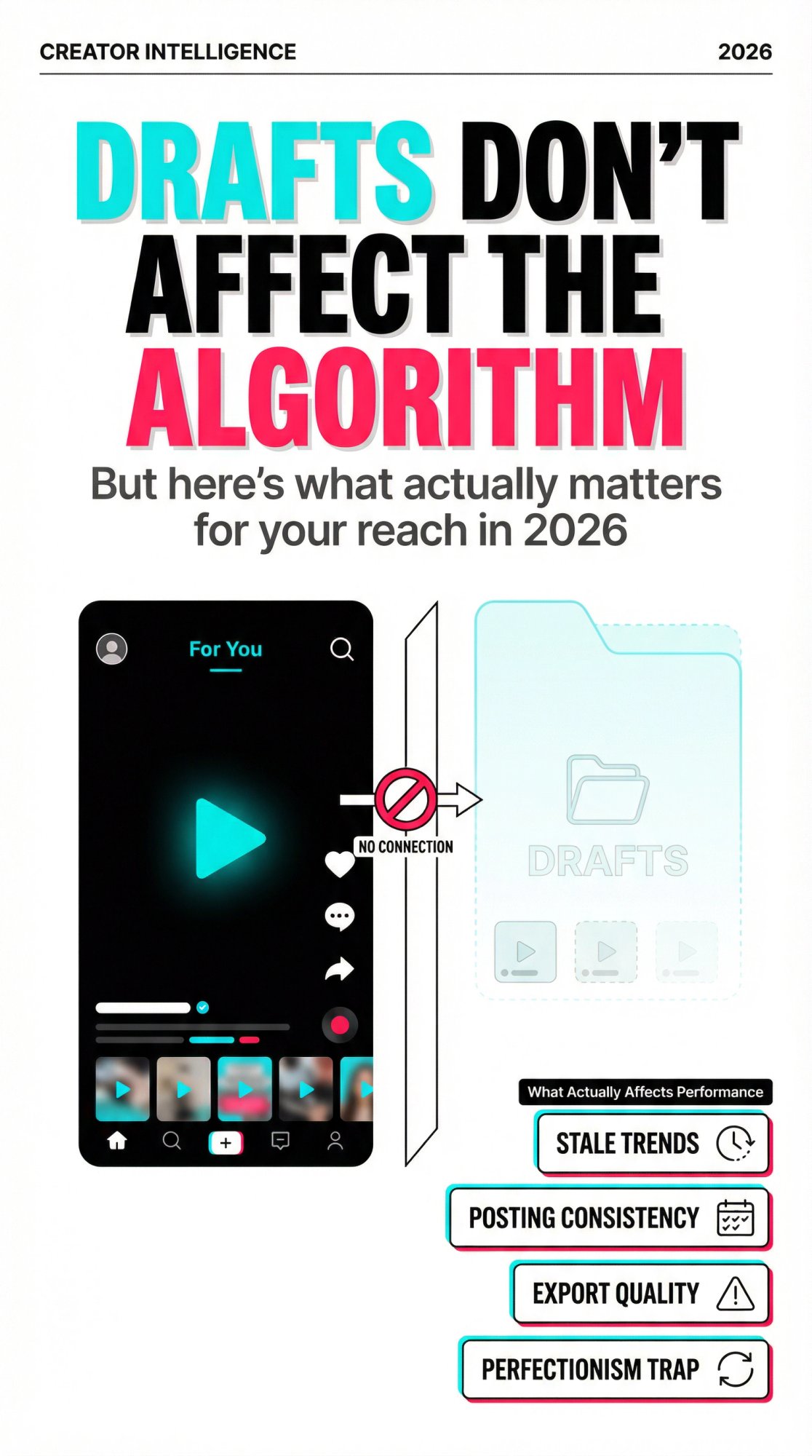
TikTok drafts do not affect the algorithm. Period.
Drafts are private, local files that the recommendation system never evaluates until you post them. There's no hidden penalty for using drafts, no secret boost for posting immediately, and no algorithmic voodoo happening in your drafts folder.
What can affect performance is how you use drafts in practice:
• Posting stale trends after they've cooled off
• Breaking your posting consistency while content sits in drafts
• Exporting and re-uploading instead of posting natively
• Using drafts as a perfectionism trap instead of a workflow tool
Use drafts strategically to batch-create content, maintain consistency, and refine your hooks. Just don't let them sit so long that you miss trend windows or disrupt your posting rhythm.
The real algorithm optimization happens in what you create and how your audience responds to it. Focus on hooks, watch time, and engagement. Use drafts as a tool to support that strategy, not as something to fear or worship.
And if you're serious about tracking what actually works, Shortimize can help you monitor performance across multiple TikTok accounts, analyze what's driving views and engagement, and make data-driven decisions about your content strategy. Whether you're tracking influencer campaigns, running competitor analysis, or simply trying to understand your audience better, having consolidated analytics helps you replace guessing with measurement.
For teams managing content at scale, Shortimize's collections feature lets you organize hundreds of videos and accounts, compare performance across creators, and export data for deeper analysis. Because the best way to beat algorithm anxiety? Replace guessing with measurement.
Now stop overthinking your drafts folder and go post something great.