Influencer marketing is exploding. An estimated 86% of U.S. marketers will use influencers this year. But most brands don't talk about the fraud problem, which is just as big.
Research shows over 55% of influencer engagement on Instagram was fake in 2024, and brands lost over $2 billion to influencer fraud in 2025. Even more concerning, roughly 1 in 4 influencers have engaged in fraudulent practices to inflate their stats.
Without proper auditing, you're flying blind.
An influencer audit is a complete evaluation of a creator's online presence, audience quality, content performance, and brand alignment. It's basically due diligence before you write a check. And it's not optional anymore.
The audit solves one core problem: helping you avoid two expensive outcomes.
Outcome #1: You pay for reach that isn't real (bots, bought followers, engagement pods, recycled audiences).
Outcome #2: You pay for reach that's real but wrong (wrong audience, wrong context, wrong vibe, wrong conversion path).
Everything else is just noise. The audit's job is to predict whether this creator will produce real attention from the right people, in a brand-safe way, at a price that makes sense.
The core principle: An influencer audit isn't about judging popularity. It's about predicting ROI. You're asking one question (will this partnership produce measurable business value?) and everything else is just supporting evidence.
That's what we'll show you how to do in this guide.
Why Influencer Marketing Fails: Real Reach vs Fake Engagement
Most influencer marketing disasters fall into one of two categories.
The first is obvious: fake engagement. This is the world of purchased followers, comment pods, and bot farms. The profile looks impressive at first glance, but the numbers are hollow. You're paying for metrics that don't represent actual humans who might care about your product.
The second is more subtle and often more expensive: mismatched audiences. The influencer's followers are real people with real engagement. They just have zero interest in what you're selling. Maybe they follow this creator for comedy but you're selling B2B software. Maybe the demographics look right on paper but the context is all wrong.
Both scenarios burn budget. Both damage ROI. And both are completely avoidable with proper auditing.
Here's the key insight: an influencer is really just two assets bundled together.
First, distribution (can they reliably get attention from a meaningful number of people?). Second, trust (do those people believe the creator enough to actually take action?).
Your audit measures distribution and trust separately, then combines them into deal math. If either component is weak or fraudulent, the partnership won't work no matter how good the other half looks.
Distribution without trust = wasted impressions. Trust without distribution = no scale. You need both, and the audit quantifies both, so you're not betting on gut feel.
What Is an Influencer Audit Framework?
We structure influencer audits in three layers, depending on how deep you need to go.
| Layer | Time | Purpose |
|---|---|---|
| Triage | 5-10 minutes | Fast elimination (obvious mismatches and obvious fraud) |
| Deep audit | 30-60 minutes | Quantify performance, verify authenticity, assess brand safety, check compliance |
| Ongoing monitoring | Weekly during campaign | Catch performance drops or unexpected viral moments |
Layer 1: Triage (5-10 minutes). This is fast elimination. You're scanning for obvious mismatches and obvious fraud. If someone has a clearly purchased following or zero alignment with your brand, you can spot it in minutes and move on. This layer saves you from wasting time on deeper analysis when the answer is already "no."
Layer 2: Deep audit (30-60 minutes). This is where you quantify performance, verify audience authenticity, assess brand safety, check compliance, and build the business case. You're calculating median views, analyzing comment quality, checking disclosure patterns, mapping audience demographics, and ultimately deciding if the numbers justify the price.
Layer 3: Ongoing monitoring (weekly during campaign). Creators change. Audiences shift. Platforms swing. The audit doesn't end when you sign the contract. You need ongoing tracking to catch performance drops (or unexpected viral moments) while you still have time to adjust.
Shortimize is built specifically for this monitoring layer. We let you track accounts you don't own across TikTok, Instagram Reels, and YouTube Shorts in one dashboard, so you can see real performance patterns instead of guessing based on what creators tell you.
How to Check Influencer Views and Distribution (Median Performance)
Stop using follower count as a proxy for reach. It's a vanity inventory number. What you're actually buying is views and attention.
Here's what you do instead: median-first performance.
Pick a recent window (last 30-90 days) and compute the median views of the influencer's last 10-20 short-form posts. Not the average. The median.
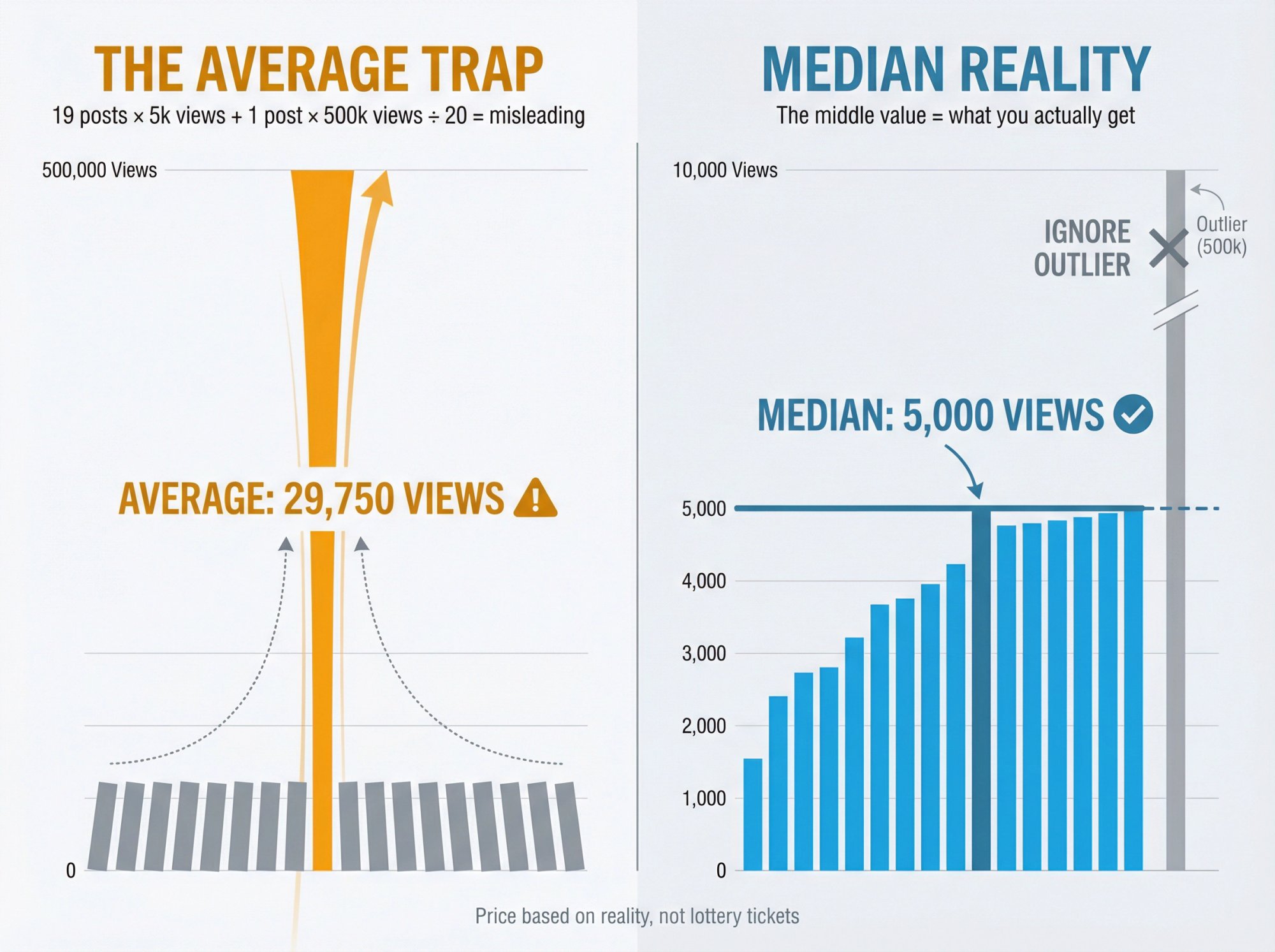
Why median? Because averages get distorted by one viral spike. If someone has 19 posts that get 5k views each and one post that got 500k views, their average looks impressive but their typical outcome is 5k. Median tells you what to actually expect.
Also look at view consistency. How wide is the spread? If every post lands between 8k and 12k views, that's predictable. If the range is 2k to 200k, you're dealing with lottery-ticket performance. Price accordingly.
And check for outlier dependence. Is the performance carried by 1-2 viral hits while everything else underperforms? That's a red flag. You want someone who can consistently deliver a baseline, not someone whose average is inflated by flukes.
Quick heuristics:
• If views are wildly spiky, price should be based on expected median, not the top 1%.
• If they can't hit a stable baseline, don't buy "guaranteed reach" without paid amplification rights.
• Cross-platform matters: An influencer might crush it on TikTok but get no traction on Reels. Make sure the platform you care about is where they actually perform.
Shortimize surfaces median and virality metrics by default, so you can immediately spot the difference between "consistent performer" and "one-hit wonder." You're not guessing anymore. You're looking at the actual pattern.
How to Tell If an Influencer Has Fake Followers
Fake followers are often obvious. Fake engagement is the bigger trap.
Here's what to look for when auditing authenticity.
How to Spot Fake Comments and Engagement Pods
Scan comments on the last 10-15 posts. Do people reference specifics from the video? Do they ask real questions or share personal stories? Or is it all "Love this! 🔥" and "Nice!" from random accounts with no profile pictures?
Pod pattern to watch for: The same 20-50 accounts commenting on every single post with generic phrases. That's engagement pod behavior, not organic community interaction.
Real engagement has substance. People tag friends. They ask follow-up questions. They disagree sometimes. If the comments section feels like a bot factory, it probably is.
What Is a Good Engagement Rate for Influencers?
You're not looking for a perfect ratio. You're looking for sudden breaks in the pattern.
• Views go up but likes and comments stay flat or drop.
• Likes spike but comments are all generic and substanceless.
• Comment counts jump with zero actual conversation happening.
Any of these signal something artificial is happening. Cross-reference with typical engagement rate benchmarks: large influencers (500k+ followers) often see 2-5% engagement rates, while micro-influencers might hit 5-10% or higher. If someone's rate is way below what's normal for their size and niche, investigate why.
How to Check Influencer Follower Growth Patterns
Plot their follower count over time. Legitimate influencers grow relatively steadily, with occasional spikes when content goes viral or they get featured somewhere.
Suspicious patterns:
• Sudden massive jumps with no corresponding viral content or external driver (press, collab, etc.).
• Big drops that indicate fake followers getting purged by the platform.
• Growth that doesn't correlate with posting activity (they go silent for months but keep gaining followers).
Healthy growth should map to content output and audience response. If it doesn't, someone's buying followers.
FTC Rules for Fake Influencer Engagement
This isn't just "annoying fraud" anymore. In the U.S., the FTC's Consumer Reviews and Testimonials Rule (effective October 21, 2024) explicitly prohibits selling or buying fake indicators of social media influence when used to misrepresent influence for commercial purposes. It authorizes civil penalties for knowing violations.
Translation: If a creator is inflating "influence" with fake indicators, that's a compliance risk for both of you.
Best Tools to Detect Fake Influencer Followers
Fraud detection tools typically look at engagement anomalies, follower growth anomalies, account metadata quality, and comment authenticity signals. Most tools use machine learning across dozens of signals to estimate inauthentic or low-quality followers and surface audience quality scores.
Best practice: Treat any tool output as a risk signal, then confirm with your own eyes and creator-provided analytics. Tools help, but they're not magic.
For a deeper dive into spotting fake engagement, check out our complete guide on how to tell if an influencer has fake engagement.
How to Analyze Influencer Audience Demographics
You can have a completely real creator with a completely real audience that's completely wrong for your business.
Audience fit breaks into two categories: demographic fit and context fit. You need both.
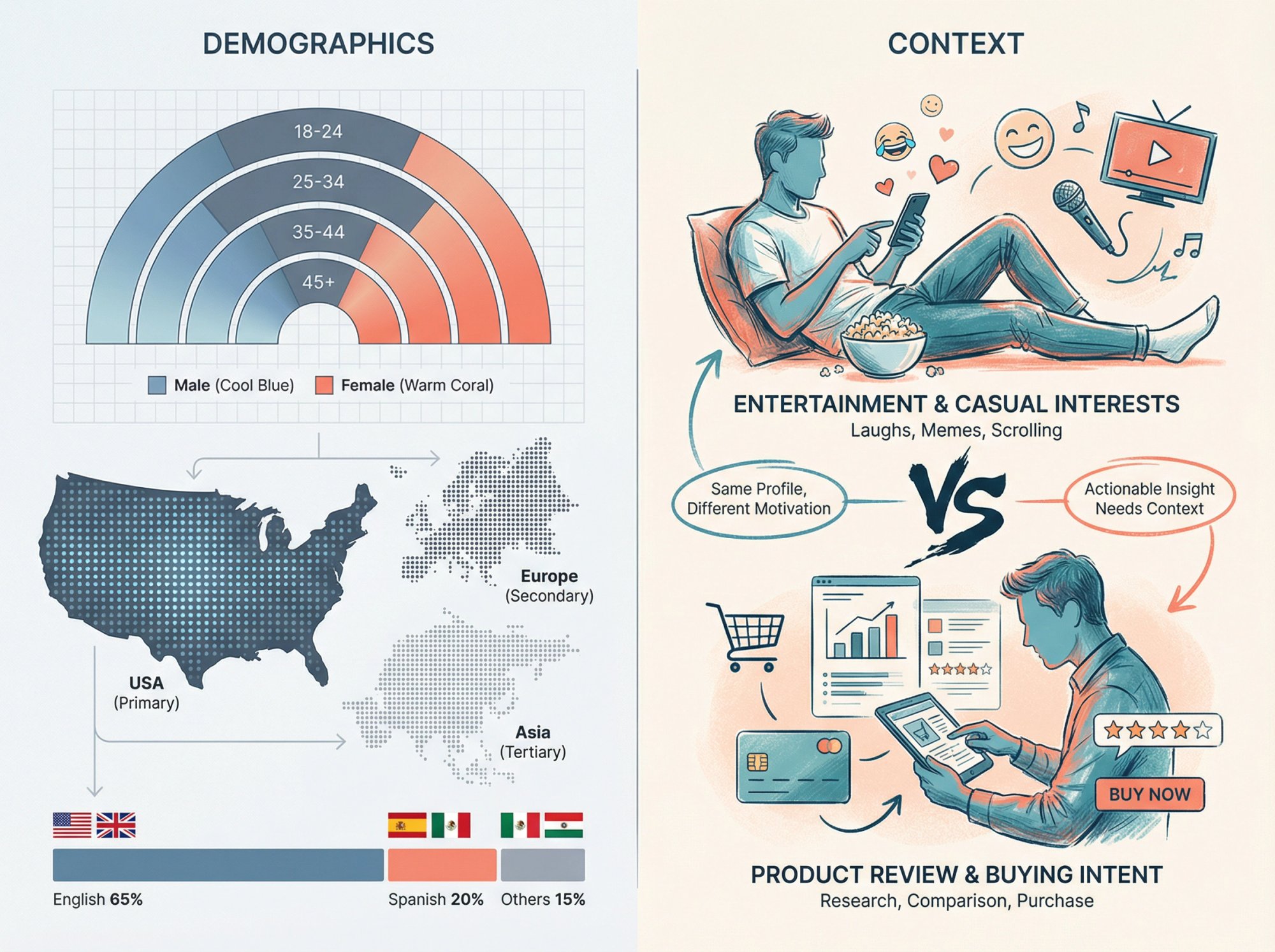
How to Check Influencer Audience Demographics
Ask for screenshots or a media kit showing:
• Top countries and cities
• Age and gender breakdown
• Language distribution
• Typical reach per post (not just follower count)
Compare this with your ideal customer profile. If you need to reach U.S. women aged 25-35 and this influencer's audience is 70% male aged 45-60 in Europe, that's a fundamental mismatch. Simple as that.
Why Audience Context Matters More Than Demographics
Context means why people follow them.
Example: A creator's audience might be "men 18-34," but are they there for comedy or buying recommendations? A lifestyle vlogger's followers are in a different headspace than a product review channel's followers, even if the demographics look identical.
Context determines conversion potential. You don't just want eyeballs. You want eyeballs that are primed to care about what you're selling.
Fast context fit test:
Look at the last 10 posts and answer these questions:
• What is the viewer promised in the first 2 seconds of each video?
• What does the viewer leave with after watching?
• Does your product naturally belong in that loop?
If you can't imagine the product fitting without "and now a word from our sponsor" energy, it's a bad fit. The best influencer partnerships feel like natural extensions of what the creator already does, not awkward interruptions.
How to Evaluate Influencer Content Quality
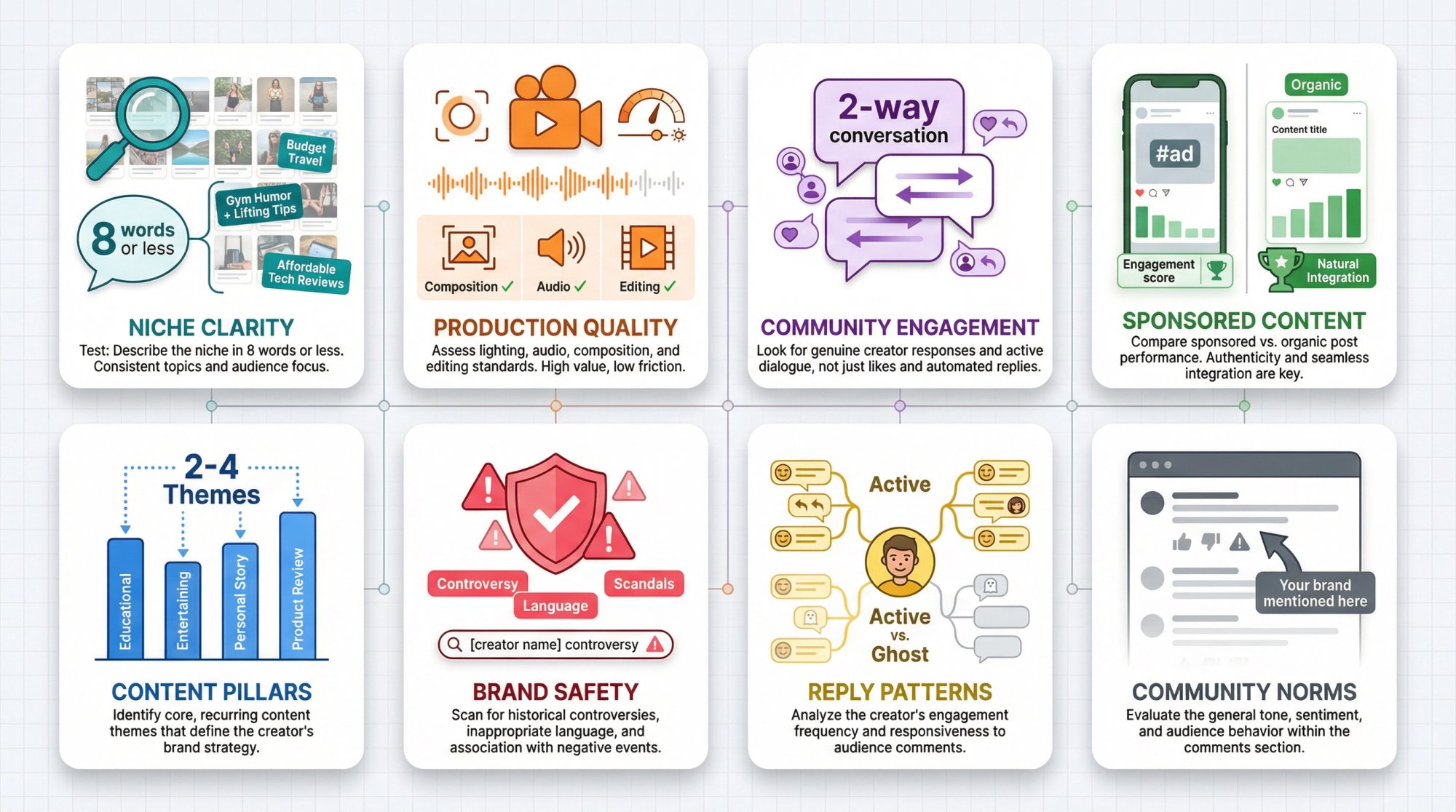
Now shift from the numbers to the craft. Does this influencer's content style, quality, and values align with your brand?
How to Check If an Influencer Has a Clear Niche
Strong influencers have a clear theme or expertise. Scroll through their feed. Can you describe their niche in 8 words or less? "Budget travel for Southeast Asia." "Gym humor plus beginner lifting tips." "ADHD productivity for college students."
If their content is all over the place (fitness one week, crypto the next, dropshipping after that), their audience probably isn't strongly loyal to any particular topic. That dilutes trust and makes partnerships less effective.
Consistency builds credibility. You want a creator with 2-4 repeating content pillars, not someone chasing every trending topic with no coherent identity.
What Is Good Production Quality for Influencer Content?
Are photos well-composed? Are videos cleanly edited? Is audio clear? Are captions thoughtful and well-written, or full of typos and shallow one-liners?
Professional-quality content signals the influencer takes their work seriously. It also suggests they'll put similar effort into a branded partnership. Low-effort content (blurry images, poor audio, zero attention to detail) often correlates with sloppy partnership execution.
How to Check Influencer Community Engagement
Do they reply to comments? Do they foster actual conversations, or do they just post and ghost?
A creator who actively engages with their audience is building a community, not just an audience. Those communities have higher trust and are more likely to act on recommendations. If someone never responds to their followers, that's a signal the relationship is one-way.
How to Evaluate Influencer Sponsored Content Performance
Find posts tagged #ad or #sponsored. Do those promotions blend naturally with their usual content style and voice? Do they get decent engagement relative to organic posts?
If sponsored posts look forced or get noticeably less engagement than organic content, that's a warning sign. It means their audience tunes out during ads. Your campaign would likely face the same problem.
On the flip side, if past partnerships felt authentic and performed well, that's a great indicator they know how to integrate brands without killing trust.
How to Check Influencer Brand Safety
Do a quick background check for controversial topics, offensive language, public scandals, or anything that could blow back on your brand.
Search "[creator name] controversy" on Google. Check Reddit. See if there's anything in their history that conflicts with your values or could damage your reputation by association. Also scan their comment sections to see what kind of community norms exist. Your brand will be mentioned there if you partner with them.
Everyone has some controversy these days, but you have to decide what's acceptable. A minor drama probably doesn't matter. Racism, fraud, harassment, or spreading misinformation? Pass.
How to Check Influencer Brand Safety and Reputation
You're not just buying attention. You're borrowing someone's credibility.
How to Scan for Brand Safety Risks with Influencers
Check for risky topics, tone issues, and community problems:
• Controversial topics (politics, hate, misinformation, unsafe health claims)
• Bullying or harassment tone in content or replies
• Association with risky communities or movements
• Comment sections that normalize behavior you don't want your brand near
Pro tip: Don't just check the creator. Check what their audience normalizes in the comments. If the comment section is toxic, your brand will get dragged into that toxicity whether the creator participates or not.
How to Check for Influencer Competitive Conflicts
Has this influencer recently worked with a direct competitor? If they just did a campaign for another athletic apparel brand last month and you're also in athletic apparel, that's a conflict.
It doesn't always disqualify them, but you'll want exclusivity for a period of time if you move forward. Ideally, they shouldn't be a current ambassador for a competitor. Past conflicts can be managed with time gaps and agreements, but identify them during the audit so there are no surprises.
Influencer Disclosure Requirements by Platform (2026)
A clean creator operation is a sign of professionalism. And non-compliance is a legal risk you don't want.
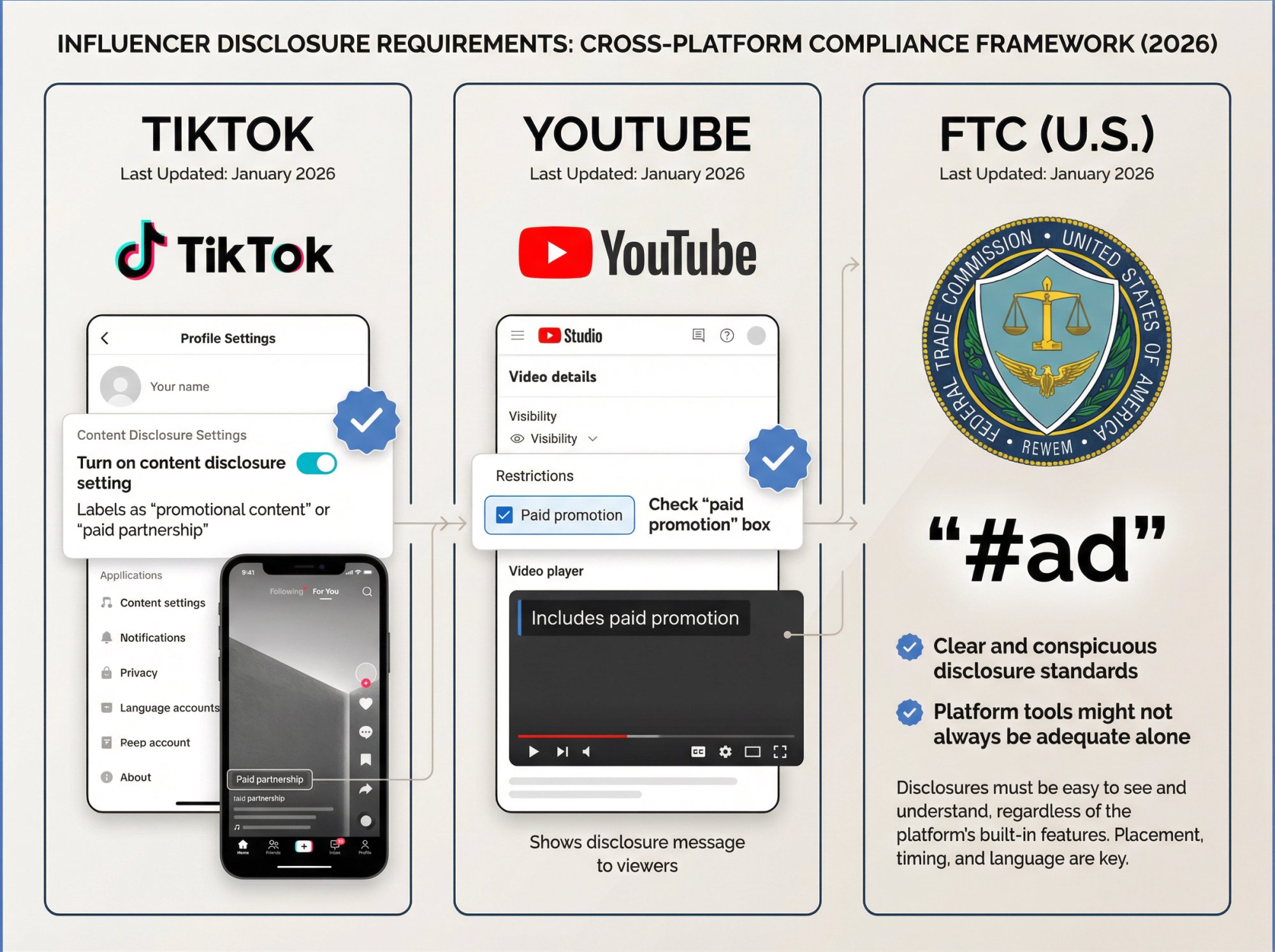
Platform Disclosure Requirements for Sponsored Content
| Platform | Disclosure Requirement | Last Updated |
|---|---|---|
| TikTok | Turn on content disclosure setting for promotional content. Labels as "promotional content" or "paid partnership." Once published, can't be changed. | January 2026 |
| YouTube | Check "paid promotion" box in video details for paid product placement, sponsorship, or endorsement. Shows disclosure message to viewers. | Applies to all formats including Shorts |
| FTC (U.S.) | Updated endorsement guides clarify "clear and conspicuous" disclosure standards. Platform tools might not always be adequate alone. | June 2023 |
How to Check Influencer Disclosure Compliance
Look at the influencer's last 20 sponsored posts and mark:
• How many are sponsored vs. organic
• How clearly they disclose (is #ad visible and upfront, or buried in a wall of hashtags?)
• Whether disclosures are consistent, readable, and properly placed
A creator who "forgets" disclosure is telling you they'll also "forget" other constraints. Proper disclosure isn't optional. It's a baseline professionalism test.
How to Check Influencer Sponsorship Saturation
Even great creators get less effective when the feed becomes mostly ads.
How to Calculate Influencer Ad Load
Scan the last 30 posts. How many are clearly sponsored? How many have affiliate links? Do posts start to look like templates?
Rule of thumb: The more templated the ads feel, the more you should expect declining marginal returns. If every other post is an #ad, their audience is probably tuning out by default.
Influencers who do too many partnerships dilute their recommendations. You're no longer getting a trusted endorsement. You're renting ad space on someone's feed, and the audience knows it.
Balance matters. A history of a few well-executed partnerships shows experience without over-saturation. But if their feed is basically a billboard, don't expect the same trust-driven results.
How to Calculate Influencer Pricing and ROI
This is where most teams get lazy. You need a defendable pricing model based on the influencer's actual performance.
How to Calculate Expected Influencer Performance
Use the creator's recent median performance as your baseline.
Inputs from the audit window:
• Median views per post (M)
• 25th percentile views (P25) = "bad but normal" outcome
• 75th percentile views (P75) = "good outcome"
• Engagement per view (optional but helpful)
Outputs:
• Expected impressions range per deliverable: P25 → P75
• Expected cost per 1,000 views = fee ÷ (expected views ÷ 1,000)
• Expected cost per engagement = fee ÷ expected engagements
This gives you a range instead of a single optimistic number. You're pricing based on realistic expectations, not best-case scenarios.
How to Negotiate Influencer Pricing
Instead of "we'll pay $X for a Reel," anchor on:
• Number of deliverables + usage rights + whitelisting options
• Performance expectations based on their own history (not industry averages)
• Reporting obligations (screenshots of reach, saves, top geos, etc.)
If their median views are 50k and they're asking for $5k per post, that's $100 per 1,000 views. Is that reasonable for your niche and conversion rates? Compare it to other channels (paid social, display, etc.) and decide if the ROI pencils out.
Deal math forces honesty. It turns vague "influencer vibes" into defensible business decisions.
Your CFO doesn't care about follower count. They care about cost per acquisition and return on ad spend. Deal math translates creator metrics into the language of business, so you can justify the investment with numbers, not hope.
Influencer Audit Scoring Framework (100 Points)
Audits can become subjective without structure. Use a scoring system so you can compare influencers objectively.
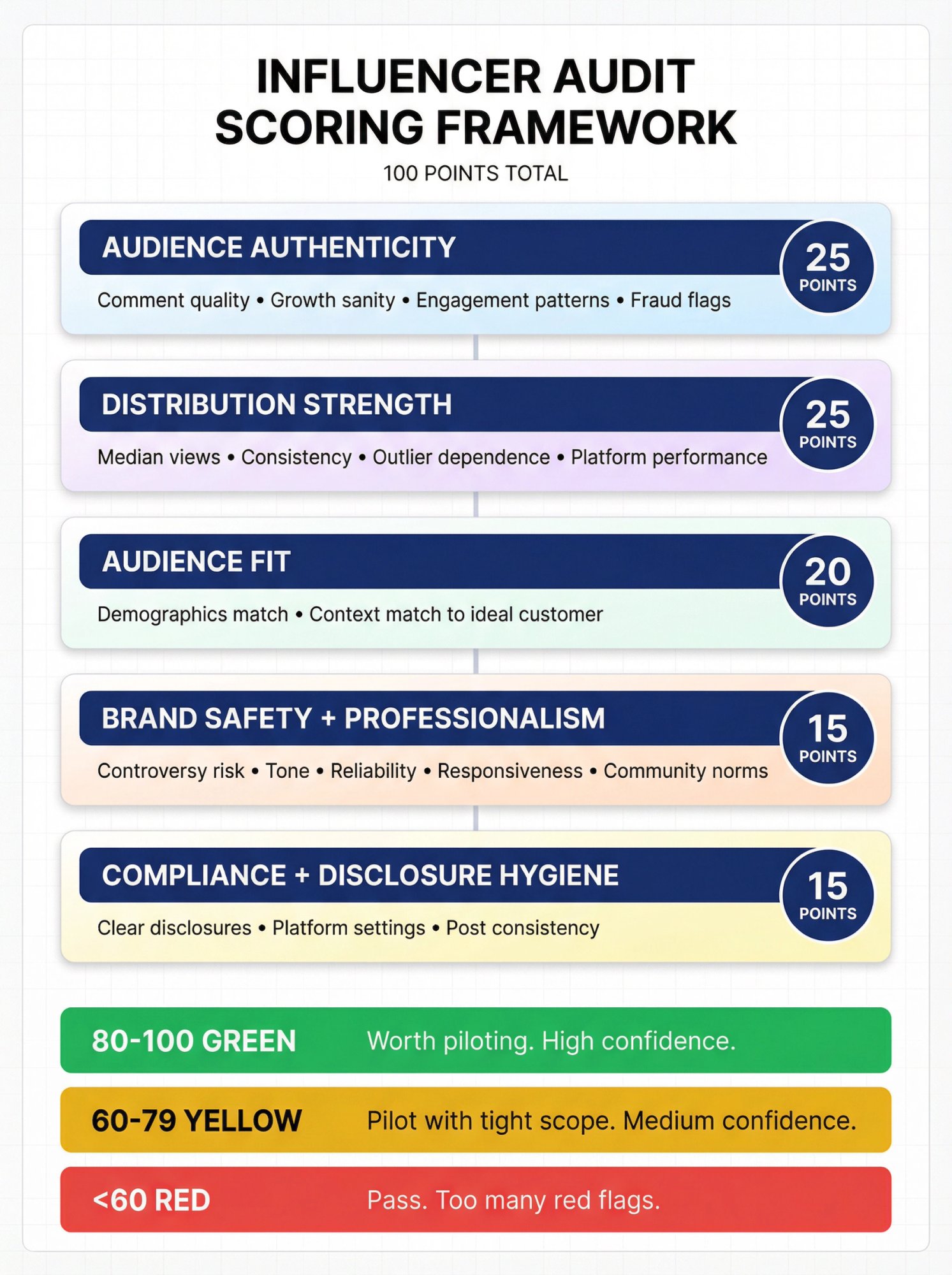
Score out of 100 points total. If you can't justify a score, you don't understand the profile yet.
| Category | Weight | What You're Scoring |
|---|---|---|
| Audience Authenticity | 25 points | Comment quality, growth sanity, engagement patterns, fraud flags |
| Distribution Strength | 25 points | Median views, consistency, outlier dependence, platform performance |
| Audience Fit | 20 points | Demographics match + context match to your ideal customer |
| Brand Safety + Professionalism | 15 points | Controversy risk, tone, reliability, responsiveness, community norms |
| Compliance + Disclosure Hygiene | 15 points | Clear disclosures, correct platform settings, consistency across posts |
Influencer Audit Decision Bands
• 80-100 (Green): Worth piloting. High confidence in authenticity, fit, and professionalism.
• 60-79 (Yellow): Pilot only with tight scope and strong reporting. Medium confidence with noted risks.
• <60 (Red): Pass. Too many red flags or misalignments to justify the risk.
The rubric prevents you from over-indexing on one great metric while ignoring glaring problems elsewhere. It forces you to assess the whole profile, not just follower count or engagement rate.
Influencer Audit Template Worksheet
Use this template every time you audit an influencer. Fill it out as you go, then calculate your score.
1) BASICS
• Handle(s):
• Platforms: TikTok / Instagram Reels / YouTube Shorts
• Niche in 8 words:
• Brand fit (yes/no + why):
2) DISTRIBUTION (last 30-90 days)
• Median views (last 10-20 posts):
• P25 views:
• P75 views:
• Consistency notes (spiky? stable?):
• Top formats/hooks that win:
3) AUTHENTICITY
• Follower growth notes:
• Comment quality notes:
• Pod/bot red flags (yes/no + evidence):
• Tool check (optional) + what it said:
4) AUDIENCE FIT (proof required)
• Top countries:
• Age/gender:
• Language:
• Why people follow them (context):
5) COMPLIANCE + DISCLOSURE
• Disclosed sponsorships clearly? (yes/no)
• Platform tools used? (TikTok disclosure setting / YouTube paid promotion) (yes/no)
• Any risky claims? (health/finance/etc.)
• Notes:
6) BRAND SAFETY
• Controversial topics?
• Comment section risk?
• Competitor conflicts?
7) DEAL MATH
• Fee asked:
• Expected views range: P25–P75
• Cost per 1k views (range):
• Required usage rights (organic only / paid / whitelisting):
• Pilot offer:
FINAL SCORE /100:
DECISION: Green / Yellow / Red
How to Audit Multiple Influencers at Scale with Shortimize
If you're auditing more than a handful of creators, doing this manually in spreadsheets and browser tabs will break you.
Here's a clean workflow using Shortimize as your cross-platform tracking hub.
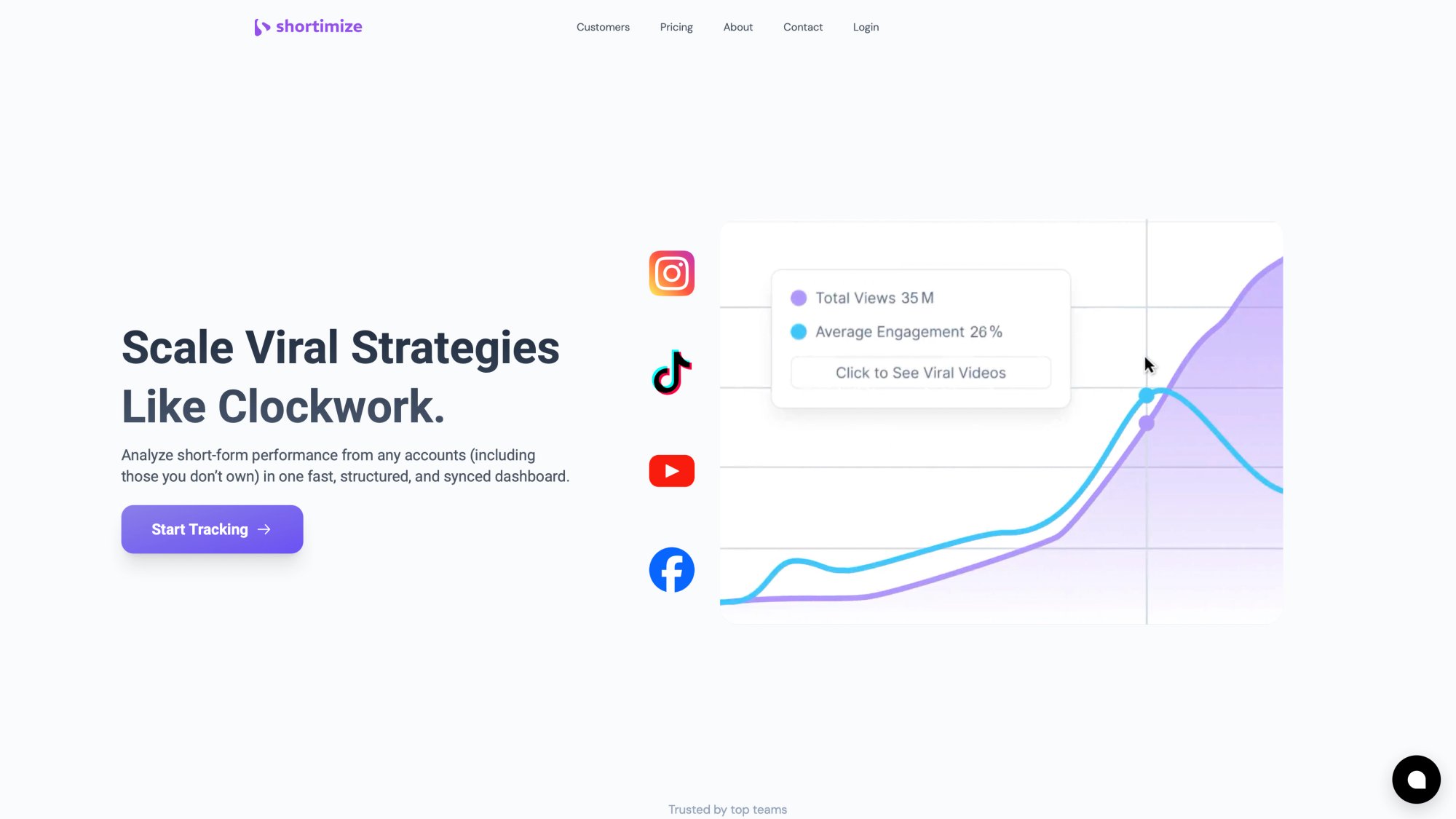
How to Track Influencer Accounts You Don't Own
Shortimize is designed to analyze short-form performance from accounts you don't own across platforms in one place. Just paste a handle or video URL and we pull the data.
This means you can audit 10, 20, 50 creators simultaneously without juggling platforms or losing track of who performed how.
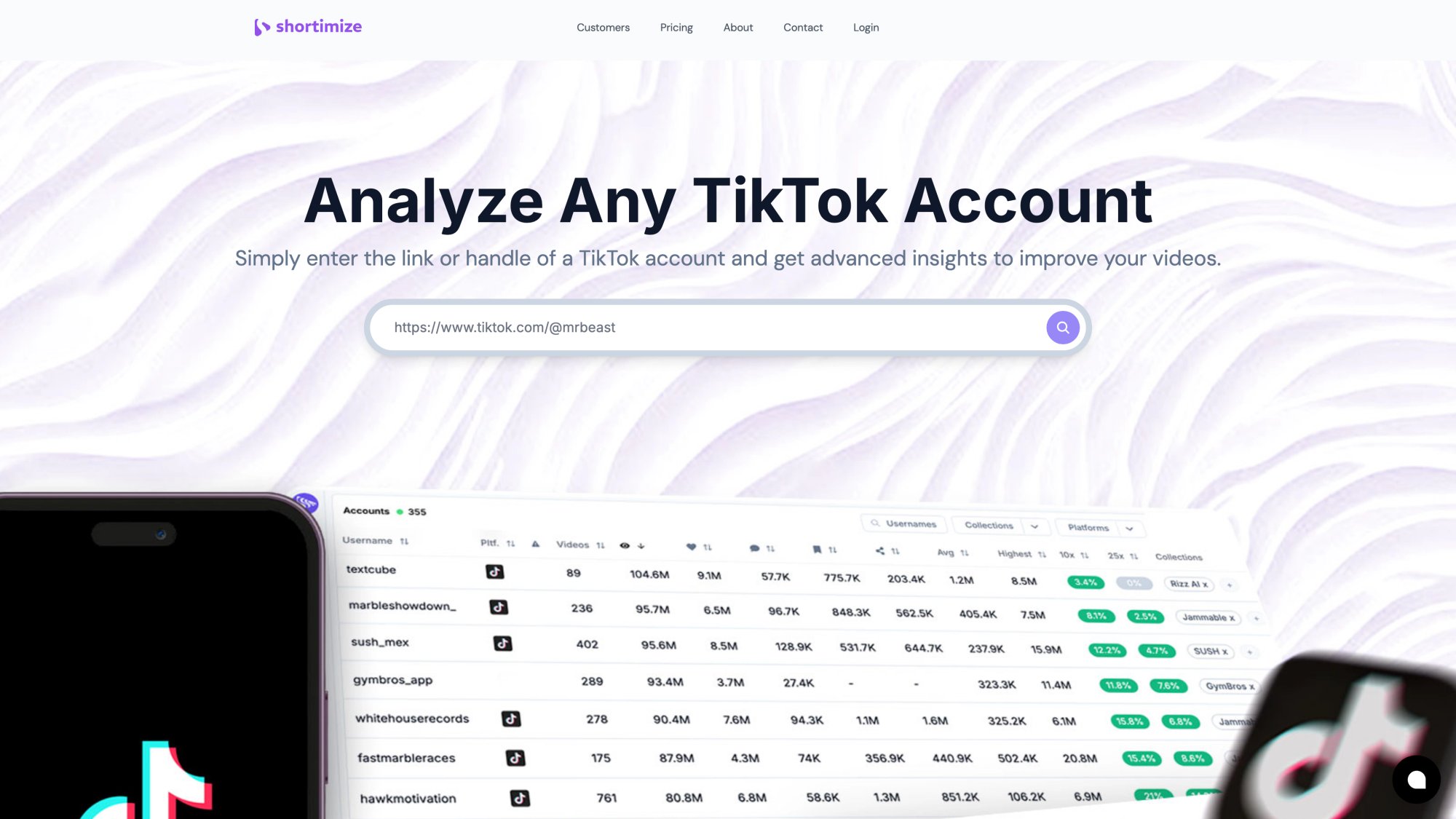
How to Use Median Performance Metrics for Influencer Audits
Shortimize surfaces median and virality metrics to spot what's actually typical versus spiky. You're not averaging outliers. You're seeing the pattern clearly.
For each creator, you'll see their median views, posting schedule, engagement trends, and which videos were true outliers versus typical performance. That clarity speeds up the entire audit process.
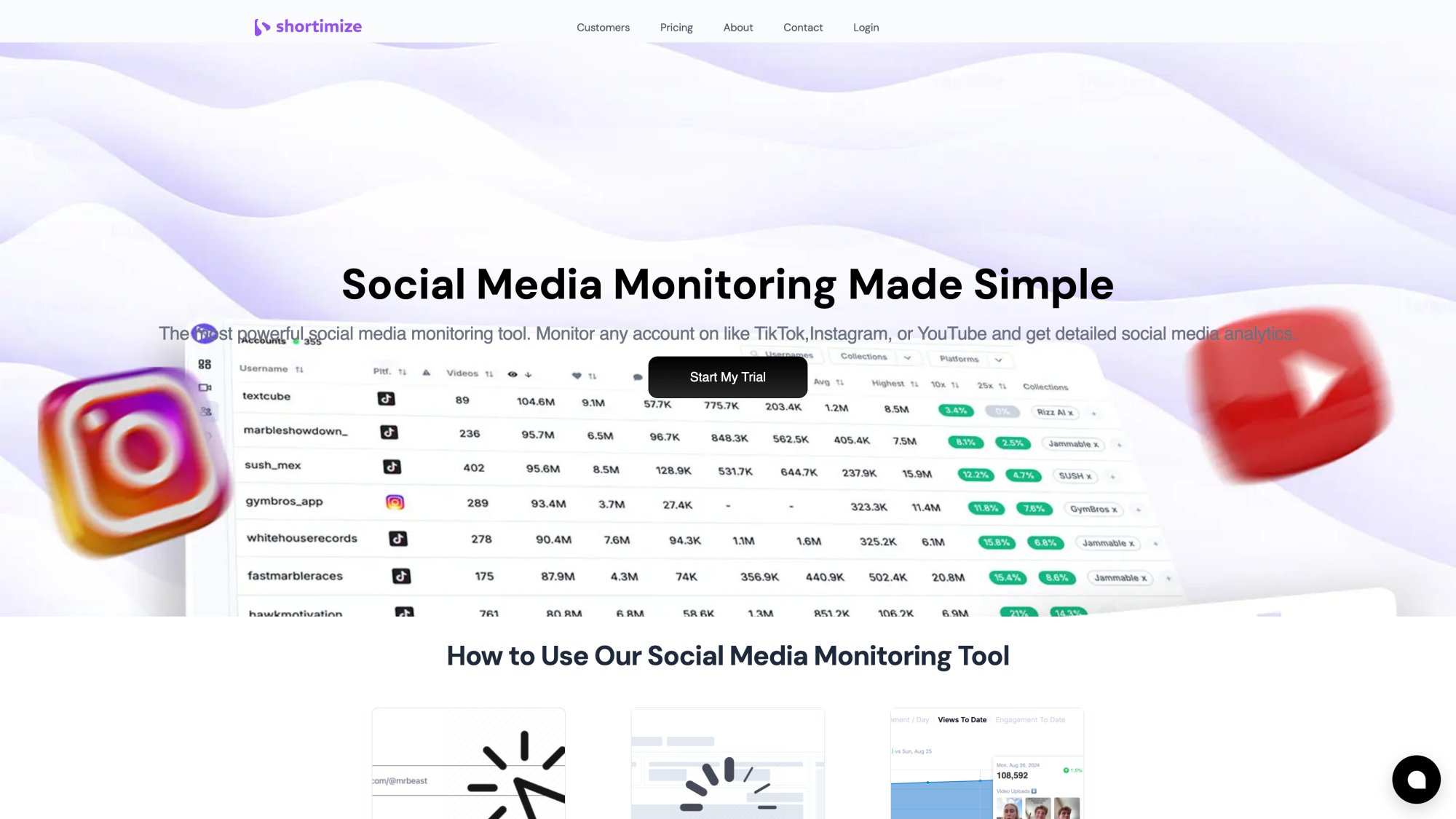
How to Build an Influencer Shortlist Collection
Group candidates into a Collection so you can:
• Compare performance side-by-side
• Keep notes and context for each creator
• Export the full comparison when it's time to present to stakeholders
Collections let you organize your audit pipeline. Instead of scattered notes in different tabs, everything lives in one structured workspace.
How to Monitor Influencer Performance During Campaigns
Shortimize emphasizes near real-time refresh (Business accounts refresh every 12 hours). Use this to:
• Catch when a creator unexpectedly goes viral (double down fast)
• Catch when performance collapses (pause spend fast)
• Track ongoing performance against the benchmarks you established during the audit
The audit doesn't stop when the contract is signed. Ongoing monitoring is where you actually protect ROI.
How to Export Influencer Audit Reports
Shortimize's monitoring capabilities let you export tables with a click for reporting. When you need to justify a partnership decision to your CMO or show campaign results to stakeholders, you have clean data to back it up.
No more screenshots from five different platforms stitched into a messy slide deck.
Best Tools for Influencer Audits
Combine manual analysis with the right tools to work smarter.
Platform Analytics Tools: Free historical data for YouTube, Instagram, TikTok. Great for checking follower growth charts and spotting odd spikes or drops at a glance.
Third-Party Analytics Platforms: Premium analytics focused on authenticity. These tools provide detailed audit reports including audience quality scores (real vs. fake followers), engagement rate trends, audience demographics, and fraud detection flags. Excellent for deep-dive fraud vetting.
Shortimize: Purpose-built for short-form video analytics. Track influencers' accounts in one dashboard, see median metrics and outlier patterns, organize candidates into Collections, and export performance reports. Best for ongoing monitoring and at-scale audits.
Platform Native Analytics: If the influencer will share their creator dashboard stats (Instagram Insights, TikTok Analytics, YouTube Studio), that's first-party data. It's the most accurate for things like audience demographics, watch time, and follower locations.
Google (for background checks): Search "[creator name] controversy" or "[creator name] scandal." Check Reddit discussions. Simple but critical for reputation auditing. If there was a major issue, you'll find it.
Build an influencer audit scorecard in a spreadsheet to compile all this info. Sections for authenticity, audience fit, content quality, engagement stats, compliance notes, tool outputs. Then you can compare multiple influencers objectively and document your decision-making process.
Influencer Audit Red Flags Checklist
Use this for fast screening. If you spot any of these within 10 minutes, dig deeper or walk away.
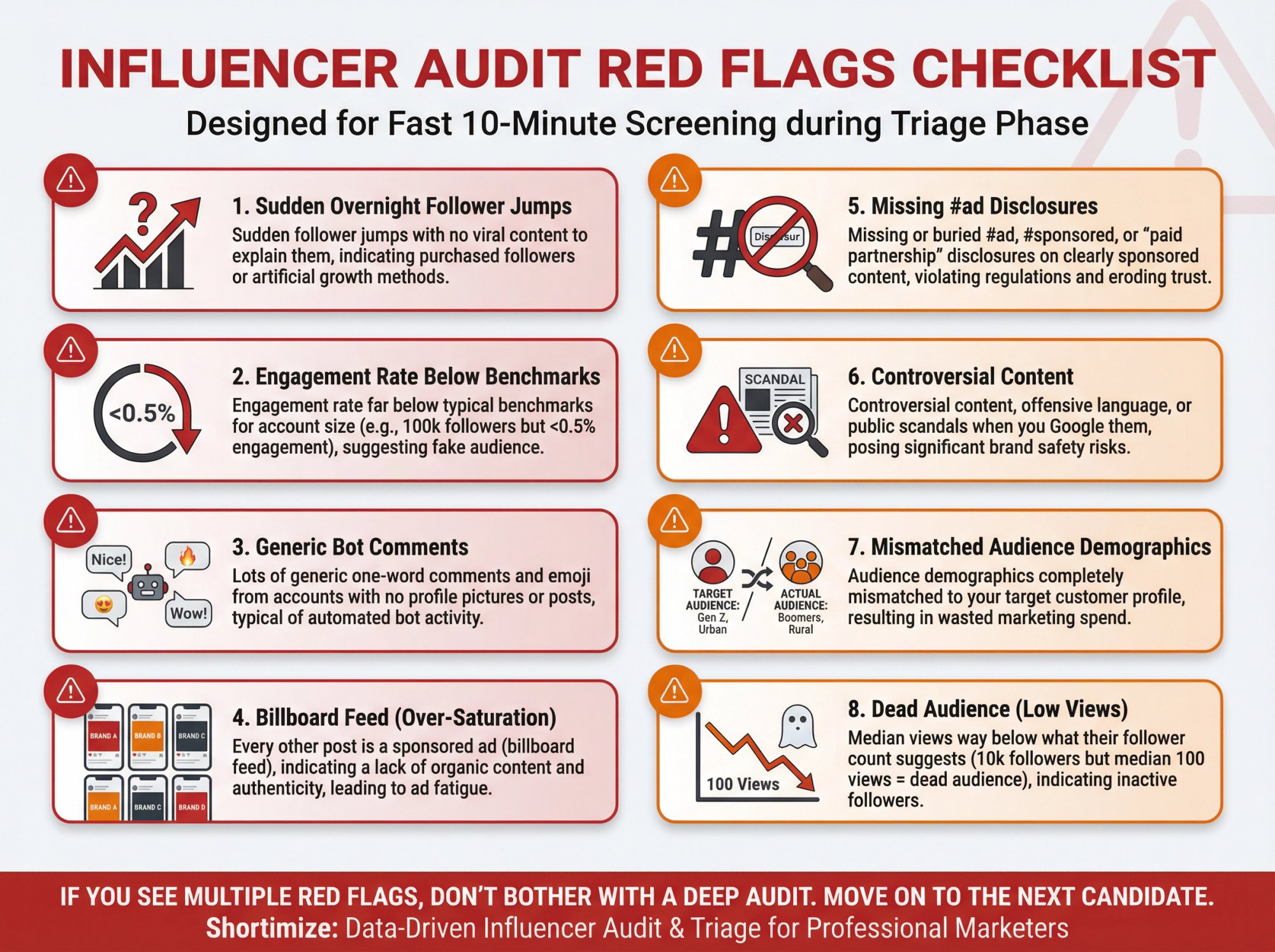
Immediate red flags:
• Sudden overnight follower jumps with no viral content to explain them
• Engagement rate far below typical benchmarks for account size (e.g., 100k followers but <0.5% engagement)
• Lots of generic one-word comments and emoji from accounts with no profile pictures or posts
• Every other post is a sponsored ad (billboard feed)
• Missing or buried #ad disclosures on clearly sponsored content
• Controversial content, offensive language, or public scandals when you Google them
• Audience demographics completely mismatched to your target customer
• Median views way below what their follower count would suggest (10k followers but median 100 views = dead audience)
If you see multiple red flags, don't bother with a deep audit. Move on to the next candidate.
What to Do After an Influencer Audit
Conducting a thorough influencer audit might feel intensive, but it's an investment that saves you from wasting budget on the wrong partners.
By verifying authenticity, analyzing audience fit, assessing content quality and engagement, and checking for compliance and brand safety, you build a complete picture of an influencer's real influence.
In 2026 and beyond, brands can't afford to take follower counts at face value. Influencer marketing spend is projected to reach over $30 billion worldwide. Audits are your insurance against the fraud and fluff that's rampant in the industry.
When you put in the work to vet creators properly (with the help of smart tools like Shortimize), you end up with partnerships that drive real ROI: genuine engagement, trust with your target customers, and ultimately conversions and sales.
How to Use Audit Findings in Influencer Negotiations
If an influencer passes your audit with flying colors, use those findings in your outreach and negotiation:
• Reference their strong median performance and consistent engagement (shows you did your homework)
• Propose content ideas that play to their top-performing formats
• Discuss disclosure expectations upfront to ensure compliance alignment
• Set clear reporting obligations based on the metrics that matter (median views, engagement quality, audience demographics)
And remember: the audit doesn't end when the contract is signed. Continue monitoring the influencer's performance throughout your campaign. An audit is a point-in-time snapshot. Ongoing tracking helps you measure actual results and catch issues early.
That's where we come in. Shortimize keeps you informed with continuous tracking, so you can spot performance changes the moment they happen. Try Shortimize free for 7 days to see how much faster and more confident your influencer audits can be.
By treating influencer selection with the same rigor as any other business investment, you maximize your chances of success. Use this guide as your go-to resource every time you evaluate a new creator. With practice, you'll become even more efficient at spotting red flags and identifying genuine opportunities.
In the fast-changing creator economy, an informed, data-driven approach is your best defense against the hype and your secret weapon for forging truly impactful influencer partnerships.