Instagram isn't just another social platform for influencer marketing. It's the platform where visual storytelling, community trust, and commerce intersect at scale.
With around 3 billion monthly active users globally and over 57% of brands preferring it for influencer campaigns, Instagram offers something rare: massive reach combined with intimate creator-audience relationships. But success isn't about finding someone with a big following. It's about understanding how to turn authentic partnerships into measurable business results (and tracking those partnerships effectively with tools like Shortimize's influencer tracking).
This guide covers everything from choosing the right influencers to measuring ROI, with current 2026 insights that go beyond surface-level tactics.
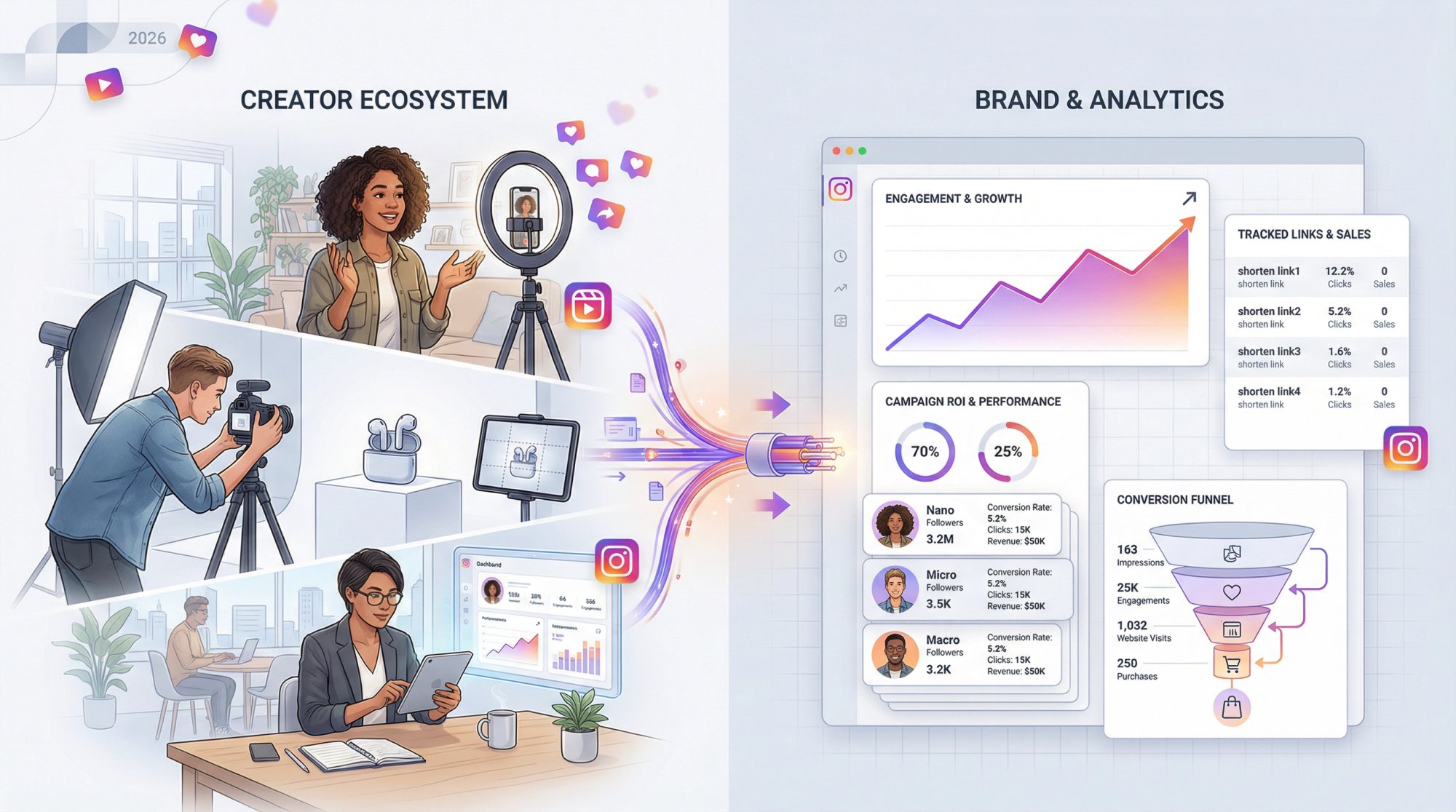
What Is Instagram Influencer Marketing and Why It Works
Instagram influencer marketing means partnering with content creators who have established followings to promote your products or services. The creator showcases your brand in their authentic style while you compensate them through payment, free products, or other arrangements.
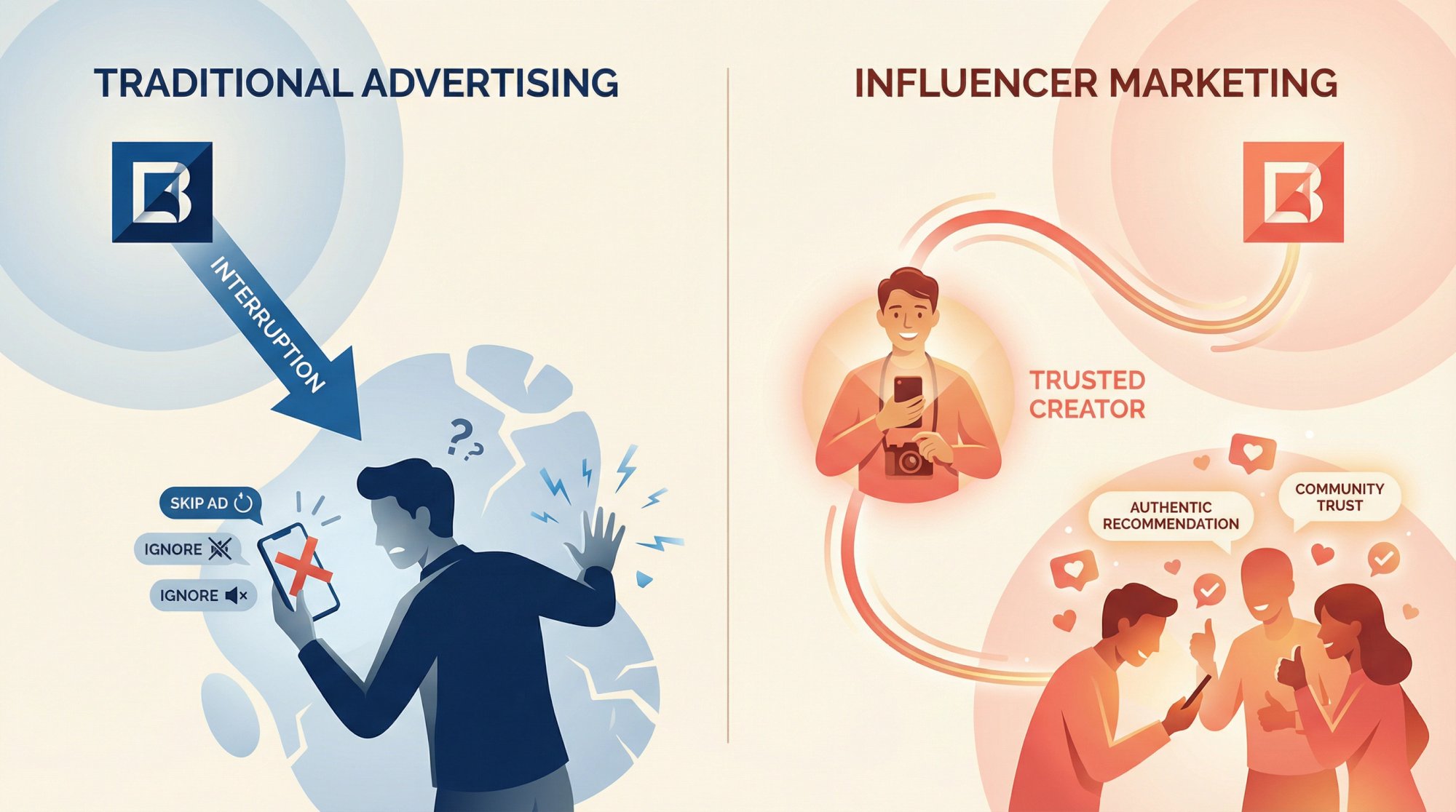
The key difference from traditional advertising: Trust transfer. When an influencer recommends something, their audience receives it as a trusted recommendation from someone they admire, not an interruption from a brand they might not know.
Here's what makes Instagram uniquely powerful for this:
→ Visual-first platform: Instagram's DNA is beautiful photos and engaging videos, perfect for showcasing products in real-world contexts
→ High engagement rates: Followers actively interact with creator content through likes, comments, shares, and DMs
→ Shopping integration: Features like product tags, link stickers, and in-app checkout create seamless paths from discovery to purchase
→ Algorithm advantages: Instagram Reels can reach beyond an influencer's existing followers, potentially going viral to massive new audiences
And the numbers back this up. Research shows 86% of consumers say influencers have encouraged them to make a purchase, with nearly half saying an influencer inspires a monthly purchase. That's serious buying power.
Why Instagram Is the Best Platform for Influencer Marketing
Instagram maintains its position as the top influencer marketing channel for good reasons. Industry research shows that 68% of marketing specialists consider Instagram crucial for their influencer efforts.
Scale meets specificity. Instagram's user base spans virtually every demographic. About 44-45% of users are 25-34 years old (prime buying age), but the platform also reaches teens, middle-aged adults, and even 15% of those over 65. Whatever your target audience, they're likely active on Instagram (and you can analyze Instagram Reels accounts to understand exactly how your influencer partners perform).
Content that converts. The platform's visual nature makes it ideal for product showcases. Whether it's a beautifully composed photo, a quick Reel, or an authentic Story, Instagram content stops mid-scroll and creates memorable impressions. Influencers here are skilled at creating polished yet relatable content that drives action.
Commerce-ready ecosystem. Instagram isn't just for browsing anymore. With Shop tags, checkout features, and link stickers in Stories, the platform has built direct paths from inspiration to purchase. Instagram leads in shoppable posts, making it natural for influencer promotions to drive sales.
Platform stability. While newer networks rise and fall, Instagram has proven staying power. Events like potential TikTok regulations have actually pushed brands to double down on Instagram as a reliable long-term bet.
4 Types of Instagram Influencers and When to Use Each
Not all influencers deliver the same value. Understanding these tiers helps you match your goals with the right partnership level.
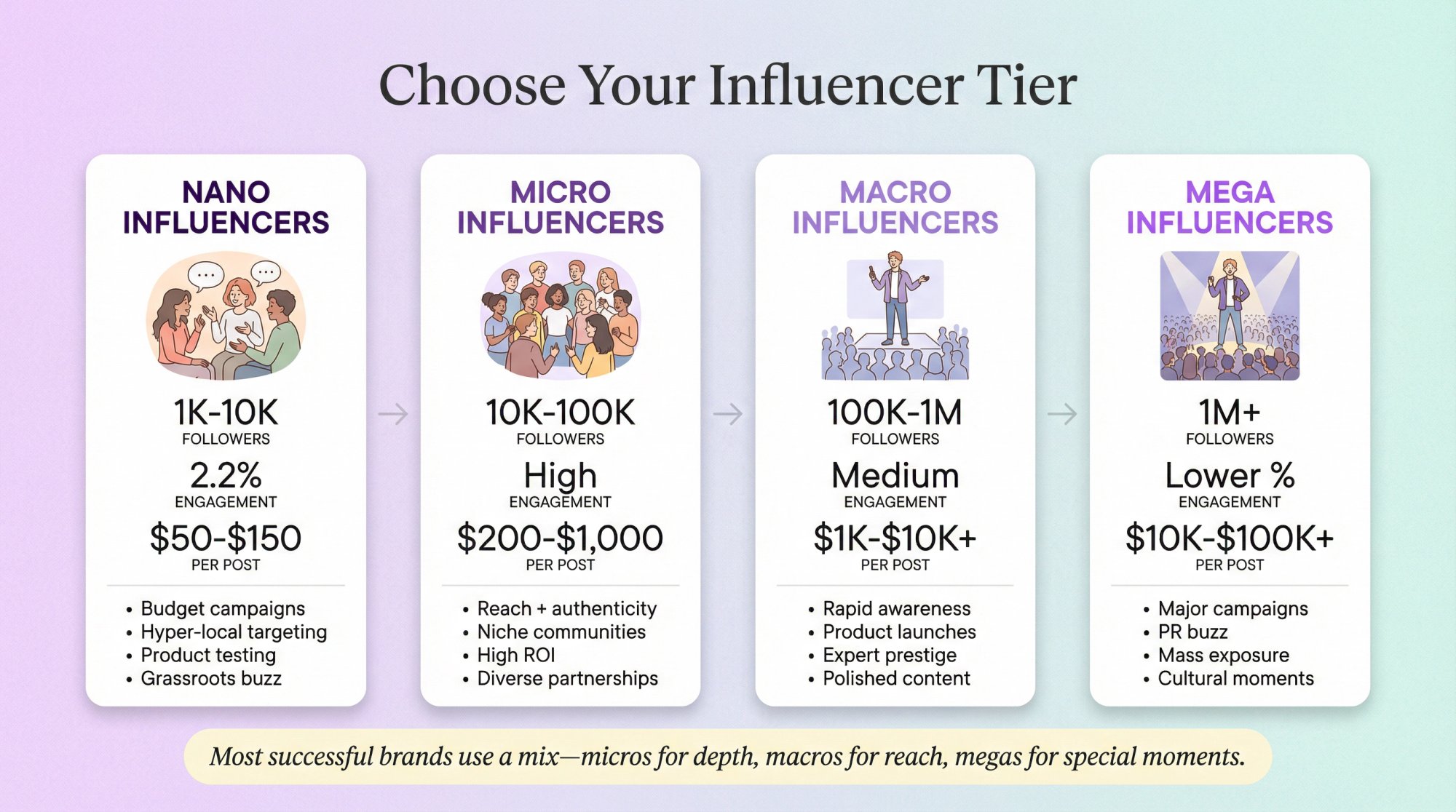
Nano Influencers: 1,000-10,000 Followers
These everyday people have built modest but highly engaged communities around specific niches. Research shows nano influencers make up about 75-76% of Instagram's influencer ecosystem, and they average around 2.2% engagement rate, the highest among all tiers.
For brands looking to work with nano influencers, tracking their performance at scale becomes essential. Even though individual nano influencers have smaller audiences, managing 20-50 of them simultaneously requires robust analytics.
When to use them:
• Budget-conscious campaigns needing grassroots buzz
• Hyper-local or niche audience targeting
• Testing product-market fit with authentic reactions
• Building volume through many small partnerships
Typical cost: Often willing to work for free products or $50-150 per post
Micro Influencers: 10,000-100,000 Followers
The sweet spot for many brands. Micros have grown beyond nano scale but maintain strong engagement and niche focus. They're often the most cost-effective tier, delivering high ROI through targeted reach.
This tier benefits significantly from systematic tracking. Using tools to discover the best micro influencers can help you identify hidden gems with authentic engagement before your competitors find them.
When to use them:
① Balancing reach with authenticity
② Reaching specific interest communities (fitness, tech, parenting, etc.)
③ Campaigns focused on engagement over raw impressions
④ Building a portfolio of diverse creator partnerships
Typical cost: $200-1,000 per post depending on niche and engagement
Macro Influencers: 100,000-1 Million Followers
Internet celebrities or well-known niche experts with broad appeal in their category. They bring professionalism, established brand equity, and significant reach.
When to use them:
Rapid brand awareness campaigns
Launching new products to large audiences
Adding prestige through association with respected experts
When you need polished, high-production content
Typical cost: $1,000-10,000+ per post
Mega Influencers: 1 Million+ Followers
Household names, celebrities, and top-tier Instagram personalities with massive, diverse followings. While they typically have much lower engagement rates by percentage, they deliver unmatched exposure.
When to use them:
→ Major product launches or brand campaigns
→ Creating PR buzz and cultural moments
→ When budget allows for significant investment
→ Reaching mainstream audiences beyond niche communities
Typical cost: $10,000-$100,000+ per post
The smart approach? Most successful brands use a mix. Work with several micro influencers for depth and engagement, add a macro for reach, and save megas for special campaigns where mass exposure justifies the cost.
How to Find the Right Instagram Influencers: Step-by-Step
This is where most campaigns succeed or fail. About 30% of marketing teams cite finding suitable influencers as a top obstacle, right alongside measuring ROI. Here's how to do it right.
Step 1: Define Your Audience and Goals First
Before hunting for influencers, get crystal clear on:
• Who you're targeting (demographics, interests, pain points)
• What you want to achieve (awareness, sales, content, engagement)
• How you'll measure success (specific KPIs, not vague "awareness")
Example: Instead of "we want more brand awareness," try "we want to reach 500,000 women aged 25-35 interested in sustainable fashion, drive 10,000 website visits, and generate $50,000 in tracked revenue."
Step 2: Search Within Your Niche Strategically
Hashtag mining: Search relevant hashtags (#sustainablefashion, #veganbeauty, etc.) to find creators consistently posting in your space
Check your existing community: Your current followers might include micro influencers. Look at who tags you, engages regularly, or has already mentioned your brand
Study competitors: See who they've partnered with. These influencers already speak to your target audience
Explore Instagram's algorithm: Interact with niche content and let the Explore page surface similar creators
Step 3: Use Discovery Tools for Data-Driven Choices
Influencer marketing tools let you filter by:
Follower count and engagement rate
Audience demographics (age, location, gender)
Content category and posting frequency
Authenticity scores (detecting fake followers)
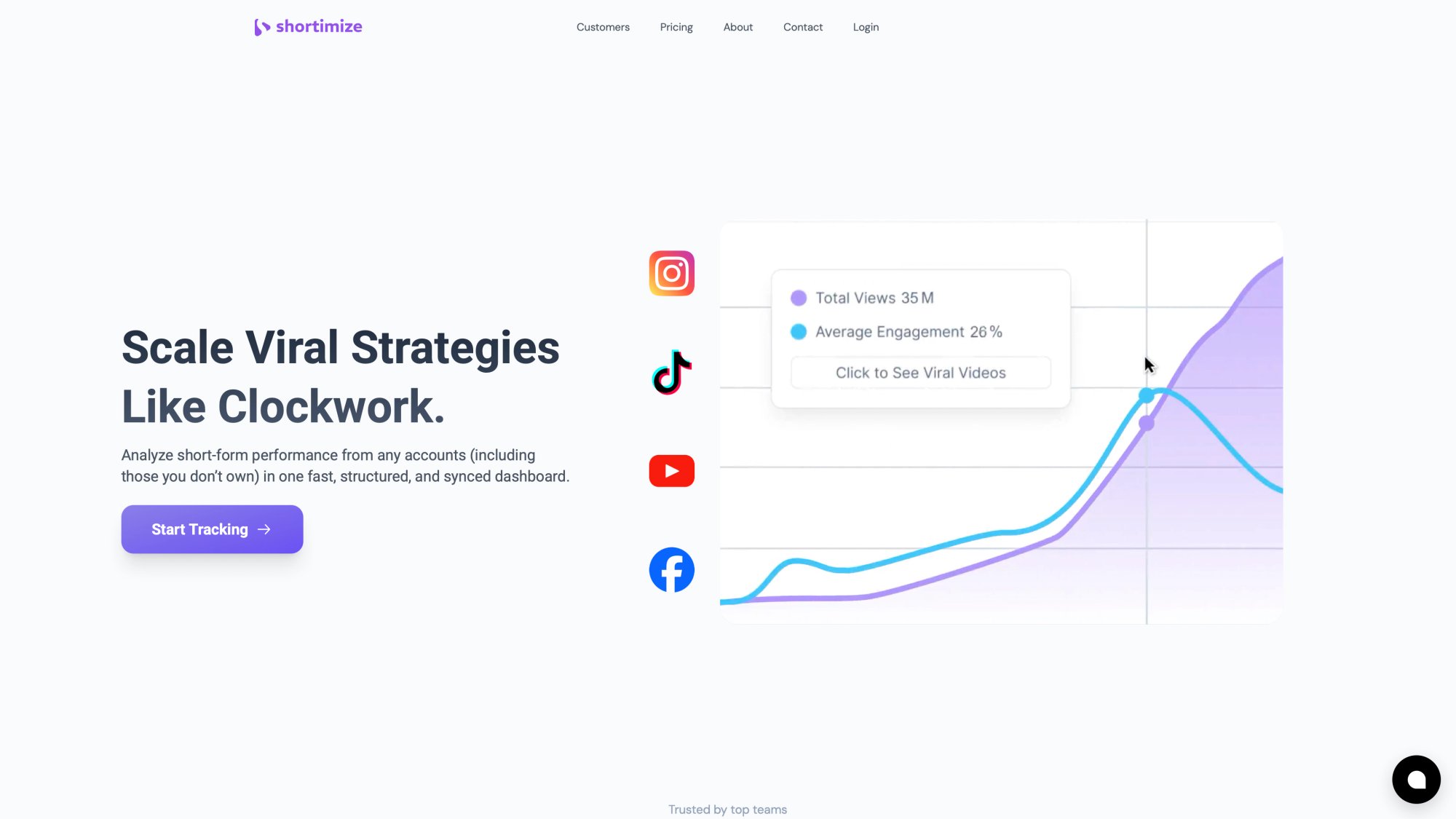
We use Shortimize's influencer tracking to monitor performance across Instagram, TikTok, and YouTube in one place. You can track any creator account, see their posting schedules, analyze engagement patterns, and discover similar influencers, which streamlines the vetting process significantly.
For brands running campaigns across multiple platforms, cross-analyzing influencers on TikTok, Reels, and Shorts reveals which creators maintain consistent quality across channels.
Pro tip: Influencer analytics tools can give quick legitimacy checks even without a paid subscription.
Step 4: Vet Candidates Thoroughly
Don't just look at follower counts. Evaluate:
Content quality and brand alignment
Does their aesthetic, tone, and style match how you want your brand represented? A premium luxury brand needs different content than a casual lifestyle brand.
Engagement depth
Look beyond likes. Check:
→ Comment quality (are they meaningful or just emojis?)
→ Response rate (does the influencer engage back?)
→ Save and share rates (strong signals of valuable content)
A micro influencer with 15,000 followers getting 1,000+ likes and 50 genuine comments per post often outperforms a 100,000-follower account with minimal engagement.
Audience demographics
Verify their followers actually match your target customer. Check:
• Age range and gender split
• Geographic location
• Interests and behaviors
Authenticity check
Red flags for fake followers:
① Abnormally high followers with very low engagement
② Generic comments from random accounts ("Nice pic!" "Cool!")
③ Suspicious follower growth patterns
Research shows 1 in 4 influencers have purchased fake followers at some point. Identifying influencers with fake engagement protects your budget from wasteful partnerships.
Sponsorship frequency
Scroll their feed. If every other post is #ad, their audience probably has sponsor fatigue. Look for creators who do some brand partnerships (showing professionalism) but aren't constant billboards.
Step 5: Start Small and Test
Not sure about an influencer? Start with a trial:
Send free product for an organic review
Do one paid Story before committing to a full campaign
Test multiple micro influencers with small budgets to see who performs
Track results from these tests. The data will show you which influencers actually drive engagement or conversions, not just vanity metrics.
How to Plan Instagram Influencer Campaigns That Drive Results
Once you've found the right creators, structure your campaign for success. Here's the framework that works.
Set Clear, Measurable Goals
Choose your primary objective:
| Campaign Goal | Primary KPIs | Success Looks Like |
|---|---|---|
| Brand Awareness | Reach, impressions, video views, engagement rate | Your brand shows up in front of X new potential customers with Y engagement |
| Traffic & Leads | Link clicks, landing page visitors, email sign-ups, conversion rate | X website sessions resulting in Y qualified leads at $Z cost per lead |
| Direct Sales | Orders, revenue, promo code redemptions, ROAS | $X revenue generated from $Y investment, with Z% attributed to specific influencers |
| Content Creation | Usable content pieces, ad performance of creator content | High-quality assets you can repurpose in paid ads, email, or on-site |
Define this upfront so both you and the influencer know what winning looks like.
Choose Your Campaign Format
Feed Posts: Permanent content that accumulates reach over time. Great for beautifully composed product showcases with detailed captions. Include the Paid Partnership tag for transparency and analytics access.
Instagram Stories: 24-hour temporary content perfect for:
• Behind-the-scenes authenticity
• Quick testimonials or unboxing
• Direct traffic with link stickers
• Interactive elements (polls, questions)
Request influencers share screenshots of Story insights or save them as Highlights so you can capture metrics.
Reels: Short-form videos (15-90 seconds) with massive viral potential. Instagram's algorithm heavily promotes Reels, often showing them to users who don't follow the creator. Perfect for:
→ Product demonstrations
→ Before/after transformations
→ Trending challenges featuring your product
→ Quick how-to tutorials
Multiple formats work best. A common winning combination: one Feed post for permanence, a Reel for viral reach, and Stories for direct conversion with link stickers.
Create a Creative Brief That Enables Success
Give influencers clear direction without killing authenticity:
Include:
• Product's key selling points
• Campaign theme or message
• 2-3 must-mention points
• Specific claims to avoid (if any)
• Required hashtags and @mentions
• Posting timeline and deadlines
• How you'll review content before it goes live
Don't include:
Word-for-word scripts (let them use their voice)
Overly restrictive rules that stifle creativity
Micromanagement of every detail
The best results come when creators' authentic voices shine through. Give constraints and outcomes, not scripts.
Negotiate Fair Compensation
Influencer payment models:
Free product/gifting: Works for nanos and some micros who genuinely want to try your product
Flat fee: Fixed payment per deliverable (most common for experienced creators)
Performance-based: Commission on sales via unique codes or affiliate links
Hybrid deals: Base fee + performance bonus (increasingly popular; research shows 4 out of 5 creators prefer this model)
2026 pricing benchmarks:
| Influencer Tier | Typical Instagram Post Cost |
|---|---|
| Nano (1K-10K) | $50-$150 |
| Micro (10K-100K) | $200-$1,000 |
| Mid (100K-500K) | $1,000-$5,000 |
| Macro (500K-1M) | $5,000-$10,000 |
| Mega (1M+) | $10,000-$100,000+ |
Note: Prices vary significantly by niche, engagement, and content type. Stories typically cost less than Feed posts; Reels often cost more due to production effort.
Negotiation tips:
① Offer smaller base fee + generous performance bonuses
② Bundle deliverables (1 Reel + 3 Stories) for better value
③ Limit usage rights initially (30 days on Meta only vs. 12 months all channels)
④ Build in one free revision/iteration
Also negotiate content rights upfront. If you want to repost their content, use it in ads, or feature it on your website, clarify that in the agreement. Many micros are fine with this if discussed transparently.
Lock Everything in a Written Agreement
Even a simple one-pager should cover:
Deliverables: Specific content types, quantities, deadlines
Compensation: Payment amount, terms (net 15/30), partial upfront if needed
Approval process: How many revisions, turnaround time
Usage rights: Organic-only vs. paid usage, duration, platforms
Exclusivity: Can't promote direct competitors for X days
Disclosure requirements: Must use #ad and Paid Partnership label
Cancellation terms: What happens if either party backs out
This protects both sides and prevents misunderstandings that kill campaigns.
Instagram Influencer Collaboration Best Practices That Work
The difference between good and great influencer campaigns often comes down to execution details.
Trust Their Creative Instincts
You chose them for their audience connection and content skills. Give guidelines, but don't micromanage. Authentic integration works because it feels like typical content from that creator, just featuring your brand.
Bad approach: "Say these exact words in this exact order."
Good approach: "We'd love you to highlight how our product saves time and is eco-friendly. Feel free to share your genuine experience in your style."
Be Clear But Not Controlling
Provide all necessary information upfront:
• What you want to achieve
• Non-negotiable requirements (brand name mention, discount code, etc.)
• Timeline and posting dates
• How you'll review content
But also listen to their input. If they say "my audience responds better to X format," consider it seriously. They know their community.
Build Real Relationships, Not Transactions
→ Follow and engage with their content regularly (before, during, and after campaigns)
→ Send products with personal notes or small extras
→ Be responsive and supportive during the collaboration
→ Share campaign results with them after
→ Keep them updated on new products or opportunities
Long-term partnerships deliver compounding benefits. An influencer who genuinely loves your brand might promote it organically between paid campaigns.
For ongoing partnerships, social media monitoring helps you stay on top of mentions, engagement patterns, and audience sentiment around your collaborations.
Ensure Proper Disclosure
This isn't optional. FTC guidelines require clear, conspicuous disclosure of any material connection (payment, free product, etc.).
Do this:
① Start captions with [AD] or "Sponsored:" in the first line
② Use Instagram's Paid Partnership tag
③ Include #ad or #sponsored hashtags
④ For Stories, overlay disclosure text on each frame
⑤ For videos, mention the partnership verbally early on
Don't do this:
Hide disclosure in a pile of hashtags
Use vague terms like "#collab" or "#sp"
Only tag the brand (not sufficient disclosure)
Assume the Paid Partnership label alone is enough
Both brands and influencers can face penalties for non-disclosure. Beyond legal risk, transparency maintains trust with audiences who actually appreciate honesty about sponsorships.
Use Instagram's Features Strategically
Use the Collab feature: Allows the post to appear on both accounts, pooling engagement
Enable Branded Content tools: Gives you analytics access and the ability to promote the content as an ad
Boost high-performing content: Partnership ads (whitelisting) let you promote the influencer's content to your target audiences beyond their followers
Add interactive elements: Polls, questions, and quizzes in Stories increase engagement and algorithm visibility
Tag products: If you have Instagram Shopping enabled, product tags create seamless purchase paths
Engage in Real-Time
When posts go live:
• Like and comment from your brand account
• Monitor comments for questions or concerns
• Address misinformation quickly
• Engage with people expressing interest
• Watch for negative sentiment requiring immediate response
Active presence in the comment section can turn curious viewers into customers.
Be Ready to Adjust Mid-Campaign
If something isn't working, don't just wait it out:
Test different formats if one underperforms
Adjust messaging based on audience feedback
Capitalize on unexpected success by extending reach
Add supporting Stories or Q&As if needed
Real-time monitoring allows optimization. Check performance at least daily during active campaigns.
How to Measure Instagram Influencer Marketing ROI
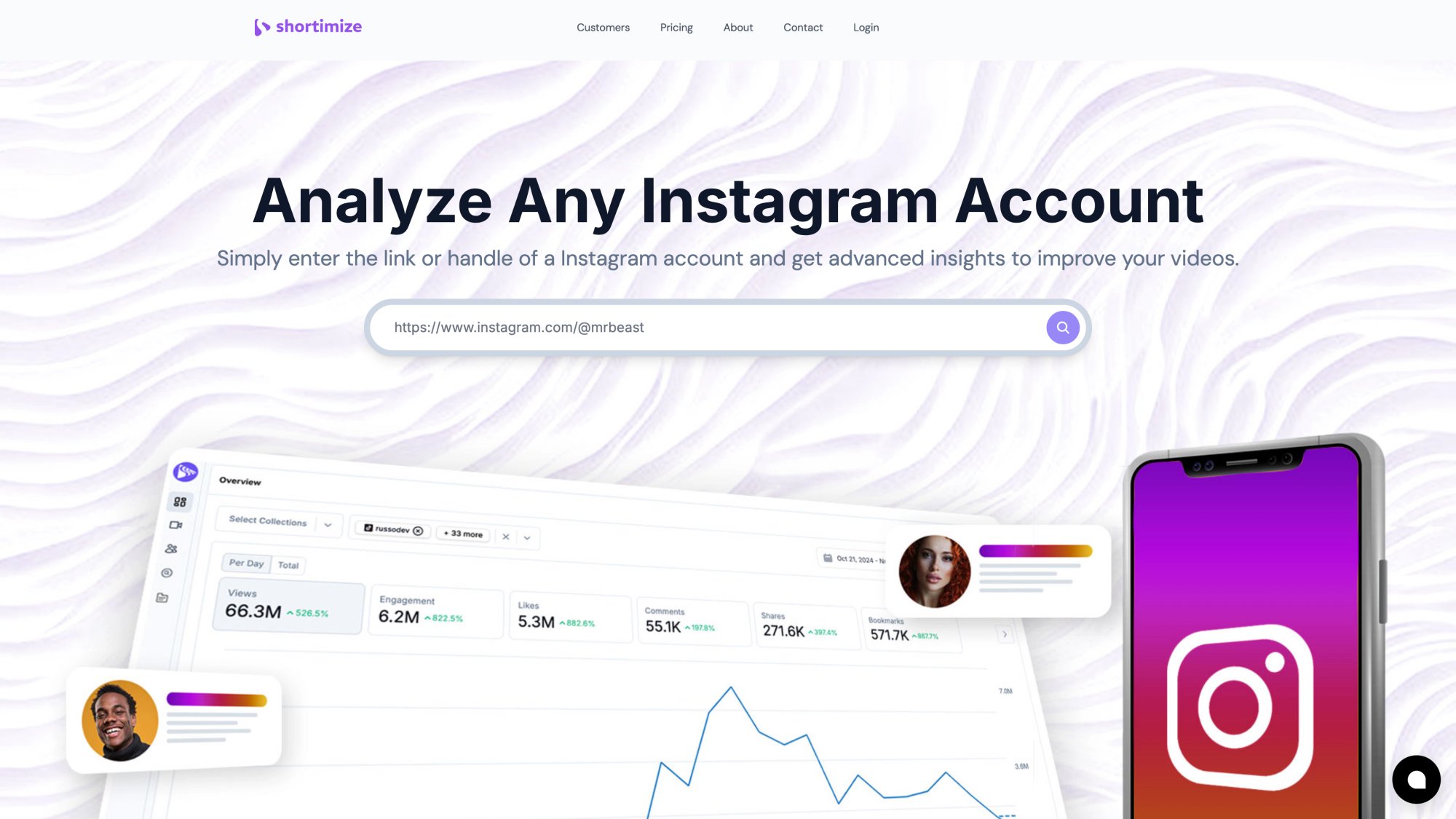
About 26% of marketers say measuring ROI is a top challenge. But it's absolutely doable with the right setup. Here's how we track influencer campaigns at Shortimize.
Track Core Metrics Based on Your Goals
| Campaign Type | Key Metrics to Track |
|---|---|
| Awareness Campaigns | Reach and impressions (how many saw the content) • Video views (for Reels and video posts) • Engagement rate (likes + comments + shares / followers) • New follower growth on your brand account • Share and save rates (strong signals of value) |
| Traffic Campaigns | Link clicks from Stories or bio • Landing page visitors (via UTM-tagged URLs) • Time on site and pages visited • Bounce rate (quality of traffic) |
| Conversion Campaigns | Promo code redemptions by influencer • Sales attributed to unique links • Cost per acquisition (CPA) • Return on ad spend (ROAS) • Revenue per influencer |
Set Up Proper Attribution
UTM parameters are non-negotiable. Create unique URLs for each influencer:
yourbrand.com/?utm_source=instagram&utm_medium=influencer&utm_campaign=spring2026&utm_content=jane_doe
This lets you see in Google Analytics exactly which traffic and conversions came from which creator.
Unique promo codes work brilliantly: Give each influencer their own discount code (JANE20, SARAH15, etc.). This:
• Makes tracking dead simple
• Incentivizes purchases
• Lets you compare influencer performance directly
• Shows exactly how many sales each creator drove
Using trackable links and codes is one of the most effective ways to measure influencer impact accurately.
Request Performance Data from Influencers
Since you can't see their private analytics, ask for screenshots showing:
For Feed Posts and Reels:
→ Reach and impressions
→ Saves and shares
→ Profile visits generated
→ Follower demographics
For Stories:
Impressions per frame
Taps forward/back
Link sticker clicks
Story replies
Put this requirement in your contract so they know to capture the data.
Calculate Real ROI
The formula is straightforward:
ROI = (Revenue Generated – Campaign Cost) / Campaign Cost × 100
Example: You spent $5,000 total (influencer fees + products + shipping) and tracked $22,000 in revenue from promo codes and UTM links.
ROI = ($22,000 – $5,000) / $5,000 × 100 = 340% ROI
Industry benchmarks average around $5.78 return per $1 spent, but your results will vary based on product, audience, and execution.
Track Beyond Direct Attribution
Not everything converts immediately. Also measure:
Brand lift: Did searches for your brand increase during the campaign?
Assisted conversions: Did Instagram touch any part of the buyer journey for people who converted later?
Content value: Can you repurpose influencer content in ads, email, or on-site? That has real dollar value.
Follower quality: New followers from influencer campaigns often convert at higher rates than other sources.
Long-term impact: Track for weeks after the campaign ends. Influencer content often keeps driving results through Explore pages or Google.
Use the Right Tools
Manual tracking works for small campaigns, but as you scale:
• Shortimize for tracking creator performance across Instagram, TikTok, and YouTube simultaneously
• Google Analytics for website traffic and conversion tracking
• Influencer tracking software for campaign management and built-in analytics
• Instagram Insights (when using Branded Content tools) for official platform data
We've found that tracking influencer campaigns across multiple platforms in one dashboard saves hours and reveals patterns you'd miss looking at each creator separately.
Analyze and Learn for Next Time
After each campaign, document:
What worked:
① Which influencers drove the best results (engagement, traffic, sales)
② Which content formats performed best
③ What messaging resonated
④ Which posting times got highest reach
What didn't:
Underperforming influencers (and why)
Content that fell flat
Technical issues or process failures
How to improve:
→ Budget reallocation for next campaign
→ Format or messaging adjustments
→ Better brief guidelines
→ Smoother collaboration processes
Shortimize's analysis features help identify these patterns by comparing posting schedules, content types, and engagement across creators.
Instagram Influencer Marketing Trends in 2026
The landscape keeps evolving. Here's what's happening now and what to prepare for.
The Micro and Nano Influencer Takeover
Research shows that about 76% of Instagram influencers have under 10,000 followers, and the "long tail" of smaller creators collectively drives massive impact. Brands are increasingly running campaigns with 20-50 micro influencers instead of one macro.
Why this works:
• Hyper-targeted reach into specific communities
• Higher engagement rates (often 2-3x what macros achieve)
• Better authenticity and trust signals
• Risk diversification (if one underperforms, others compensate)
• More cost-effective at scale
The future likely involves platforms and AI tools that help manage these "micro-influencer armies" efficiently.
Authenticity Over Everything
Consumers are alert to fake followers and forced partnerships. Expect to see:
Greater scrutiny of influencer authenticity metrics
More transparent, long-term brand ambassador relationships
Less scripted, more candid content that feels genuine
Zero tolerance for fake engagement from brands and platforms
Influencers who consistently deliver authentic content will command premium rates, while those with questionable engagement will lose partnerships.
Performance-Based Compensation Becomes Standard
With economic pressures driving ROI focus, more brands are shifting to hybrid models. Data shows 80% of creators prefer flat fee + performance bonus over pure payment models.
This aligns incentives. Influencers get guaranteed income plus upside, while brands pay for results.
Cross-Platform Strategies
Most influencers aren't Instagram-only anymore. Smart brands execute coordinated campaigns across:
① Instagram (community hub, commerce)
② TikTok (viral discovery, younger demographics)
③ YouTube (long-form trust building)
④ Newsletters (owned audience channels)
Instagram often remains the anchor, but omnichannel presence reinforces messaging and captures different audience segments.
AI-Powered Discovery and Analytics
Over 66% of marketers say AI has improved campaign outcomes. Expect more:
→ AI matching systems that find ideal creators based on content analysis
→ Predictive performance models
→ Automated fraud detection
→ Real-time optimization suggestions
Virtual influencers (AI-generated personalities) are also emerging, though human creators will remain dominant for authentic connection.
Instagram's Continued Evolution
Platform developments to watch:
• More seamless in-app commerce and checkout
• Enhanced Creator Marketplace features
• Better analytics sharing between brands and influencers
• Advanced AR effects for product visualization
• Improved collaborative posting tools
Brands that quickly adopt new features gain early-mover advantages.
Stricter Regulations
Compliance will only get more important. The FTC updated guidelines in 2023 with more explicit requirements, and global regulators are following suit.
Expect:
Clearer enforcement and potential automation of disclosure checks
Platform-level prompts requiring proper labeling
Standardized industry metrics frameworks
More transparency requirements
Build strong compliance habits now rather than scrambling later.
7 Instagram Influencer Marketing Mistakes to Avoid
Learn from others' failures:
① Choosing influencers by follower count alone
Fix: Prioritize engagement rate, audience fit, and content quality over vanity metrics
② Not tracking properly
Fix: Use unique codes, UTM links, and establish attribution methods before launching
③ Over-scripting content
Fix: Give creative freedom within clear guardrails. Authentic voices perform better than robotic scripts.
④ Ignoring fake followers
Fix: Vet authenticity using influencer analytics tools. Research shows 1 in 4 influencers have bought followers at some point.
⑤ Not negotiating usage rights
Fix: Secure rights to repurpose content in ads, on your website, and in other marketing. This multiplies campaign value.
⑥ Lack of disclosure
Fix: Always use #ad, Paid Partnership tags, and clear disclosure. Both brands and influencers face liability.
⑦ One-and-done mentality
Fix: Build long-term partnerships with creators who perform well. Repeat collaborations feel more authentic and drive better results.
⑧ Poor product-market fit blamed on creators
Fix: If multiple influencers underperform, the issue might be your offer or messaging, not the creators. Test and iterate.
Some brands also fail by not keeping tabs on their competition. Understanding your competitors' influencer strategies can reveal gaps in your own approach.
30-Day Instagram Influencer Campaign Launch Plan
Here's how to execute a real campaign from scratch:
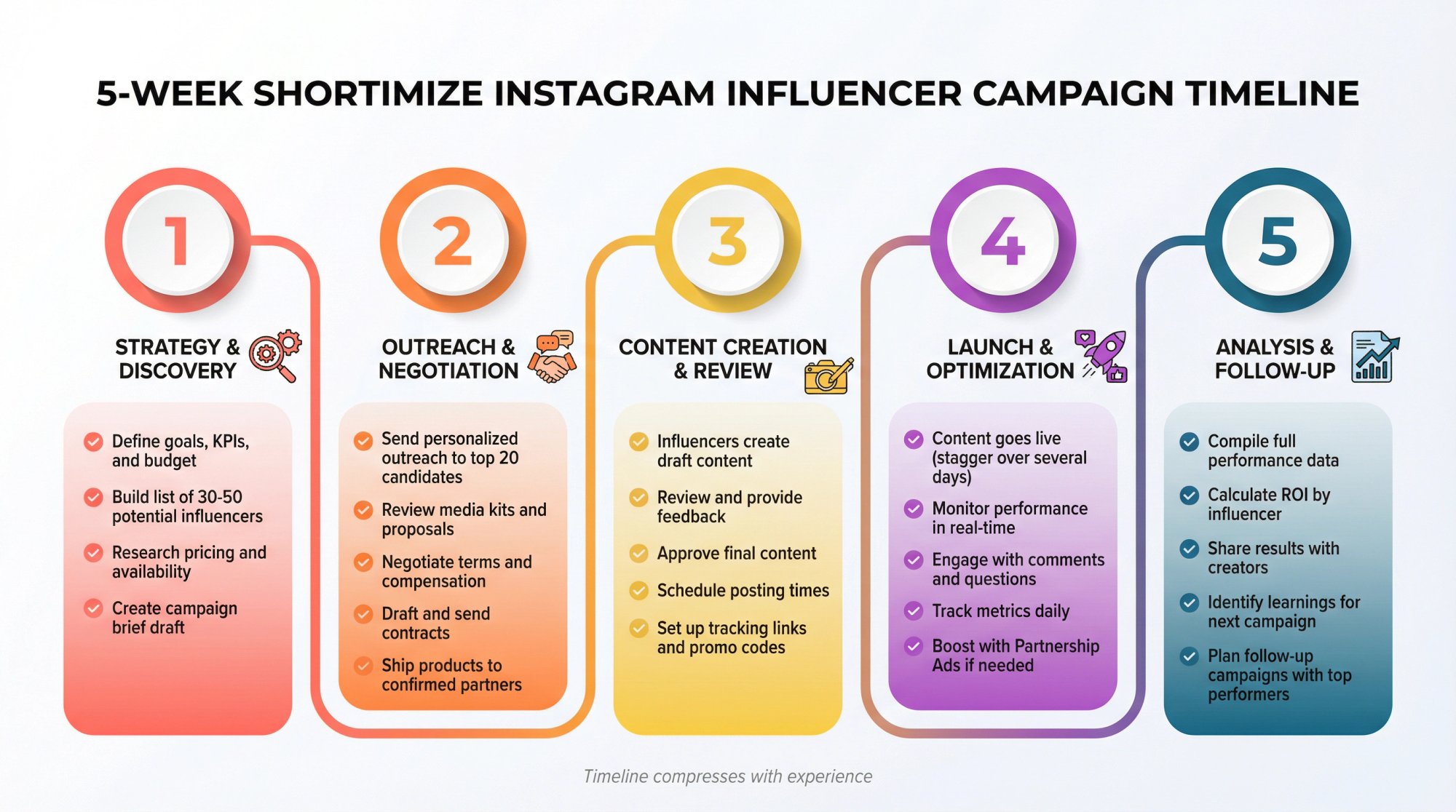
Week 1: Strategy & Discovery
→ Define goals, KPIs, and budget
→ Build list of 30-50 potential influencers
→ Research pricing and availability
→ Create campaign brief draft
Week 2: Outreach & Negotiation
→ Send personalized outreach to top 20 candidates
→ Review media kits and proposals
→ Negotiate terms and compensation
→ Draft and send contracts
→ Ship products to confirmed partners
Week 3: Content Creation & Review
→ Influencers create draft content
→ Review and provide feedback
→ Approve final content
→ Schedule posting times
→ Set up tracking links and promo codes
Week 4: Launch & Optimization
→ Content goes live (stagger over several days for sustained momentum)
→ Monitor performance in real-time
→ Engage with comments and questions
→ Track metrics daily
→ Identify early winners and boost with Partnership Ads if needed
Week 5: Analysis & Follow-up
→ Compile full performance data
→ Calculate ROI by influencer
→ Share results with creators
→ Identify learnings for next campaign
→ Plan follow-up campaigns with top performers
This timeline compresses further with experience, but never skip the planning phase. Check out our strategy guides for more tactical frameworks.
Instagram Influencer Marketing: Your Complete Growth Strategy
Instagram influencer marketing works. The projected $37 billion in 2025 creator economy ad spend proves it's not a fad. But success requires moving beyond surface tactics:
Stop thinking "we need an influencer to post about us."
Start thinking "we need to build authentic partnerships with creators whose audiences overlap with our ideal customers, create trackable campaigns with clear goals, and measure results rigorously so we can optimize and scale what works."
The brands winning with Instagram influencer marketing in 2026 are those who:
• Choose quality creators over large follower counts
• Build real relationships, not transactional one-offs
• Track everything and let data drive decisions
• Stay compliant and transparent
• Adapt quickly to platform changes and new features
• Use tools like Shortimize to manage campaigns efficiently across platforms
The human element is what makes influencer marketing powerful. A relatable creator genuinely endorsing your product carries more weight than any polished ad. But that human element needs to be supported by strategic planning, proper measurement, and continuous optimization.
Whether you're a startup testing your first micro-influencer partnership or an enterprise running sophisticated multi-tier campaigns, the fundamentals remain: find creators who authentically fit your brand, empower them to create content their audiences love, track everything, and use data to get better with each campaign.
Instagram influencer marketing can become one of your highest-ROI channels. It just requires treating it with the same rigor and intentionality as any other major marketing initiative.