If you're running an agency in 2026, you already know TikTok isn't optional anymore. With roughly 1.6 billion monthly active users worldwide and over 135 million in the U.S. alone, the platform represents a massive opportunity. But engagement on TikTok is absurdly high. Average influencer engagement rates hover around 15-18%, far surpassing Instagram or YouTube.
The catch? You can't wing it anymore.
What Does TikTok Analytics Actually Do for Agencies?
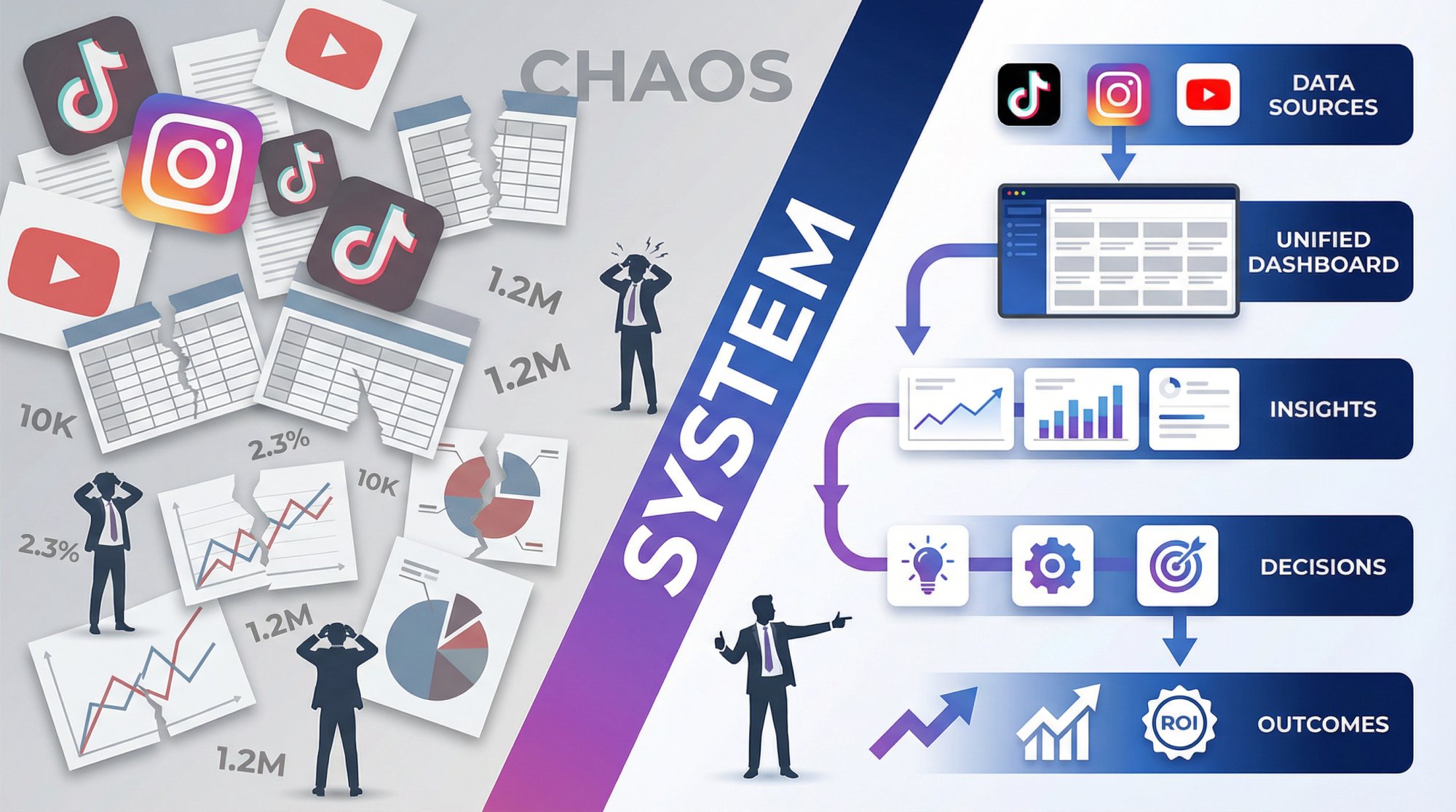
When agencies search for "TikTok analytics," they're not looking for a metrics dictionary. You need a repeatable operational system that:
Proves value to clients with clear ROI stories, not vanity metrics
Scales across many accounts without descending into spreadsheet chaos
Connects creative decisions to performance to business outcomes consistently
Surfaces what to do next (content pivots, budget shifts, creator choices)
Survives platform volatility (algorithm changes, reporting windows, privacy updates)
Most online content stops at "here are the metrics." This is the agency version: governance + measurement + benchmarking + reporting + automation. The goal is running TikTok as a performance discipline, not an art project.
How to Measure TikTok Analytics Success
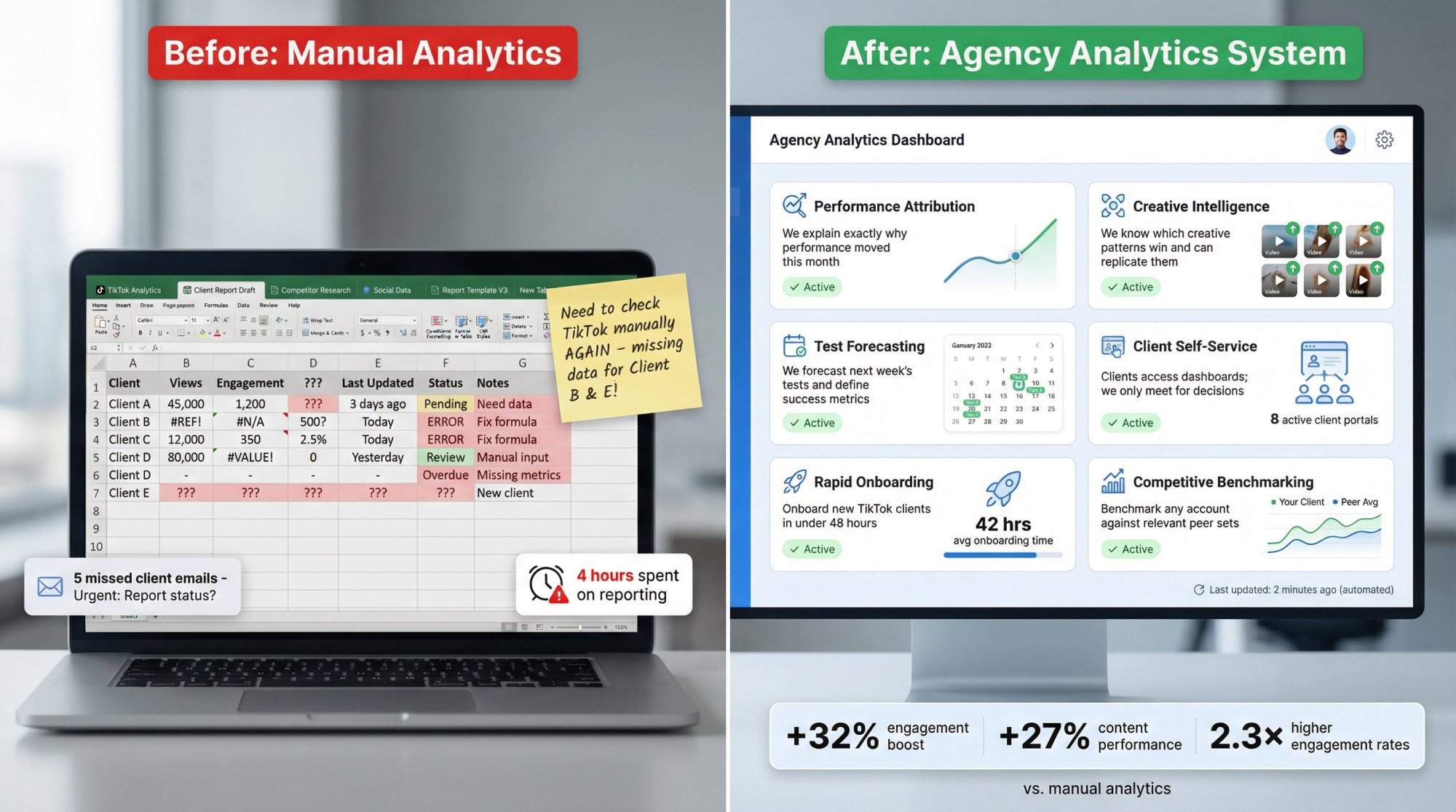
By the end of implementing this system, you should be able to say:
• "We explain exactly why performance moved this month"
• "We know which creative patterns win and can replicate them"
• "We forecast next week's tests and define what success looks like"
• "Clients self-serve dashboards; we only meet for decisions"
• "We onboard new TikTok clients in under 48 hours without password sharing"
• "We benchmark any account against relevant peer sets"
Companies using advanced TikTok analytics see a 32% boost in engagement and 27% better content performance on average. Research shows data-driven TikTok campaigns achieve 2.3× higher engagement rates than those flying blind.
That's not a small edge. That's the difference between keeping clients and losing them.
What Are The 6 Layers of TikTok Analytics?
Think of TikTok analytics as a stack with six distinct layers:
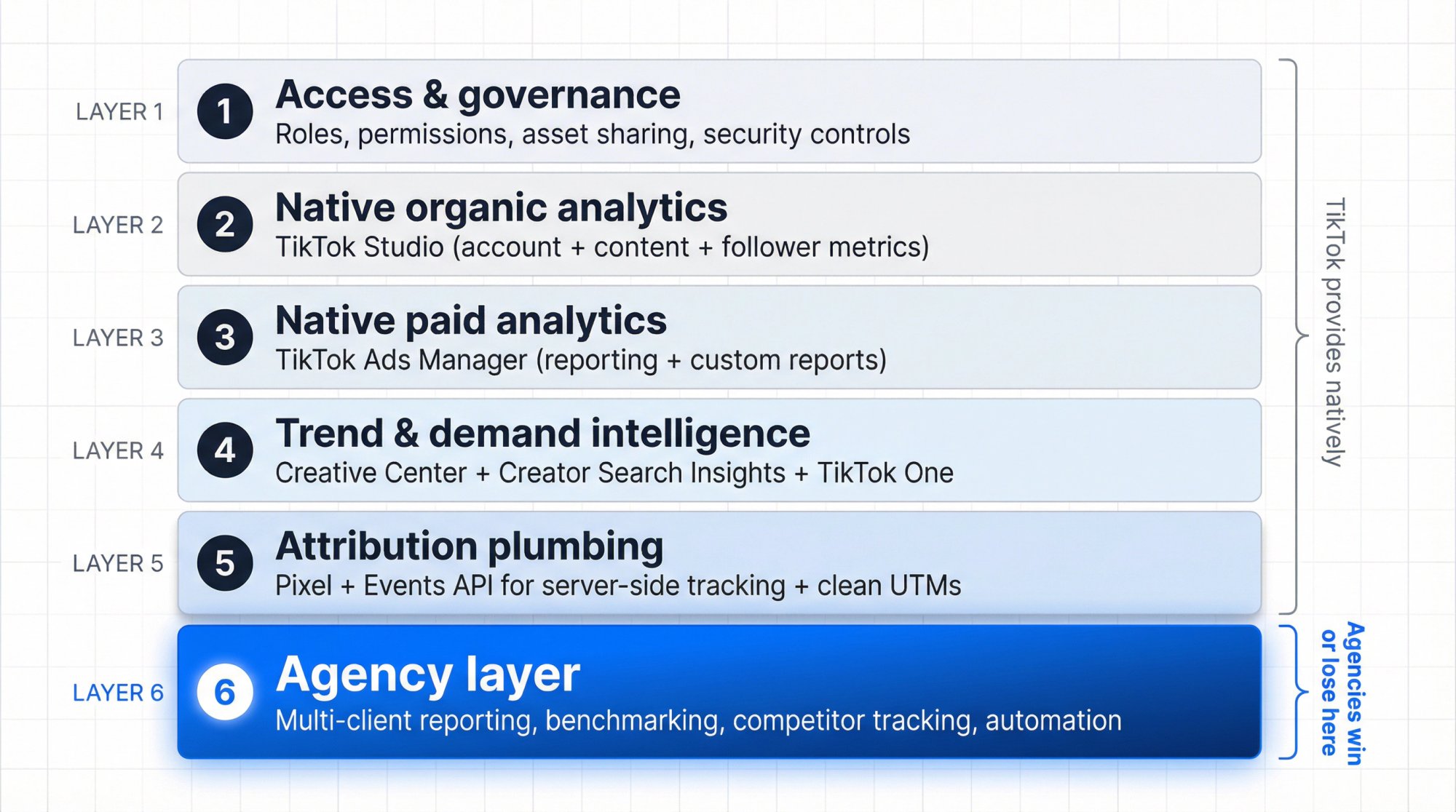
① Access & governance: Roles, permissions, asset sharing, security controls
② Native organic analytics: TikTok Studio (account + content + follower metrics)
③ Native paid analytics: TikTok Ads Manager (reporting + custom reports)
④ Trend & demand intelligence: Creative Center + Creator Search Insights + TikTok One
⑤ Attribution plumbing: Pixel + Events API for server-side tracking + clean UTMs
⑥ Agency layer: Multi-client reporting, benchmarking, competitor tracking, automation
TikTok provides layers 1-5 natively. Agencies win or lose on layer 6.
How to Set Up TikTok Business Center for Agencies
Why Does Business Center Matter for Agencies?
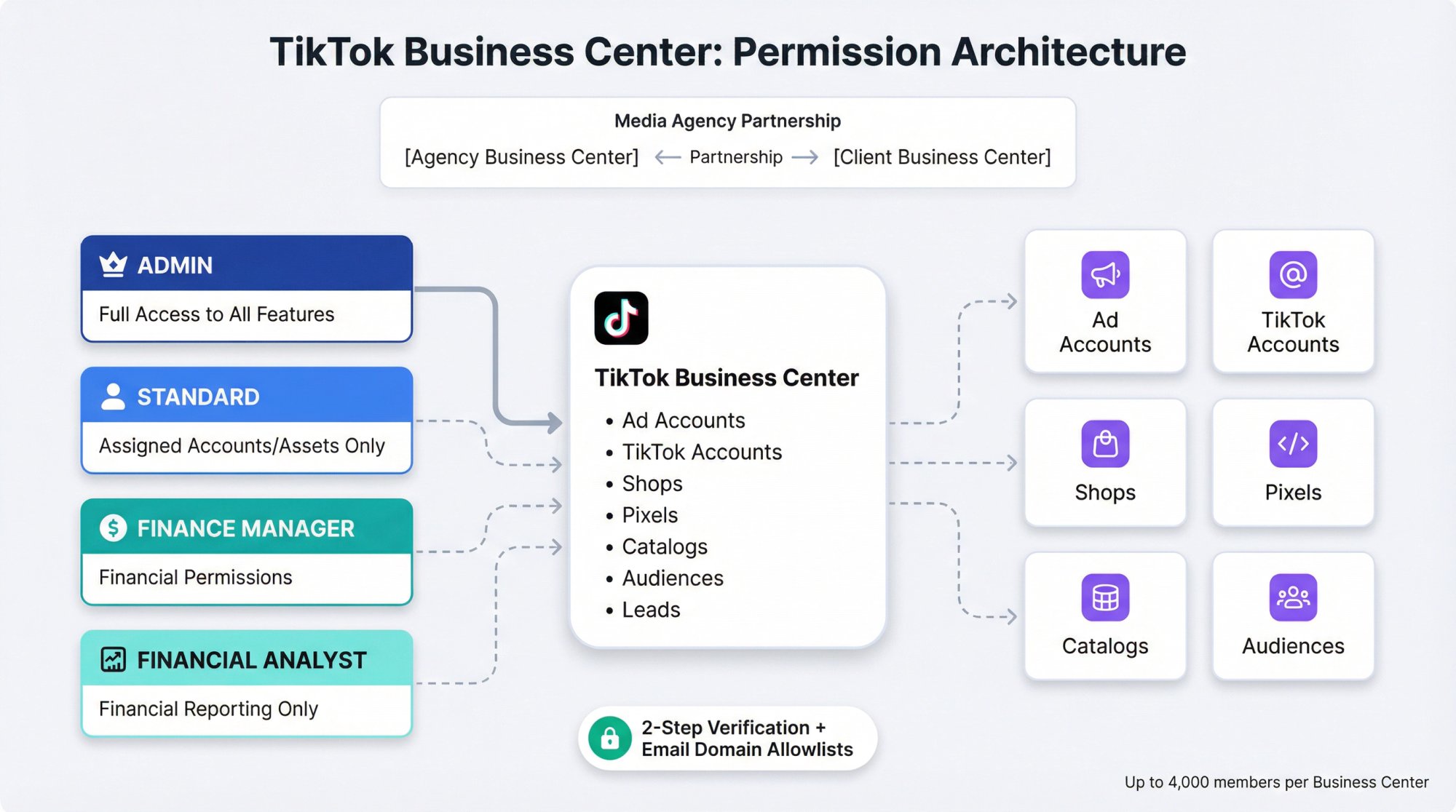
TikTok describes Business Center as a central hub to manage business and advertising activities. You can control access to ad accounts, TikTok accounts, Shops, Pixels, catalogs, audiences, and leads from one place. Last updated September 2025.
Security features include 2-step verification and email domain allowlists.
How to Assign Permissions in TikTok Business Center
When adding team members, TikTok offers these roles:
| Role | Access Level |
|---|---|
| Admin | Full access to all Business Center features |
| Standard | Only assigned accounts/assets |
| Finance Manager | Financial permissions |
| Financial Analyst | Financial reporting only |
Best practice for agencies: Give your team Standard access by default. Reserve Admin for the client and 1-2 trusted agency ops leads. TikTok's security guidance recommends limiting admin access and maintaining at least 2+ Business Center admins to prevent lockouts. Source: TikTok Business Help Center, February 2025.
How to Control Asset-Level Permissions
Business Center supports granular asset-level permissions. For ad accounts specifically, roles include:
→ Business Account admin (full features)
→ Business Account operator (manage analytics, messages, profile)
→ Business Account analyst (analytics-only, perfect for your reporting team)
How to Add Your Agency as a TikTok Partner
TikTok supports adding partners so you can share assets and set permissions without mixing your staff inside a client's internal member list. The platform even references a media agency partnership label when pairing Direct and Agency Business Centers.
Operational note: TikTok's documentation shows up to 4,000 members per Business Center, though some FAQ pages reference lower limits (around 1,000). If you're a large agency, confirm your exact limits inside your account.
How to Manage Multiple Users on One TikTok Account
TikTok documents a workflow to upgrade a Business Account to an Organization Account, which "allows multiple organization members to log in and manage the account more efficiently." Last updated October 2025.
What TikTok Analytics Does TikTok Studio Provide?
How to Use TikTok Studio for Analytics
TikTok Studio provides tools to create, manage, and analyze content performance on mobile, web, or via the TikTok Studio app. TikTok Help Center.
On the web, Studio analytics organizes into three sections:
Key metrics (account performance overview)
Content (individual video metrics and retention curves)
Followers (demographics and activity patterns)
The web experience works best for deep analytics dives and content management.
What to Track Beyond Vanity Metrics
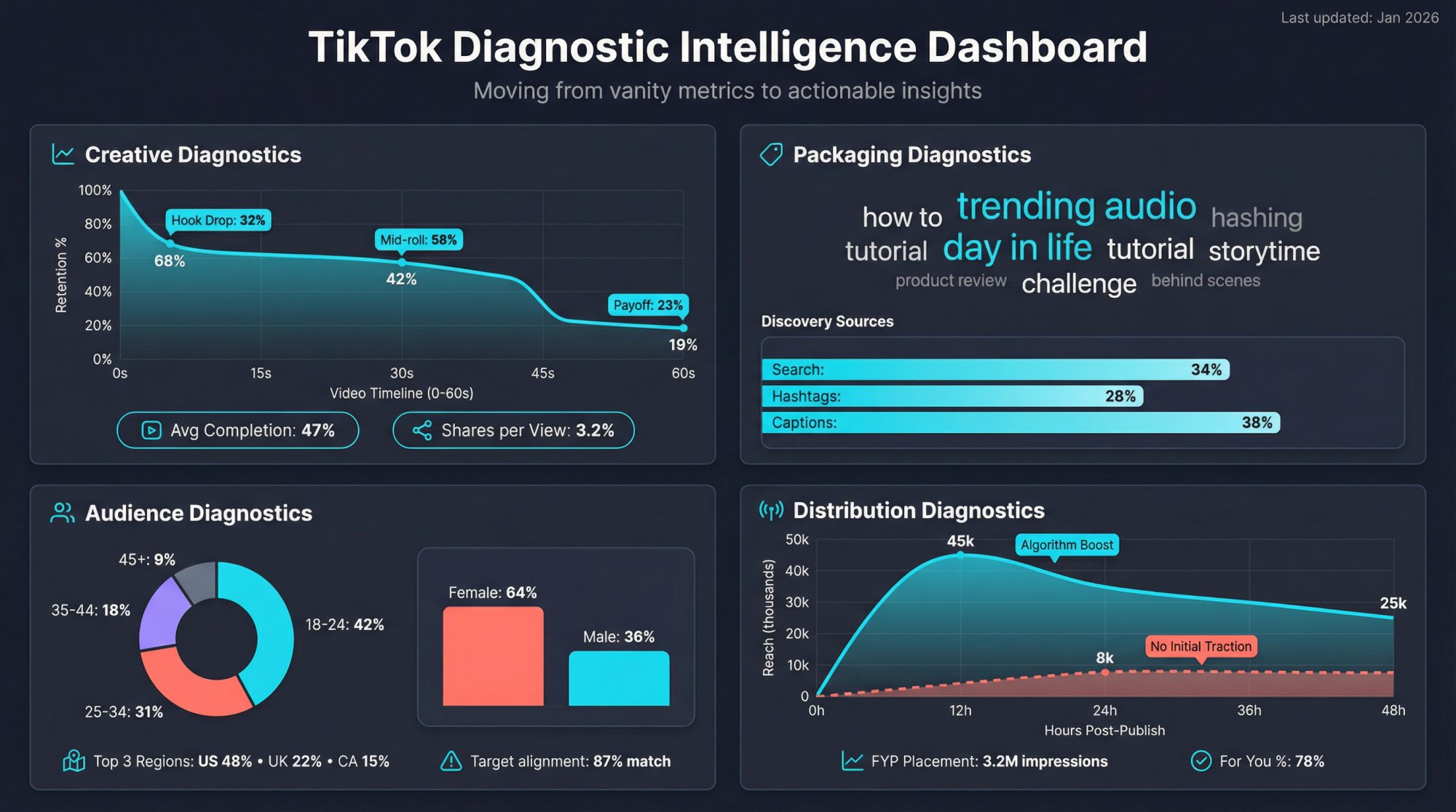
For agencies, organic analytics isn't about "report views." It's diagnostic intelligence for four critical areas:
① Creative diagnostics
Where do viewers drop? (Hook, mid-roll, or payoff)
Which topics and structures drive completion and shares?
② Packaging diagnostics
How do captions, keywords, on-screen text, and search intent alignment affect discovery?
③ Audience diagnostics
Are you reaching the intended demographic cohort?
④ Distribution diagnostics
Did the video get initial algorithmic pickup and stall, or never get traction at all?
Critical insight: Every report should end with a decision about what you'll do next, not just a performance recap.
How to Use TikTok Search for Content Strategy
What is Creator Search Insights and How Does It Work?
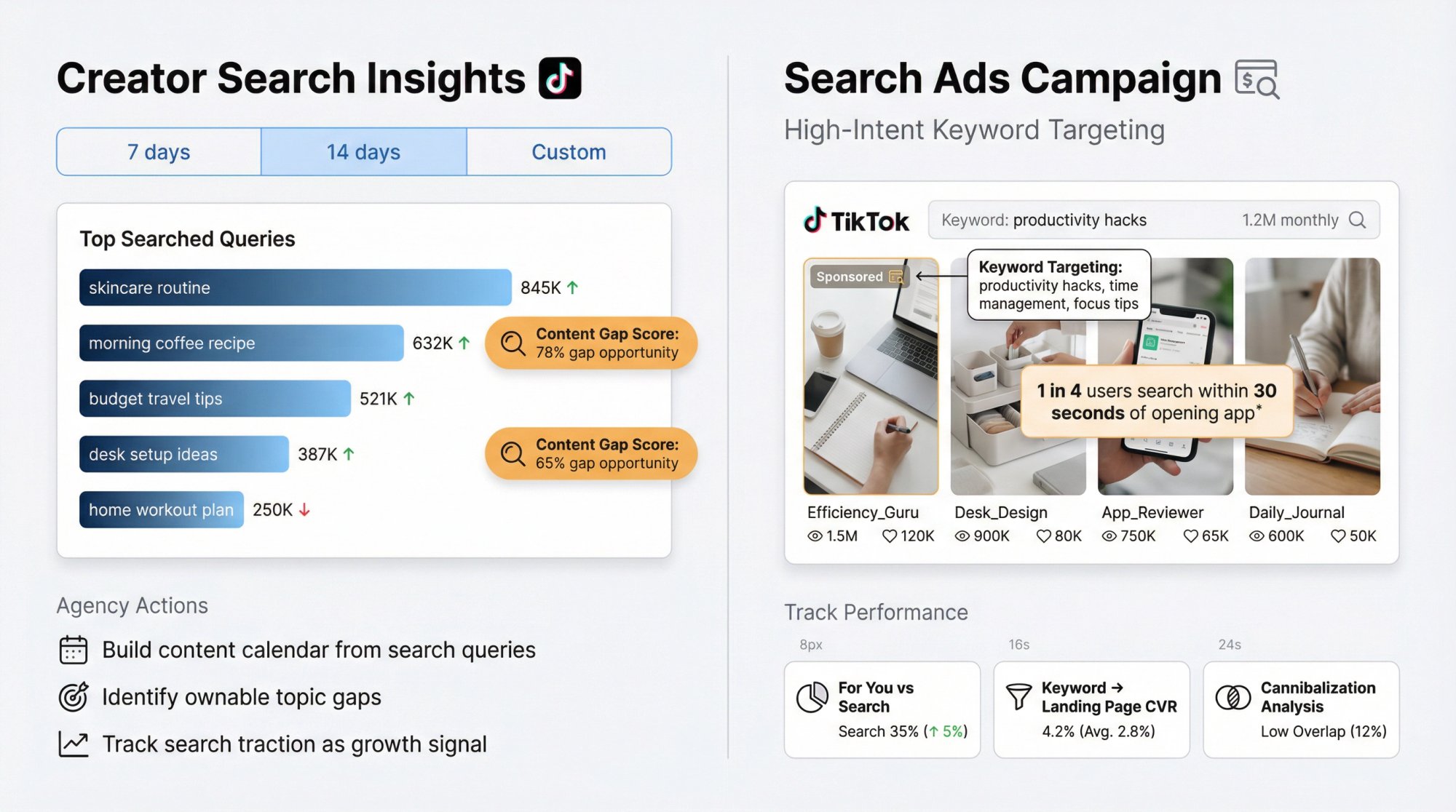
TikTok's Creator Search Insights shows what people search for on TikTok, helps discover content gaps, and tracks how posts perform in search. Date ranges include last 7 days, 14 days, or custom ranges. TikTok Help Center.
Agency use cases:
→ Build content calendars from queries, not just trending sounds
→ Identify content gap topics your client can own
→ Report search traction as a leading indicator of organic growth
How TikTok Search Ads Work for Agencies
TikTok's Search Ads Campaign positions keyword-based ads within search results for high-intent moments. TikTok for Business blog, October 2025.
One in four users searches within 30 seconds of opening the app. That's reported from TikTok's advertiser summit.
What this means for agencies: Search is now part of TikTok's performance story. Track:
• Which topics win on For You versus Search
• Which keywords map to converting landing pages
• Whether paid search cannibalizes or expands organic search demand
How to Use TikTok Ads Manager Analytics
What Metrics Does Ads Manager Track?
TikTok Ads Manager provides metrics across categories like:
Attribution metrics
In-app events
Page events
Video play metrics (including 6-second focused views)
Onsite events
TikTok explains that low 6-second focused view counts indicate early video drop-off.
How to Build Custom Reports in TikTok Ads Manager
TikTok's Custom reports let you select Dimensions (campaigns, ad groups, ads) and Metrics (CPM, CPC, CTR, CVR), then save and export. TikTok Ads Manager Help Center, April 2025.
Two export modes:
Scheduled Running: Reports delivered via email on a schedule
Run & Export: Immediate one-time export
Agency win: Build one standardized custom report per client template, then automate scheduled delivery.
How to Set Up TikTok Pixel and Events API
Why Events API is Required for TikTok Conversion Tracking
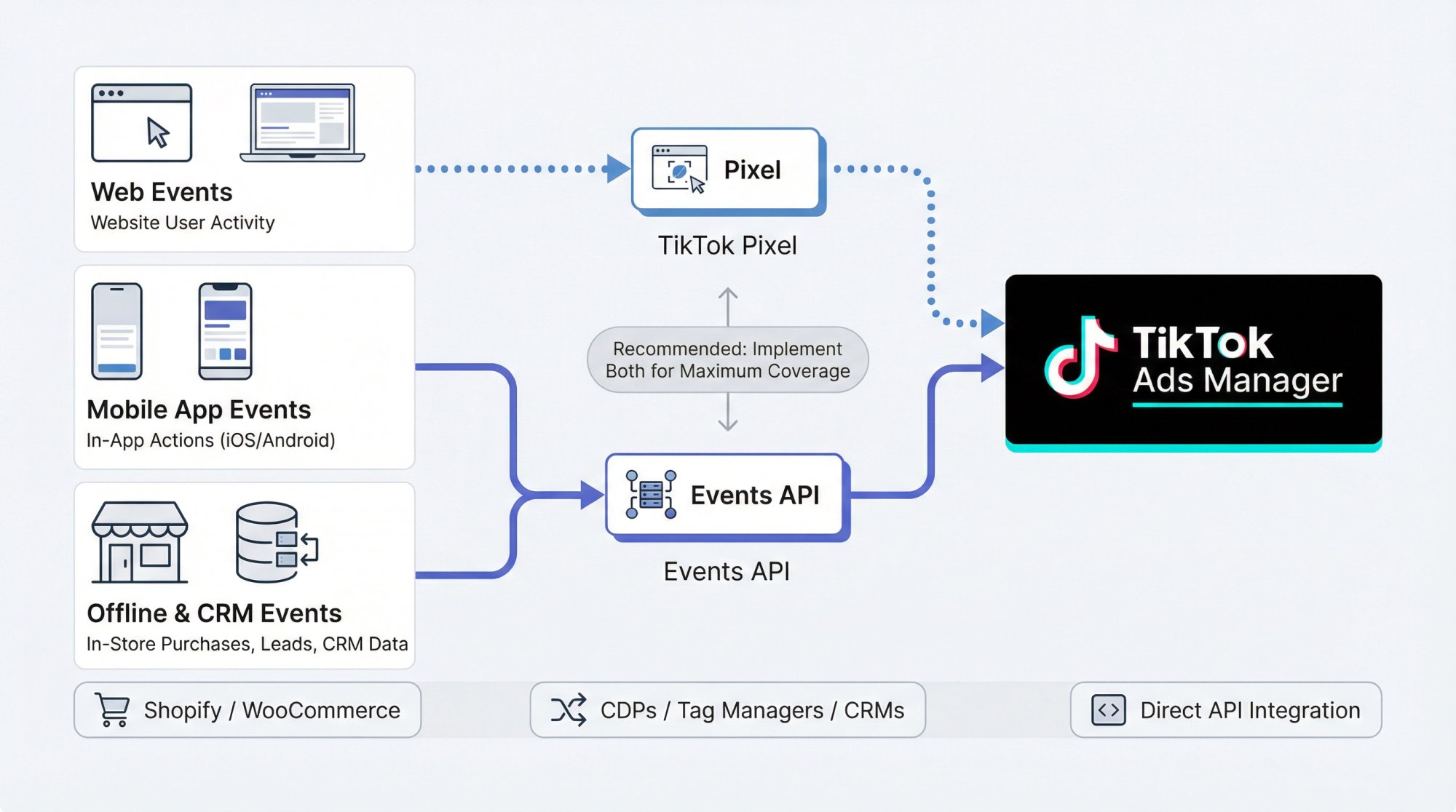
TikTok describes Events API as a reliable connection between TikTok and your marketing data across web, app, and offline channels (stores, CRM). TikTok recommends implementing Events API alongside Pixel for website connections. Last updated April 2025.
Critical requirement: TikTok states that Pixel or Events API setup is a prerequisite for the Web Conversions objective in Ads Manager.
How to Implement TikTok Events API
TikTok advises agencies to:
① Define events, parameters, and match keys aligned to objectives
② Choose integration method (Shopify/WooCommerce, CDPs/tag managers/CRMs, or direct API)
③ Validate setup with web diagnostics tools
If you can't trust conversion data, every "creative optimization" conversation becomes subjective. Attribution plumbing makes TikTok performance legible.
How to Use TikTok Creative Center for Trend Research
What is TikTok Creative Center?
TikTok's Creative Center positions itself as the place to find best-performing ads, viral videos, and trending hashtags by region and vertical. TikTok Creative Center.
The Trends section shows trending hashtags, songs, creators, and videos by region and industry. TikTok explicitly notes it can be used for both organic and paid messaging strategies. Last updated February 2025.
Keyword Insights highlights top keywords and phrases from TikTok ads for script and copy ideation.
How to Use TikTok One Insights Spotlight
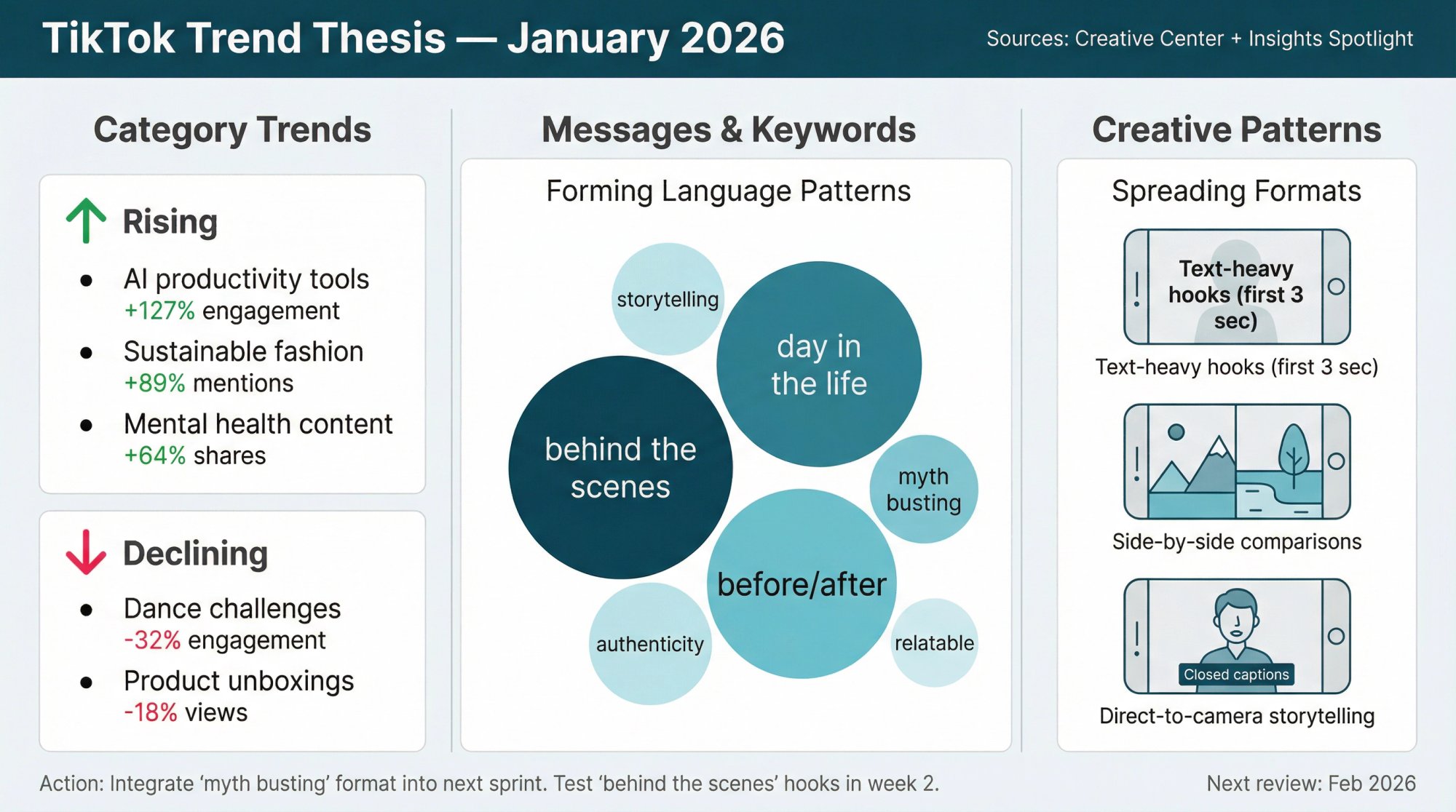
Insights Spotlight on TikTok One centralizes real-time trends, audience behavior, and brand perception data aimed explicitly at "brands and agencies." TikTok for Business blog, June 2025.
Agency use case: Add a "Trend thesis" slide to monthly reviews covering:
• What's rising/declining in the category
• What messages and keywords are forming
• What creative patterns are spreading
Then tie it directly to your client's creative backlog.
How to Build a TikTok KPI Framework
How to Choose Your Primary TikTok Objective
You can't optimize for everything. Pick one:
Awareness / Reach
Engagement / Community building
Pipeline / Leads
Revenue / Purchases
App installs / Activation
TikTok Shop / Commerce
How to Define Leading and Lagging Indicators
Example for Revenue:
| Stage | Metrics |
|---|---|
| Lagging | Purchases, revenue, ROAS |
| Mid-funnel | Add-to-cart, checkout starts, landing page CVR |
| Leading | Hold rate, focused views, CTR, view-through rates |
TikTok categorizes many of these as reporting metrics across attribution, page events, video play, and onsite events. TikTok Ads Help Center, April 2025.
How to Set Performance Decision Thresholds
Instead of arbitrary benchmarks, define action triggers:
🟢 Green: Scale budget, replicate creative
🟡 Yellow: Iterate creative, keep spend stable
🔴 Red: Pause, repackage, or change audience targeting
Thresholds should be based on your historical baseline + peer benchmarks (covered next), not internet folklore.
What Are Good TikTok Engagement Rate Benchmarks?
Benchmarks are useful only if you understand how they were computed. Different reports use different definitions (by followers vs by views, median vs mean, vertical mixes).
What is a Good TikTok Engagement Rate?
Industry reports suggest average engagement rates ranging from 2.65% to 4.90% for analyzed periods in 2024-2025, though methodologies vary significantly.
Recent benchmark studies note engagement rates fell across platforms in 2025, with some showing a 34% drop on TikTok (context depends on definition and methodology).
What to publish in client reports: Use a range and specify your definition (engagement rate by views vs followers). Then show the client's relative movement versus their own baseline.
How Posting Frequency Affects TikTok Growth
Research suggests accounts posting more frequently see higher follower growth (stronger growth for accounts posting 5+ times per week).
Agency translation: More posts help, but only if your creative process maintains quality. Track creative hit rate (the percentage of posts above a defined performance threshold).
What is a Good TikTok Follower Growth Rate?
Industry benchmarks highlight TikTok as fast-growing, citing 21% median monthly follower growth figures for 2024 in some reports.
Agency translation: Don't promise "X% growth." Use benchmarks to sanity-check whether your client is underperforming their peer cohort.
How to Structure TikTok Analytics Reports for Clients
How to Create Weekly TikTok Performance Reports
Goal: Visibility + early warnings
Include:
• Top 3 posts (why they worked)
• Bottom 3 posts (what failed: hook/topic/packaging)
• Notable audience signals (comment themes, saves/shares)
• Next week's test plan (3-5 experiments)
How to Build Monthly TikTok Strategy Reports
Goal: Tell the story of performance and decisions
Include:
① KPI scorecard (objective-aligned)
② Creative pattern analysis (what's winning/losing)
③ Trend + demand inputs (Creative Center, search insights)
④ Competitive benchmark snapshot
⑤ Next month's creative roadmap
How to Conduct Quarterly TikTok Strategy Reviews
Goal: Re-align on objectives, formats, resourcing
Include:
• KPI tree health check
• New content pillars
• Paid/organic integration plan
• Creator strategy approach
• Measurement & attribution audit
How to Build a TikTok Decision Log
This turns analytics into trust.
Format:
Decision: What we're changing
Evidence: Metrics + examples
Expected outcome: What should move
Review date: When we evaluate results
TikTok Analytics Templates for Agencies
How to Create a TikTok Analytics Scorecard
Use this as the first page of every monthly report:
Objective: __________
Primary KPI: __________
Secondary KPIs: __________

This month vs last month: ↑/↓

What drove the change (3 bullets):
1. ---
2. ---
3. ---

Decisions we're making next month (3 bullets):
1. ---
2. ---
3. ---

Risks / unknowns: __________
How to Track TikTok Content Experiments
Columns:
Date posted | Hypothesis ("If we do X, Y will improve because Z") | Variables changed (hook/topic/length/editing/CTA) | Success metric (pre-defined) | Result | Keep/kill/iterate | Notes + link
How to Name TikTok Assets for Scalability
Pick one schema and never deviate:
Client | Objective | Pillar | Format | HookType | Talent | Month | Version
Example:
Acme | Sales | SkincareMyths | UGC_Tutorial | Contrarian | CreatorA | 2026-01 | v3
Why it matters: When performance moves, you can filter and attribute it to patterns, not vibes.
What TikTok Analytics Tools Should Agencies Use?
What Native TikTok Tools Are Required?
TikTok Studio for organic analytics and content management
Ads Manager reporting + Custom reports for paid campaigns
Events API + Pixel for conversion measurement
Creative Center for trend + ad intelligence
Creator Search Insights for search-led content planning
What Analytics Tools Do Agencies Need?
You need capabilities that support:
Multi-client dashboards
Benchmarking and peer sets
Competitor and influencer tracking
Exports/API to BI systems
Alerts (virality, spikes, drops)
Cross-platform consolidation (because clients don't run TikTok in isolation)
How Shortimize Helps Agencies Track TikTok Analytics
Shortimize is built as a cross-platform analytics and tracking system for short-form video. It ingests public data for TikTok, Instagram Reels, and YouTube Shorts so teams can track accounts and videos, analyze performance, and run reports in one place.
Agency workflows where Shortimize is uniquely helpful:
→ Benchmark any public TikTok account (competitors, creators, category leaders) without waiting for client access – simply analyze any TikTok account by pasting the URL
→ Build peer sets for quarterly business reviews using Collections
→ Cross-platform short-form reporting (TikTok + Reels + Shorts) when clients ask "What's working overall?" – compare watch time across platforms
→ Collections as client-ready curated libraries of competitors, creators, and trends you're monitoring
Shortimize also integrates with Amplitude, Mixpanel, and Posthog out of the box through integrations, allowing you to sync short-form video data with product analytics platforms. Plus, Slack and Discord notifications alert your team instantly when videos go viral.
The platform offers three pricing tiers:
| Plan | Price | Videos | Refresh Rate | Key Features |
|---|---|---|---|---|
| Pro | $99/month | 1,000 | 24 hours | 1 seat, unlimited accounts, email support |
| Business | $249/month | 5,000 | 12 hours | 3 seats, WhatsApp founder support, API/webhooks add-on |
| Enterprise | Custom | Unlimited | Custom | Unlimited seats, success manager, whitelabeling |
API & Webhooks are available as a $150/month add-on for Business plan users, or included in Enterprise.
What Cross-Platform Social Media Tools Include TikTok?
For agencies managing TikTok alongside Instagram, YouTube, Facebook, and Twitter, platforms like Hootsuite, Sprout Social, Sprinklr, and Buffer have added TikTok analytics support.
Advantages: Monitor all channels in one dashboard, schedule TikTok posts, engage via unified inbox, generate cross-platform reports.
Trade-offs: Expensive (especially enterprise tiers) and sometimes less deep on TikTok-specific features than specialized tools.
What TikTok Influencer Marketing Tools Exist?
If your agency runs influencer collaborations, platforms provide analytics for influencer posts and audiences, including fake follower detection and audience demographics.
Some platforms offer over 35 metrics about an influencer's audience and let you track campaign performance across influencers.
Shortimize doubles as an influencer tracking tool by letting you plug in any influencer's handle and pull stats from their profile – learn how to track influencer campaign performance across TikTok and Instagram.
What Are TikTok Research APIs?
TikTok's developer documentation lists Research tools giving access to public data on profiles, videos, and comments, but they're available only to approved researchers. TikTok for Developers.
Agency note: This isn't your production analytics path. Your best bet is Business Center + Ads Manager + agency layer tools like Shortimize.
What Data Quality Issues Affect TikTok Analytics?
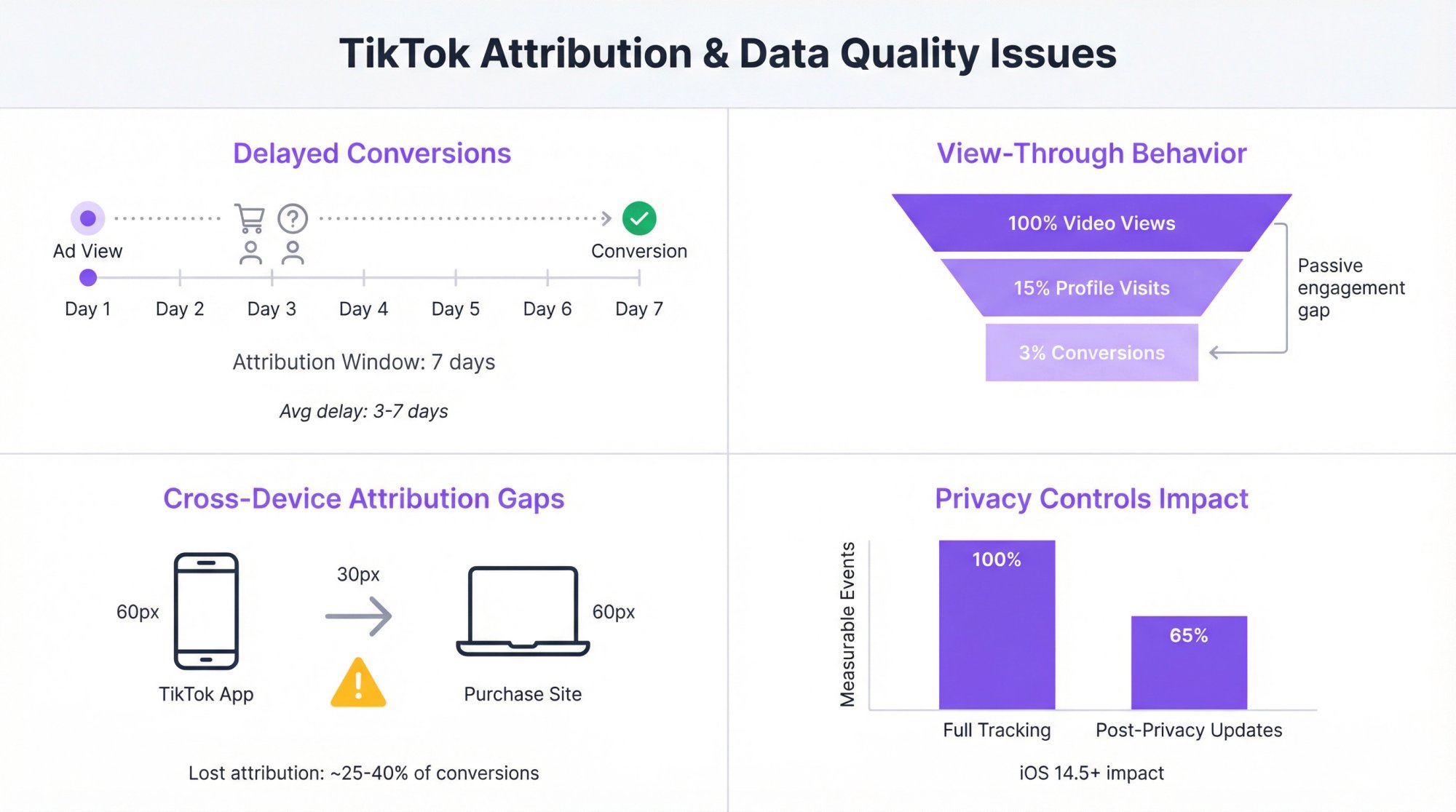
Why TikTok Attribution Is Never Perfect
Expect:
• Delayed conversions
• View-through behavior
• Cross-device attribution gaps
• Platform-native privacy controls affecting measurement
That's why TikTok recommends using Events API alongside Pixel to capture more conversions and improve measurement reliability. TikTok Ads Help Center, April 2025.
How to Build an Agency Data Policy for TikTok
Don't share passwords. Use Business Center.
Apply least privilege access (Standard by default).
Define what data you store, how long, and who accesses it.
Make client reporting reproducible (same definitions every month).
TikTok emphasizes careful admin control and limiting admin access for Business Center security. TikTok Business Help Center, February 2025.
What TikTok Metrics Should Agencies Track?
Not all metrics are created equal. Focus on KPIs that align with client goals and signal real performance:
How to Track TikTok Follower Growth
How fast is the account growing?
Track follower count daily or weekly. A steady upward trend means content attracts new audiences. Agencies often set growth targets per campaign or month to demonstrate expanding reach.
For insights on what drives follower growth, read our guide on how to increase TikTok video views.
How to Measure TikTok Video Views
How many times was each video watched?
Look at total views per video and average views across content. Comparing views helps identify which topics or formats draw the biggest audience. A spike in views signals viral success worth replicating.
For agencies, high view counts matter, but pair them with engagement and watch time to gauge quality.
Learn how many views is viral on TikTok to set proper expectations.
What is a Good TikTok Engagement Rate?
Are viewers interacting with the content?
TikTok engagements include likes, comments, shares, and saves. Engagement rate (engagements divided by views or followers) reveals content resonance.
A video with 100K views but 1% engagement didn't connect. A smaller video with 10% engagement hit a nerve.
TikTok's engagement rates are generally higher than other platforms (often mid-teens percentage for influencers). High engagement means your content strategy works and boosts algorithmic reach. Understand what is a good engagement rate on TikTok for your niche.
How to Analyze TikTok Watch Time and Retention
How well does content hold attention?
TikTok provides average watch time per video and percentage of video viewers watch on average. These are among the best indicators of content quality and relevance.
High average watch time and high completion rate mean viewers are hooked. Drop-off after a few seconds means the content isn't engaging or the hook failed.
TikTok's analytics show second-by-second retention curves for each video. This informs creative teams where viewers lose interest.
TikTok's algorithm heavily rewards videos watched to completion. Aim for retention rates of 60% or higher, which data suggests can trigger strong algorithmic distribution. Discover optimal video length sweet spots for TikTok, Reels, and Shorts.
How to Track TikTok Profile Views
Are people intrigued enough to check out the profile?
Profile views measure how many users visited the account page. This indicates deeper interest (they liked a video and want to see more content or learn about the brand).
Profile view spikes around campaigns can proxy for interest generated.
How to Use TikTok Audience Demographics Data
Who is the content reaching, and when are they online?
In the TikTok Followers/Audience tab (Pro/Business accounts), you see follower demographics (age, gender, territories) and when followers are most active by day and hour.
These insights ensure content aligns with target audiences. If a client wants Gen Z females in the US, but analytics show 30+ males overseas, that's a red flag to adjust.
Follower activity times help with scheduling. Content posted during peak times can achieve ~23% better reach according to TikTok analytics data. Learn the best time to post YouTube Shorts and apply similar principles to TikTok.
How to Track TikTok Traffic Sources
How are viewers finding your videos?
TikTok's analytics break down views by source: For You Page (algorithmic discovery), Followers (followers' feed), Profile (via your profile), Sounds, or Hashtags.
For agencies, this is gold for understanding reach beyond the follower base.
A high percentage of For You page views means the content hits the algorithm jackpot and reaches new audiences (great for awareness).
If most views come from Followers, the content might be safe/expected and less viral (fine for nurturing existing fans but won't grow the account as fast).
Seeing views from Sounds or Hashtags tells you if using trending audio or hashtag challenges paid off. TikTok's own data shows branded hashtag challenges can increase engagement by 40% or more.
Learn how to find top performing videos in any TikTok niche to identify winning patterns.
How to Track TikTok Hashtag and Sound Performance
Which trends and topics amplify reach?
TikTok's native analytics list top hashtags viewers came from for each video. Track how each hashtag or sound used in campaigns performs.
Third-party tools or TikTok's Creative Center provide trending hashtag and sound insights across the platform.
Since TikTok culture is driven by sounds and hashtags, analyzing these elements helps agencies spot viral content opportunities. Videos using trending sounds see about 52% higher engagement rates on average.
Discover the best Reels hashtags for Instagram to go viral and apply similar strategies to TikTok.
How to Track TikTok Conversion Metrics
What actions result beyond TikTok views?
While TikTok is often top-of-funnel, agencies increasingly want downstream results. Business Accounts provide extra analytics like profile link clicks or website visits via the bio link.
These "link actions" show how many people tapped through to a website or shopping page (crucial for driving traffic or sales).
For TikTok Shop or live shopping features, track product clicks or live stream metrics (viewers, diamonds, etc.). Learn how to track TikTok Shop affiliate performance across multiple creators.
For influencer campaigns, use promo codes or UTM links to track conversions. While these conversion metrics often live outside TikTok's native analytics (Google Analytics or TikTok Ads dashboard), they're important for showing full-funnel impact from views and engagement to sign-ups or sales.
Translate TikTok metrics into business outcomes whenever possible.
What Are TikTok Native Analytics Limitations?
TikTok provides free analytics for all Creator and Business accounts (switch your account to Pro in settings). This native tool gives essentials like views, likes, follower info, all within the TikTok app.
For a single creator or small business managing one account, TikTok's built-in analytics may be sufficient. But agencies face specific challenges that quickly expose limitations:
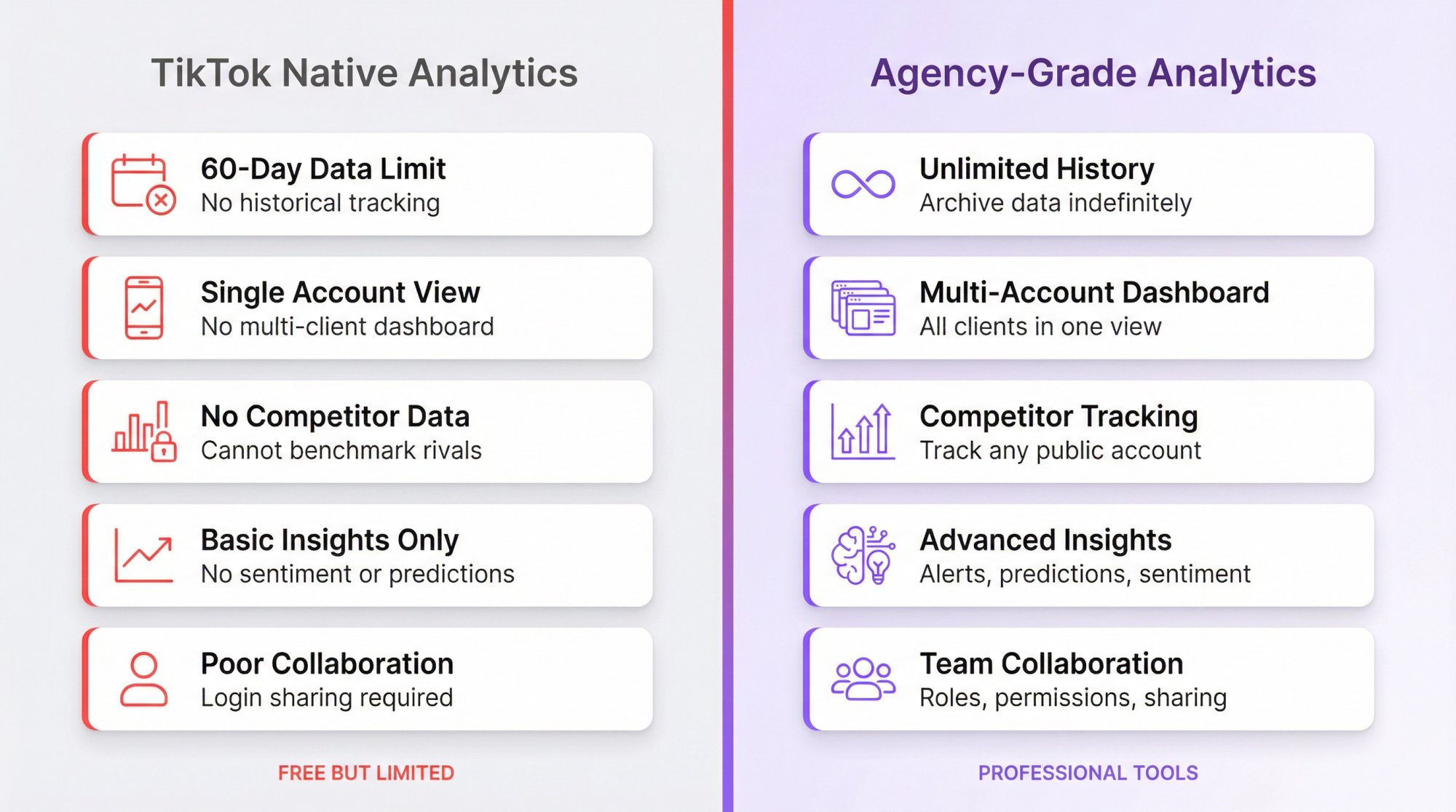
Why TikTok's 60-Day Data Limit Is Problematic
TikTok's native Analytics dashboard stores data for last 7 days, 28 days, or up to 60 days max. Anything older than 60 days isn't accessible.
For agencies tracking long-term growth or year-over-year trends, this is a big problem.
Solution: Export data periodically (TikTok Business accounts on desktop allow exporting CSV reports), or use third-party tools that archive historical data indefinitely.
Why Single-Account View Doesn't Work for Agencies
TikTok's app analytics are account-specific. For an agency managing 5 TikTok accounts for different clients, there's no unified dashboard natively. You'd constantly switch accounts.
There's also no way to compare two accounts side by side in TikTok's native interface.
Solution: Third-party social media management tools offer multi-account dashboards (monitor all clients' TikTok profiles in one place, often alongside other platforms). Shortimize creates combined reports to compare account performance across all your clients.
How to Benchmark TikTok Against Competitors
By design, TikTok's built-in analytics only show data for your own account. There's no native feature for competitor analysis or market benchmarks.
Agencies need to put performance in context. Is a 5% engagement rate good in your client's niche? What content are competitors posting that's going viral?
Solution: Use analytics tools that support competitor tracking. Some platforms allow tracking multiple TikTok accounts (even ones you don't own) in one interface.
Shortimize, for example, lets you track any public TikTok account or video by entering the URL (no login needed). Learn how to spy on your competitors' influencer strategy.
What Advanced Insights Does TikTok Not Provide?
TikTok's native analytics gives basics but lacks granular or customizable analysis professionals need. It won't do sentiment analysis of comments or correlate which video attributes lead to better performance. It doesn't provide predictive insights or alerts.
Solution: Premium analytics platforms offer custom report builders, cross-platform comparisons, automated alerts (Slack notification if a video goes viral or if a competitor posts), and AI-driven insights like recommending posting times or flagging content types that over-index in engagement.
Shortimize provides Slack and Discord notifications when videos hit viral thresholds.
How to Enable Team Collaboration for TikTok Analytics
TikTok's app isn't designed for team collaboration. An agency with multiple team members (strategists, analysts, content creators) needing analytics access might share login credentials or screenshot graphs. That's clunky and poses security issues.
Solution: Agency-oriented tools have multi-user access, roles/permissions, and easy ways to share dashboards or reports. Some offer white-label reports you can brand with your agency logo.
TikTok's built-in analytics are a great free starting point. But as you scale to multiple accounts, need competitive context, or require in-depth analysis over time, you'll hit a wall. Third-party tools give you a bigger picture of performance and help you make smarter decisions faster.
What TikTok Analytics Tools Should Agencies Consider?
The ecosystem of TikTok analytics tools ranges from free utilities to enterprise-grade software. Here's how to navigate it:
How to Use TikTok's Native Analytics
It's free, easy, and provides all basic metrics (views, likes, shares, follower info) in-app. Fine for individual accounts and short-term analysis.
But it lacks multi-account support, competitor data, and long-term storage.
What Free TikTok Analytics Tools Exist?
Free web tools provide simple dashboards of any TikTok account's stats (no login needed) with CSV export capability.
These are useful for quick checks or smaller clients where budget is an issue. Free tools usually lack real-time updates or per-post analytics depth.
What TikTok-Specific Analytics Platforms Exist?
Paid tools focus primarily on TikTok (sometimes covering other short-form platforms) and provide deep TikTok insights.
These tools let you compare multiple profiles side-by-side and even estimate how many followers a particular post could generate. Agency plans unlock advanced features like tracking unlimited competitors and exporting reports.
The strength of these tools is granular platform expertise. The downside can be cost and narrow scope (they usually don't integrate other social networks' data).
What Cross-Platform Analytics Suites Include TikTok?
Big social media management platforms like Hootsuite, Sprout Social, Sprinklr, and Buffer have added TikTok analytics support.
These platforms provide TikTok analytics within their interface and allow customizable reports. Some became official TikTok marketing partners, tapping into TikTok's API for audience demographics not available publicly.
The advantage is efficiency and holistic insight. The trade-off is expense and sometimes less depth on TikTok-specific features than specialized tools.
What Influencer Marketing Analytics Platforms Track TikTok?
If your agency's TikTok work involves influencer collaborations, platforms provide analytics for influencer posts and audiences.
Some tools give over 35 metrics about an influencer's audience (age, location, authenticity) and track campaign performance. Learn how to cross-analyze influencers on TikTok, Reels, and Shorts.
Shortimize doubles as influencer tracking by letting you plug in any influencer's handle and pull stats.
How to Build Custom TikTok Analytics Dashboards
Tech-savvy teams can build custom TikTok analytics dashboards using TikTok's API (for business accounts and ads) with tools like Dataslayer or Supermetrics piping data into Google Data Studio or spreadsheets.
Benefits include full control and potentially no recurring software fees. But this requires technical effort and maintenance. TikTok's official API has limitations, especially on organic analytics (it's primarily for ads and your own business account data).
How to Choose the Right TikTok Analytics Tool
Consider these factors:
Scope of needs: If TikTok is one piece of larger social strategy, a cross-platform tool might serve better. If TikTok is your main focus, a specialized tool could be more effective.
Number of accounts and volume: Ensure the tool handles the number of TikTok profiles and videos you need to track. Agencies often need "unlimited" or high limits due to multiple clients. Shortimize offers up to 5,000 tracked videos on the Business plan and unlimited on Enterprise.
Collaboration & reporting: Do you need automated PDF reports for clients? A live dashboard you can share? White-label (no tool branding)? Some tools have beautiful reporting features, others assume you'll export to Excel.
Real-time alerts: If your agency needs to monitor if a client's video goes viral or a competitor launches a campaign, look for alerts/notifications. Shortimize integrates with Slack/Discord to send viral video alerts instantly.
API and integrations: If you want to integrate TikTok data into other systems (client marketing dashboard, internal BI tool), check if the platform offers an API or webhooks. Shortimize offers API/webhook add-ons for pulling data programmatically through our social media analytics API.
Budget: Costs range widely. Free options at $0, single-account tools $50-100/month, enterprise suites many hundreds or thousands monthly.
Some agencies use multiple tools: Shortimize for deep short-form analytics and competitor tracking, and Hootsuite for scheduling and cross-network reporting.
How to Use TikTok Analytics Effectively
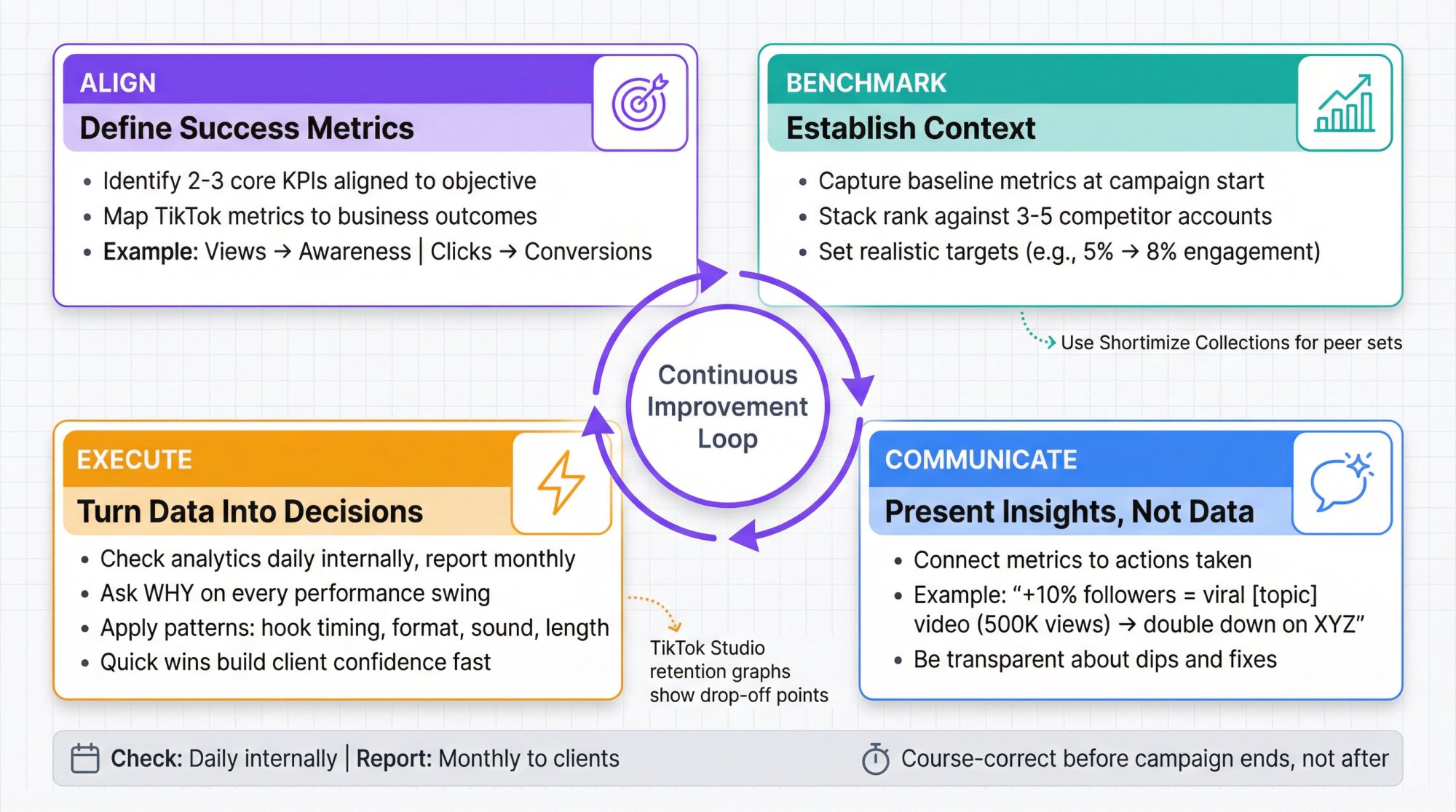
How to Align TikTok Metrics with Client Goals
Begin every campaign by defining what success looks like on TikTok. Is the goal brand awareness (views, reach, followers), engagement (likes/comments/shares), or conversions (website clicks, sign-ups)?
Identify 2-3 core KPIs and monitor them religiously.
Translate TikTok metrics into the client's business language. If the client cares about sales, report "TikTok-driven web sessions" or "promo code uses from TikTok" in addition to in-app metrics.
How to Establish TikTok Performance Benchmarks
At campaign start, capture baseline metrics. What's their average views per video currently? Current engagement rate? Follower growth per week?
Look at competitor benchmarks: how do the client's stats stack up against key competitors or industry averages? Learn how to benchmark your Reels against competitors and apply the same framework to TikTok.
These benchmarks set expectations and provide context. They also help you set realistic targets (e.g., "increase engagement rate from 5% to 8% in 3 months" based on what top competitors achieve).
How Often Should You Check TikTok Analytics?
Keep a close eye on data daily or weekly internally so you can tweak tactics on the fly. But for client communication, don't overwhelm them with too frequent or granular updates.
Typically, a monthly report with key insights works well, supplemented by immediate alerts for major milestones or crises. Learn how to manage multiple TikTok accounts efficiently.
Use analytics to be proactive. If something isn't working, the data will tell you, and you can course-correct long before the campaign ends.
Quick wins backed by data (e.g., "Our video using the trending challenge got 500K views in 2 days, a 5× jump over their previous best") build client confidence.
How to Turn TikTok Analytics Into Content Strategy
TikTok analytics should feed into content creation. Always ask why a video performed the way it did.
Look at audience retention graphs (did viewers drop off after the first 3 seconds? Maybe the hook wasn't strong).
Examine which videos got the most comments or shares (what sparked conversation or virality?).
Identify patterns: perhaps videos under 15 seconds are outperforming longer ones, or all the top videos feature a certain format (skit or tip list). Read our analysis of TikTok SEO optimization.
Use these findings to give creative feedback. For example: "We noticed our highest completion rates are on videos where the main message is delivered in the first 5 seconds (let's apply that format more)."
Another example: Videos using trending sounds had 50% higher engagement (let's incorporate hot audio in next week's content).
How to Use Competitive Analysis for TikTok Strategy
An agency should be your client's eyes on the broader TikTok landscape. Regularly review competitors' TikTok content performance using social media competitive analysis.
Identify what their top hits are about: is there a trend or creative angle you can borrow (or do better)?
Watch TikTok-wide trends using TikTok's Creative Center/Trends or third-party trend reports. If "storytime" format or a certain challenge is blowing up on TikTok overall, bring that idea to your client (backed by engagement trend data). Learn about TikTok's 2025 algorithm update.
Use analytics to answer questions like: Are we posting at the right times relative to our audience and competitors? If competitors consistently do well at 6pm posts, consider testing that time slot.
How to Balance Quality vs Quantity on TikTok
TikTok analytics often reveal that one great video can outperform ten mediocre ones. Encourage quality content creation by showing clients how a single high-quality video that goes viral can drive a huge spike in followers or site visits.
That said, consistency is still key on TikTok (posting regularly keeps the algorithm's attention). Learn how often to post on TikTok for optimal results.
Use analytics to find the sweet spot in posting frequency. Maybe data shows diminishing returns after 3 posts per day, or perhaps your engagement actually increases when you go from 3 to 5 per week.
Also, don't overlook audience sentiment. Read the top comments for qualitative insight. Sometimes comments reveal why a video did well ("This was so relatable!") or alert you to issues ("I couldn't hear the audio").
How to Present TikTok Analytics to Clients
When presenting analytics to clients, educate them gently (explain what "average watch time" means and why it matters).
Always highlight insights and actions, not just data points.
Instead of "Your follower count grew 10% this month," say:
"Follower count grew 10% (from 10,000 to 11,000), outpacing competitor X's growth – likely thanks to the viral video we produced on [topic], which gained 500K views. This suggests our content direction is resonating and we should continue with more of XYZ."
Connect the dots between numbers and what you did or will do about them.
Be honest about learnings from dips: "Engagement dipped in the third week, possibly due to less timely content (we've adjusted our content calendar to be more reactive to trending topics, which already showed improvement in week four)."
How to Stay Updated on TikTok Analytics Changes
TikTok is evolving. New metrics or features can roll out (for instance, the platform recently integrated analytics into TikTok Studio on desktop).
Be aware of changes like extended data retention or new data fields. Keep an eye on policy changes: TikTok's terms for data scraping, API usage, privacy laws like GDPR.
Using official partners or tools that comply with TikTok's policies ensures your agency doesn't run into issues. TikTok's API access for partners can provide more reliable data like official audience demographic data.
By following these practices, agencies move beyond just reporting metrics to truly driving growth on TikTok using those metrics. The ultimate goal is that analytics become integral to your creative and strategic process (informing decisions at every step).
TikTok Analytics FAQ for Agencies
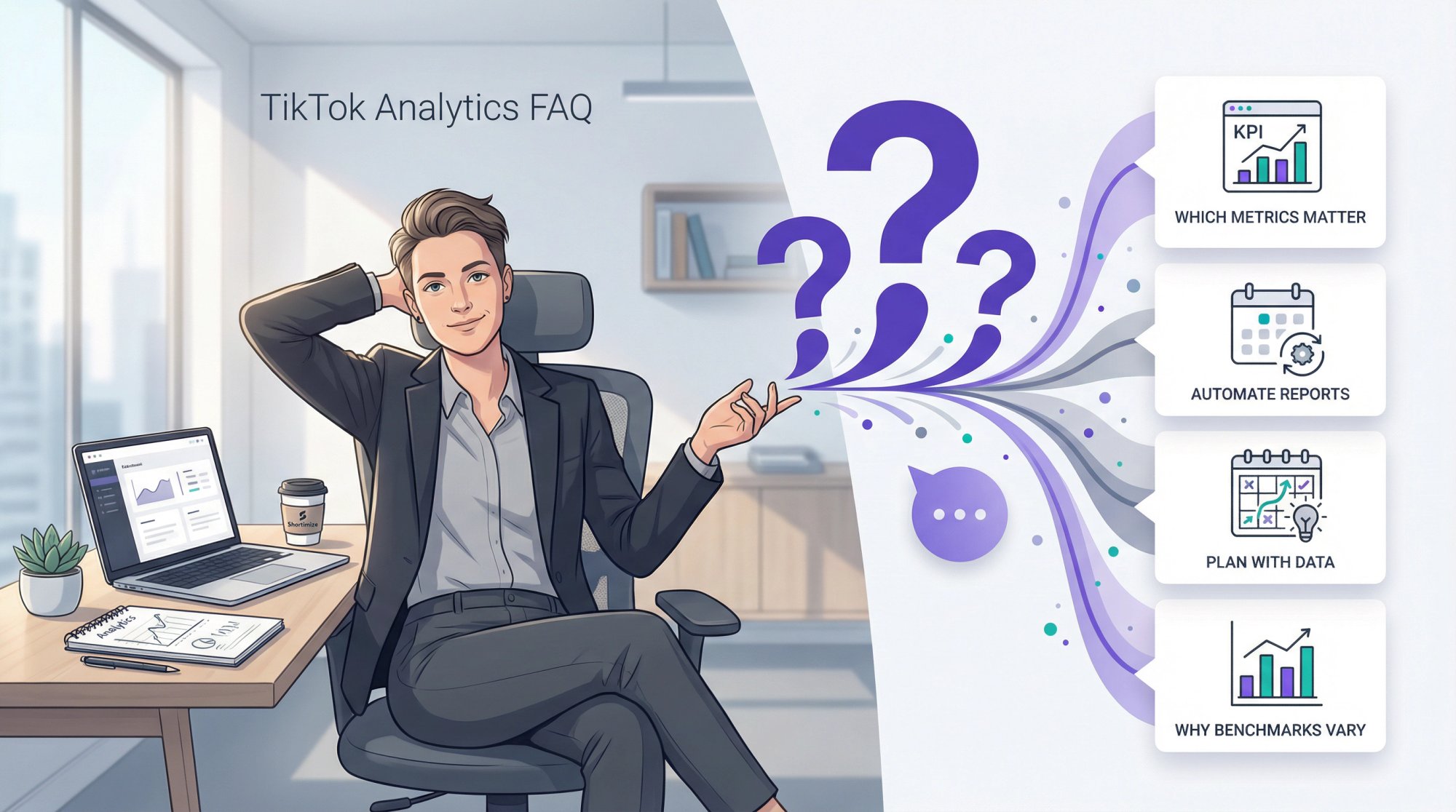
Which TikTok Metrics Matter Most for Agencies?
It depends on the objective, but agencies should always report:
• One primary KPI tied to the objective (e.g., purchases/ROAS for performance)
• A small set of leading indicators (attention + action)
TikTok's Ads Manager metrics include reach, impressions, clicks, conversions, cost, and more.
How to Automate TikTok Analytics Reports
Use Ads Manager Custom reports and schedule email deliveries.
Standardize dimensions/metrics so every client report uses the same schema.
TikTok Ads Help Center, April 2025.
For cross-platform reporting, use Shortimize's API to automate data pulls.
How to Plan TikTok Content with Data
Use:
Creator Search Insights (what people search for + content gaps)
Creative Center Trends and Keyword Insights
TikTok One Insights Spotlight for real-time trend intelligence aimed at brands/agencies
Learn how to find low-competition niches for faceless accounts for content opportunities.
Why Do TikTok Benchmarks Vary So Much?
Because sources measure different things:
• Engagement per view vs per follower
• Different verticals and account sizes
• Means vs medians
Use external benchmarks as directional, then anchor decisions to your client's own baseline plus a relevant peer set.
Key Takeaways: TikTok Analytics for Agencies
Analytics are essential, not optional
TikTok is too big and too fast-moving to wing it. Agencies using analytics see substantially higher engagement and content performance, proving its value.
Know what to measure
Focus on metrics that matter for your client's goals (whether it's views for awareness, engagement rate for content resonance, or click-throughs for conversions). Understand what is a good view rate for TikTok.
Go beyond TikTok's built-in tools
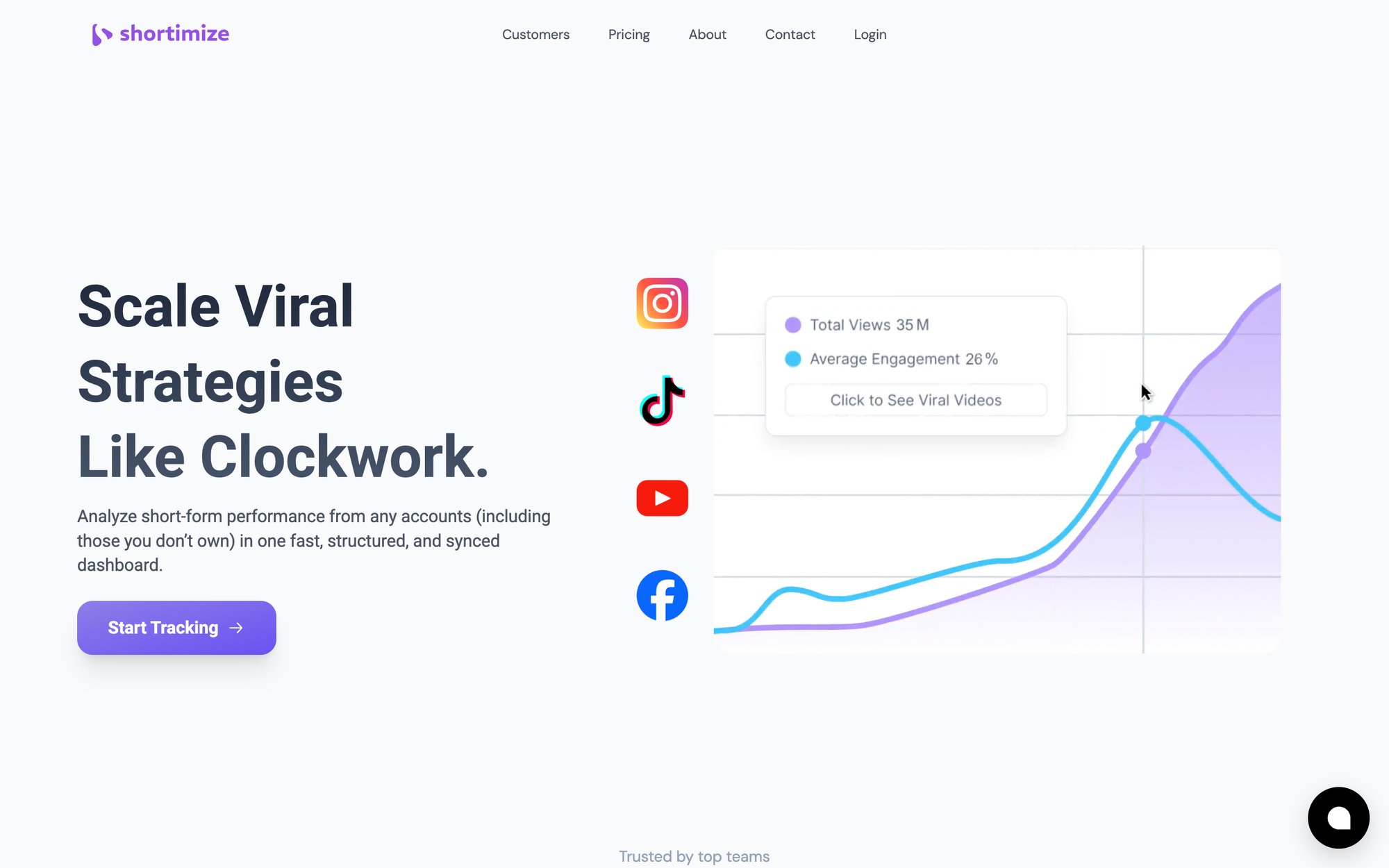
TikTok's native analytics have a 60-day limit and single-account silo. Agencies should use third-party solutions like Shortimize to gain unlimited history, multi-account dashboards, competitor analysis, and cross-platform capabilities.
Integrate analytics into strategy
Don't just collect data for reporting's sake. Use it to inform your content strategy in real time. Double down on content formats that analytics show are working (and cut tactics that aren't).
Align posting times with when your audience is most active (data-backed timing can boost reach by ~23%).
Communicate insights to clients
Present TikTok metrics in a way clients can appreciate. Translate numbers into narratives: how did your agency's efforts move the needle and why does it matter for the client's business?
Stay agile and keep learning
TikTok trends can emerge and fade within days. Use analytics to stay agile (if something suddenly spikes good or bad, investigate immediately and respond). Learn about social media monitoring to stay on top of changes.
By mastering TikTok analytics, agencies can create content that truly resonates, allocate resources more effectively, and build transparent, trust-based relationships with clients through clear results.
TikTok is a dynamic, creative playground. Pairing that creativity with solid data analysis is the formula for sustainable success on the platform.
Use this guide as your starting point, equip your team with the right tools like Shortimize, and watch your clients' TikTok presence transform from a shot in the dark into a finely tuned, results-generating machine.