

If you're searching for "how to find viral video patterns in your niche," you're past the point of wanting vague advice about going viral.
You need a repeatable system that answers the hard questions:
What exactly is working right now in your specific niche (not generic viral tips)?
Why it's working (so you can adapt it, not just copy it)?
How to spot patterns early, before everyone else saturates them?
How to turn insights into templates your team can execute every week?
This guide gives you a pattern-mining methodology that works across TikTok, Instagram Reels, and YouTube Shorts. We'll show you practical workflows you can run with Shortimize or your existing analytics stack.
What Are Viral Video Patterns?
A viral pattern is a repeatable combination of choices that reliably increases the odds of outlier performance in a specific niche.
A useful pattern isn't "use trending audio." It's way more precise:
"In personal finance, contrarian hooks + single visual proof in the first second + fast cuts every 1–1.5 seconds + comment-bait CTA ('comment 'sheet' and I'll send it') repeatedly produce 2–5× median performance across multiple accounts."
A pattern is only real if it's:
Repeatable (shows up in multiple videos and/or multiple creators)
Specific (you can write it as a template someone else can execute)
Measurable (you can test it as a hypothesis)
Niche-causal (it works because it matches niche demand, not random luck)
What Aren't Viral Patterns?
One viral video that happened to hit a trend at the right moment isn't a pattern.
A single creator's personality can't be replicated (you can't copy charisma).
A "format" without a reason (like "podcast clips") tells you nothing. You need why that format works in your niche.
Why Do Viral Patterns Work on TikTok, Reels, and Shorts?
Patterns work because algorithms are recommendation systems that predict what a person will enjoy next, based on signals.
How Does TikTok's Algorithm Reward Content?
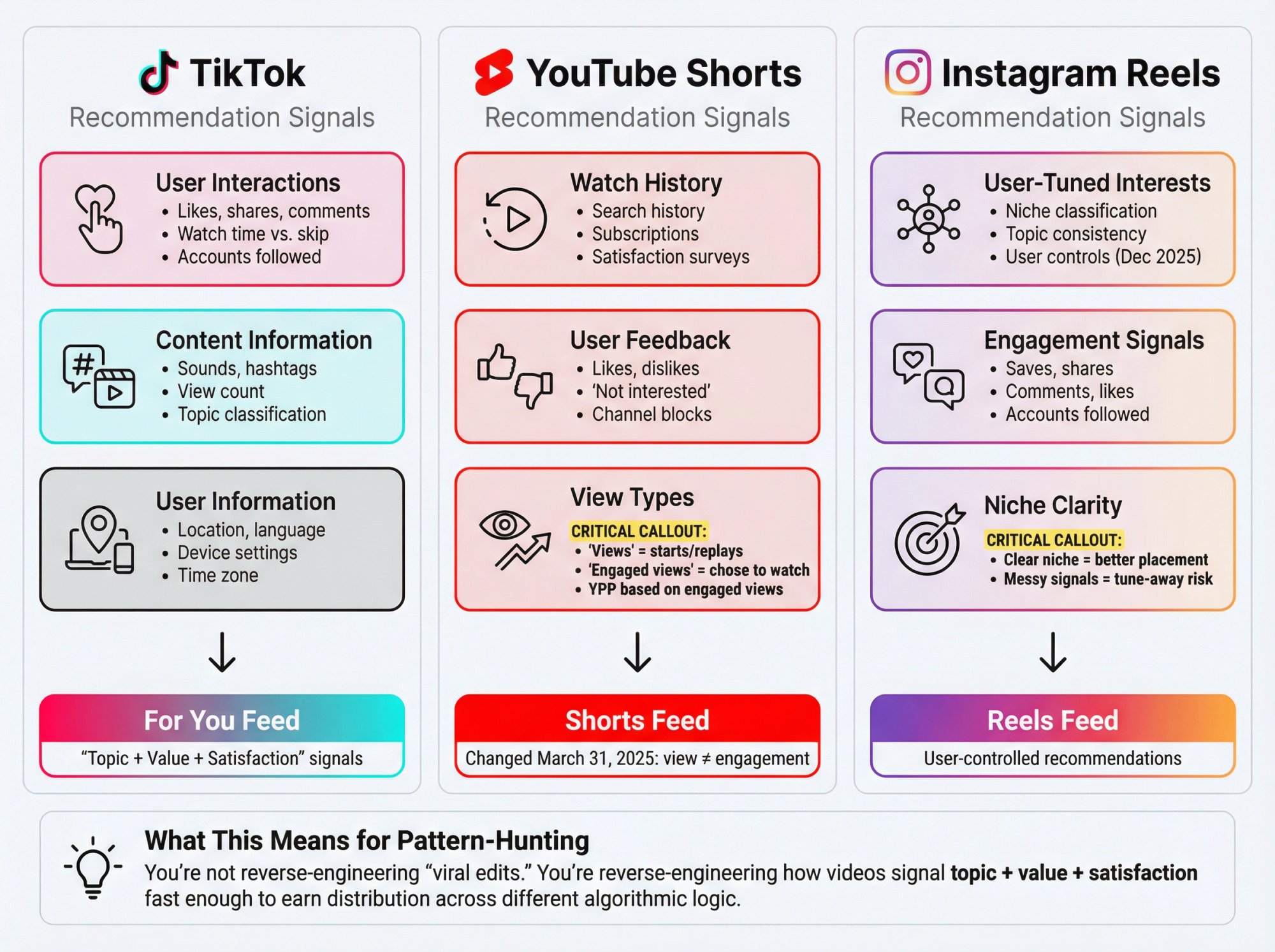
TikTok's Help Center describes three main factor groups influencing recommendations:
User interactions (what you like, share, comment on, watch fully or skip)
Content information (sounds, hashtags, view count, country published)
User information (device settings, language, location, time zone, device type)
TikTok also rolled out a "Why this video" explainer, showing reasons like your interactions, followed accounts, content posted recently in your region, and popular regional content. This matters because it reveals what TikTok "thinks" your video is about and who it's for.
In 2025, TikTok expanded Manage Topics controls and keyword filtering, reinforcing that topic classification matters. TikTok explicitly categorizes content into topics and lets users tune how often they see them.
What this means for pattern-hunting: You're not just reverse-engineering "viral edits." You're reverse-engineering how videos signal topic + value + satisfaction fast enough to earn distribution.
How Does YouTube Shorts Algorithm Work?
YouTube's recommendations rely on signals including watch history, search history, subscriptions, likes, dislikes, "Not interested" feedback, "Don't recommend channel," and satisfaction surveys. It's not purely watch time.
YouTube changed how Shorts views are counted on March 31, 2025:
Views now count when a Short starts to play or replay (no minimum watch time).
The previous metric remains as "Engaged views," tracking viewers who chose to continue watching.
Shorts monetization and YPP eligibility are based on Engaged views, not the new "starts" views.
What this means for pattern-hunting: If you're comparing Shorts performance over time or across platforms, you must know which view metric you're using. For pattern analysis, "engaged views" is closer to "did people actually watch?"
What About Instagram Reels Algorithm?
In December 2025, Instagram introduced new ways for people to control their Reels recommendations, which matters because it strengthens the platform's direction toward user-tuned interest graphs.
What this means for pattern-hunting: Being clearly in a niche (and signaling it consistently) is increasingly valuable. Messy topic signals make it harder for the system to place your content and easier for users to tune away from it.
How to Find Viral Patterns: Step-by-Step System
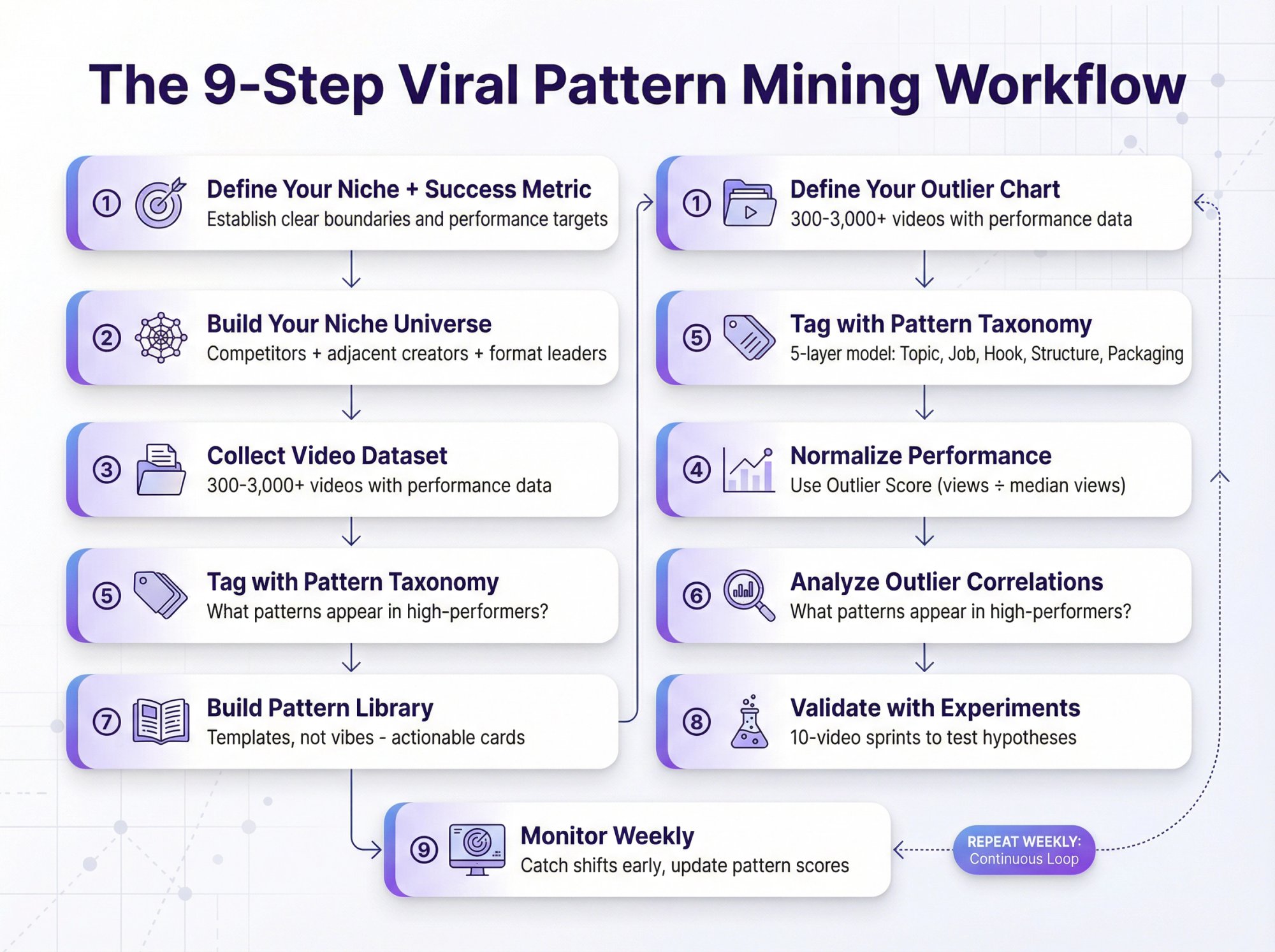
This is the process high-performing teams use (explicitly or implicitly). We'll make it structured.
The 9-Step Viral Pattern Mining Workflow
① Define your niche + your success metric
② Build a competitor and adjacent-competitor "niche universe"
③ Collect a dataset of videos (with performance data)
④ Normalize performance (so you aren't fooled by big accounts)
⑤ Tag videos using a pattern taxonomy
⑥ Analyze what correlates with outliers (with guardrails)
⑦ Turn findings into a Pattern Library (templates, not vibes)
⑧ Validate patterns with controlled experiments
⑨ Monitor weekly so you catch shifts early
You can do this manually, but it's slow. The "unfair advantage" is speed + scale + cross-platform visibility, which is exactly what Shortimize is built for: tracking and analyzing short-form performance across accounts you do not own, across platforms, with outlier detection and organization workflows.
How to Define "Viral" (Avoid This Common Mistake)
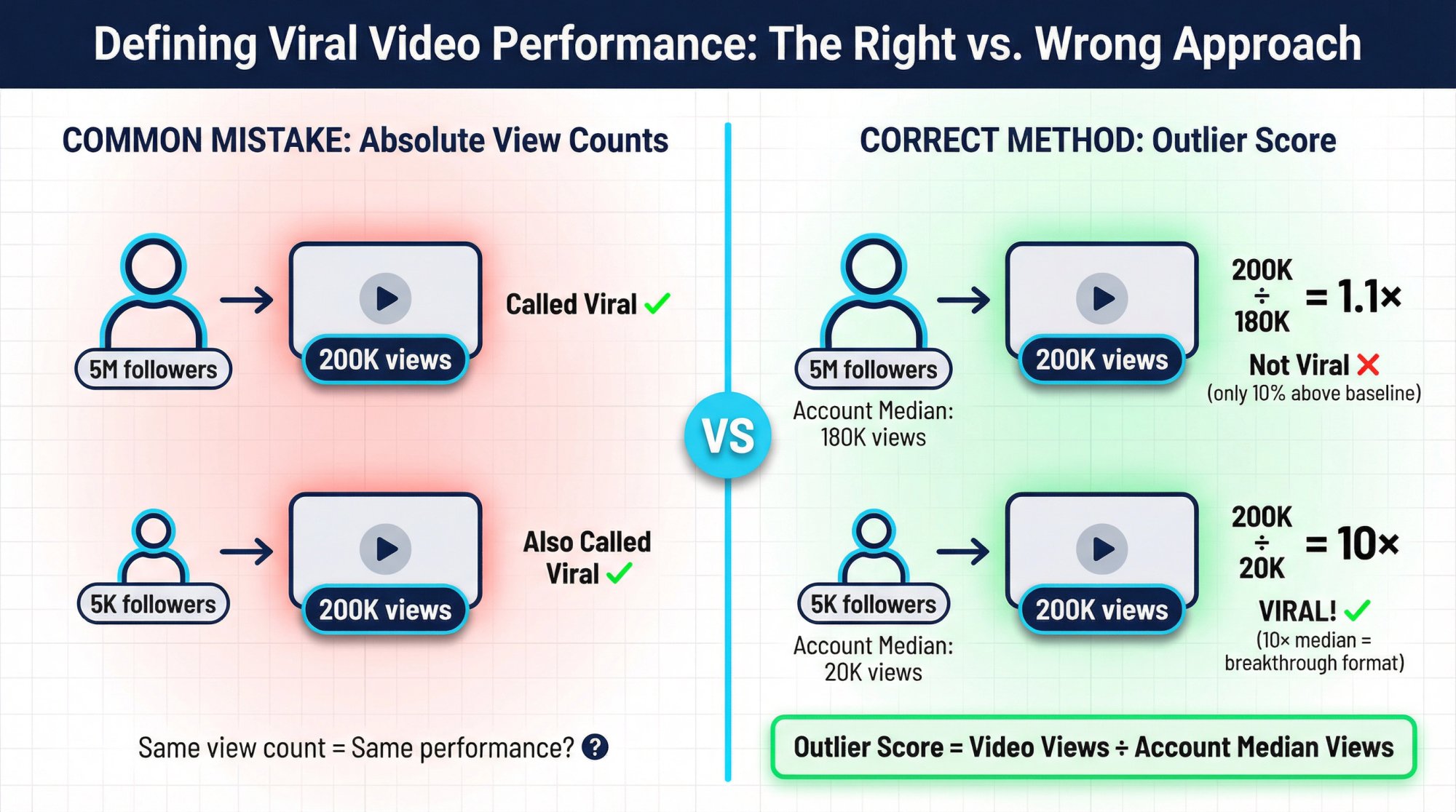
Most people define viral like this: "Videos above X views."
That's misleading. A 5M-follower creator and a 5k-follower creator live in different universes.
Use Outlier Score vs Baseline
A better definition is:
Outlier Score = Video Views ÷ Account Median Views (in same time window)
Example:
If an account's median is 20,000 views and a video gets 140,000 views:
Outlier Score = 140,000 / 20,000 = 7×
This is how you identify breakthrough formats rather than "this creator is famous."
Shortimize explicitly supports median and virality metrics and outlier identification at the account level, which makes this approach work at scale.
When Should You Use Absolute View Counts?
Absolute thresholds can help when evaluating trends across the niche, but treat them as context, not truth.
For example, Shortimize's 2025 benchmark guide notes that "viral" is subjective and often discussed as hitting around 1M views quickly, but stresses that relative performance vs your norm is what truly matters.
Practical rule: Track both:
Outlier Score (truth for patterns)
Absolute Views (truth for trend reach and saturation)
How to Build Your Niche Universe for Pattern Mining
Your niche universe is not "top 5 creators."
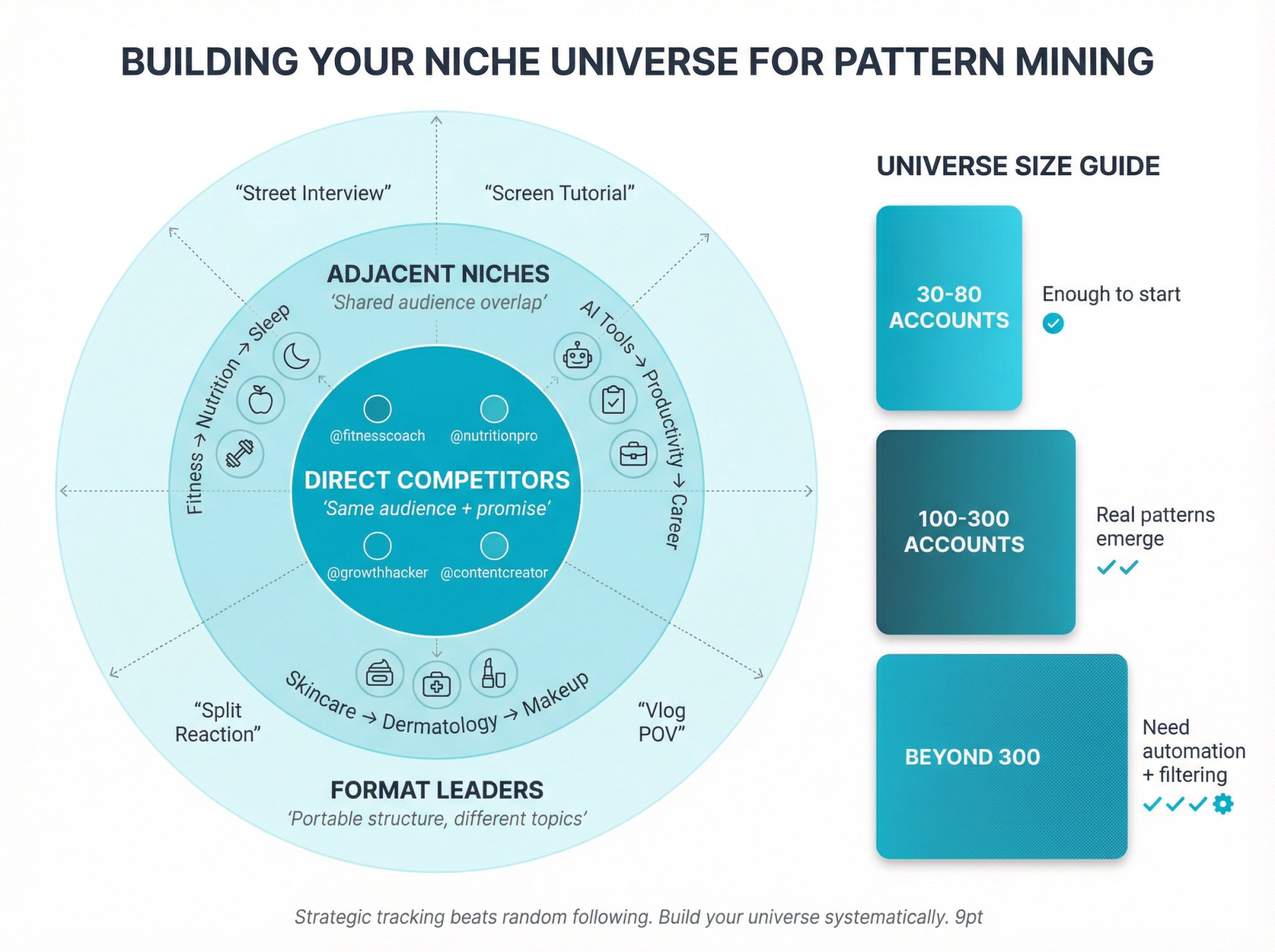
It should include:
Direct Competitors in Your Niche
Creators or accounts with the same target audience and promise.
Using influencer tracking tools helps you systematically monitor these direct competitors and spot when they test new formats.
Adjacent Niches with Shared Audience
Examples:
→ Fitness ↔ nutrition ↔ sleep optimization
→ AI tools ↔ productivity ↔ career advice
→ Skincare ↔ dermatology ↔ makeup
Adjacent niches often reveal patterns before they arrive in your lane.
Competitor analysis workflows can help you identify these adjacent players and understand what's working across related niches.
Format Leaders (Even If Niche Is Different)
Sometimes the structure is portable even if the topic isn't (like "street interview," "screen-record tutorial," "split-screen reaction").
How Many Accounts Should You Track?
For serious pattern mining:
| Universe Size | What You Get |
|---|---|
| 30–80 accounts | Enough to start |
| 100–300 accounts | Real patterns emerge |
| Beyond 300 | Need automation and filtering |
Shortimize's positioning emphasizes the ability to track and analyze accounts you don't own and scale from small sets to very large account lists.
How to Collect Viral Video Data Without Drowning
You need enough videos to distinguish patterns from noise.
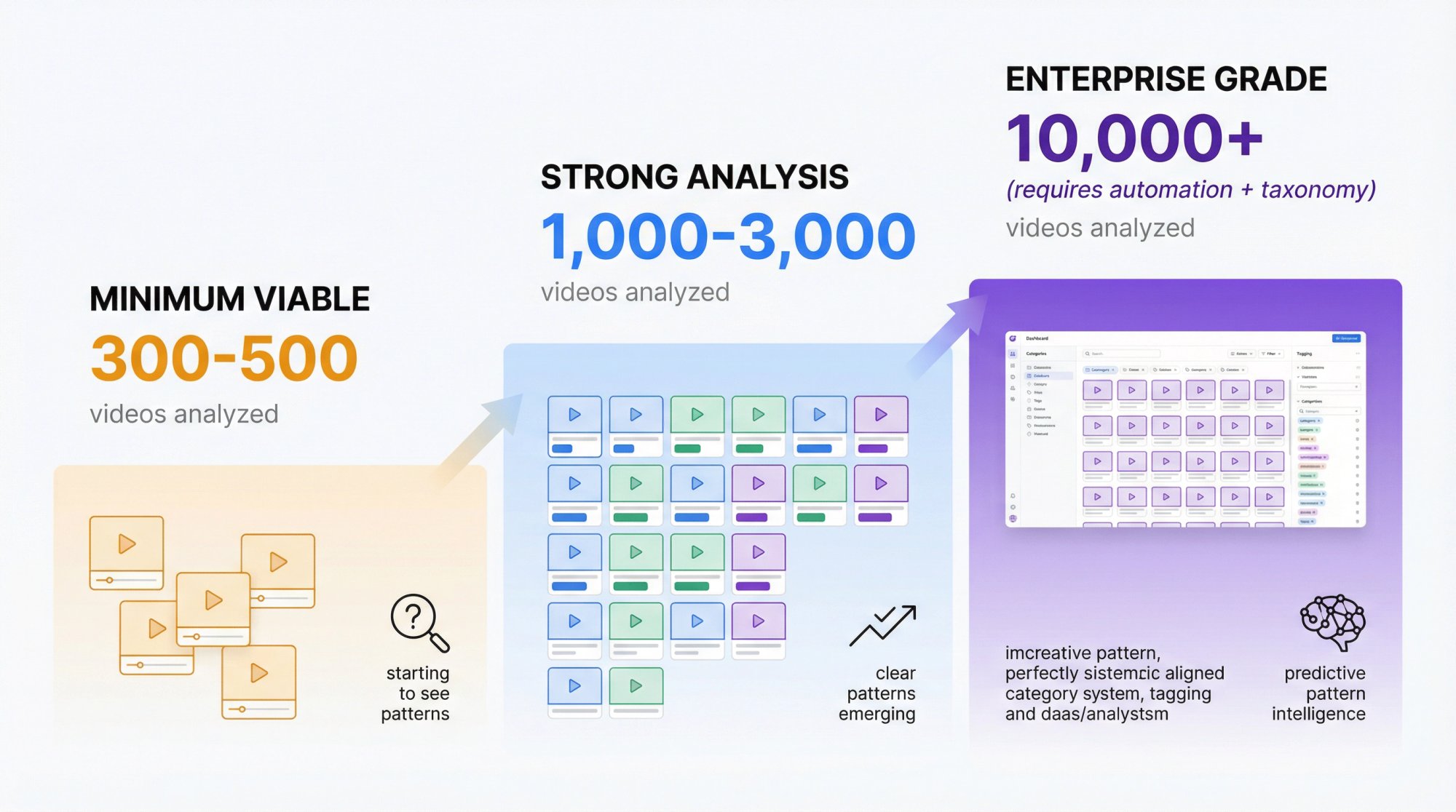
How Many Videos Do You Need to Analyze?
Minimum viable: 300–500 videos
Strong: 1,000–3,000 videos
Enterprise-grade: 10,000+ videos (only if you have automation and a good taxonomy)
What Time Window Should You Analyze?
Last 90 days for "what's working now"
Last 12 months only if you're studying evergreen patterns
Understanding the best time to post on different platforms can help you contextualize performance patterns within your dataset.
What Data Points Do You Need for Each Video?
At minimum:
→ Platform
→ Account name
→ Post date/time
→ Views, likes, comments
→ (If available) shares, saves
→ Caption text
→ Video length
→ Link/URL to video
Shortimize's analyzer pages describe retrieving every video and surfacing aggregate statistics in exportable tables, plus posting schedules and video length performance by account.
How to Tag Videos So Patterns Become Visible
Virality is messy until you turn videos into structured variables.
Here's a proven tagging taxonomy for short-form.
The 5-Layer Viral Pattern Tagging Model
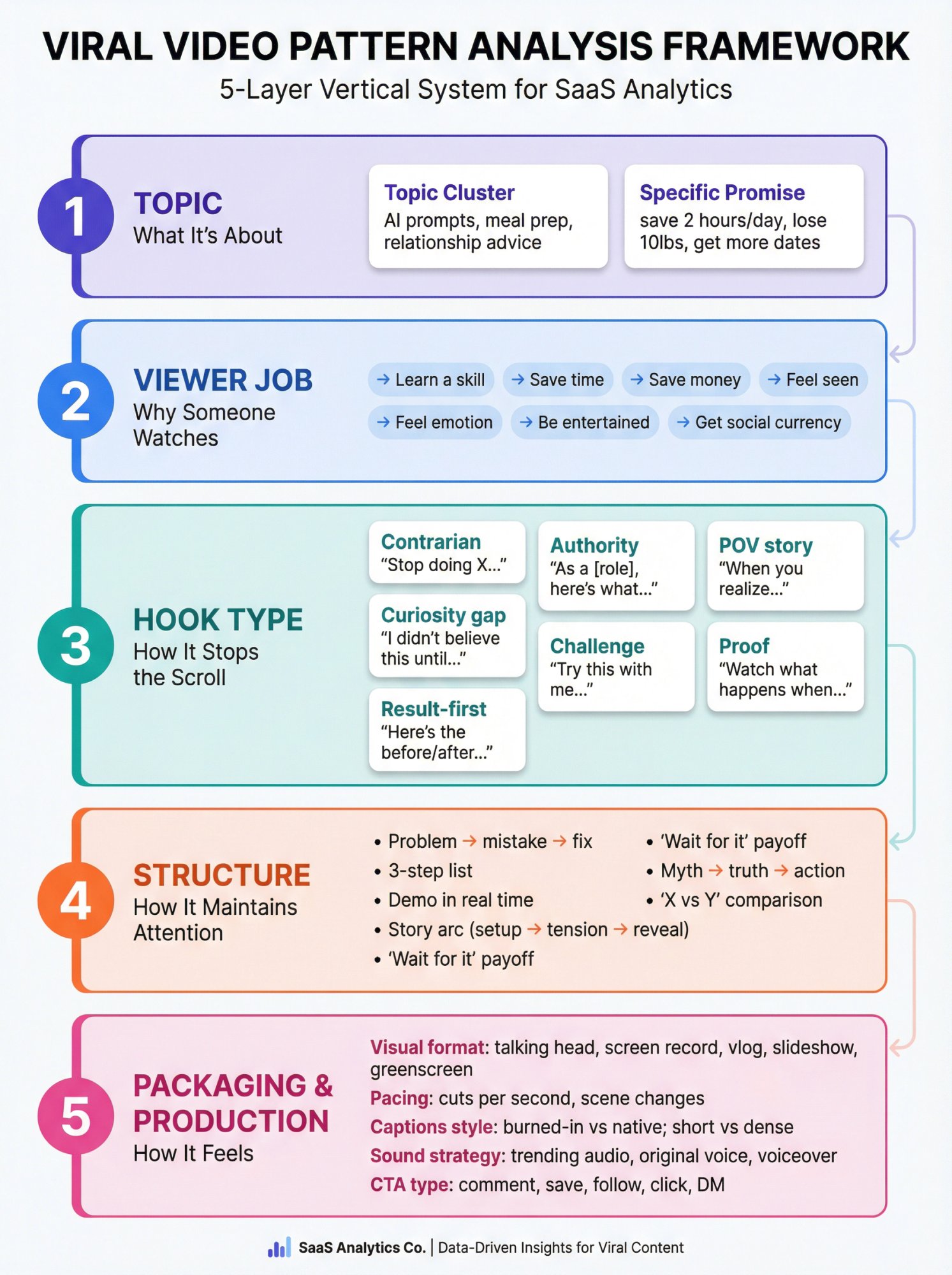
Layer 1: Topic (What It's About)
Topic cluster (e.g., "AI prompts," "meal prep," "relationship advice")
Specific promise (e.g., "save 2 hours/day," "lose 10lbs," "get more dates")
Layer 2: Viewer Job (Why Someone Watches)
Pick one:
→ Learn a skill
→ Save time
→ Save money
→ Feel seen (relatability)
→ Feel emotion (awe, anger, inspiration)
→ Be entertained
→ Get social currency ("I should send this to someone")
Layer 3: Hook Type (How It Stops the Scroll)
Examples:
Contrarian ("Stop doing X…")
Curiosity gap ("I didn't believe this until…")
Result-first ("Here's the before/after…")
Authority ("As a [role], here's what people miss…")
Challenge ("Try this with me…")
POV story ("When you realize…")
Proof ("Watch what happens when…")
Layer 4: Structure (How It Maintains Attention)
Examples:
• Problem → mistake → fix
• 3-step list
• Demo in real time
• Story arc (setup → tension → reveal)
• "Wait for it" payoff
• Myth → truth → action
• "X vs Y" comparison
Understanding optimal video length patterns helps you determine which structures work best for different platforms.
Layer 5: Packaging & Production (How It Feels)
Visual format (talking head, screen record, vlog, slideshow, greenscreen)
Pacing (cuts per second and scene changes)
Captions style (burned-in vs native; short vs dense)
Sound strategy (trending audio, original voice, voiceover)
CTA type (comment, save, follow, click, DM)
Social media engagement tracking helps you measure which CTA types drive the most meaningful interactions.
How to Analyze Patterns Without Fooling Yourself
Here's where most "pattern" guides fail: they don't tell you how to avoid fake patterns.
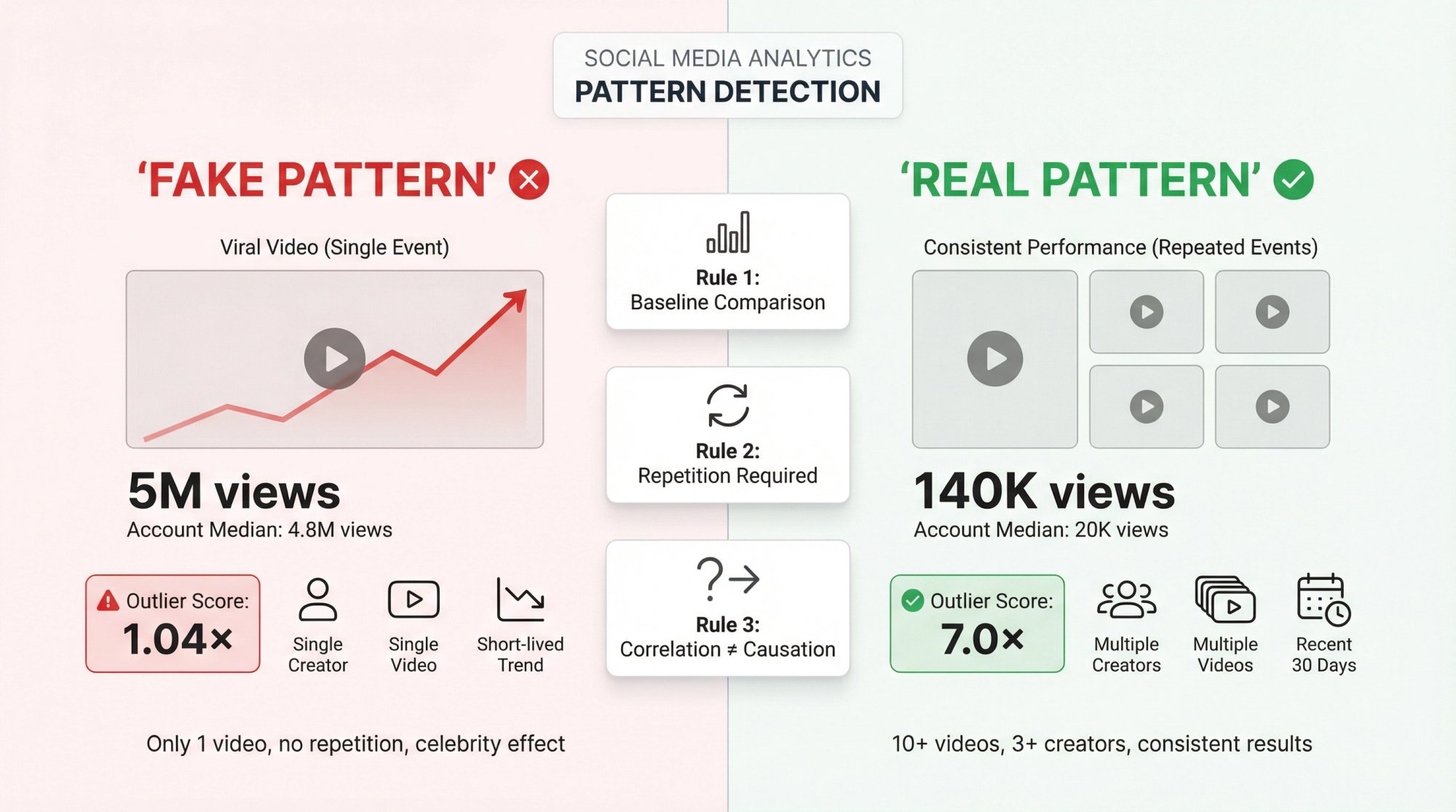
3 Rules for Real Pattern Detection
Rule 1: Always Compare Against Baseline
Use Outlier Score (views ÷ median views).
Understanding good view rates helps you establish appropriate baselines for your niche.
Rule 2: Require Repetition
Set thresholds like:
• Minimum 5–10 videos per tag before you trust it
• Minimum 2–3 different creators showing the same pattern
Rule 3: Separate Correlation from Causation
A pattern might correlate with performance because of:
→ A trend wave (short-lived)
→ Creator distribution advantage
→ Paid boosts
→ External events
→ Seasonality
Your job is to identify patterns that survive those factors.
How to Score Pattern Confidence (Simple Formula)
When you find something promising, score it:
Pattern Confidence = (Repeatability × Cross-Creator × Recency × Clarity) − Saturation
Where each factor is 1–5.
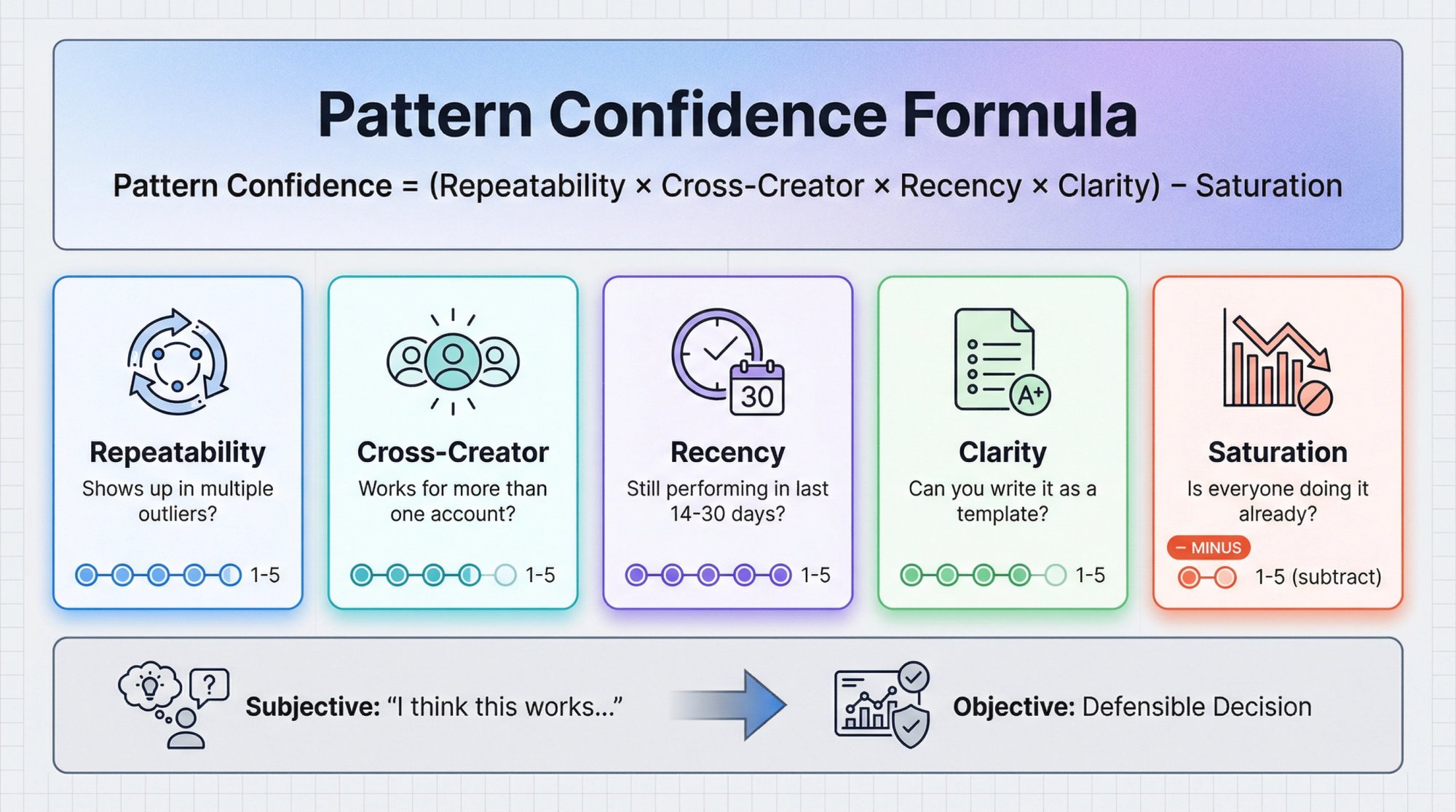
Repeatability: Does it show up in multiple outliers?
Cross-Creator: Does it work for more than one account?
Recency: Is it still performing in the last 14–30 days?
Clarity: Can you write it as a template?
Saturation: Is everyone doing it already?
This turns "I think this works" into a decision you can defend.
How to Build a Pattern Library That Makes This Worth $10k
A Pattern Library is the difference between "we noticed a trend" and "we can ship 20 videos next week."
The Pattern Card Template
Every pattern gets a one-page card:
① Pattern name (Make it memorable, like "Receipt Breakdown," "3 Mistakes You Didn't Know You're Making," "Before/After in 2 Seconds," "Expert Reacts")
② The promise (What outcome is the viewer getting?)
③ Hook lines (10 options) (Write them like scripts, not concepts)
④ Structure beats
Example:
• 0–1s: show result
• 1–3s: state contrarian claim
• 3–10s: proof and steps
• 10–12s: recap
• 12–14s: CTA
⑤ Production rules (framing, caption density, pacing, audio, B-roll style)
⑥ CTA options (comment CTA, save CTA, follow CTA, share CTA)
⑦ "When to use and when not to use" (This prevents your team from forcing it)
How to Test Patterns in Days, Not Months
Patterns are hypotheses. You validate them with controlled output.
The 10-Video Validation Sprint
Pick 1 pattern. Ship 10 versions in 7–14 days.
Control variables:
• Same creator or voice
• Same niche topic cluster
• Same video length range
• Same posting window
Change only:
• Hook line
• Opening visual
• Proof style
• CTA
Measure:
• Outlier Score
• Engagement rate (relative)
• "Did it create followers/saves/comments?" depending on your goal
A/B testing for YouTube Shorts provides a systematic framework for validating patterns through controlled experiments.
Why 10 Videos Beat 1 Test Video
One video can be luck. Ten videos gives you signal.
How Patterns Transfer Across TikTok vs Reels vs Shorts
Here's the key insight:
Patterns transfer, but metrics don't transfer cleanly.
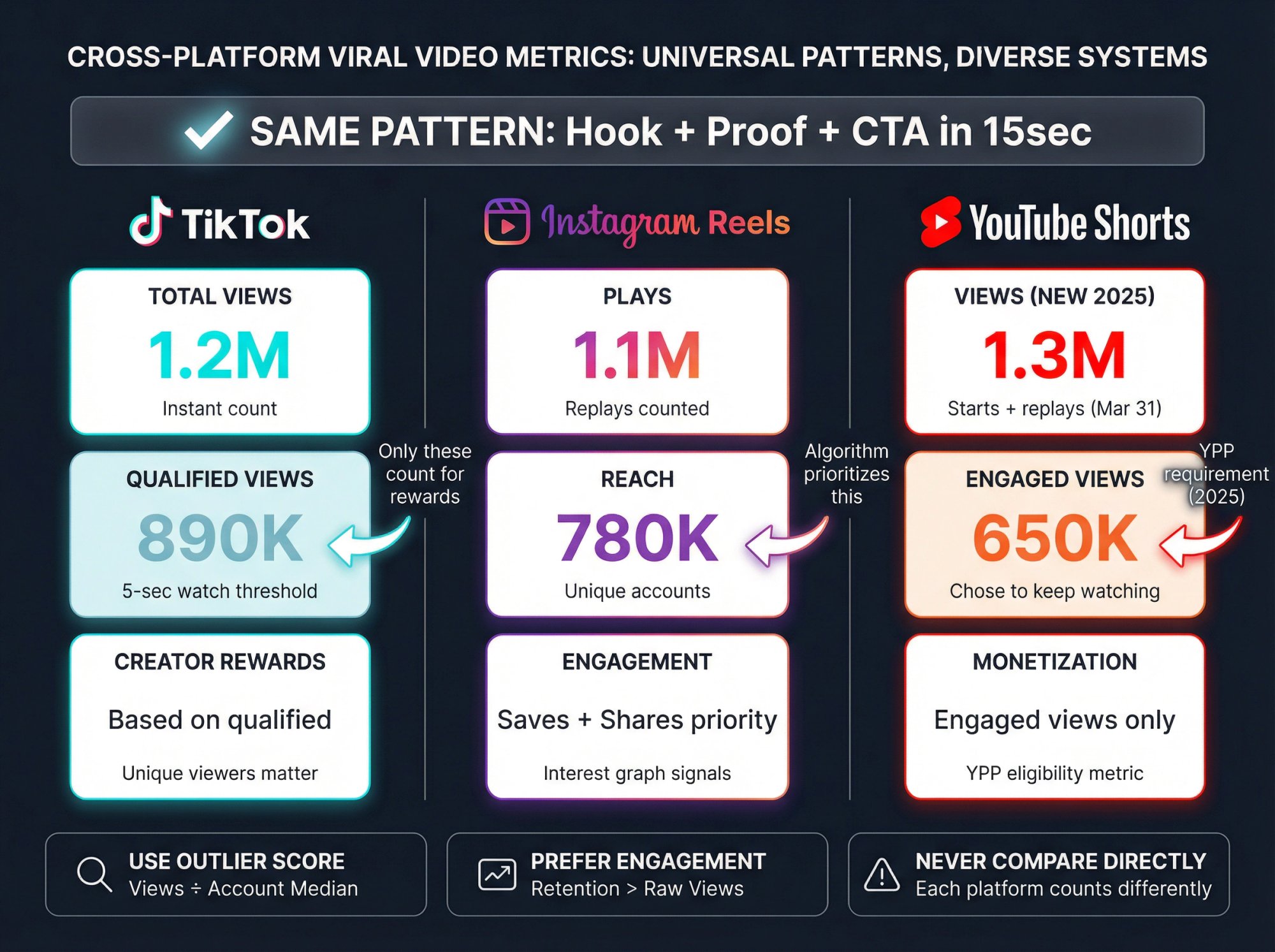
YouTube Shorts Views Changed in 2025 (What You Need to Know)
Because Shorts views now count starts/replays, a "high view" Short might not mean "high satisfaction." YouTube preserved Engaged views as the metric that reflects viewers who chose to keep watching, and monetization/YPP eligibility uses engaged views (change effective March 31, 2025).
So when you compare across platforms:
• Use Outlier Score (relative)
• Prefer engagement and retention proxies over raw views
Comparing watch time across TikTok vs Reels vs Shorts helps you understand how engagement metrics differ across platforms.
What Are TikTok Qualified Views vs Total Views?
If you monetize, TikTok's Creator Rewards logic may emphasize "qualified" views rather than total plays.
Shortimize's Dec 23, 2025 guide summarizes the distinction between total views and "qualified views," including criteria like unique viewers and a 5-second watch threshold.
Even if you don't monetize, the strategic takeaway is universal:
A view is not always "real attention." Patterns that win long-term are attention patterns, not counter-inflation patterns.
Understanding what constitutes a good engagement rate on TikTok helps you move beyond vanity metrics to true performance indicators.
How to Find Patterns Before They Saturate: Search Demand Signals
Most creators only watch the For You feed and call it "research."
That's late-stage.
In 2024, TikTok introduced Creator Search Insights, a tool showing creators what people are searching for and including "content gap topics" (searched often, but not featured in many videos). Announced March 13, 2024.
This matters because it helps you find:
→ What your niche wants next
→ What's underserved
→ Which topics are likely to keep performing (evergreen demand)
If you combine:
• Search-demand gaps (what people want)
• Outlier video patterns (how it's presented)
You get a powerful strategy: build viral templates around proven demand.
TikTok SEO optimization helps you align your patterns with what people are actively searching for.
Weekly Pattern Radar Routine: How to Stay Ahead
If you want a sustainable system, make it a cadence:
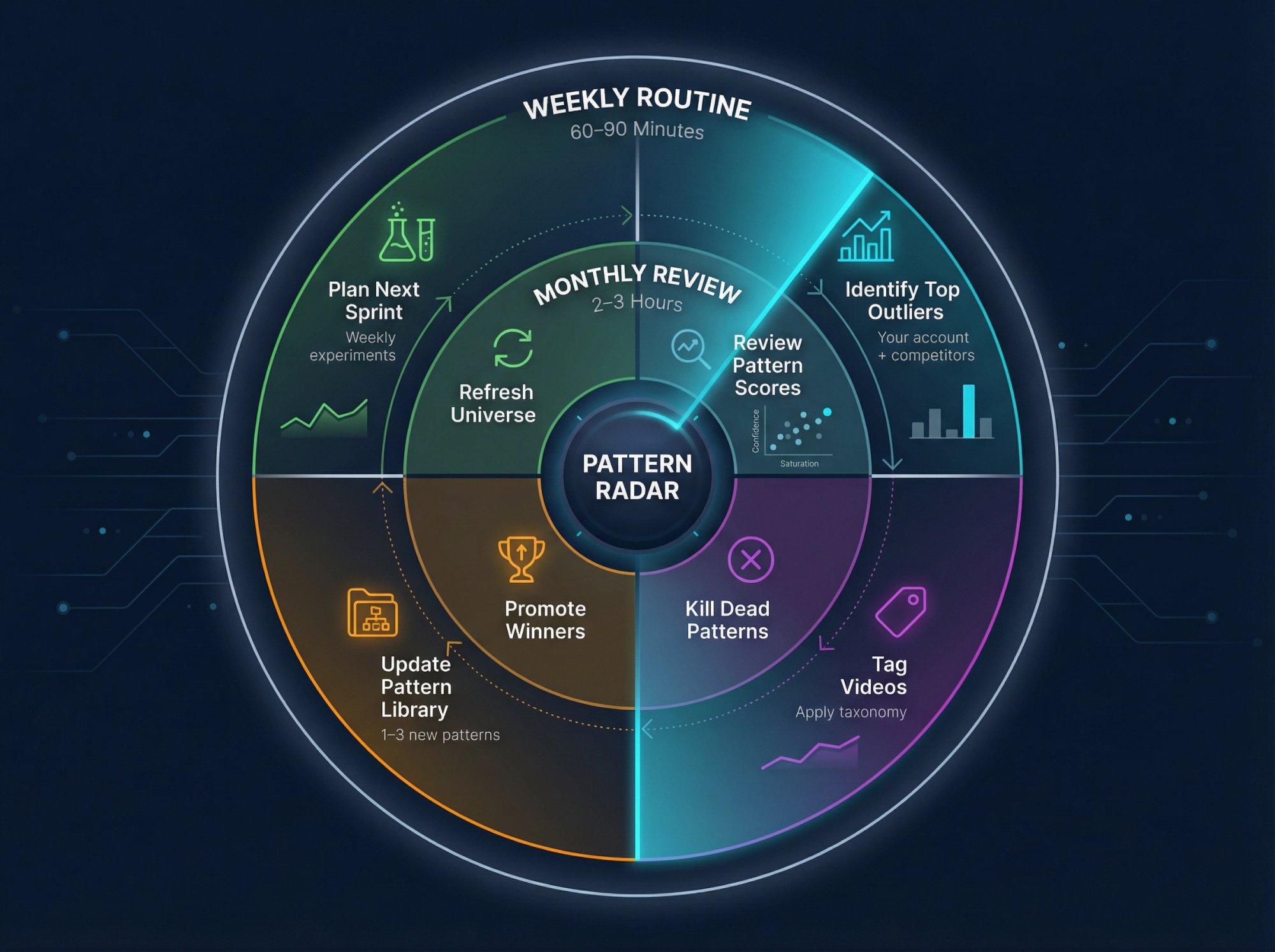
Weekly (60–90 Minutes)
① Identify top outliers this week (your account + competitors)
② Tag them quickly using your taxonomy
③ Add 1–3 patterns to your library (or update old ones)
④ Decide next week's experiment sprint
Monthly (2–3 Hours)
① Review pattern scores (confidence vs saturation)
② Kill patterns that stopped working
③ Promote patterns that keep repeating
④ Refresh competitor universe (add new breakouts)
Shortimize's homepage highlights outlier detection and real-time/reactive workflows (including notifications and frequent refresh, depending on plan), which supports this kind of cadence at scale.
Social media monitoring enables continuous tracking of competitor patterns and emerging trends.
5 Mistakes That Make Pattern Research Useless
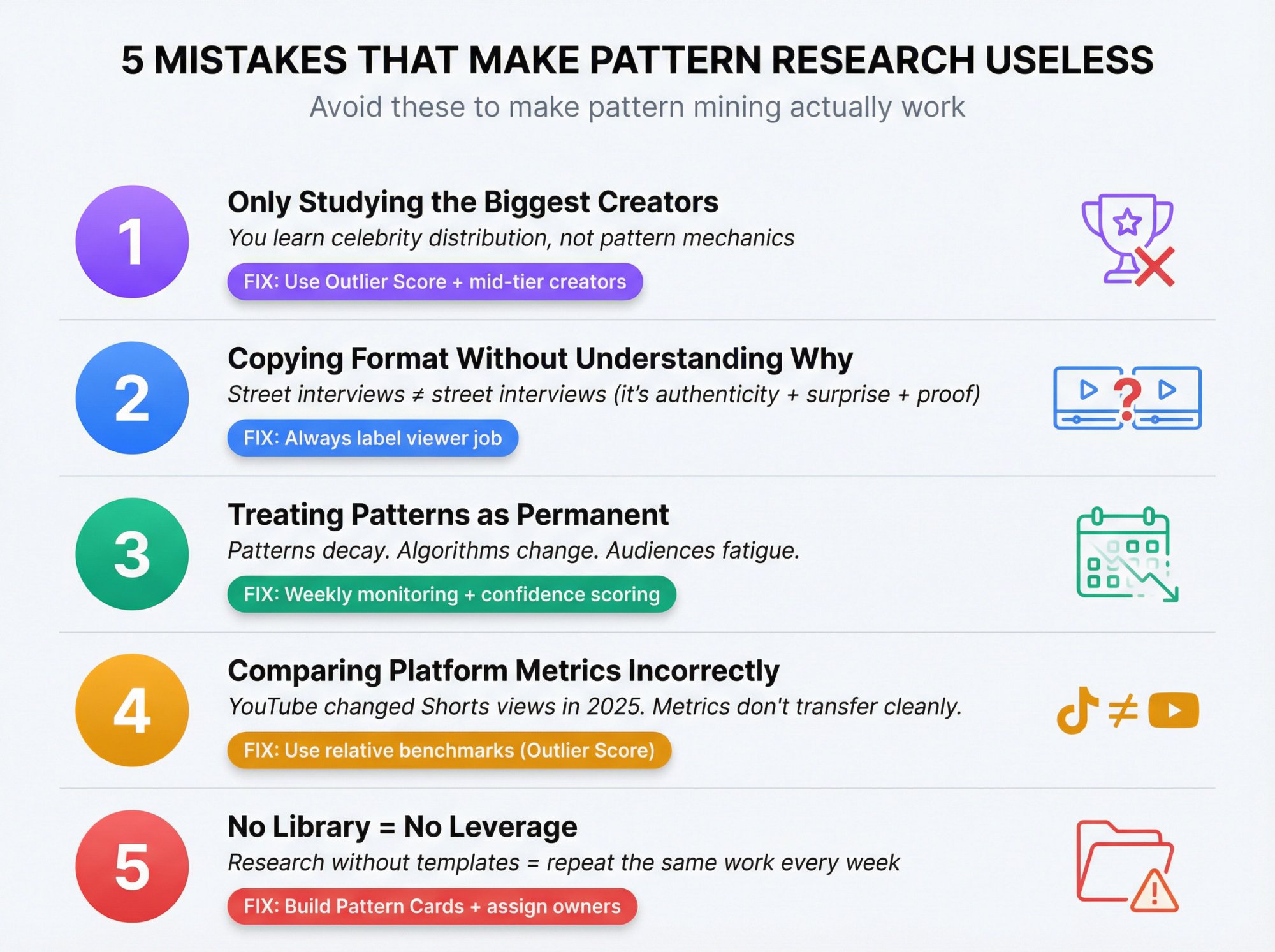
Mistake 1: Only Studying the Biggest Creators
You end up learning "celebrity distribution," not "pattern mechanics."
Fix: Use Outlier Score, and include mid-tier creators.
Analyzing micro and nano-influencers often reveals more replicable patterns than studying mega-creators.
Mistake 2: Copying Format Without Understanding Why It Works
"Street interviews" might work because they deliver authenticity + surprise + social proof, not because they're street interviews.
Fix: Always label "viewer job."
Mistake 3: Treating Patterns as Permanent
Patterns decay. Algorithms change. Audiences fatigue.
Fix: Set up weekly monitoring and pattern confidence scoring.
TikTok's 2025 algorithm update shows how platforms evolve and why ongoing monitoring is essential.
Mistake 4: Comparing Platform Metrics Incorrectly
YouTube changed Shorts views counting in 2025; TikTok and Instagram count differently; retention metrics differ.
Fix: Use relative benchmarks and platform-native "quality metrics" (e.g., engaged views on Shorts).
YouTube Shorts vs TikTok comparison breaks down the key platform differences that affect pattern analysis.
Mistake 5: No Library = No Leverage
If your research doesn't turn into templates, you'll repeat the same work every week.
Fix: Build Pattern Cards and assign owners.
How to Use Shortimize for Pattern Mining (Practical Setup)
If you want to run this like a growth team instead of a solo creator with a notebook, you need:
• A clean dataset (lots of accounts, lots of videos)
• Consistent metrics (medians, outliers)
• Organization (collections, segmentation)
• Monitoring (alerts when a competitor spikes)
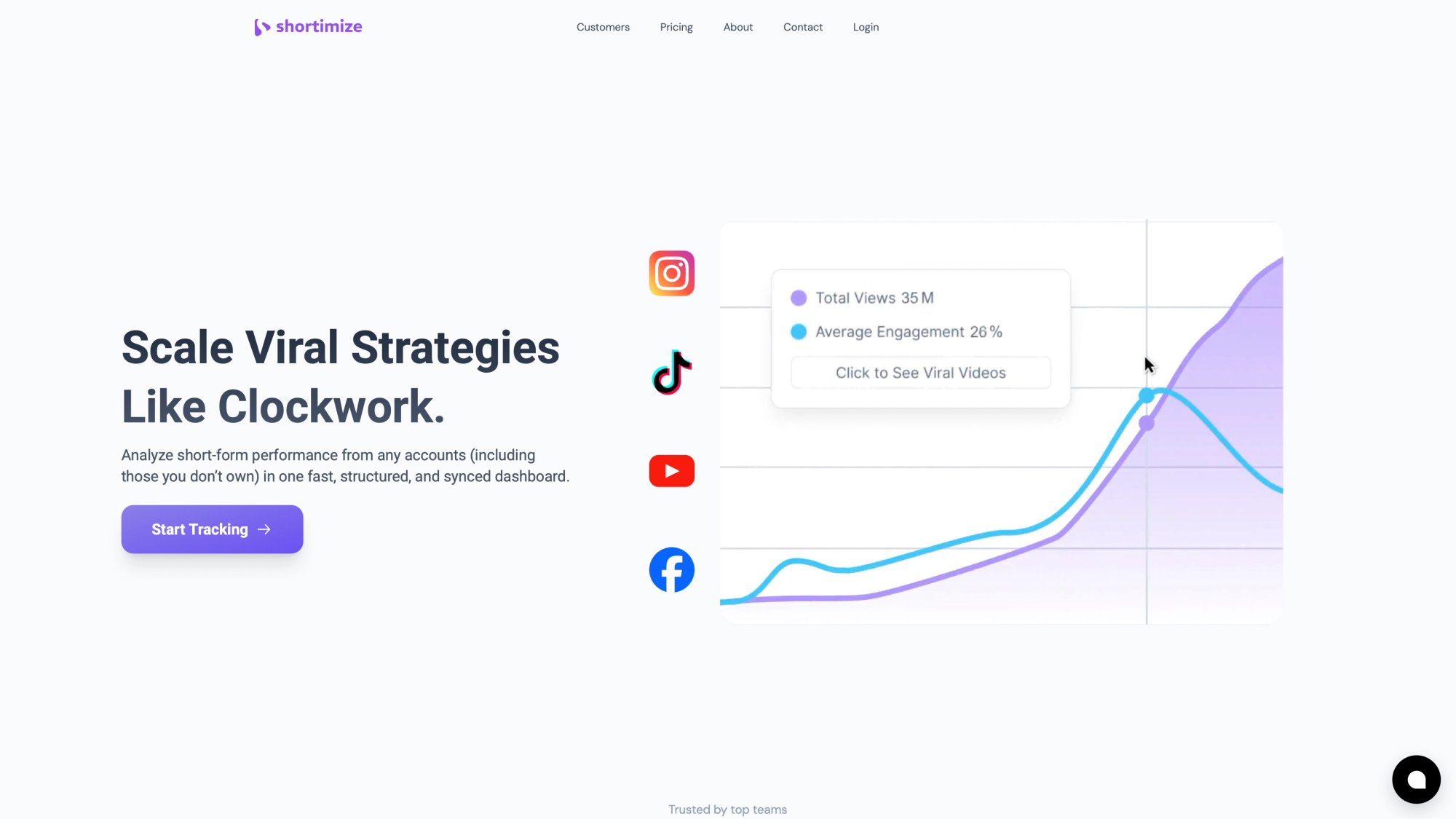
Shortimize is built around those jobs:
• Track and analyze short-form performance from accounts you don't own, in a unified dashboard
• Analyze any TikTok account by URL/handle and get posting schedules, optimal lengths, virality/outlier views, and similar accounts/videos
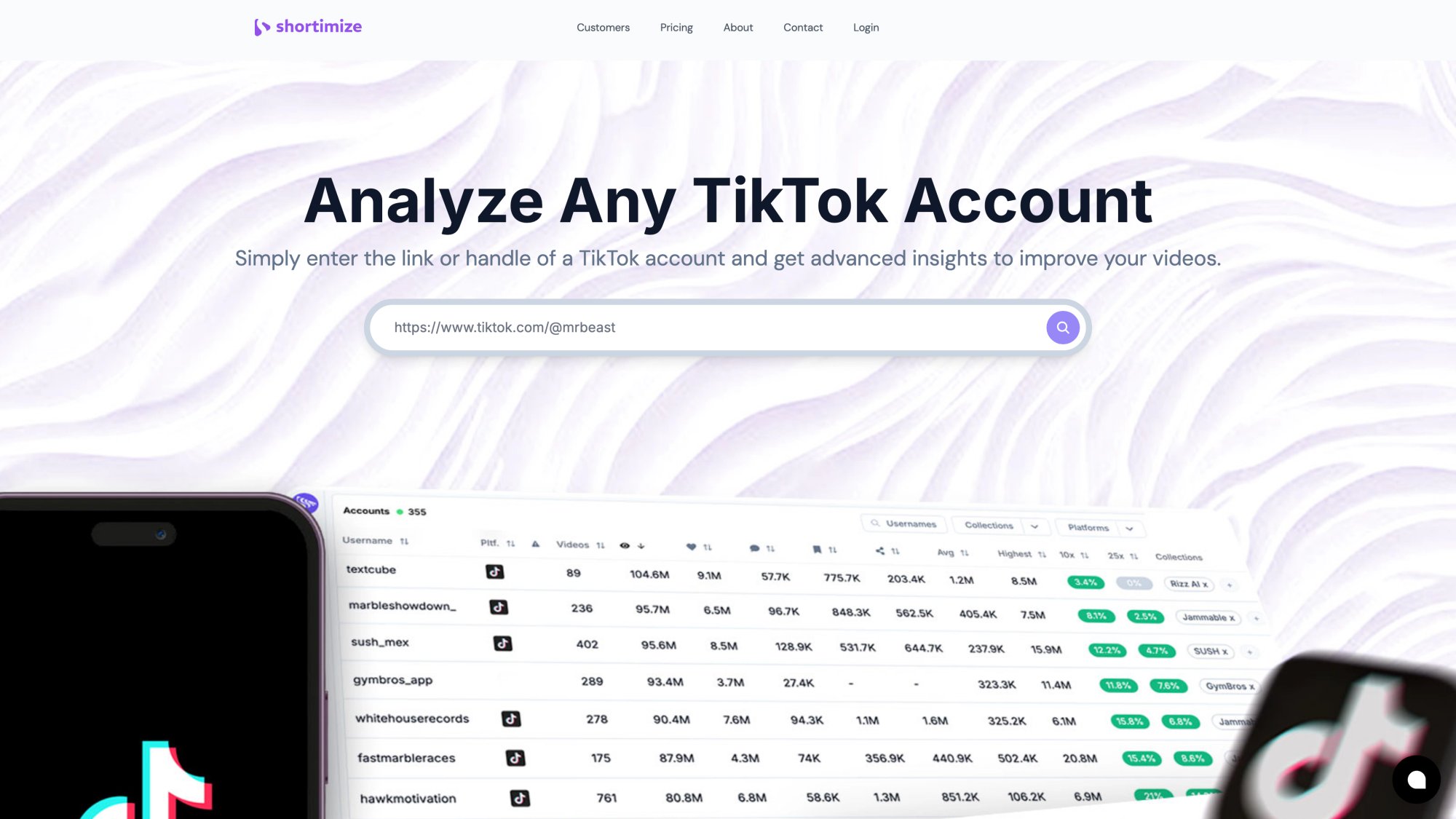
• Monitor accounts across TikTok, Instagram, and YouTube, export tables, and surface virality metrics and trends
14-Day Pattern Mining Sprint Inside Shortimize
| Day | Action |
|---|---|
| Day 1 | Build a Collection of 30–50 niche accounts |
| Day 2 | Filter/sort by outliers (viral ratio vs median) |
| Day 3 | Tag top 50 outliers (hook type, structure, format, CTA) |
| Day 4 | Identify top 3 patterns + write Pattern Cards |
| Day 5–14 | Run a 10-video validation sprint per pattern |
| Ongoing | Set alerts so you know when a competitor hits a new outlier |
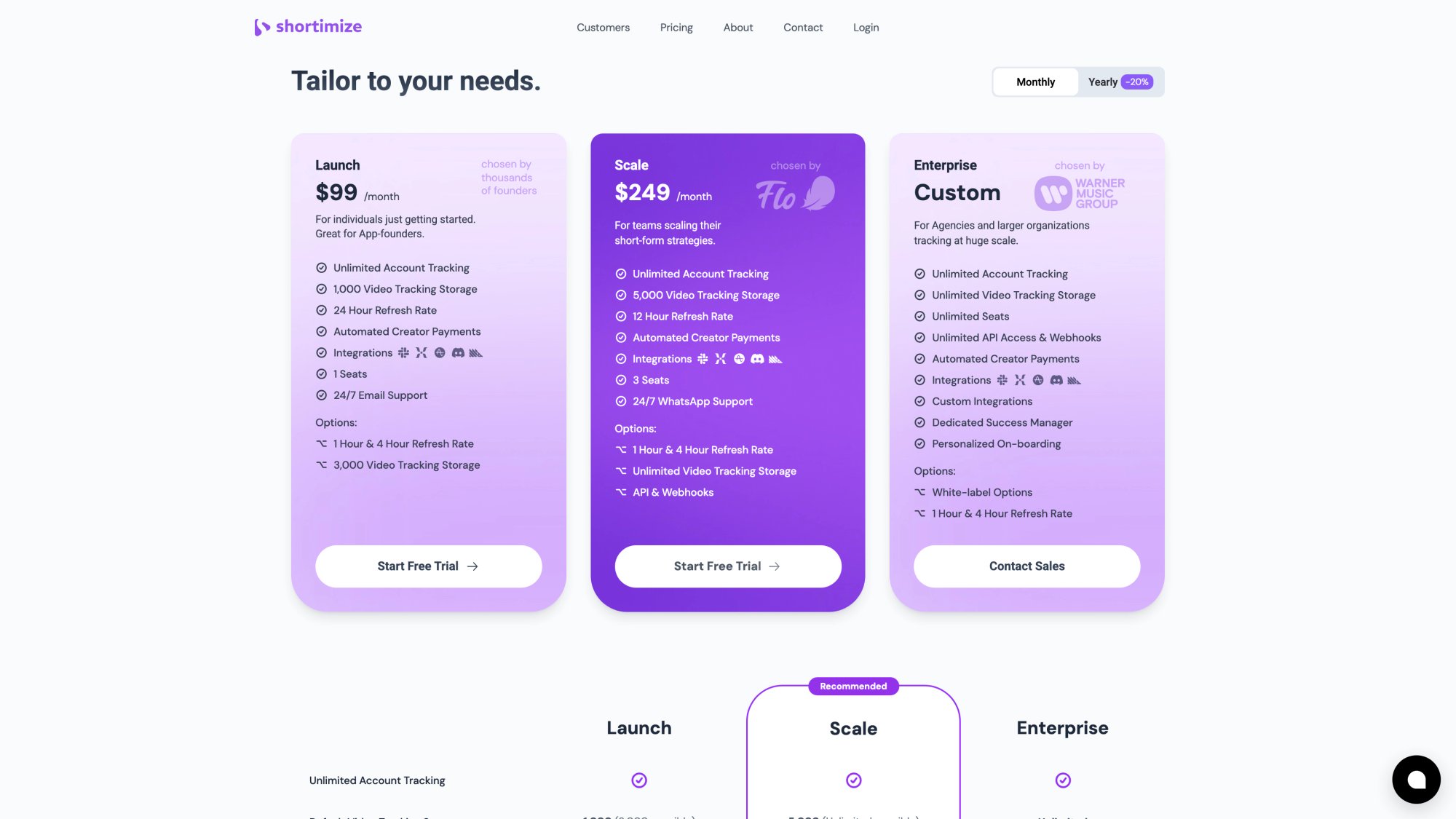
Cross-analyzing influencers across platforms streamlines the data collection and pattern identification process.
More Resources for Pattern Mining
If you're publishing this on the Shortimize blog, these internal links naturally deepen the reader's journey:
• Analyze Any TikTok Account (product workflow, outliers, video length patterns, similar accounts/videos)
• Social Media Monitoring (monitor competitor accounts, export tables, trend insights)
• What Is a Good View Rate for TikTok? (2025 Benchmarks) (useful for defining "baseline" and interpreting performance)
• How Many Views Is Viral on TikTok? (2025) (useful as a discussion of "absolute viral" vs "relative viral")
• Qualified Views vs Total Views on TikTok (2025) (important if the reader monetizes; highlights why "views" can be a vanity metric)
• Analyze Instagram Reels Account (comprehensive Instagram analytics workflow)
• Analyze YouTube Shorts Account (YouTube Shorts tracking and performance analysis)
• How Does YouTube Shorts Algorithm Work (algorithmic insights for pattern optimization)
• Best Instagram Analyzer Tools (comparison of analytics tools and capabilities)
• Influencer Analytics Tools (guide to tracking and analyzing influencer performance)
Final Takeaway
Finding viral patterns isn't luck. It's a measurable process:
• Collect the right dataset
• Normalize performance with outlier scoring
• Tag videos into analyzable variables
• Validate patterns with controlled sprints
• Maintain a living Pattern Library
• Monitor weekly so you catch shifts early
Do that, and "going viral" stops being a mystery and becomes an execution discipline.


