

The video that performed brilliantly on TikTok might completely tank on YouTube Shorts. And that punchy Reel you loved? It could feel too rushed for TikTok's audience. Video length can genuinely make or break your content's performance, and what works on one platform often fails spectacularly on another.
This creates a real problem for creators and brands managing content across multiple platforms. You're not just making videos. You're trying to decode three different algorithms, each with its own preferences for how long your content should be. The "sweet spot" varies between TikTok, Instagram Reels, and YouTube Shorts, and getting it right means the difference between content that gets buried and content that actually reaches people.
Platforms keep changing the rules, too. TikTok now allows videos up to 10 minutes or even longer. Instagram Reels extended to 3 minutes in January 2025 after feedback that 90 seconds felt too limiting. YouTube Shorts also moved to 3 minutes in late 2024. So what's the actual optimal length now?
We've analyzed the latest data from late 2025 to break down exactly what's working on each platform. Whether you're tracking performance through Shortimize or using your own analytics approach, these insights will help you understand what each algorithm rewards and how to adjust your content strategy accordingly.
What Is the Best TikTok Video Length in 2025?
TikTok built its empire on ultra-short videos. But the platform that popularized the 15-second clip has evolved dramatically, and so has the optimal video length.
The early days (2019-2021) had a clear formula. TikTok's own data from 2021 showed the highest-performing videos were just 21 to 34 seconds long. Short attention spans and loop-friendly clips drove virality. Many creators were told to keep everything under 30 seconds, maybe under a minute at most.
That advice is now outdated.
TikTok has been actively pushing for longer content. The platform expanded upload limits from 60 seconds to 3 minutes, then to 10 minutes, and has even tested 20-60 minute uploads for some users. This isn't just an option they're offering. It's a direction they're deliberately steering the platform toward. Understanding TikTok's 2025 algorithm update helps explain why these changes matter for your content strategy.
The data backs this up. By mid-2024, TikTok's analytics revealed that viewers were spending half their time on videos over one minute long. TikTok has explicitly stated it's favoring content longer than the bite-sized clips of its early days, saying user behavior is "shifting away from the 21-to-34-second sweet spot."
The view count data is striking. Analysis of millions of TikToks shows that videos in the 3-10 minute range received roughly double the views of 6-10 second videos. If you can hold an audience, TikTok's algorithm may reward you with dramatically greater reach. This is why understanding what constitutes a good view rate for TikTok becomes essential for benchmarking your performance.
But there's a trade-off worth understanding. Shorter clips still boast higher full-watch rates. A 10-second TikTok will almost always be watched to the end before someone even thinks of swiping. A 3-minute video? That requires genuinely compelling content to keep viewers engaged. Interestingly, there's a completion rate spike for videos around 2-3 minutes, suggesting well-crafted videos in this range can retain viewers better than you might expect. Learning how to increase TikTok video views often comes down to mastering these engagement patterns.
How Long Should Your TikTok Videos Be?
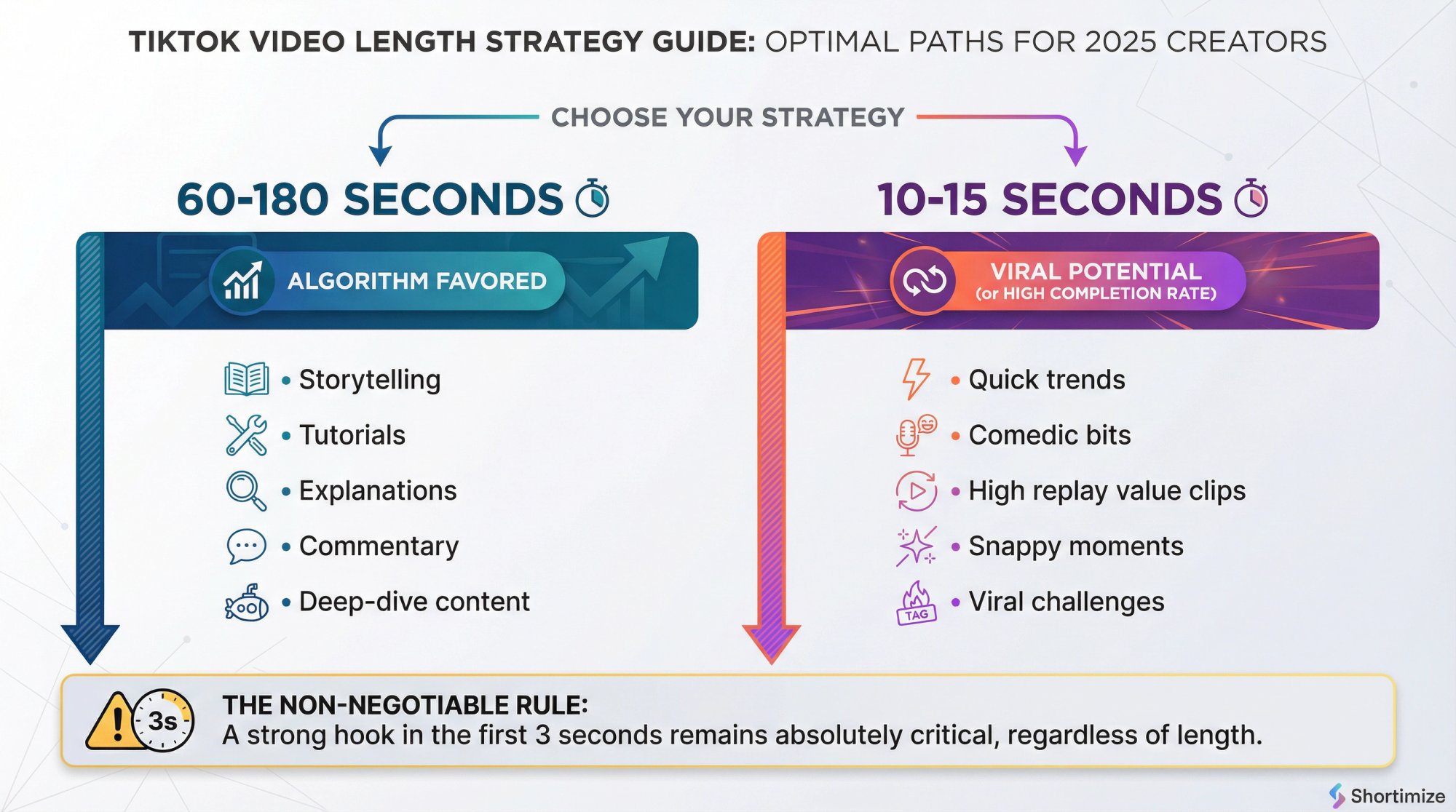
For substantive content, aim for 60-180 seconds. This is where TikTok's algorithm currently rewards creators who can deliver value throughout. Storytelling, tutorials, explanations, commentary, anything with depth benefits from this longer format.
For trend-driven content, ultra-short still works. A snappy 10-15 second video (especially comedic bits or quick trends) can still rack up millions of views through high replay value and completion rate. Don't abandon this format. Just don't assume it's the only format. Understanding how many views is viral on TikTok can help you set realistic goals for both short and long-form content.
The non-negotiable rule: A strong hook in the first 3 seconds remains absolutely critical, regardless of length. Viewers decide almost instantly whether to keep watching or swipe.
A two-pronged approach often works best. Mix short, trend-driven clips with occasional longer deep-dive videos. You should also consider how often to post on TikTok to maintain consistent growth. Track which lengths yield the best results for your specific audience by analyzing your TikTok account data to understand what's actually working.
How Long Should Instagram Reels Be for Maximum Views?
Instagram Reels started as Instagram's response to TikTok, adopting the short-and-sweet approach. But Reels has developed its own nuanced sweet spot that's worth understanding.
The platform extended its maximum length to 3 minutes in January 2025. Adam Mosseri explained they made the change because 90 seconds felt "too short" for the stories creators wanted to tell. So where does the ideal length actually land?
The conventional wisdom says go short. Many social media marketers recommend the 15-30 second range, and they're not wrong. Analysis from 2024 found that 15-30 seconds is the sweet spot for viral potential. The logic is straightforward: Instagram users scroll rapidly. A punchy sub-30 second Reel can loop multiple times, boosting its view count and increasing its chances of hitting the algorithm in a way that spreads it further. Quick cuts, trending audio, and single-idea clips thrive in this format. Using the best Reels hashtags for Instagram can amplify this effect significantly.
Short Reels cater to shrinking attention spans. When people rewatch a 15-second clip three times, that's three views logged. The algorithm notices.
But 2025 data tells a more nuanced story. Studies examining Reels performance found something interesting: Reels between 60 and 90 seconds actually achieved the highest average views and engagement.
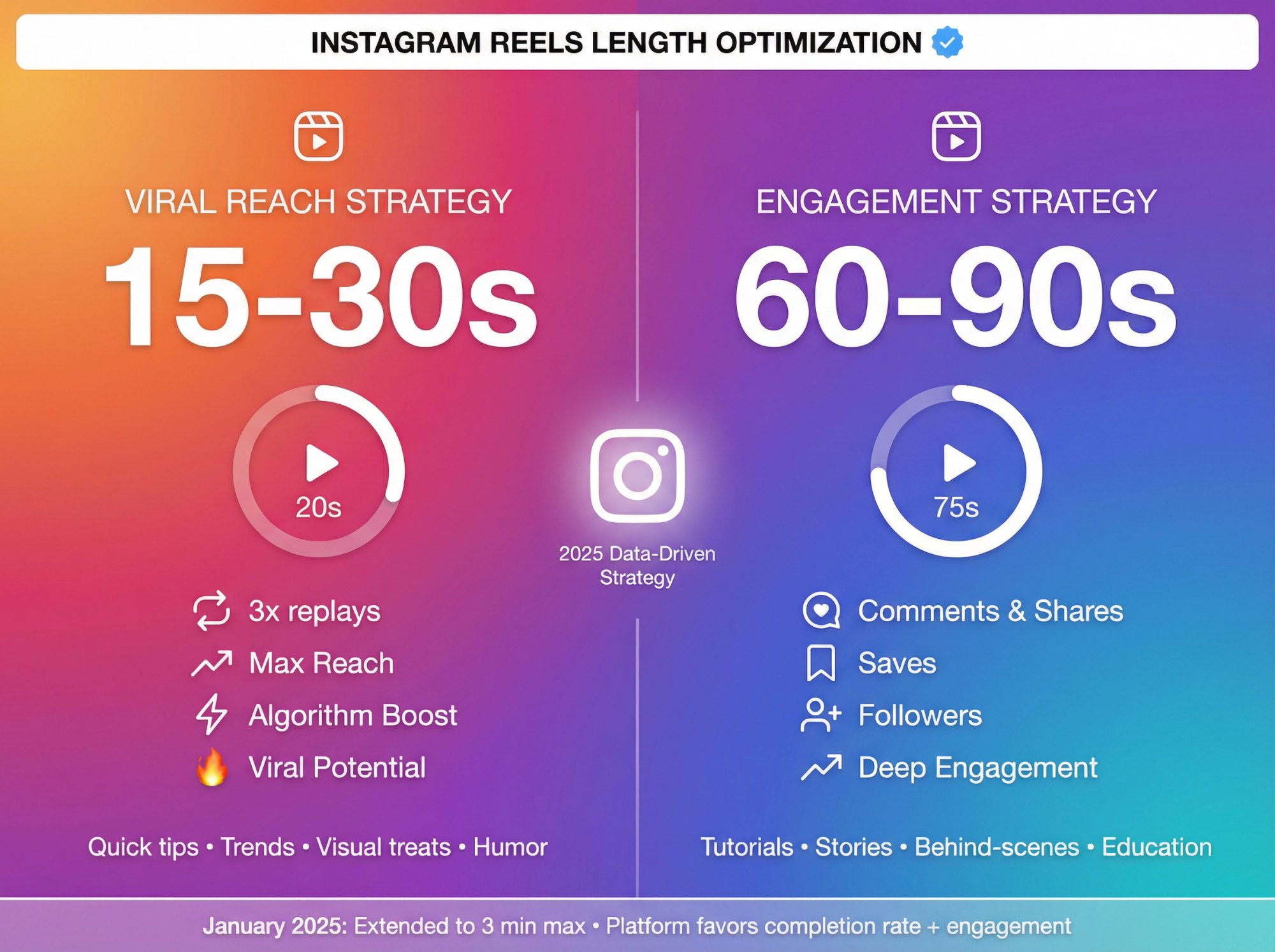
Why would longer Reels outperform? A minute-plus Reel lets you tell a mini-story or add context that sparks comments and shares. Research argues that 60-90 seconds is a "sweet spot" for engagement because it's long enough to develop a narrative and deliver real value, but still short enough to maintain attention to the end.
Instagram heavily weighs completion rate and engagement in its ranking. A Reel that viewers watch through and then interact with will beat a quick clip that gets passive plays. If you're wondering why your Instagram Reels are not getting views, completion rate is often the culprit.
Short Reels vs Long Reels: Which Gets More Engagement?
These findings aren't contradictory. They represent two different goals:

| Goal | Recommended Length | Best For |
|---|---|---|
| Maximum reach / viral potential | 15-30 seconds | Trending content, quick tips, visual treats, humor |
| Meaningful engagement | 60-90 seconds | Tutorials, storytelling, behind-the-scenes, educational content |
If you want quick views and broad reach, err shorter. Think 15, 20, 30-second clips that people replay.
If you want comments, shares, and deeper connection, try the 60-90 second range. Instagram's algorithm favors content that keeps people on the app, so a highly engaging minute-long Reel can outshine a forgettable 15-second throwaway.
The universal rule applies here too: grabbing attention in the first 2-3 seconds is crucial whether your Reel is 10 seconds or 90 seconds. The hook determines if people watch or swipe. Timing also plays a role, so understanding the best time to post on Instagram Reels can maximize your content's initial reach.
Just because Instagram now allows 3 minutes doesn't mean you should use all of it. Only extend length when the content truly calls for it. Many creators still find their best success well under one minute. Analyze your Instagram Reels account to see which lengths resonate with your specific audience.
A note on Facebook Reels: They share Instagram's Reels infrastructure, so similar principles apply. Understanding the best time to post Reels on Facebook can help you optimize across both Meta platforms.
What Is the Best YouTube Shorts Length for Views?
YouTube Shorts launched as YouTube's answer to TikTok with a familiar format: videos under 60 seconds. In late 2024, YouTube began allowing Shorts up to 3 minutes. But should you actually make 180-second Shorts?
Probably not. At least not yet.
YouTube's audience still expects brevity in the Shorts format, and the platform's own data suggests sticking closer to the original short form for now. Before the 3-minute extension, successful Shorts were often extremely short, frequently 15 seconds or less. Viewers scrolling the Shorts feed want snappy, instantly gratifying content. Many creators settled around the 15-30 second range as the sweet spot. Understanding how the YouTube Shorts algorithm works is crucial for optimizing your content length strategy.
Why 13 Seconds and 60 Seconds Both Work on YouTube Shorts
Research analyzing 35 billion Shorts views uncovered something fascinating: Shorts perform best at either ~13 seconds OR a full 60 seconds.
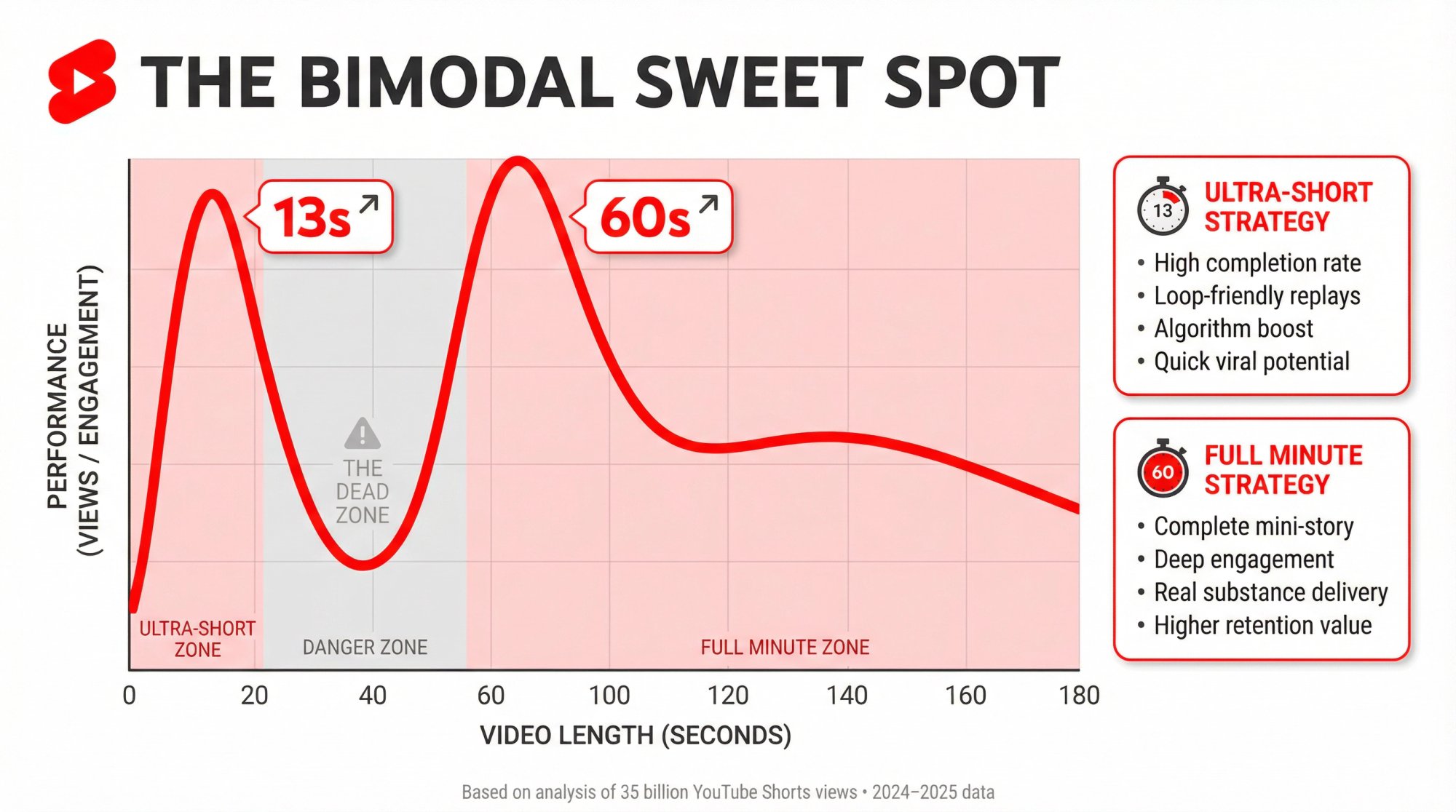
This bimodal pattern suggests two winning strategies:
-
Ultra-short (around 13 seconds): Quick engagement, high completion rate, likely to be watched multiple times, algorithm-friendly loop effect
-
Full minute (60 seconds): Complete mini-story or high entertainment value throughout, enough time to deliver real substance
The middle ground underperforms. Many Shorts in the 30-45 second range don't show the same outlier success. A 30-second mediocre video can lose people halfway through and doesn't benefit from the quick loop effect of a 10-second clip. It's a bit of a no-man's land, though quality can overcome this. Engaging 30-second Shorts do exist and perform well. Analyzing YouTube Shorts performance helps you identify which length works best for your specific content type.
Should You Make 3-Minute YouTube Shorts?

Now that YouTube allows 3-minute Shorts, we're in uncharted territory. But we know a few things so far:
Most creators aren't using it. The vast majority of Shorts content remains well under 60 seconds. According to 2025 research, more than 70% of Shorts exceed the old 15-second minimum, but very few max out even the 60-second limit. The average Short appears to land in the 20-40 second range.
YouTube itself has indicated that Shorts longer than one minute come with caveats like music usage restrictions and Content ID blocks. This hints that the platform expects most Shorts to remain short. The 3-minute option seems geared toward giving creators flexibility for specific use cases, not replacing the core format.
Treat 3-minute Shorts as experimental. If you venture beyond 60 seconds, monitor closely how viewers respond. Do they drop off, or stay? Does YouTube's algorithm pick it up? The data on this is still emerging.
Analyzing your YouTube Shorts account regularly will help you track these experiments effectively.
How to Use YouTube Shorts to Grow Your Channel
Some brands use the full 60 seconds strategically: creating mini-trailers or previews of longer videos. The Short is self-contained enough to satisfy viewers, but tantalizing enough to drive clicks to the main video. This strategy works particularly well when you're focused on converting Shorts into subscribers for long-term channel growth.
For pure Shorts content aimed at discovery: the faster you deliver a payoff, the better. Whether it's a joke punchline, a revealed tip, or a visual spectacle, hit it early. YouTube's own guidance emphasizes that Shorts fans want you to "get to the point at lightspeed."
How to Optimize Video Length When Cross-Posting to All Platforms
Many creators cross-post content between TikTok, Reels, and Shorts. It saves time and extends reach. But each platform's audience responds differently, even to the same video. If you work with creators across platforms, understanding how to cross-analyze influencers on TikTok, Reels, and Shorts provides valuable benchmarking data.
What Video Length Works on All Three Platforms?
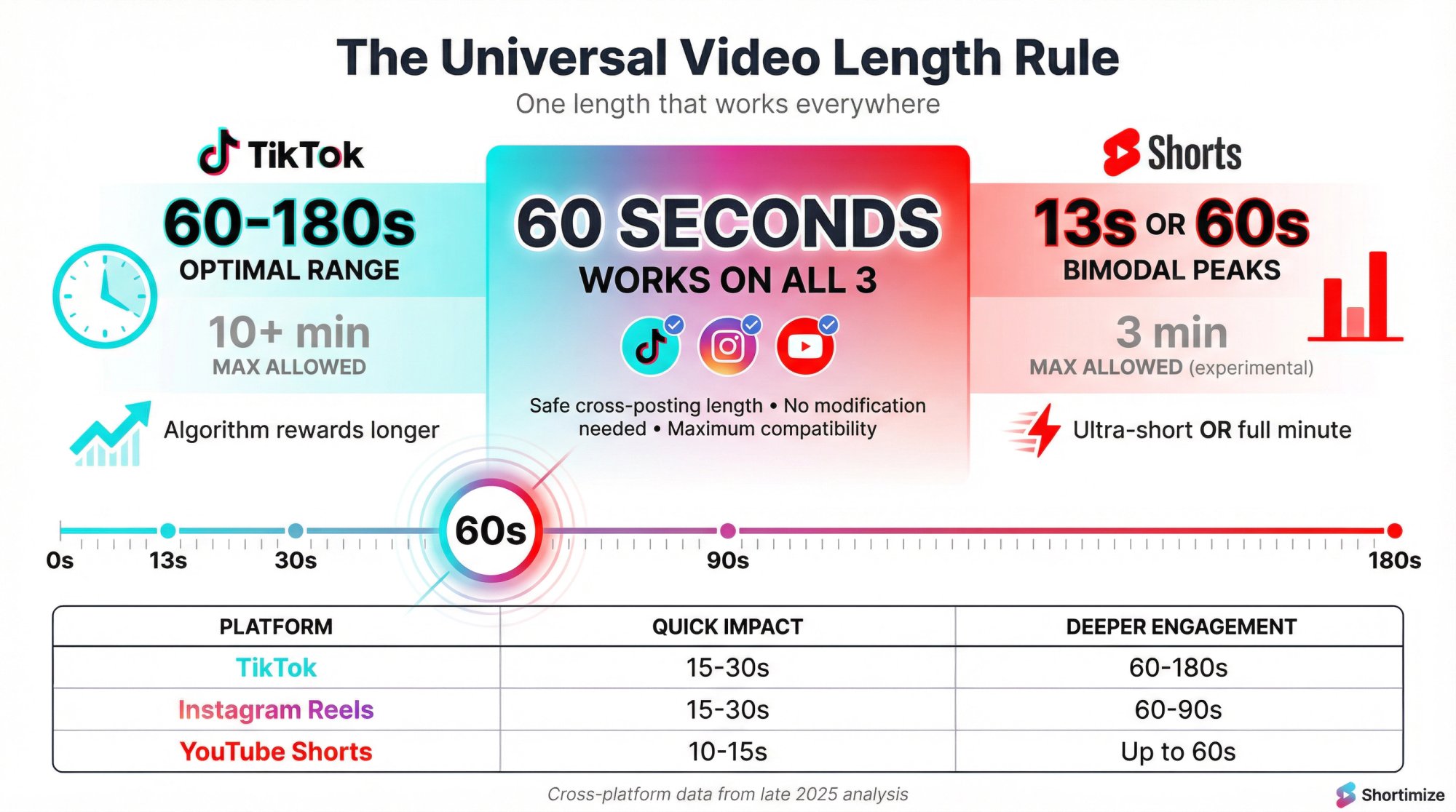
The safest approach when cross-posting: keep your video under 60 seconds so it fits everywhere without modification. Yes, TikTok and Reels now allow longer content. But a 60-second video that performs well can go straight to all three platforms.
If you create a fantastic 2-minute TikTok, consider cutting a 60-second highlight version for Shorts. Conversely, if a 20-second Reel blows up, that same file works perfectly across TikTok and Shorts.
Why the Same Video Performs Differently on Each Platform
Even at the same length, you might need different pacing:
TikTok audiences often tolerate (and even prefer) more raw, less polished content. They'll sit through a 2-minute storytime if it feels authentic and genuine. This is why many founders are using personal TikTok and Reels accounts to drive business growth through authentic storytelling.
Instagram Reels culture rewards slick, snappy editing. A 2-minute talking Reel might struggle, while the same content delivered as 4 punchy 30-second parts with trendy edits could do much better. Understanding how to optimize Instagram Reels reach helps you adapt your content strategy for this platform.
YouTube Shorts viewers expect fast-paced content. YouTube itself notes that Shorts fans want you to get to the point at "lightspeed." Even at the same length, tighten your edit for Shorts compared to TikTok. The platform differences become even clearer when you examine the YouTube Shorts vs TikTok comparison in depth.
Does Video Length Matter More Than Content Quality?
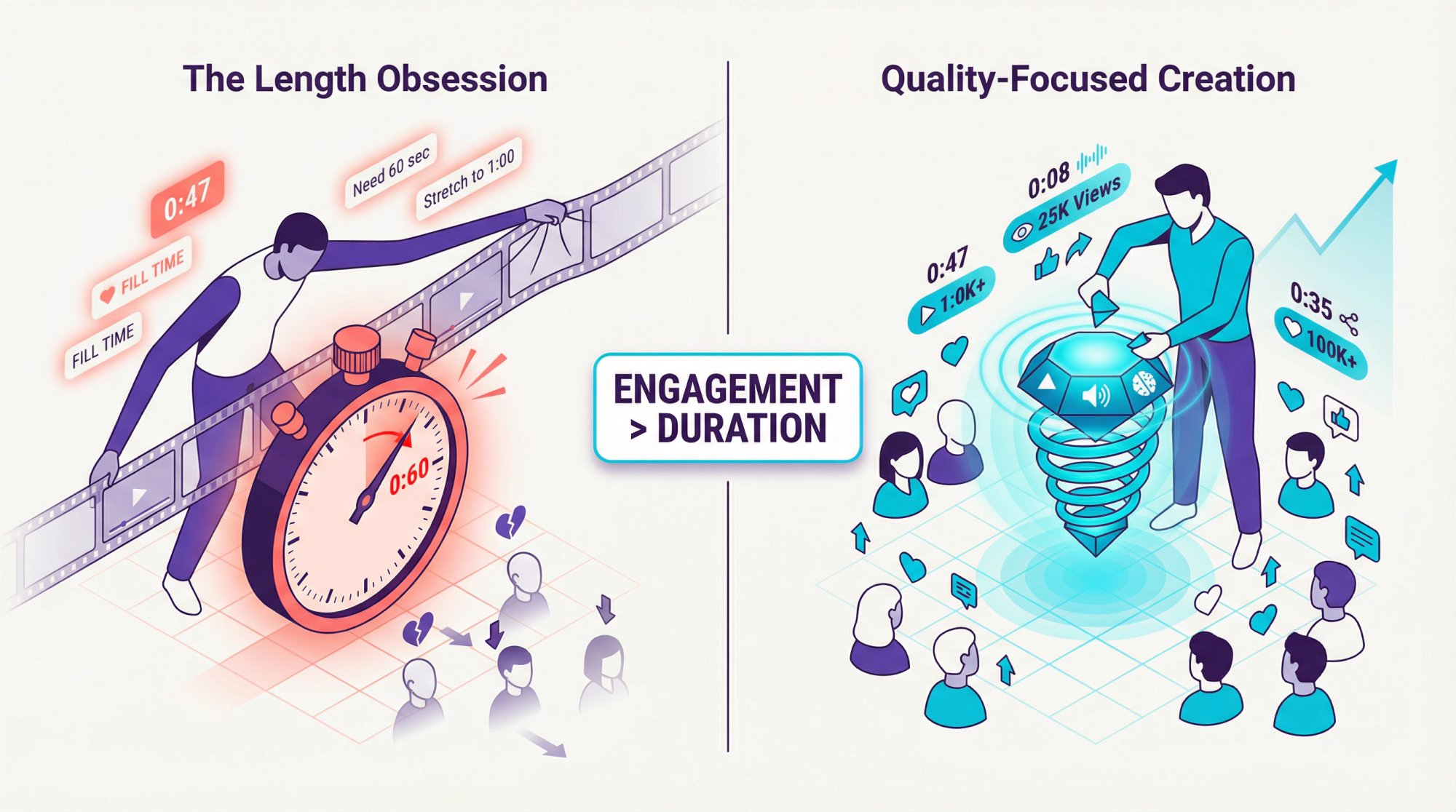
This is the overarching principle: a video's ability to engage beats its length every time.
A 5-second video that makes people laugh can outperform a 50-second average one. And a 2-minute deeply interesting clip can beat a 20-second bland one. Don't stretch a video just to hit some "ideal length." You'll lose viewers. Trim the fat instead.
Both 7-second clips and 90-second clips can succeed. What they share is that they deliver value appropriate to their length. Quick inspiration or a deeper narrative. Both work when executed well. Aim to entertain, inform, or inspire. Do it quickly. If you can't articulate why a certain length benefits your content, try a shorter cut. Tracking social media engagement helps you identify which content lengths drive the most meaningful interactions.
How to Find the Best Video Length for Your Audience
While the general ranges we've discussed provide solid starting points, the optimal length varies by niche and audience. Your comedy sketches might lose viewers after 20 seconds. Your mini-vlogs might hold steady to 45 seconds. Your cooking demos might work better at 60 seconds on Reels but need to be punchier on TikTok.
Experiment in increments. Take the same concept and test a 15-second version, a 30-second version, and a 60-second version across a few posts. Compare performance. Over time, you'll identify what works for you.
This is where tracking becomes essential. Using Shortimize's analytics platform helps you track performance of all your videos across TikTok, Reels, and Shorts in one place. You can spot patterns you might miss when checking each platform's native analytics separately. Maybe your cooking demos do best on Reels at 60+ seconds but need to be under 30 seconds on TikTok. Cross-platform data makes these patterns visible.
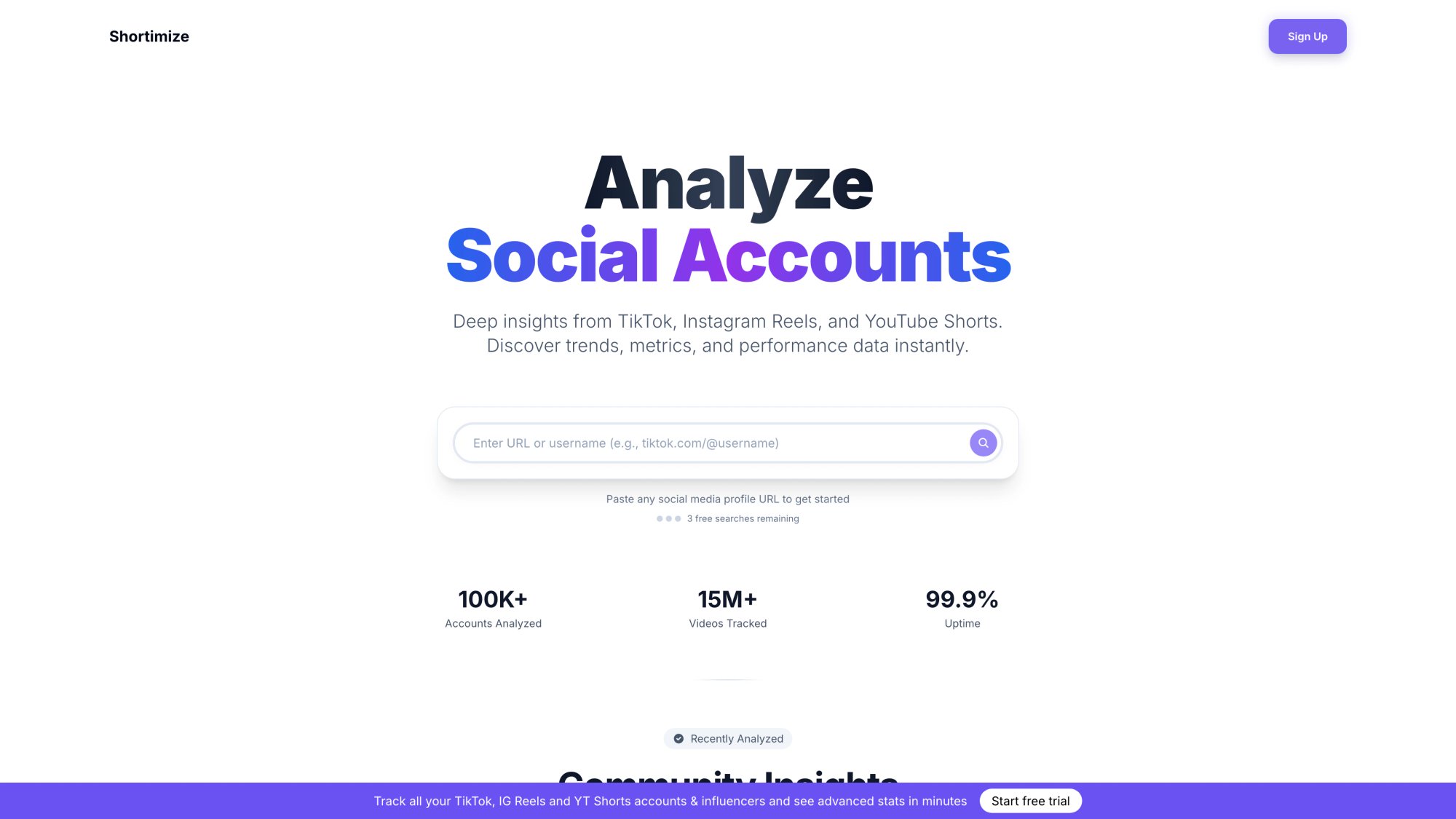
Here is what the actual Shortimize analyze interface looks like when you start tracking your accounts:
Why Video Length Best Practices Keep Changing
The social video landscape changes quickly. Platforms tweak algorithms and introduce features constantly. TikTok's push for 10-minute videos. YouTube adding 3-minute Shorts. Instagram extending to 3 minutes. The "sweet spot" today might shift next year if user behavior changes. Using social media monitoring helps you stay on top of these changes and adapt your strategy accordingly.
The advice in this article reflects current trends as of late 2025. Keep your ear to the ground for future algorithm changes and platform announcements.
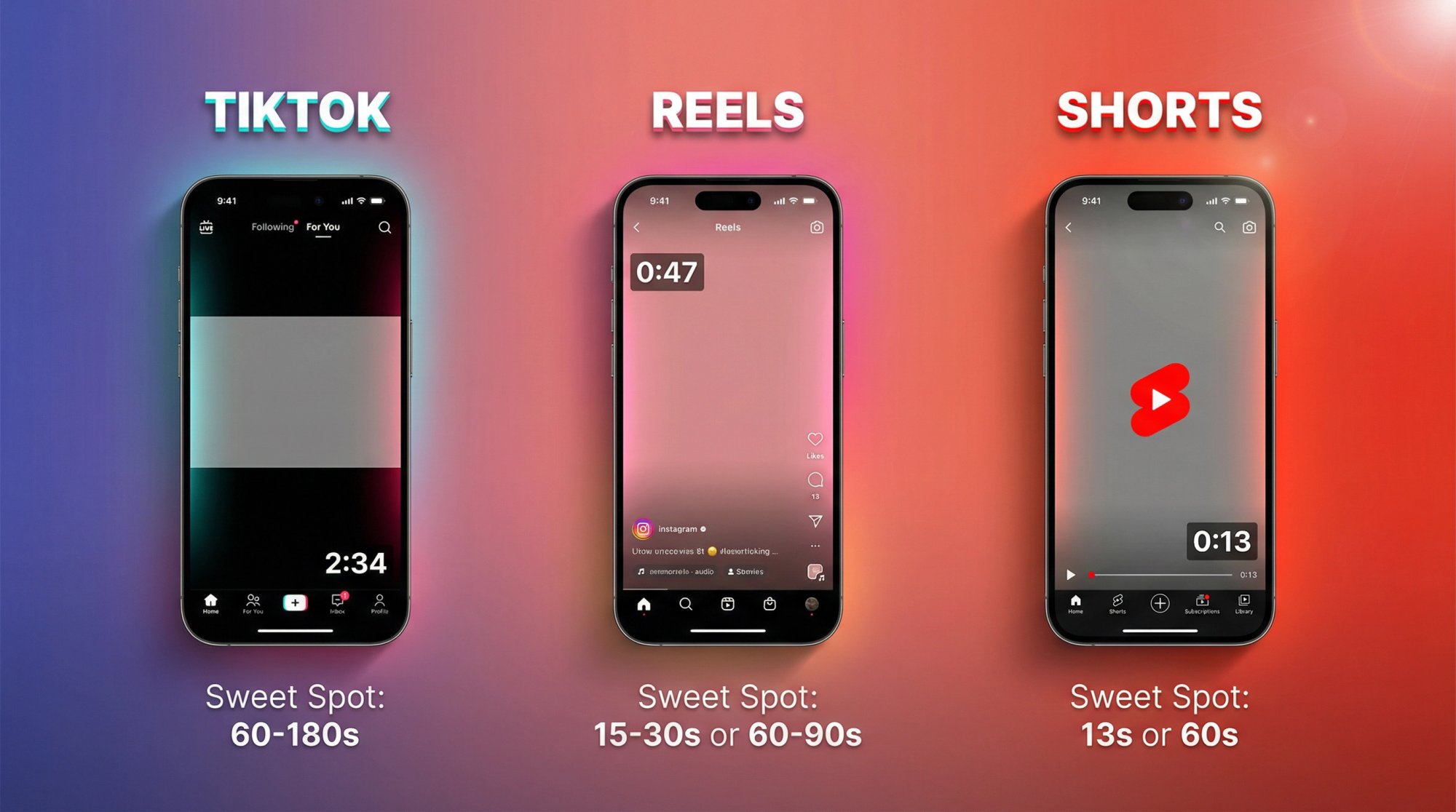
TikTok vs Reels vs Shorts: Video Length Comparison Chart

A quick reference for video length sweet spots across all three platforms:
| Platform | Quick Impact | Deeper Engagement | Max Allowed | Key Insight |
|---|---|---|---|---|
| TikTok | 15-30 seconds | 60-180 seconds | 10+ minutes | Algorithm now rewards longer videos with strong hooks |
| Instagram Reels | 15-30 seconds | 60-90 seconds | 3 minutes | Two strategies: viral reach (short) vs. engagement (longer) |
| YouTube Shorts | 10-15 seconds | Up to 60 seconds | 3 minutes | Bimodal success: ultra-short OR full minute |
TikTok has shifted the most dramatically. The old 21-34 second sweet spot is officially outdated. For content with substance, aim for 60-180 seconds. A strong hook in the first 3 seconds is non-negotiable. The TikTok beginner guide covers these fundamentals in detail.
Instagram Reels offers two paths. For viral potential and quick reach, 15-30 seconds works well. For meaningful engagement and storytelling, 60-90 seconds outperforms. Match your length to your goal. Analyzing Instagram accounts helps you understand which approach works best for your specific audience.
YouTube Shorts still favors brevity. Keep most content under 60 seconds. The 3-minute option exists but remains experimental. Either go ultra-short (around 13-15 seconds) for quick engagement, or commit to a full minute of genuinely compelling content. The analyze YouTube Shorts accounts guide provides deeper insights into optimization strategies.
How to Choose the Right Video Length for Your Content
There's no universal answer to "what's the best video length?" But you now have a platform-by-platform roadmap based on the latest data.
The sweet spots serve as starting points. The real answer comes from testing, tracking, and refining based on how your audience responds to your content. Create value, watch how people engage, and adjust accordingly.
Understanding what constitutes a good engagement rate on TikTok and similar benchmarks across platforms helps you evaluate whether your video length strategy is working. And when videos do perform well, knowing how to retain new followers after going viral becomes equally important.
The perfect length is the one that keeps viewers glued until the end. And perhaps leaves them wanting just a little more.
If you're serious about optimizing your short-form video performance, tracking across all three platforms in one place makes a real difference. Shortimize lets you monitor TikTok, Reels, and Shorts analytics together, helping you spot the patterns that native platform analytics miss. Sometimes the insight that transforms your strategy comes from seeing your content performance side by side.
Good luck, and happy filming.


