Influencer marketing isn't "send product, hope for posts." It's a production pipeline plus a measurement system plus a relationship flywheel.
And it matters more than ever. IAB projects U.S. creator economy ad spend at $37 billion in 2025, up from $29.5 billion in 2024. Brands are calling out measurement and consistent reporting as top areas to improve. In the same vein, eMarketer estimated U.S. influencer marketing spend hitting $10.52 billion in 2025, after a 23.7% jump in 2024.
The reality: 89% of marketers say influencer campaigns deliver measurable ROI, yet many struggle with execution. Those results depend entirely on how well you manage the process.
This guide gives you a complete operating system for planning, sourcing, briefing, contracting, shipping, amplifying, tracking, and scaling influencer campaigns, especially on short-form (TikTok, Reels, Shorts).
What Is Influencer Campaign Management?
When someone searches this, they're usually trying to solve five real problems:
1. Get predictable output
Content shipped on time, in the right format, with the right messaging.
2. Avoid getting burned
Compliance disasters, usage rights conflicts, brand safety issues, creator flakiness.
3. Prove it worked
Not just likes or impressions. Actual business impact you can show stakeholders with social media analytics.
4. Scale without spreadsheet hell
More creators, more posts, more platforms without operational chaos (using influencer tracking tools).
5. Build a reusable growth machine
Where learnings compound and creator relationships compound.
Success looks like this:
• You can answer "what's working?" within 48 hours of launch
• You can answer "should we renew this creator?" with evidence, not vibes
• You can reliably turn winners into more posts, whitelisted ads, new creator lookalikes, and new creative angles
How to Plan an Influencer Campaign
How to Write a Campaign Charter
If you skip this, your campaign becomes 20 micro-decisions made inconsistently.
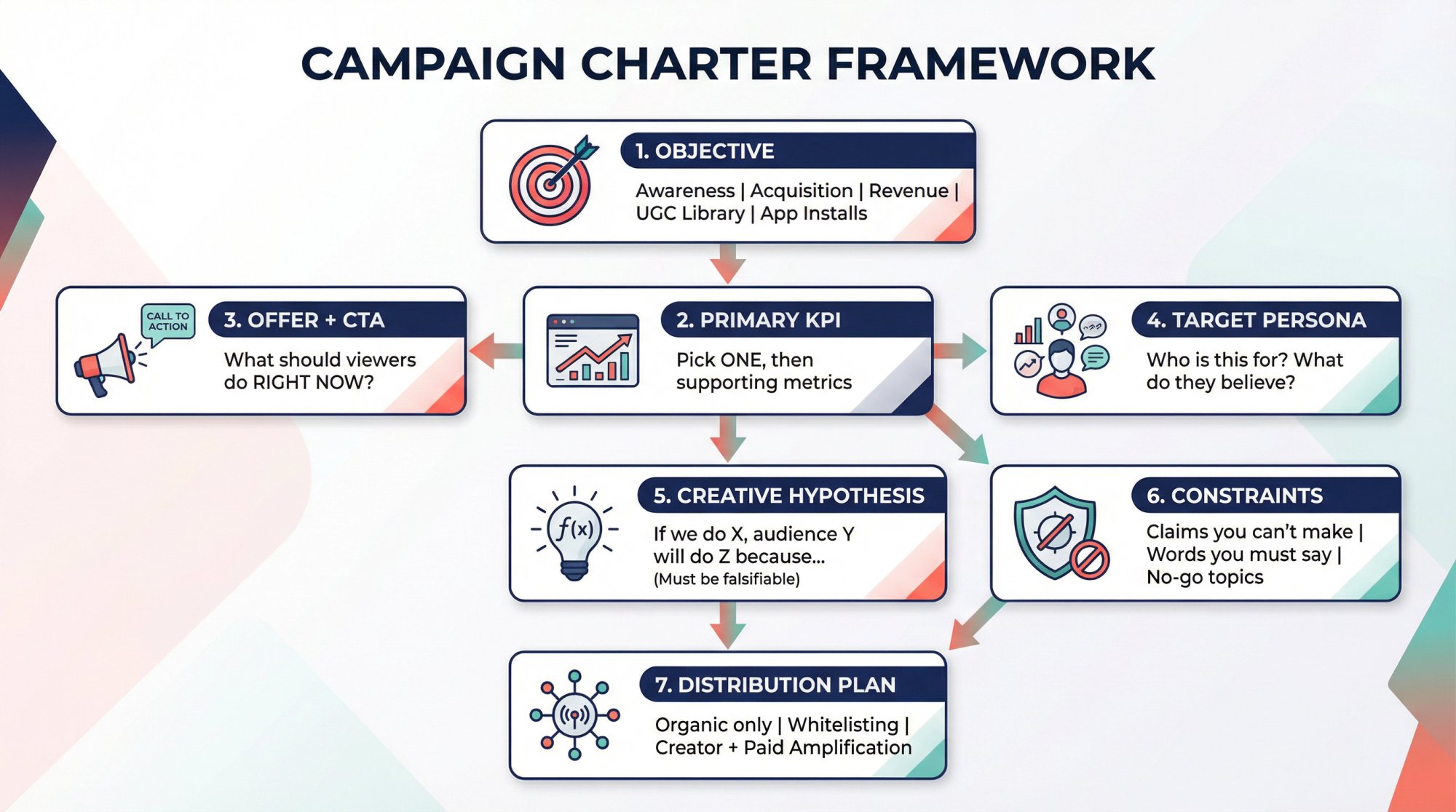
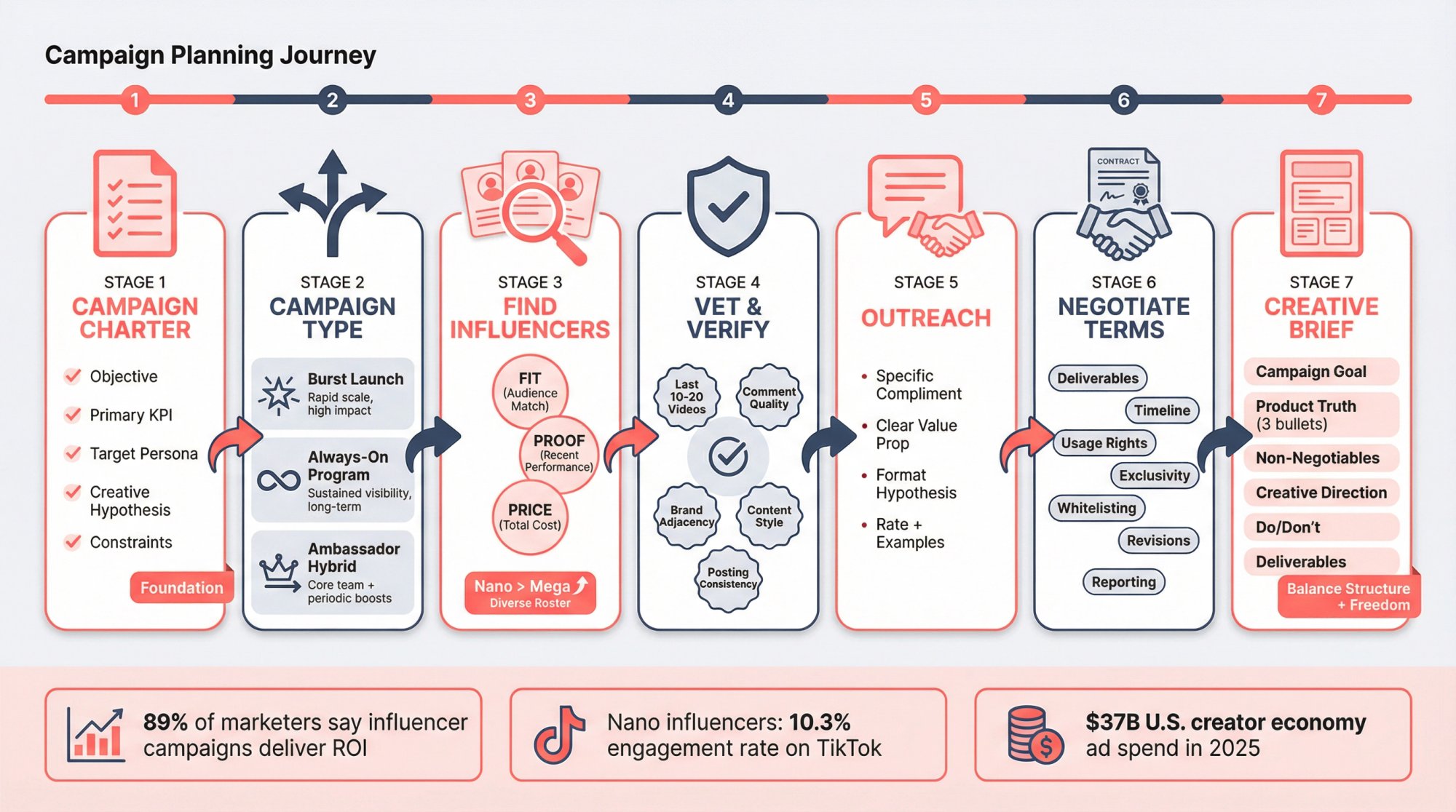
Your charter should lock:
Objective
Awareness / acquisition / revenue / UGC library / app installs
Primary KPI
Pick one, then choose supporting metrics
Offer + CTA
What do you want the viewer to do right now?
Target Persona
Who is this for, and what do they already believe?
Creative Hypothesis
"If we say/do X, Y audience will do Z because…" (Must be falsifiable. "Make it go viral" is not a hypothesis.)
Constraints
Claims you can't make, words you must say, no-go topics
Distribution Plan
Organic only vs whitelisting vs creator posting + paid amplification
Research from IAB notes brands are using creators across the funnel (awareness and reach are common, but sales and conversions are also major goals). Your "shape" should match your funnel intent, not just what's trendy.
Which Campaign Type Works Best?
Three options that actually work:
| Campaign Type | Best For | How It Wins | Risk |
|---|---|---|---|
| Burst Launch (2-3 weeks) | Product drops, feature launches, seasonal pushes | Volume + fast iteration | You learn fast but relationships are shallow unless you renew winners |
| Always-On Creator Program | Steady growth, consistent UGC inflow, long-term trust | Compounding learnings + compounding creators | Requires better ops and clear scorecards |
| Ambassador / Affiliate Hybrid | Products with repeat purchase or strong communities | Incentives align; tracking is cleaner | Needs tight compliance + fraud guardrails |
How to Find the Right Influencers
Don't start with follower count. Start with:
Fit
Audience match + creator vibe match
Proof
Recent performance on the formats you care about (Shorts/Reels/TikTok) (use TikTok analytics tools to evaluate)
Price
Total cost including usage rights, whitelisting, reshoots
Creator tiers are still useful for budgeting and expectations. Industry guides frame tiers by follower count: nano (<15k), micro (15k-75k), mid-tier (75k-250k), macro (250k-1M), mega (1M+).
Critical insight: Research shows nano-influencers hold the highest engagement rate on TikTok at 10.3% in 2024, with micro also strong. Smaller creators often give you better "attention per dollar" and they're easier to brief and iterate with. Learn more about discovering micro-influencers.
What to Look for When Vetting Influencers
→ Last 10-20 videos show consistent views relative to their baseline (not one lucky hit) (analyze TikTok account performance to verify)
→ Comments quality: real discussion, not "nice!" spam
→ Brand adjacency: have they promoted competitors? How recently?
→ Content style: can your product fit naturally inside their format?
→ Operational reliability: do they post consistently? Do they meet deadlines? Track posting patterns to verify.
How to Spot Fake Engagement
You don't need perfect detection. You need to avoid obvious traps:
• Sudden follower spikes
• Engagement that doesn't match views (learn how to tell if an influencer has fake engagement)
• Audience geography mismatch
• Repetitive comment patterns
Regulators are also cracking down. The FTC finalized a rule banning fake reviews and testimonials in 2024 (effective October 21, 2024), aimed at deceptive practices.
How to Reach Out to Influencers
Creators are running businesses. Your outreach should read like: "Here's why this will perform on your channel."
Outreach Message Template (DM/Email)
Hey [name], love how you [specific thing they do] (esp your [specific video]).

We're [one-line what you do] and I think your format could crush with this angle:
[hypothesis in one sentence].

We're looking for:
- [#] short-form videos (TikTok/Reels/Shorts)
- [posting window]
- [option: whitelisting / usage rights]

If you're down, I'll send a tight brief + we can move fast.
What's your rate + do you have examples of brand vids that performed best?
What to Negotiate Before Starting
Agree on:
Deliverables: count + platform + duration + post type
Timeline: draft due, revisions, post date
Usage rights: organic repost vs paid ads vs duration
Exclusivity: category, duration, what counts
Whitelisting permissions: if you plan to amplify
Revision policy: how many rounds, what triggers reshoot
Reporting: links to posts, metrics screenshots
FTC Disclosure Requirements for Influencer Posts
You need legal disclosure plus platform disclosure tools.
This is non-negotiable. Get it right from the start.
Legal Disclosure Requirements
① US (FTC): The FTC's endorsement guides were updated in June 2023, emphasizing that material connections (payment, free product) should be disclosed clearly and conspicuously.
② UK (ASA/CAP): UK guidance stresses influencer ads must be obviously identifiable as ads (commonly "#ad").
③ India (ASCI): ASCI's influencer advertising guidelines define disclosure requirements and labels.
If you're in regulated categories (finance, health, alcohol, gambling), treat this as "get counsel involved," not "wing it."
Platform Disclosure Tools
TikTok
If content promotes a brand/product/service, TikTok requires you must turn on the content disclosure setting. The post gets labeled as promotional content (your own brand) or paid partnership (third-party brand). TikTok can remove or restrict posts without proper disclosure.
Meta's guidance says branded content must be disclosed using the paid partnership label.
YouTube/Shorts
YouTube requires creators to indicate paid promotions by selecting the paid promotion box in video details. YouTube then shows a disclosure to viewers.
Real talk: If your process doesn't force disclosure, you're not "moving fast." You're building a future mess.
How to Write a Creative Brief That Gets Results
Bad briefs kill performance. Over-scripted creator content performs like an ad because it is.
Your brief has two jobs:
① Give creators enough structure to be on-message
② Keep enough freedom that it still feels like their content
Brief Skeleton (Copy/Paste)
Campaign goal:
Primary KPI:
Target audience:
Offer + CTA:

Product truth (3 bullets):
1)
2)
3)

Non-negotiables (must include):
- Disclosure: [paid partnership / #ad etc]
- Key phrase: [if required]
- Safety: [no medical claims, no guarantee language, etc]

Creative direction (pick 1-2, not 10):
Angle A: [hook idea + what to show]
Angle B: [hook idea + what to show]

Do / Don't:
Do: [3 bullets]
Don't: [3 bullets]

Deliverables:
- [#] videos, [length], [platform(s)]
- Raw files due: [date]
- First draft due: [date]
- Post date window: [date range]

Approval process:
- Submit via: [drive/link/email]
- Max revision rounds:
- Response SLA:
Pro tip: Invite the influencer's input on the brief. They know their followers best. Incorporating their ideas not only improves content but also gets them more invested in the outcome.
How to Manage Influencer Campaign Production
Use a kanban:
Sourced → Pitched → Contracted → Briefed → Draft Received → Approved → Scheduled → Posted → Reported → Renew/Stop
What kills campaigns isn't "bad creators." It's:
• Slow approvals
• Unclear revision rules
• Missing assets (logos, b-roll, product shots)
• Trying to force brand voice onto creator voice
• Forgetting to capture raw assets for future edits
How to Amplify Influencer Content with Paid Ads
Most brands underuse the biggest lever: turning winners into ads.
Organic content is just the beginning. Paid amplification is the multiplier.
• On Instagram, this often means partnership ads / boosting creator content (requires the creator to allow promotion).
• On TikTok, creator content can be amplified via Spark Ads workflows (creator authorization + ad creation).
Practical Amplification Play
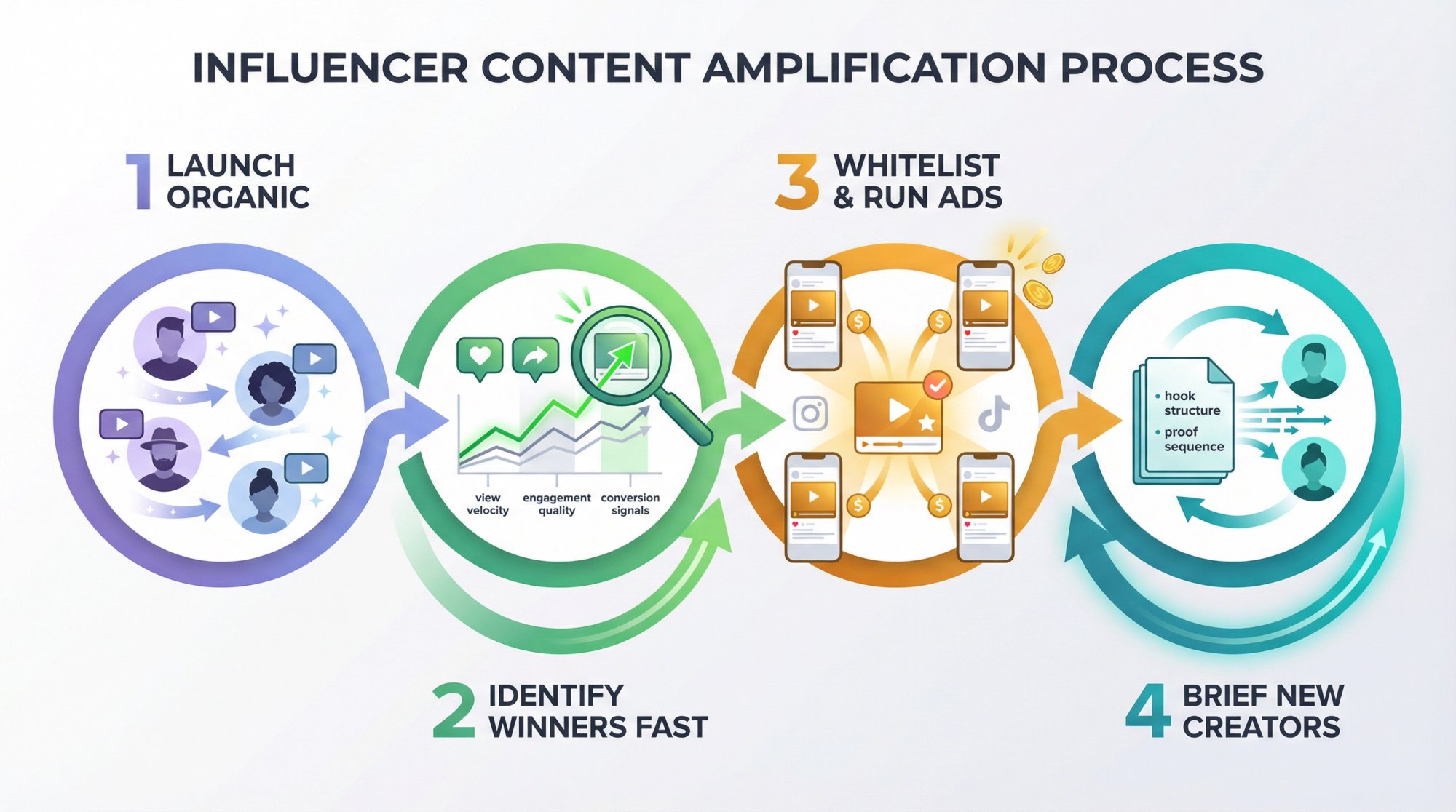
① Launch organic with multiple creators/angles
② Identify winners fast (by early view velocity + engagement quality + click/conversion signals) (use influencer tracking to monitor performance)
③ Whitelist the winners and run them as ads
④ Brief new creators using the winning pattern (not "make it like this video," but "use this hook structure + proof sequence")
IAB explicitly calls out the need for better attribution and consistent reporting in creator marketing as budgets scale. Paid amplification makes the measurement story cleaner, but only if your tracking is set up.
How to Measure Influencer Campaign Performance
Your job isn't to find the one perfect attribution method. It's to build a stack of evidence that converges on truth.
Measurement philosophy: Don't search for the perfect attribution method. Build a stack of evidence that converges on truth.
The Evidence Stack
| Layer | What You Track | Tools |
|---|---|---|
| ① Public platform metrics | Views, likes, comments, shares, saves | TikTok account analysis, Instagram Reels analytics, YouTube Shorts monitoring |
| ② Traffic signals | UTM sessions, landing page behavior | Google Analytics, Mixpanel |
| ③ Conversion signals | Purchases, signups, installs | Your conversion tracking |
| ④Incrementality signals | Geo tests, holdouts, lift studies | Testing infrastructure |
| ⑤ Creative learnings | What hooks, formats, claims drove outcomes | Pattern recognition |
Quick KPI Mapping
| Goal | Key Metrics |
|---|---|
| Awareness | Views, watch time proxies, share rate, follower lift |
| Consideration | Saves, comments quality, profile clicks, site sessions |
| Conversion | CPA/ROAS, code redemptions, attributed purchases, assisted conversions |
| UGC Library | Cost per usable asset, creative win rate (% assets you reuse in ads) |
Budgeting tip that actually works:
Think in expected cost per outcome, not cost per post. A $500 post that reliably produces 5 usable ad creatives is cheaper than a $2,000 post you can't reuse.
Industry benchmarks suggest sponsored video costs scale with expected views, reinforcing that pricing tends to track distribution expectation more than "time spent filming." Use influencer analytics tools to verify performance patterns.
Why Long-Term Influencer Relationships Win
The campaign may be over, but your work shouldn't necessarily end there. If an influencer was a great partner and drove meaningful results, this campaign is the beginning of a longer partnership.
Why long-term relationships win:
Authenticity through consistency: When an influencer talks about your brand repeatedly over time, it resonates much more authentically. Research shows that 47% of consumers expect influencer posts to feel genuine even if sponsored. Consistency builds that trust.
Better performance over time
The influencer gets more familiar with your product and how to integrate it naturally. Their audience becomes more familiar with your brand through repeated exposure, which drives higher conversion likelihood.
Nearly half of consumers make at least one purchase per month because of an influencer's post, and those recommendations work best when they come from repeated, sincere endorsement.
Lower costs and easier logistics
Many influencers are open to long-term deals or bundle agreements at a discount. Studies indicate that 71% of influencers might offer lower rates for longer partnerships. There's also less onboarding time once an influencer knows your brand.
How to Nurture the Relationships
→ Express appreciation right after a successful campaign
→ Share results where appropriate ("Your code got used 120 times, one of the best we've seen!")
→ Stay in touch between campaigns (engage with their content organically)
→ Co-create and involve them (for top partners, invite input on product development)
→ Ensure reliable and timely payment (paying quickly or even giving bonuses where earned can really endear a brand to an influencer)
→ Plan future collaborations and communicate them early
Over time, you can cultivate a roster of go-to influencers who become like an extended family of brand advocates. This is a real competitive advantage.
How We Track Influencer Campaigns at Scale with Shortimize
If you're doing this seriously, the pain is always the same: data fragmentation across TikTok, Reels, and Shorts plus too many moving parts.
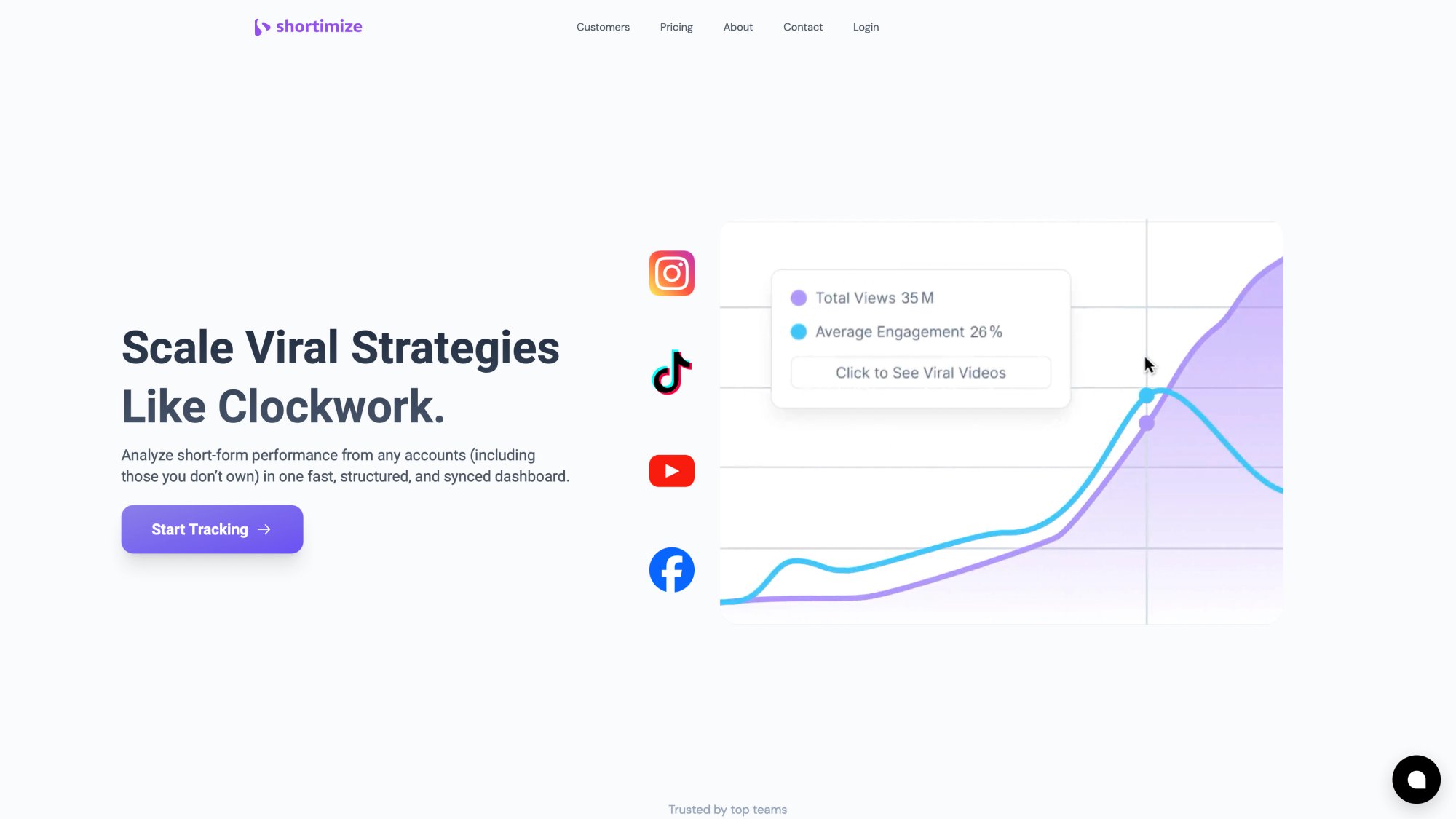
Shortimize is built for the part most teams mess up: tracking and learning at scale.
Here's what the actual product looks like:
What You Can Do with Shortimize (Practical Workflow)
① Track creators you don't own across platforms in one dashboard
See what your competitors' influencers are doing with competitive analysis tools. Monitor creators before you reach out. Benchmark performance across similar accounts.
② Auto-track accounts + videos so you're not manually logging posts
Paste a URL or handle for any public TikTok, YouTube, or Instagram account. Shortimize continuously collects and updates performance data.
③ Organize creators into Collections
Group by cohort: "Q1 ambassadors," "paid test cohort," "competitor creators," "always-on program." Collections make it easy to compare performance across groups and export reports fast.
④ Export tables fast for client reporting or internal scorecards
No more manual screenshots. Pull performance data across multiple creators and platforms in seconds.
⑤ Get notifications when content spikes
So you can decide whether to amplify while it's hot. If a creator's video is going viral, you want to know within hours, not days.
⑥ Connect the dots with your analytics stack
Shortimize includes integrations with Amplitude, Mixpanel, and PostHog out of the box. Sync Shortimize data with those platforms. Plus Slack and Discord notifications built in.
If you want to go deeper on measurement methods, Shortimize has a dedicated guide with 8 tracking approaches (promo codes, UTMs, monitoring tools, etc.). Use it as a playbook menu, not gospel.
The Campaign Manager's Weekly Rhythm (Steal This)
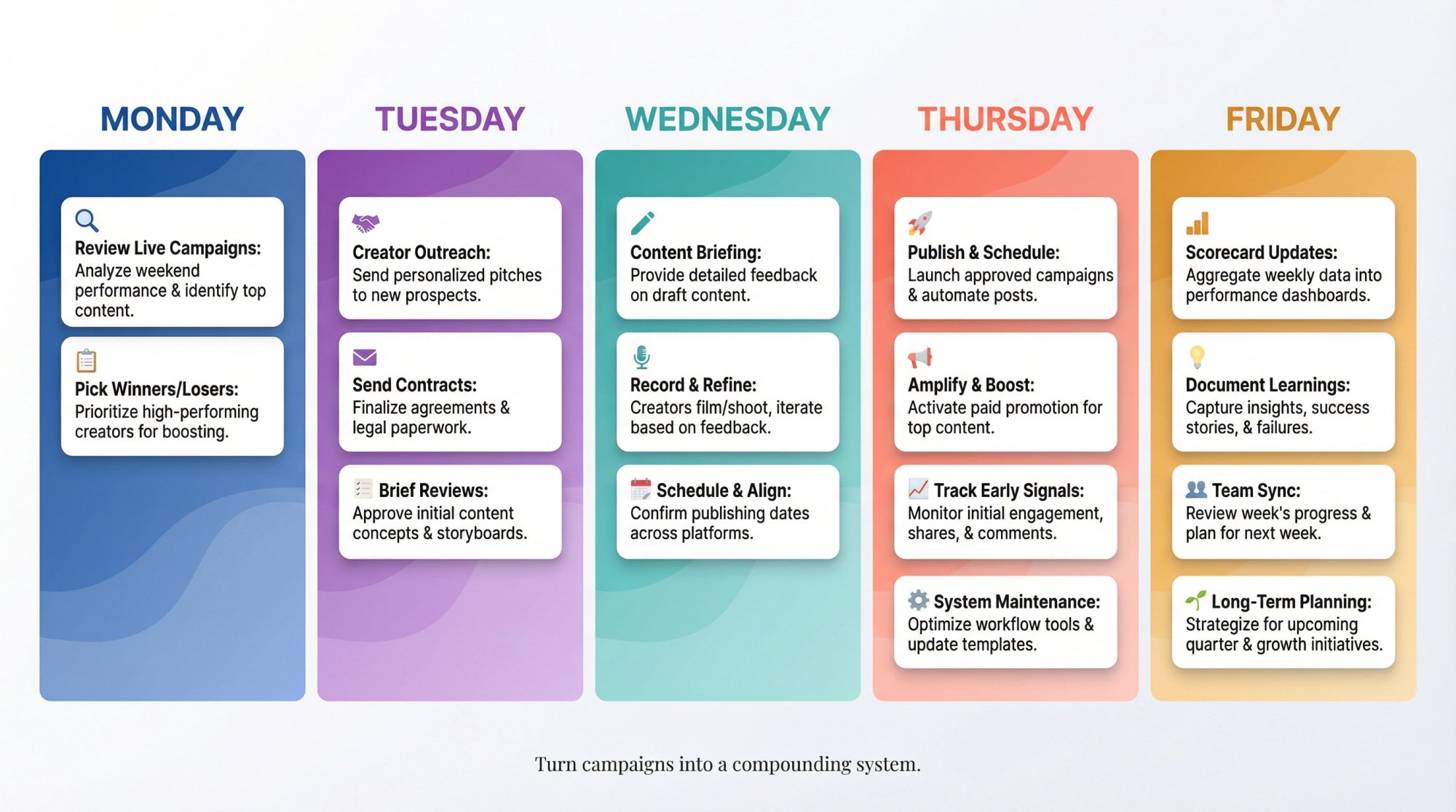
| Day | Focus |
|---|---|
| Monday | Review live campaigns (top 10 posts by views + engagement quality) using social media monitoring. Pick 2 winners to amplify / remake. Pick 2 losers to kill or rebrief. |
| Tuesday | Creator outreach (new cohort). Negotiate + send contracts. |
| Wednesday | Briefs + creative reviews. Approve drafts (fast). |
| Thursday | Publish day / schedule day. Track early signals (first 24h) with real-time analytics. |
| Friday | Scorecard updates. Document learnings: hooks, formats, proof points. Update next week's brief templates. |
This rhythm turns influencer marketing from "campaigns" into a compounding system.
Influencer Contract Template and Legal Checklist
If you only add one thing to your process, add this: a contract checklist.
Industry bodies like ISBA publish influencer marketing codes of conduct and contracting guidance to reduce ambiguity (deliverables, transparency, payment, and responsibilities).
Contract Checklist (Minimum Viable)
| Element | What to Include |
|---|---|
| Parties + deliverables + deadlines | Names, deliverable count, due dates |
| Compensation + payment terms | Amount, net 15/30, milestone triggers |
| Usage rights | Organic repost, paid ads, duration, territories |
| Whitelisting permissions | What accounts, how long, approval flow |
| Exclusivity | Category + duration + penalties |
| Disclosure obligations | Legal + platform tools requirements |
| Claim substantiation rules | No unapproved promises |
| Approvals + revision rounds | How many rounds, reshoot triggers |
| Cancellation + force majeure | Makegood terms, termination clauses |
| Content ownership + raw assets | Who owns what, delivery requirements |
| Reporting requirements | Links, screenshots, metrics window |
| Confidentiality | Especially for fast-moving startups |
Common Influencer Campaign Mistakes and Fixes
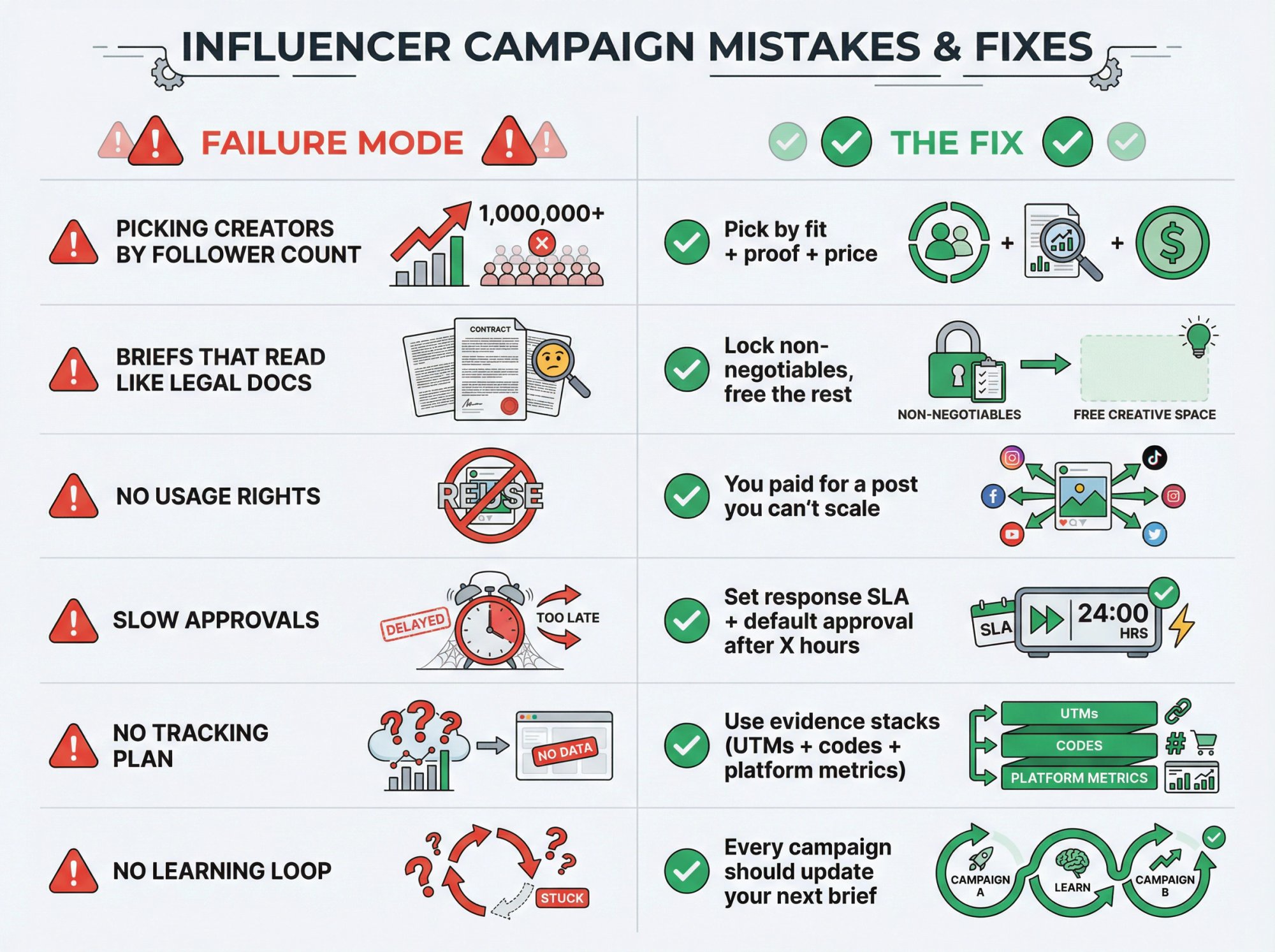
| Failure Mode | The Fix |
|---|---|
| Picking creators by follower count | Pick by fit + proof + price |
| Briefs that read like legal docs | Lock non-negotiables, free the rest |
| No usage rights | You paid for a post you can't scale |
| Slow approvals | Set response SLA + default approval after X hours |
| No tracking plan | Use evidence stacks (UTMs + codes + platform metrics) |
| No learning loop | Every campaign should update your next brief |
The 14-Day Fast Path to "This Actually Works"
Do this in your next two weeks:
Day 1-3: Run a 10-20 creator test (nano + micro)
Day 4-7: Test 2 angles per creator (same offer, different hook/proof)
Day 8-10: Set up UTMs + a code per creator
Day 11-12: Pick 2 winners by day 3-5 and whitelist them
Day 13-14: Renew the top 20% creators into an always-on program
Throughout: Track everything cross-platform in one place with Shortimize (built for exactly this workflow)
Final Word: Build Systems, Not Campaigns
The brands that win in 2026 treat this like an operating system, not a series of one-off campaigns.
Influencer marketing is a production pipeline, a measurement system, and a relationship flywheel. It's not "send product and hope."
The brands that win in 2026 are the ones who treat this like an operating system:
• Clear charters lock objectives
• Compliance is built in, not bolted on
• Tracking is cross-platform and real-time
• Learnings compound from campaign to campaign
• Creator relationships turn into competitive moats
If you're serious about scale, you need tools that match that ambition. Shortimize gives you cross-platform tracking, Collections for cohort management, and real-time notifications when content spikes. You can track accounts you don't own, monitor competitors, and export performance tables in seconds.
Your future customers are scrolling right now, watching their favorite creators. With smart campaign management and the right tracking infrastructure, your brand's story can be woven into that content in a way that feels natural, engaging, and persuasive.
Now go build something that compounds.