Your brand is being discussed on TikTok right now. Someone's praising your product in a video caption. A creator's comparing you to a competitor. Maybe someone's complaining about your customer service in a comment thread.
The question isn't whether people are talking about your brand on TikTok (they probably are). The question is: do you know about it?
With over 1.59 billion monthly active users spending an average of 90 to 95 minutes per day on the app, TikTok drives massive conversations and trends. If people are talking about your brand there, you need to know. A single mention can skyrocket a product's popularity or ignite a PR crisis overnight.
But there's a problem. Unlike platforms such as Twitter or Facebook, TikTok doesn't offer an open public API for searching content. In fact, TikTok has tightened access to its data in recent years, limiting it mostly to official partners. For the average marketer or developer, there's no easy way to track every time your brand gets mentioned in a video or caption.
So how can you monitor TikTok brand mentions without an official API? This guide walks you through everything: from manual tricks to advanced social listening tools and DIY technical solutions, so you never miss important chatter about your brand on TikTok.
Why Tracking TikTok Brand Mentions Is Critical in 2026
Monitoring brand mentions isn't vanity. It's vital for brand health, customer insight, and even AI visibility in 2026.
When a TikTok user tags your brand or references it in passing, it's a signal worth paying attention to. Here's why:
Real-Time Brand Pulse
TikTok mentions show you what real users are saying about your products right now. They unveil trending opinions, unfiltered feedback, or creative uses of your product that you wouldn't catch elsewhere. Every mention is a piece of the puzzle that shapes your brand's story on social media.
Engagement and Reach
Interacting with users who mention your brand can boost engagement and goodwill. TikTok's algorithm rewards interaction, so responding to a positive shout-out or addressing a complaint can amplify your organic reach. Popular creators mentioning your brand can introduce you to thousands of new potential customers, so you want to know (and respond) when that happens.
Reputation Management
Early warning is everything. If a negative comment or snarky TikTok about your brand starts gaining traction, catching it quickly lets you address the issue before it blows up. On the flip side, a wave of positive mentions is an opportunity to reinforce what's working. Monitoring sentiment via mentions is like having a live focus group on your brand.
Competitive Insights
People might mention your brand alongside competitors. Tracking these posts can highlight your unique strengths or areas to improve, and even flag emerging competitors in your space. If users keep saying they prefer your product over a competitor (or vice versa), that's gold for your marketing strategy.
Influence on AI and Search
Here's a new twist: mentions feed into how AI models and search algorithms perceive your brand. Large Language Models (think ChatGPT or Bard) scan online conversations and social content to form knowledge. Every TikTok mention (even untagged) contributes to your brand's online presence and context.
In short, the more positive, relevant mentions you have, the more likely an AI or search engine will surface your brand in responses and results. Monitoring TikTok isn't just about TikTok. It can indirectly influence your discoverability across the web.
Critical insight: Brand mentions on TikTok are early signals. They can drive massive engagement, shape public sentiment, and even impact how algorithms treat your brand.
Now, let's look at why monitoring them has been tricky, thanks to TikTok's API limitations.
Why TikTok Doesn't Offer a Public Mentions API
If TikTok offered a simple "monitor my brand" API, you wouldn't be here.
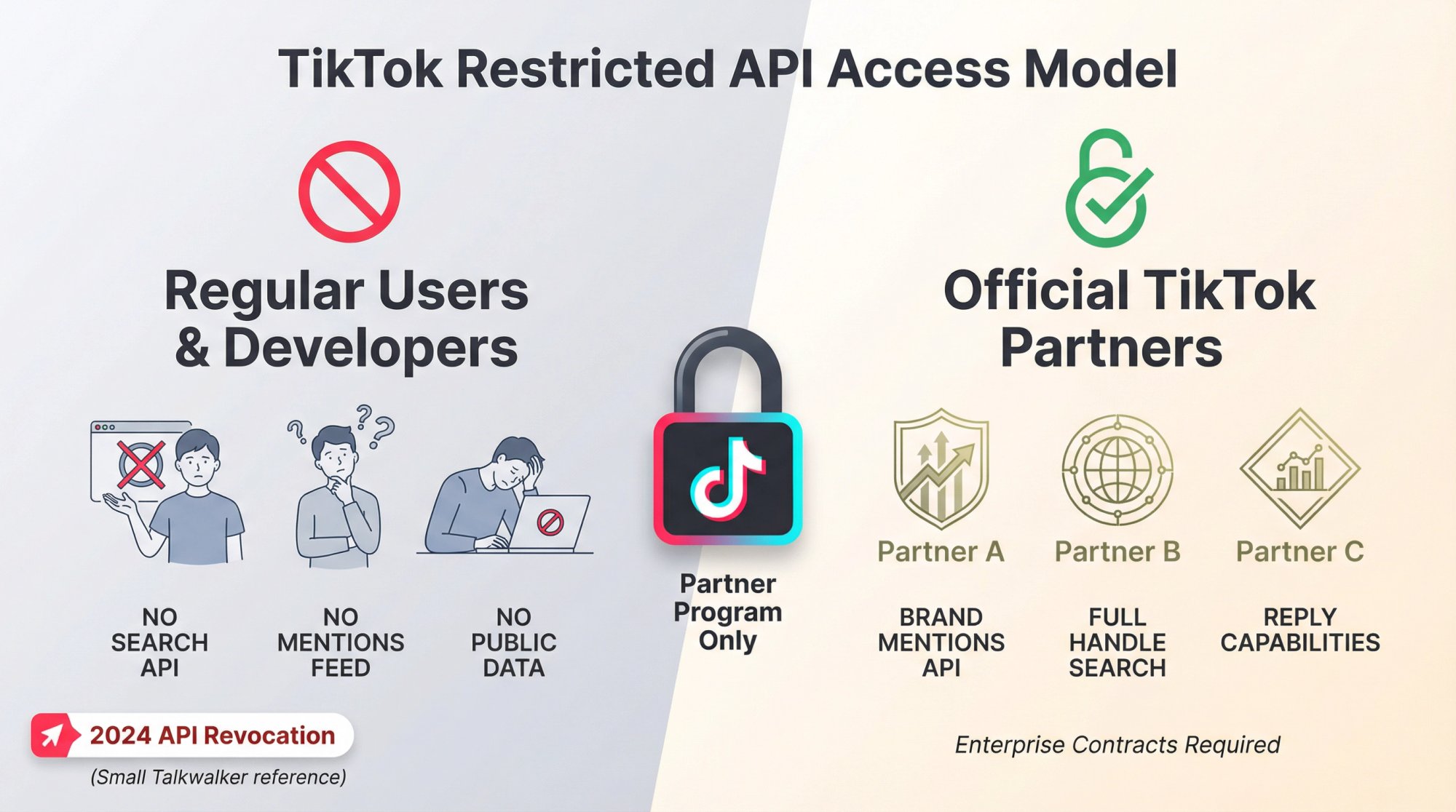
Unfortunately, TikTok's official API doesn't provide open access to search content or mentions for most of us. TikTok's APIs are geared toward advertisers (TikTok for Business) and content posting integrations, not general social listening. In fact, TikTok has made it intentionally difficult for external tools to pull data without special permission.
A telling example: in 2024, enterprise listening platforms like Talkwalker suddenly lost access to TikTok data after TikTok revoked or changed its API access. One marketer noted they specifically wanted to measure mentions on TikTok, but the API was revoked so the platform wasn't pulling any results from TikTok anymore.
TikTok shut the door on third parties that weren't part of an approved partner program.
Why the lockdown?
TikTok is protective of its data (user privacy concerns, competitive secrets, etc.) and only grants full access to select partners. Platforms like Sprinklr and Brandwatch became official TikTok Marketing Partners, which gives them access to a private Brand Mentions API and other endpoints.
For instance, Sprinklr announced in 2025 that it integrated TikTok's Brand Mentions API, allowing Sprinklr clients to retrieve all videos where their brand's handle is mentioned, and even reply to those mentions. These partnerships come with stringent agreements and enterprise-sized price tags.
So, if you're not a TikTok official partner (which is nearly everyone except large SaaS vendors), you cannot simply call an official endpoint like /search?query=YourBrand to get mentions. Even developers have to get creative. TikTok's Research API for academics provides some data access, but it's restricted in scope and requires approval.
In summary: TikTok's own ecosystem won't readily help you monitor brand mentions unless you're a privileged partner.
This means we have to rely on alternative methods. Luckily, there are ways to get the job done, from using TikTok's native features to leveraging third-party tools that have found workarounds.
What Are the 7 Types of TikTok Brand Mentions?
Before diving into monitoring methods, you need to understand what actually counts as a "mention" on TikTok.
On TikTok, mentions aren't one thing. There are at least seven distinct mention types, and each requires different detection strategies.
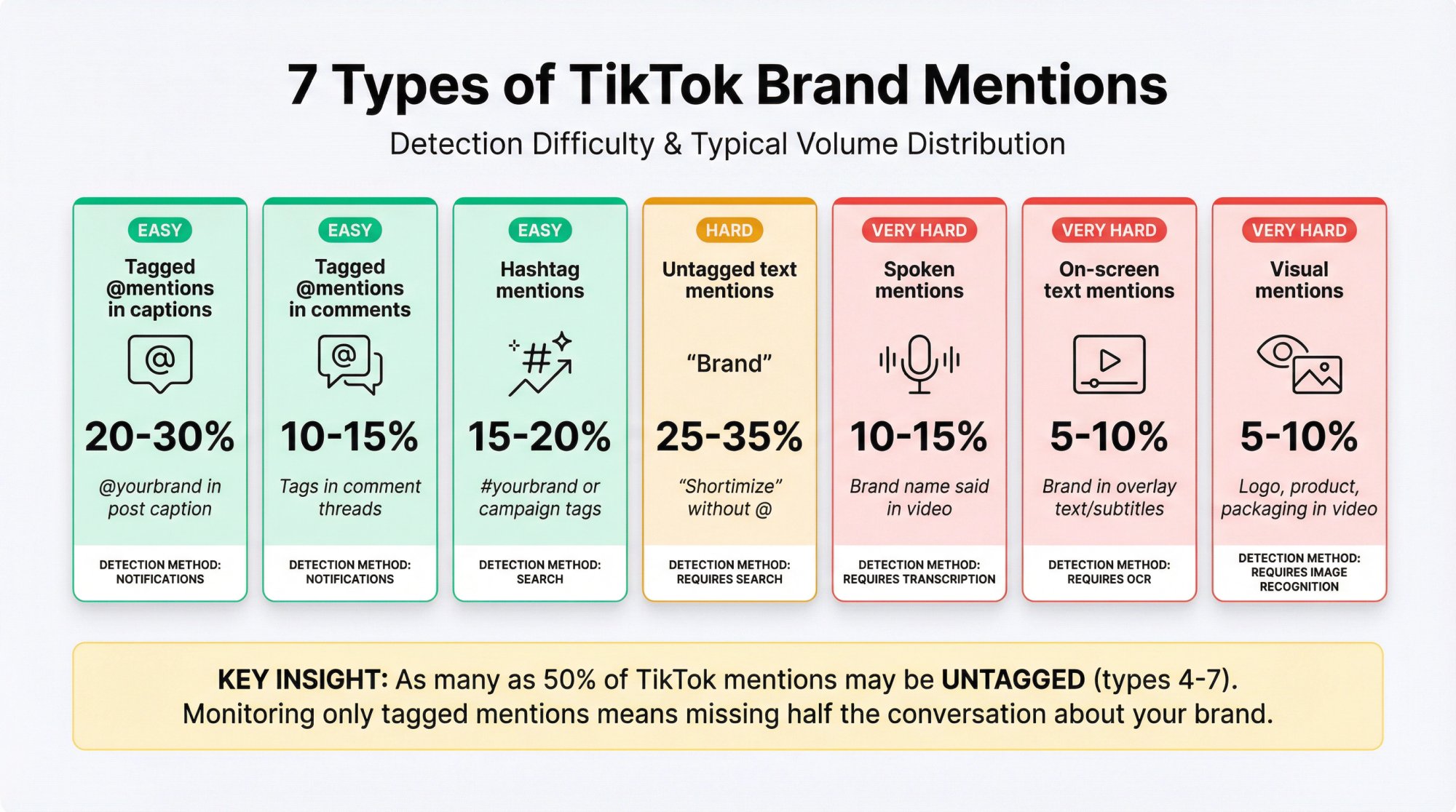
| Mention Type | Example | Detection Difficulty | Typical Volume |
|---|---|---|---|
| Tagged @mentions in captions | @yourbrand in post caption |
Easy (notifications) | 20-30% of mentions |
| Tagged @mentions in comments | Tags in comment threads | Easy (notifications) | 10-15% of mentions |
| Hashtag mentions | #yourbrand or campaign tags |
Easy (search) | 15-20% of mentions |
| Untagged text mentions | "Shortimize" without @ | Hard (requires search) | 25-35% of mentions |
| Spoken mentions | Brand name said in video | Very hard (requires transcription) | 10-15% of mentions |
| On-screen text mentions | Brand in overlay text/subtitles | Very hard (requires OCR) | 5-10% of mentions |
| Visual mentions | Logo, product, packaging in video | Very hard (requires image recognition) | 5-10% of mentions |
A key operational reality: as many as half of TikTok mentions may be untagged. One monitoring vendor even claims this matches what many social teams observe in practice.
This distinction is crucial. If you're only monitoring tagged mentions (the easy stuff), you're potentially missing 50% of the conversation about your brand.
How to Monitor TikTok Mentions Manually (Free Method)
When you have no special tools, you can still manually hunt for brand mentions on TikTok.
This is a good starting point, especially for small brands with low volume of mentions. It's free, and it uses TikTok's built-in features. But be aware it can be time-consuming and not very comprehensive.
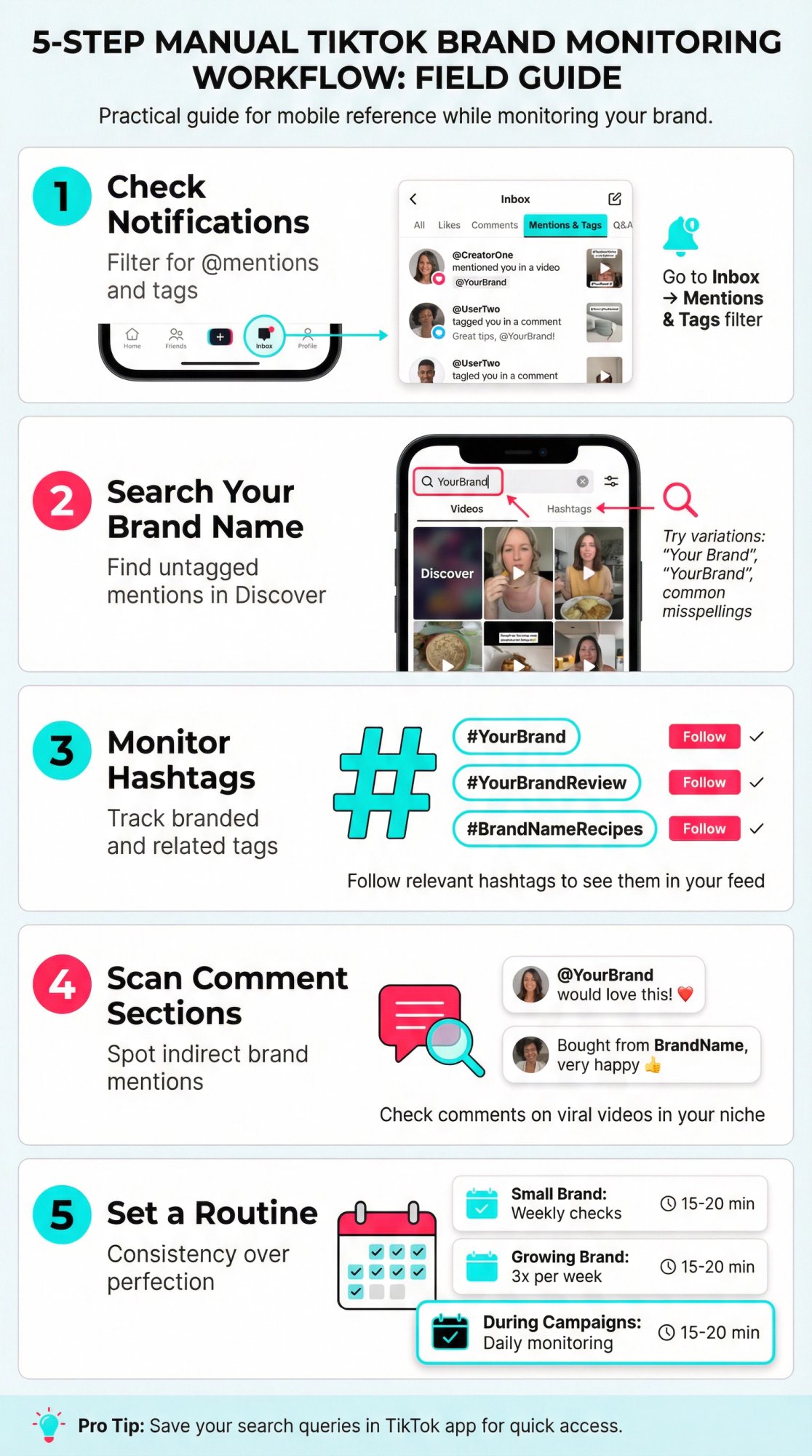
Here's how to do it:
Check your notifications for tagged mentions
If your brand has an official TikTok account, the app provides a way to see if someone tagged you (used @YourName) in a video or comment.
Go to your Inbox (notifications tab) and filter by Mentions and tags. TikTok actually has a filter so you can view only notifications where your account was mentioned. This is the low-hanging fruit: direct shout-outs you don't want to miss when tracking your TikTok presence.
Keep in mind though, not every mention will tag your official account. Many users will talk about your brand without the @ symbol.
Use TikTok's search bar for your brand name (and variations)
This is the trick for finding untagged mentions: times people talk about your brand without tagging you.
In the TikTok app (or on the web), head to the Discover tab (the magnifying glass) and enter your brand name as a keyword. Try variations and related terms:
→ Your exact brand name
→ Brand name with spaces (e.g., "Style Hub" vs "StyleHub")
→ Common misspellings of your brand
→ Branded hashtags you use (#YourBrand, #YourBrandReview)
Also search any branded hashtags you use. If your customers know a hashtag like #StyleHub or #StyleHubReview, check those too.
TikTok's search will return a mix of top videos, accounts, sounds, and hashtags matching that query. Focus on the Videos and Hashtags tabs in the results for content referencing your brand.
Pro Tip: Save or favorite that search query in the app, so you can easily run it again regularly.
What to expect
TikTok search tends to surface the most popular videos for that keyword first. When searching for brand mentions like "Coachella", the top results were often the official account and viral videos, not every user mention.
This means manual search might miss smaller or newer mentions. You might have to scroll deep or apply filters (e.g., filter by date posted, if available) to catch recent or less popular mentions. It's not exhaustive, but it's better than nothing.
Scan relevant hashtags
If your brand is commonly discussed via a hashtag (even an unofficial one), search that hashtag on TikTok.
For instance, a food brand might find content under #BrandNameRecipes even if the brand isn't tagged. TikTok allows you to follow hashtags. Consider following your brand's hashtag so that new videos using it show up in your feed.
Keep in mind, though, hashtags can be broad or used by others coincidentally. You'll need to pick out which posts are truly about your brand using strategic content analysis.
Monitor comments sections
Don't forget that mentions can happen in comments too. Users might mention your brand in comments on other videos (for example: "This looks like something @YourBrand would make!" or "I bought this from BrandName and love it").
TikTok doesn't make comment search easy for regular users, but if you suspect people might mention you in comments of certain popular videos in your niche, you can skim those comments manually. Some brands do spot-check comments on viral videos in their industry to see if they're mentioned.
Set a routine
Manual searching isn't one-and-done. Make it a routine to search your brand weekly or during major campaigns.
① Consistency Over Perfection
It's better to check 3 times a week consistently than to do deep dives once a month.
② Campaign Intensity
If your brand is trending or you're running a major campaign, you'll want to search daily.
③ Volume Awareness
If your brand is small, you might only need to check occasionally.
Limitations of manual monitoring
This approach can be labor intensive and still won't catch everything.
As noted, TikTok's search might miss niche mentions. One experiment found that searching a brand name mainly showed the most popular videos and the brand's own account, while skipping many user-generated mentions.
Manual monitoring also lacks analytics. You might find the mentions, but you won't automatically know how many views they got, what the sentiment is, or if there's a spike in mentions over time.
Still, for a smaller brand or interim solution, these steps are your first line of defense and cost nothing but your time.
Best Social Listening Tools for TikTok Monitoring (2026)
To truly cast a wide net and save time, social listening tools are the go-to solution.
Over the past couple of years, many social media monitoring platforms have figured out ways to include TikTok in their radar (even without official open APIs). These tools are built to track mentions, keywords, and hashtags across platforms, TikTok included, and often add valuable analytics like sentiment analysis, reach, trending themes, and alerts.
Here's what you need to know about using social listening tools for TikTok:
Comprehensive coverage
Advanced monitoring platforms will continuously crawl public TikTok content (along with other social networks, forums, news, etc.) looking for any reference to your chosen keywords.
They don't rely on being tagged. They can pick up untagged brand mentions hidden in a caption or even in a hashtag. These services essentially serve as your TikTok search patrol, 24/7.
Analytics and insights
The real power of these tools is what they do after finding the mentions.
They typically provide dashboards showing:
| Metric | What It Shows | Why It Matters |
|---|---|---|
| Volume of mentions | Track over time to spot trends | Identify viral moments and campaigns |
| Potential reach/views | Estimate how many people saw the mentions | Measure brand exposure impact |
| Sentiment analysis | Positive, negative, or neutral posts | Gauge brand perception in real-time |
| AI-driven insights | What caused spikes, trending themes | Understand why mentions happened |
| Influencer identification | Who's talking about you | Find partnership opportunities |
| Competitive benchmarking | Your mentions vs competitors | Strategic positioning insights |
For example, monitoring tools use AI to identify spikes in your brand mentions and will point out what caused the spike (say, a celebrity mentioned you). They can also auto-generate summaries of what people are saying about your brand on TikTok.
In other words, they don't just gather data. They interpret it, saving you from sifting through hundreds of videos manually.
Multi-platform monitoring
Most of these tools track more than just TikTok.
If you care about brand mentions, you probably want to see them on Instagram, YouTube, Twitter, Reddit, blogs, news sites, etc. Social listening platforms cast a wide net. For instance, when you set up a keyword like "YourBrand", a tool will pull mentions from TikTok, Instagram, YouTube, LinkedIn, forums, review sites and more.
This gives a unified view of your brand's buzz across the internet.
Alerts and workflow
You can usually set up real-time alerts. Get an email or Slack notification whenever a new TikTok mention crosses a certain threshold (like a video mentioning your brand gets 100k views, or a sentiment-negative post appears).
Some tools integrate with team workflows so you can assign a mention to a team member to respond, etc. Essentially, these tools are built for professional brand monitoring and response.
Top 7 TikTok Monitoring Tools Compared
There are many players in this space, each with strengths. Here's how the landscape breaks down:
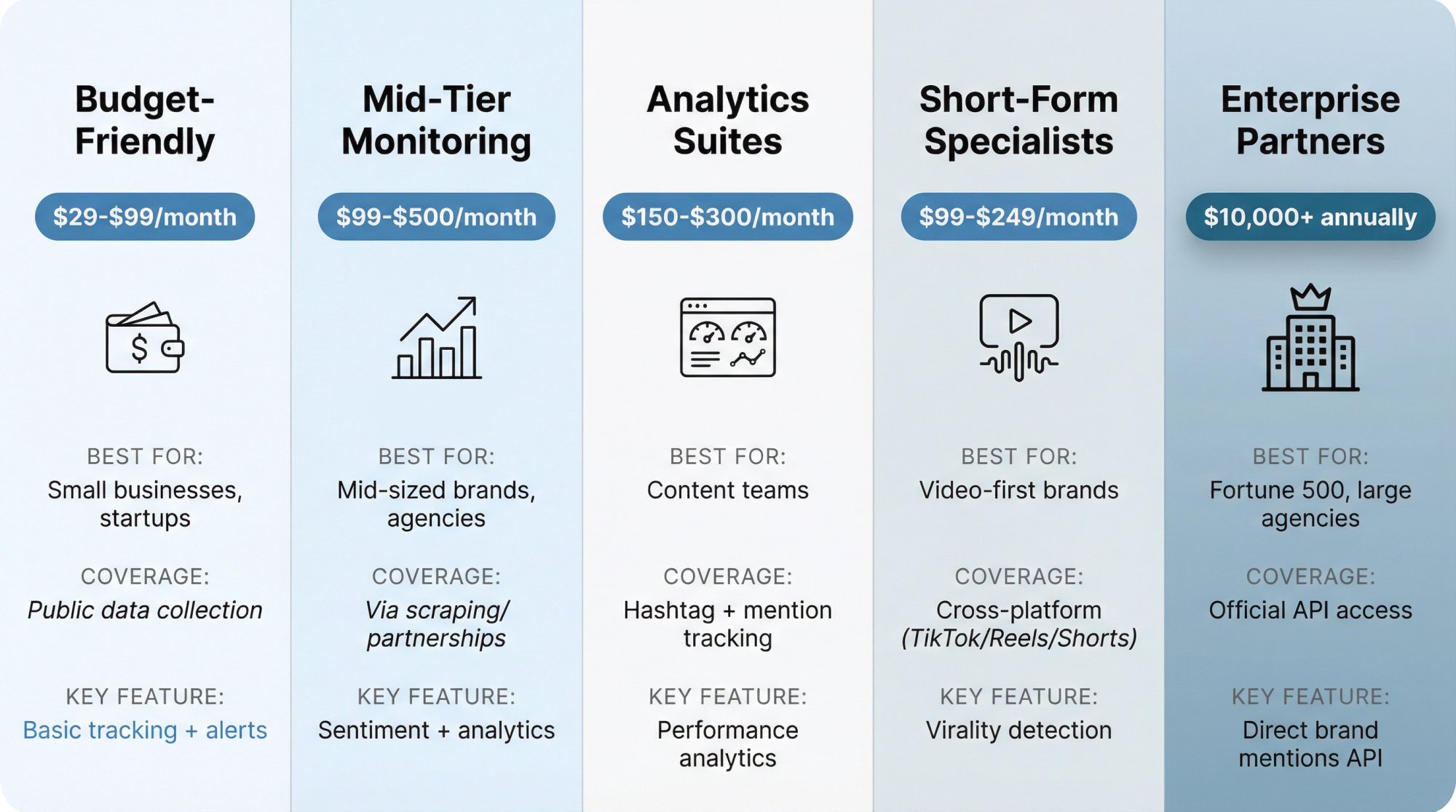
| Tool Category | Typical Price Range | Best For | TikTok Coverage | Key Feature |
|---|---|---|---|---|
| Enterprise Partners | $10,000+ annually | Fortune 500, large agencies | Official API access | Direct brand mentions API |
| Mid-Tier Monitoring | $99-$500/month | Mid-sized brands, agencies | Via scraping/partnerships | Sentiment + analytics |
| Budget-Friendly | $29-$99/month | Small businesses, startups | Public data collection | Basic tracking + alerts |
| Analytics Suites | $150-$300/month | Content teams | Hashtag + mention tracking | Performance analytics |
| Short-Form Specialists | $99-$249/month | Video-first brands | Cross-platform (TikTok/Reels/Shorts) | Virality detection |
Monitoring platforms
Focused on ease of use for tracking all mentions (tagged or not) across social media. Tools in this space explicitly support TikTok and can identify "untagged TikTok mentions" in their interfaces.
These platforms provide sentiment analytics, trending keywords in mentions, and AI analysts that summarize the chatter. They're paid services (plans often start around tens of dollars a month and up).
Use case: Mid-sized brands or agencies wanting a do-it-all listening tool.
Affordable listening tools
Some social listening tools offer TikTok coverage at accessible price points. Users report these platforms still reliably pull TikTok mentions despite API changes.
They can track keywords and offer sentiment and audience insights.
Use case: Small to mid businesses. These often appeal by being user-friendly.
Budget-friendly options
Relatively affordable listening tools (plans from €29/month) known for scanning the web and social for brand mentions.
These tools scour TikTok along with Twitter, Reddit, news sites, etc., and give you data on share of voice and top influencers mentioning your brand. Some even offer a social listening API for custom integrations.
Use case: Businesses on a budget who still want robust listening (popular with startups and marketers).
Social media analytics platforms
Social media analytics and listening platforms which have kept TikTok in their roster. Users mention these can automatically track mentions and hashtags, with customizable reports.
These platforms are more known for hashtag tracking and influencer metrics, and they provide recommendations like optimal posting times.
Use case: Those who want both monitoring and some content performance analytics in one.
Broader social management suites
These are broader social media management suites, primarily known for scheduling and analytics, but they have some listening capabilities or integrations.
Some platforms added TikTok listening in some form. But be aware such large platforms might rely on partial data or integrations. They're great if you need an all-in-one social tool (management + monitoring), though their listening depth on TikTok might not equal dedicated tools.
Use case: Larger teams managing many social channels with a need for basic TikTok mention tracking.
Enterprise solutions
If you are an enterprise or have a big budget, these are top-tier listening platforms.
Enterprise platforms are official TikTok partners, meaning they have direct access to TikTok's Brand Mentions API. They can pull in every mention of your official handle (and possibly track keywords and hashtags) with TikTok's blessing.
For example, some platforms let you create a "Mentions" feed to retrieve all videos that mention your brand's handle, up to the minute. Others monitor TikTok conversations for your brand in their Consumer Research products.
These enterprise tools are powerful but costly (think five-figure annual contracts).
Use case: Fortune 500 companies, agencies with large clients, or brands where TikTok mention volume is so high that you need the best of the best (and a team to utilize it).
Short-form video specialists
A shout-out to tools that specialize in short-form video analytics.
For example, influencer marketing platforms added TikTok monitoring features. These platforms can specifically "track who is posting about your brand and how those posts perform," and even calculate a Brand Vitality Score that measures the impact of content mentioning your brand.
This is more geared toward influencer-driven brands (popular in the beauty industry).
Another option helps discover influencers and track content, showing trending posts about your brand or competitors.
And Shortimize offers a cross-platform monitoring solution for short-form videos. You can input keywords, hashtags, or accounts and track them across TikTok, Instagram Reels, and YouTube Shorts in one dashboard.
Shortimize's social monitoring leverages AI to surface trending videos and mentions related to your brand, while also providing deep analytics on any specific account or video you track.
How to Set Up TikTok Brand Monitoring Tools
Whichever tool you choose, success comes from a good setup.
Define the keywords you want to monitor (your brand name, product names, common misspellings, campaign hashtags, etc.). Also consider monitoring industry keywords or competitor names. TikTok posts that mention your brand might mention others too, which is competitive intel.
Set up alerts or daily digests so you don't have to live in the dashboard. Let the tool tell you when something needs attention (e.g., "Spike: 50 new TikToks mentioning YourBrand in the last 24h").
And make sure to hook up your team. If customer support or PR needs to jump in on certain mentions, have a workflow in place.
Reality check: Data sources
These tools obtain TikTok data either by official partnerships or by clever scraping of public data.
Changes in TikTok's site or API can sometimes disrupt them (as happened with some platforms). Reputable tools usually adapt quickly or have backup methods to continue providing data.
When evaluating a tool, ask how it gets TikTok mentions. If it's an official partner, data should be reliable (but maybe limited to tagged mentions). If it's unofficial, it might collect a broader set of mentions (including untagged brand name references) via web scraping or third-party data providers.
The technical reality is less important than the results. Both approaches can work. Just be aware that no third-party tool is 100% infallible with a platform as protective as TikTok.
The key is that using these tools will save you a ton of time and catch far more mentions than you ever could manually. Most offer free trials or demos, so you can try and see the results for your brand.
How to Build a Custom TikTok Mention Scraper
For developers, data scientists, or the very adventurous marketer, there is another route: build your own TikTok monitoring pipeline using web scraping or unofficial APIs.
This path is by far the most technical, and it comes with maintenance headaches and ethical considerations. But it can give you raw, customizable access to TikTok data without relying on a vendor.
Essentially, you'll be recreating what a social listening tool does under the hood.
Use TikTok's "hidden" web API endpoints
TikTok's web application (the site you see in a browser) communicates with various endpoints that aren't publicly documented but can be observed.
For example, when you use the search bar on tiktok.com, it calls a URL like:
https://www.tiktok.com/api/search/general/full/?keyword=<YourQuery>&offset=<N>&...
This is a hidden search API that returns search results in JSON form. Understanding these technical aspects of social media data collection can help you build effective monitoring systems. Developers have reverse-engineered such endpoints. By replicating the requests (including necessary headers, cookies, and maybe a signature), you can programmatically fetch TikTok search results for a given keyword.
In fact, scraping guides show how to capture the network call when you perform a TikTok search and how to use that in a script. Using this method, you could write a script to search for your brand name every few hours and collect new results.
Leverage scraping libraries and APIs
You don't have to start from scratch. There are open-source libraries and paid APIs tailored to TikTok scraping.
For instance, web scraping services have published detailed guides on scraping TikTok efficiently. They demonstrate how to:
• Automate search queries
• Handle pagination (loading more results)
• Parse the JSON data that TikTok returns
• Maintain a session with cookies to satisfy TikTok's anti-bot checks
Another example: web scraping platforms offer pre-built TikTok scrapers. Some platforms have "TikTok Videos by Keyword" actors. You give it a keyword, and it will output a list of TikTok videos matching that search.
You can call this via their API, meaning with a simple HTTP request you get structured data on videos that contain your keyword in the description or hashtags. This significantly lowers the barrier: no need to handle headless browsers or reverse-engineer JSON. The service does it for you (for a usage-based fee).
Scrape profiles and hashtags
Another strategy is to monitor specific high-risk areas for mentions.
For example, scrape all new videos under a popular hashtag related to your industry (some might mention your brand). Or scrape specific influencer profiles to see if they mention you in new content.
There are tools that specialize in scraping TikTok profiles, hashtags, or sounds, which you could either use, or emulate with custom code using TikTok's web APIs for user feeds and hashtag feeds.
Use Python/R API wrappers (cautiously)
There have been community-driven TikTok API wrappers (e.g., the TikTok-Api Python package). These libraries simulate the app or web requests to fetch data like videos, user info, etc. Some can perform keyword search or get trending hashtags.
Be cautious though: many unofficial libraries break frequently as TikTok changes its site and security. If you find one that's maintained and supports searching by keyword, you could integrate it into a custom monitoring script. Always test with a throwaway account or IP to avoid any risk to your main accounts.
Common Problems When Scraping TikTok Data
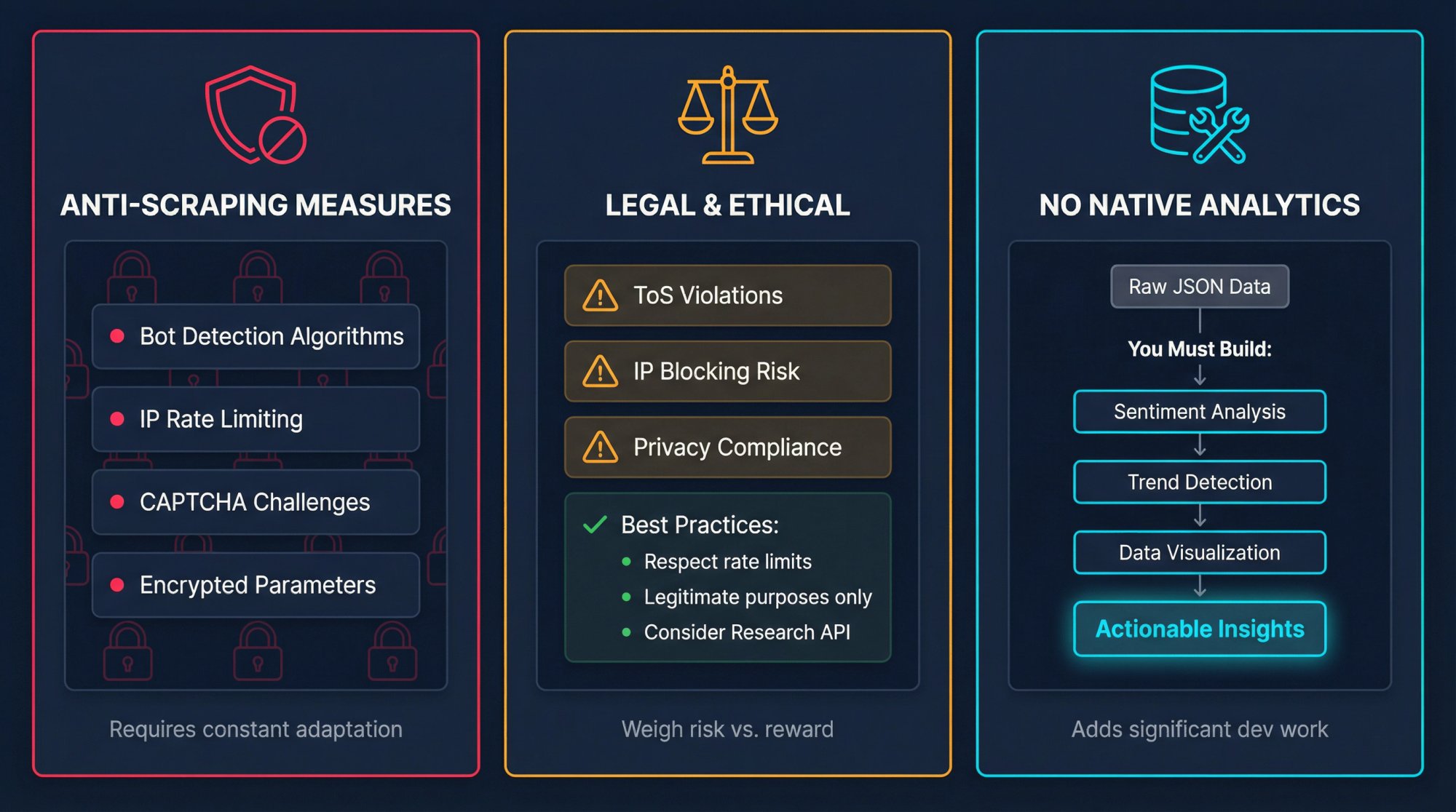
Now, the challenges:
Anti-scraping measures
TikTok employs serious anti-bot defenses. Scrapers often have to deal with things like:
• Bot detection algorithms
• IP rate limiting
• CAPTCHA challenges
• Encrypted request parameters
Scraping guides note that TikTok's algorithms to prevent scraping require constant adaptation. People use proxy rotations and even solve CAPTCHAs to keep scrapers running.
This means a DIY solution isn't "set it and forget it." You'll need to monitor it and update your approach when (not if) it stops working due to TikTok's changes.
Legal and ethical considerations
Scraping TikTok may violate their Terms of Service. While accessing public information is generally legal in many jurisdictions, platforms can enforce their terms by blocking your IP or taking other actions.
If you go this route, do it responsibly:
→ Respect rate limits (don't hammer their servers)
→ Use the data only for legitimate purposes within your organization
→ Consider using TikTok's official "Research API" where possible
Also consider privacy: you're collecting user-generated content. Make sure you handle it in compliance with any applicable data protection laws. Some companies choose a middle ground: using TikTok's official "Research API" or limited official endpoints for certain data, then scraping what's missing, to stay partially above-board.
No native sentiment/analytics
When you scrape raw data, it's on you to analyze it.
You'll get JSON with video descriptions, maybe view counts, etc. If you want sentiment analysis, you'd need to run the captions or comments through an NLP sentiment tool. If you want trends over time, you need to store the data and visualize it.
You become the analytics engine. This is doable (especially for those with data analysis skills), but it adds work.
Despite the hurdles, a DIY approach can be cost-effective at scale and highly tailored. You might pursue this if:
① You have a competent dev/data team
② Existing tools don't meet your needs or are too expensive
Even if you use a listening tool, having a backup DIY pipeline can be useful for verification or additional data points.
Example DIY setup
Imagine a simple Python script running on a schedule: it uses the TikTok search API (via a scraping service or direct scraping) to search your brand name, parses the results to extract video URLs or IDs, checks against a database of what you've seen before, and sends you an email or Slack message if it finds a new mention with, say, over 10k views or an unusual spike.
It could also automatically collect the video's stats (views, likes, comments) and the caption text for you to review. Over time, you build a dataset of every found mention, which you can analyze for sentiment or common themes. You could then feed this data into influencer tracking tools for deeper analysis.
This is very doable with a few hundred lines of code and some glue services. But again, requires maintenance when TikTok changes things.
Important: If you go the custom route, ensure you're not logging into TikTok with credentials or doing anything that could be seen as a breach of account. Stick to public, non-authenticated scraping if possible (it's safer legally).
TikTok's terms explicitly forbid unauthorized crawling, so there is a risk if they detect and decide to enforce. Many companies weigh this risk and either go with approved partners or use third-party data providers to shield themselves.
So weigh the pros and cons carefully.
Manual vs Tools vs Scraping: Which TikTok Monitoring Method?
We've outlined three major ways to monitor TikTok brand mentions without an official API: manually, with third-party tools, or via DIY scraping.
How do you decide which is right for you? It depends on your resources, budget, and the importance of TikTok to your brand.
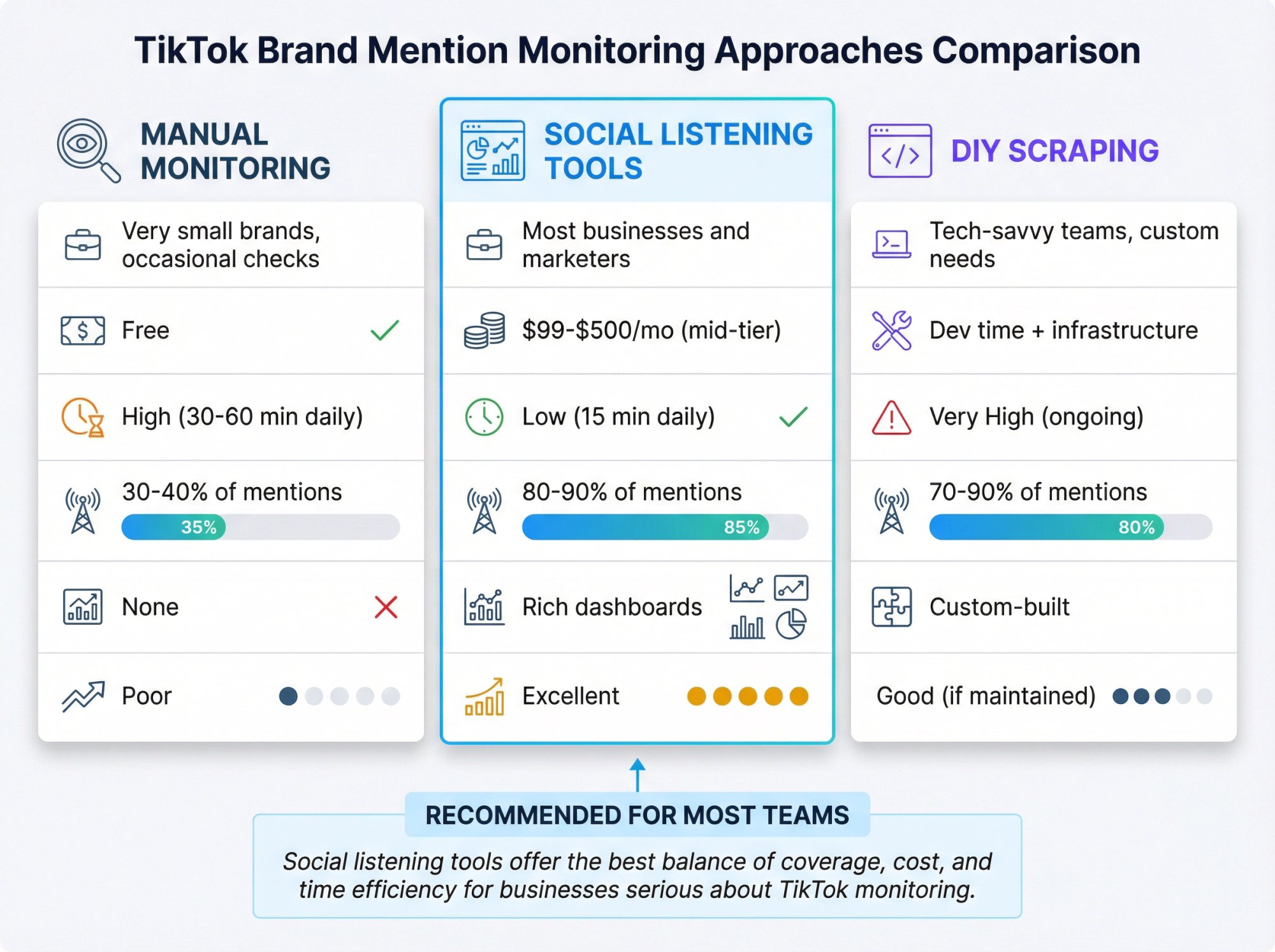
Here's a quick comparison:
| Approach | Best For | Cost | Time Investment | Coverage | Analytics | Scalability |
|---|---|---|---|---|---|---|
| Manual Monitoring | Very small brands, occasional checks | Free | High (30-60 min daily) | 30-40% of mentions | None | Poor |
| Social Listening Tools | Most businesses and marketers | $99-$500/mo (mid-tier) | Low (15 min daily) | 80-90% of mentions | Rich dashboards | Excellent |
| DIY Scraping | Tech-savvy teams, custom needs | Dev time + infrastructure | Very High (ongoing) | 70-90% of mentions | Custom-built | Good (if maintained) |
Manual monitoring
Best for: Very small brands or individuals just needing occasional insight.
It's free, but costs a lot of time and will miss many mentions. Use it as a stopgap or a learning exercise to gauge how much you're being mentioned.
If you find barely any TikTok mentions via manual search, you might not need a pricey tool yet. Set a reminder to check weekly, and you're done.
On the other hand, if you discover a ton of TikTok activity around your brand manually, that's a sign you should invest in automation (tool or DIY).
Manual monitoring is also a good supplement to tools. Sometimes you'll do a quick search on a new keyword or double-check something the tool surfaced.
Social listening tools
For most businesses and marketers, this is the sweet spot.
A good tool will immediately level up your awareness by catching mentions you would never find yourself, and saving you hours of scrolling.
The cost can range widely: some tools are <$100/month, whereas enterprise suites can be thousands per month. Choose one that fits your budget and scope. Review pricing options to understand what different tiers offer.
If you're a startup or small business, try mid-tier monitoring platforms which tend to be reasonably priced. If you're a larger brand deeply invested in TikTok (e.g., running big campaigns or frequently collaborating with creators), a more advanced tool or even an enterprise solution might make sense to handle the volume and provide richer analysis.
Remember to take advantage of free trials and demos. See the quality of TikTok data they provide.
Success metric: The tool should immediately surface TikTok videos about your brand that you weren't aware of. If after a month it hasn't revealed anything new or actionable, either your brand truly isn't being discussed (possible), or the tool isn't doing its job.
DIY scraping approach
Best for: Tech-savvy teams or those with very custom needs.
It can also be a necessity if you need raw data integration (for example, feeding TikTok mention data into your internal dashboards, data warehouse, or mixing it with other analytics).
It's also a learning opportunity. You'll gain understanding of how TikTok's backend works. But expect to invest in development time and ongoing maintenance.
Use this approach if third-party tools are insufficient (maybe they don't cover your language or niche well, or you require real-time data faster than some tools provide).
Also consider using a hybrid: some companies use a tool for the user-friendly interface and broad capture, and maintain a small custom script for backup or specific queries. For instance, you might use a platform for overall monitoring, but have a Python script that specifically checks a certain hashtag daily and writes to a database, just so you have that raw data archive.
How to Respond to TikTok Brand Mentions Effectively
Monitoring is step one. Doing something about it is step two.
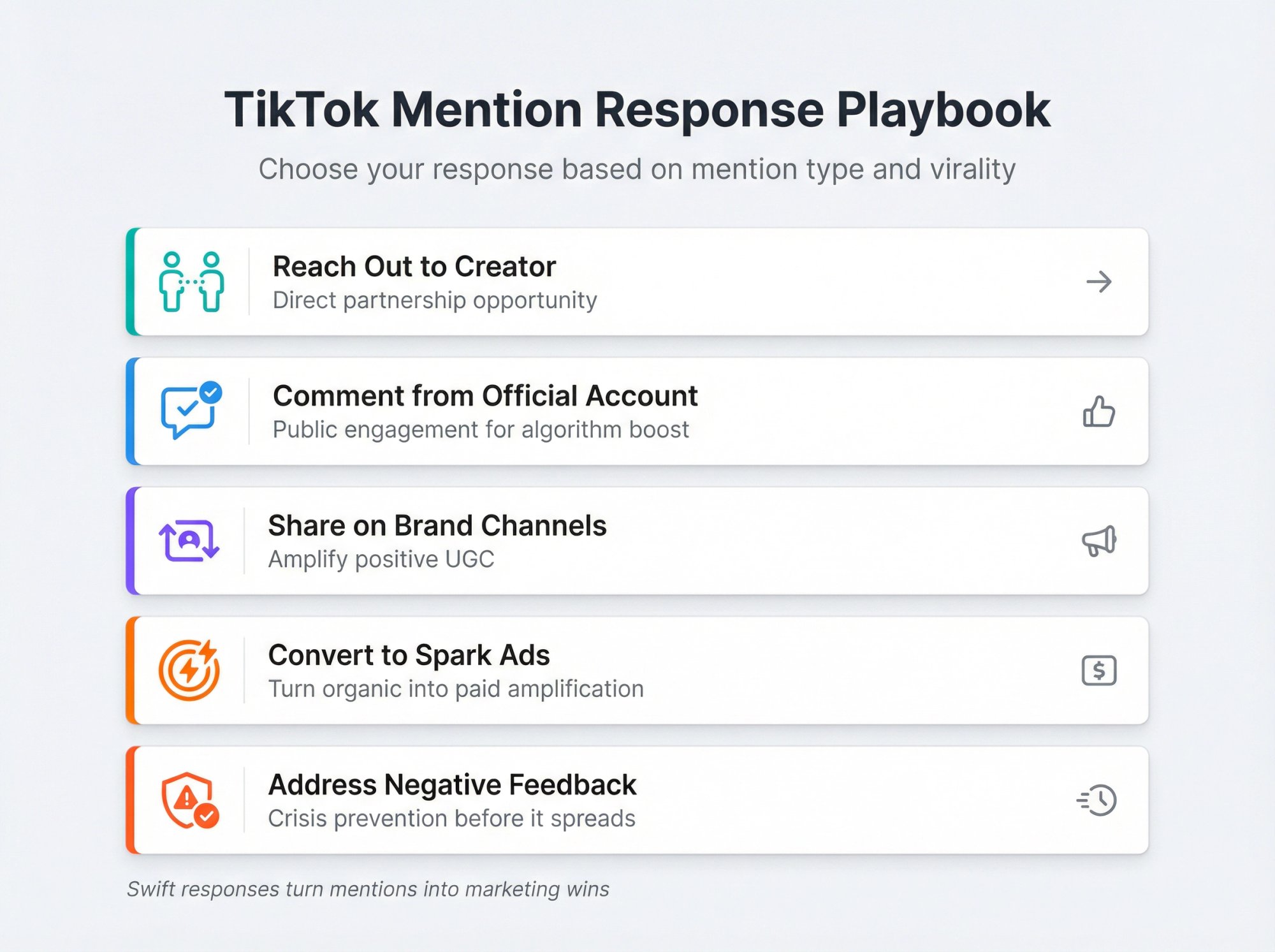
If a TikTok mention is blowing up (say a video praising or critiquing your brand goes viral), have a plan:
→ Are you going to reach out to the creator?
→ Drop a comment from your official account?
→ Share the mention on your own social channels?
→ Turn positive UGC into paid amplification (Spark Ads)?
→ Address negative feedback before it spreads?
Swift, savvy responses can turn mentions into marketing wins. On the flip side, ignoring a negative firestorm could be costly.
Many listening tools allow you to respond via the platform or at least assign it to someone. Even if you're monitoring manually, designate who is responsible for reacting to TikTok mentions (social media manager, PR team, etc.) and define guidelines for response.
How to Track TikTok Mention Performance with Analytics
Monitoring only matters if it drives action. Here's where Shortimize fits into your monitoring stack.
Shortimize is built to ingest public short-form data and provide a unified place to track accounts and videos across TikTok, Reels, and Shorts.
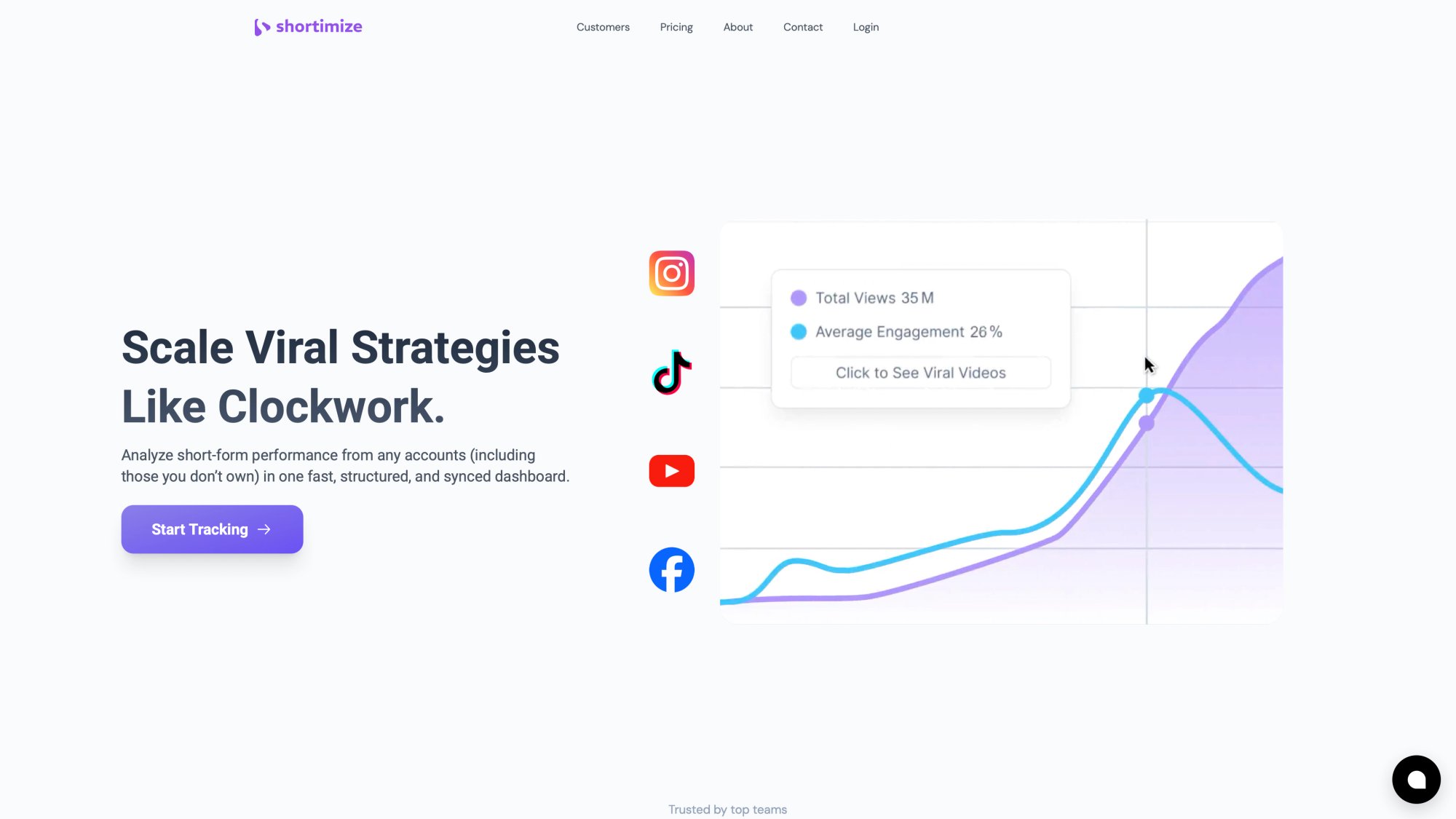
The platform provides a centralized dashboard where you can monitor brand mentions discovered through any of the methods discussed earlier. Whether you find mentions manually, through listening tools, or via your discovery pipeline, Shortimize transforms that raw data into actionable insights.
The clean way to use Shortimize for brand mention monitoring:
① Detect mentions using:
• Manual TikTok monitoring
• A listening platform
• Creator submissions
• Discovery pipeline
② Add the mention content to Shortimize
Paste the video URL or account handle to start tracking.
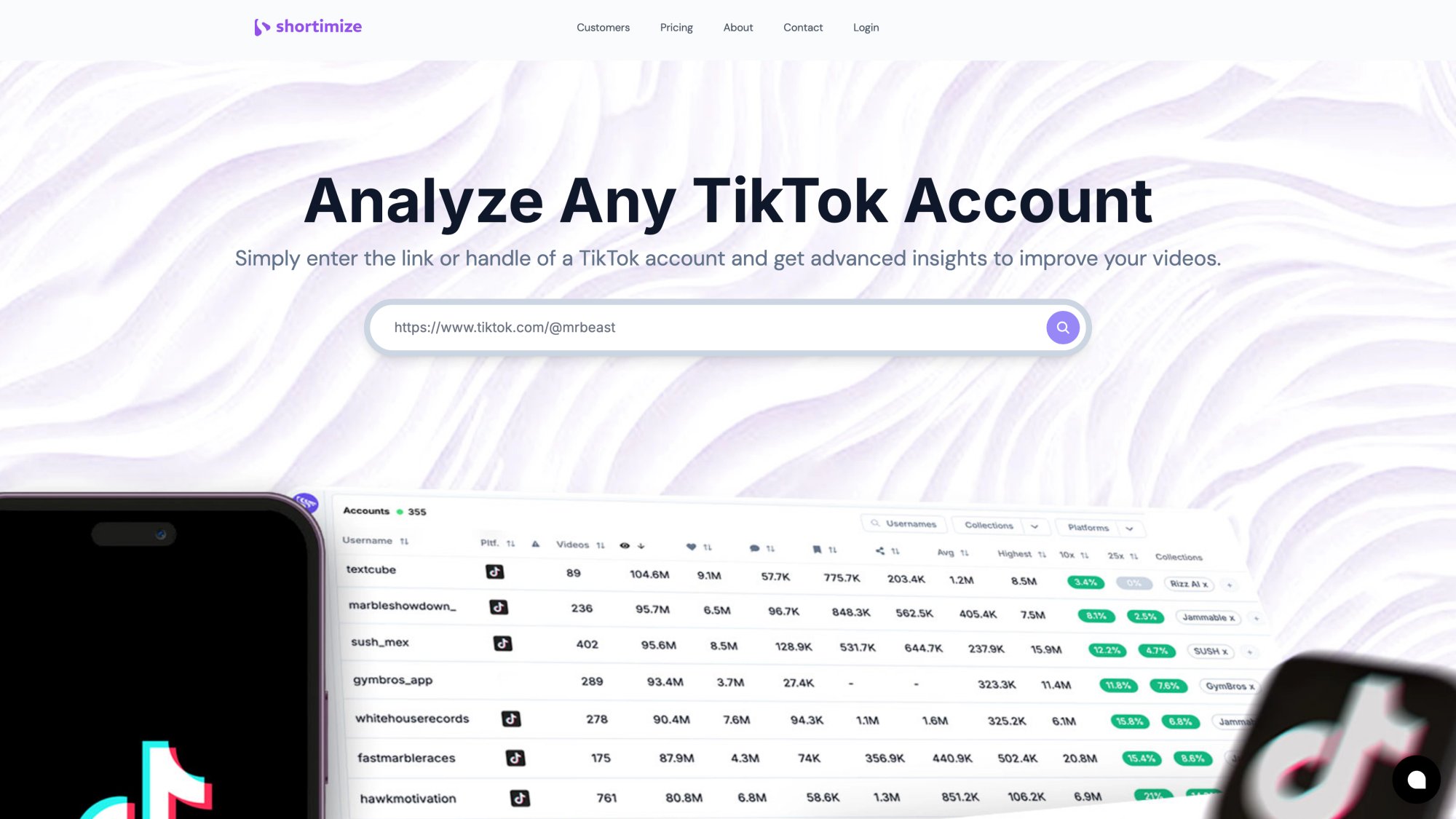
The TikTok account analysis interface provides deep insights into any public account. You can track posting patterns, engagement rates, viral video detection, and performance trends over time.
③ Track performance like an analyst
Watch velocity, engagement, and whether the mention is compounding over time. Compare across platforms if the creator cross-posted.
④ Organize mentions into Collections
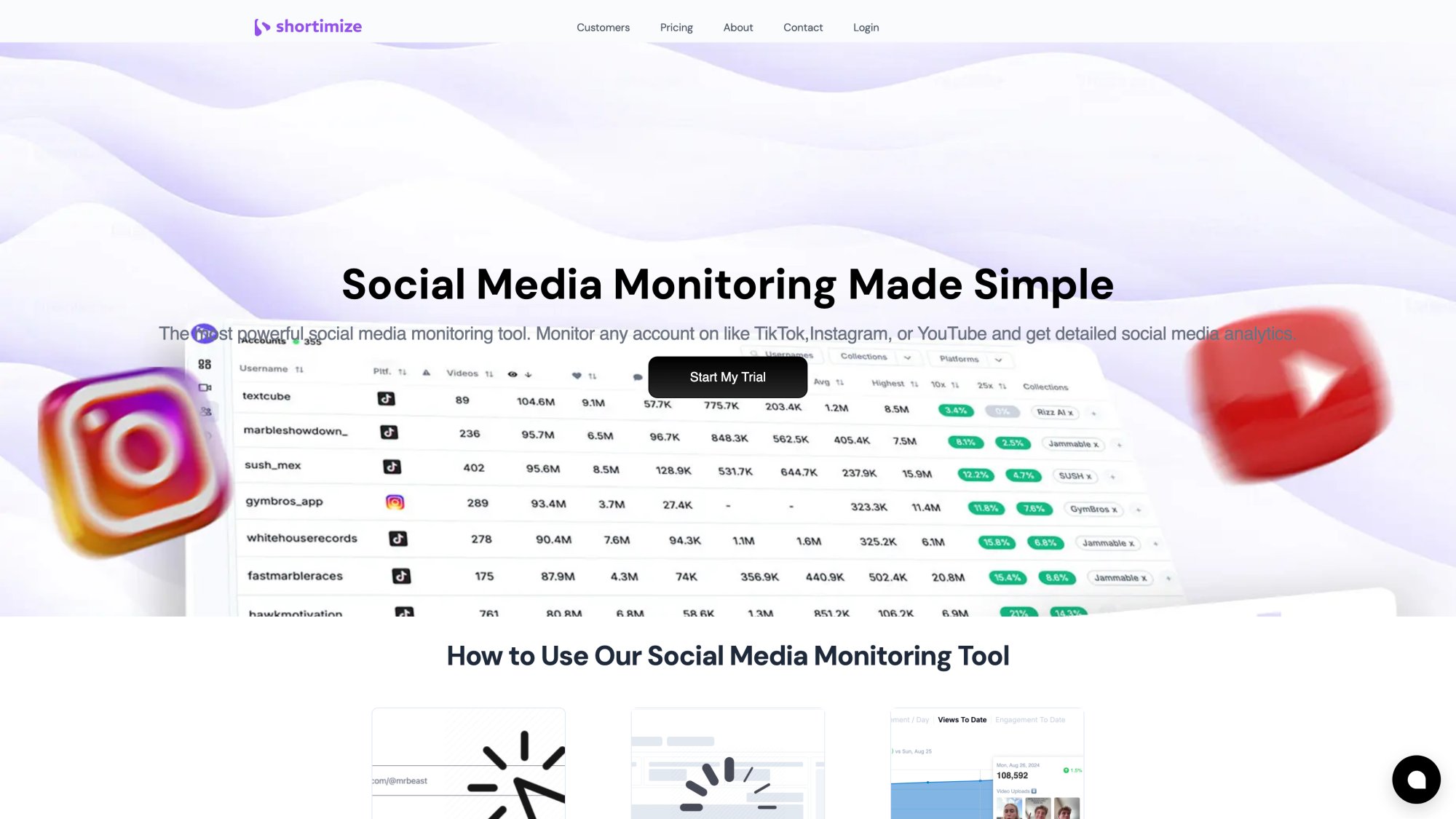
Example collections:
• "UGC to License"
• "Competitor Comparisons"
• "Customer Complaints"
• "Affiliate Mentions"
• "PR Risks"
The monitoring dashboard lets you organize discovered mentions into strategic collections, making it easy to segment UGC for licensing, track competitor comparisons, flag customer complaints, monitor affiliate partnerships, and identify potential PR risks.
⑤ Report and share
Export lists for stakeholder updates. Turn ad hoc mentions into a measurable pipeline.
This "listening → analytics" split is the most stable architecture in 2026, because it doesn't depend on one platform's policies to do everything.
7 Best Practices for TikTok Brand Mention Tracking
Here are the highest ROI mention actions:
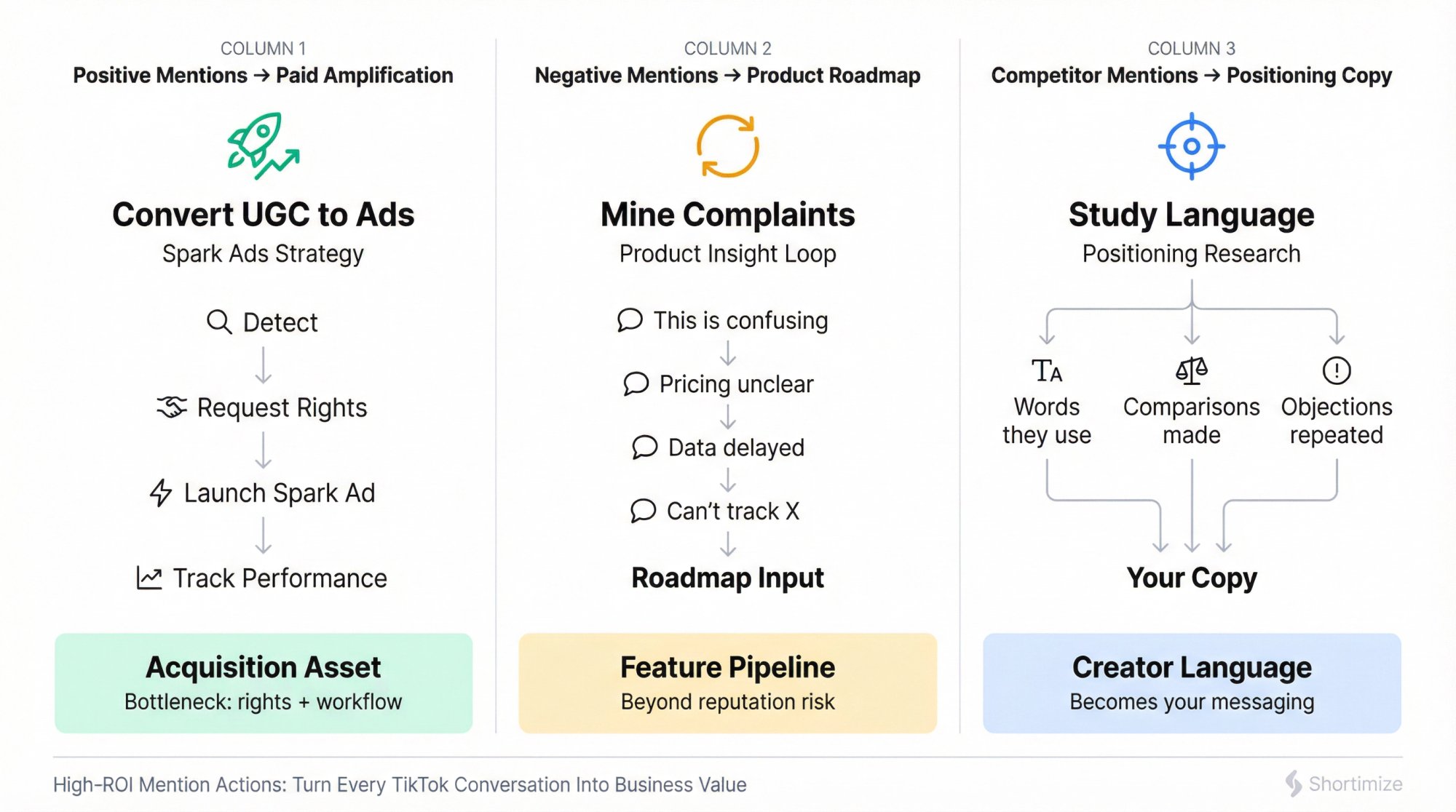
Convert positive UGC into paid amplification
Some tools position "detect → rights request → Spark Ads" as an integrated flow. Platforms describe detecting creator mentions, requesting rights, and launching Spark Ads, with performance tracked in Ads Manager.
Even if you don't use that product, the strategic takeaway is key:
Mentions are acquisition assets. The bottleneck is usually rights + workflow, not creative.
Use negative mentions as product roadmap inputs
When the same complaint repeats:
• "This is confusing"
• "Pricing is unclear"
• "Data feels delayed"
• "Can't track X"
That's not just reputation risk. It's product insight.
Use competitor-mentions as positioning research
Creator language becomes your positioning copy:
• The words they use
• The comparisons they make
• The objections they repeat
Start Monitoring Your TikTok Brand Mentions Today
Monitoring brand mentions on TikTok without an official API may require a patchwork of strategies, but it's absolutely doable.
TikTok might be a newer frontier compared to Facebook or Twitter, but the age-old truth of marketing applies: know what your customers (and critics) are saying about you.
Given TikTok's viral nature, a single mention can have outsized impact (positive or negative) on your brand's perception. By deploying the methods above, you can catch those mentions and capitalize on them.
To recap:
Start with the basics. Make sure you've checked TikTok's native avenues for mentions (notification filters, search queries, hashtag follows). It's quick and free, if limited.
Invest in a tool if you can. A good social listening tool paying attention to TikTok is like an insurance policy for your brand's online reputation. It will catch things while you sleep and give you the context (sentiment, reach) that you wouldn't have otherwise.
For the technically inclined: Consider building a custom scraper or using scraping services to get raw TikTok data. Just weigh the effort and ethical use carefully.
Stay updated. TikTok's landscape and policies will continue to evolve. What works today might need tweaking in six months. Keep an eye on communities (Reddit's r/socialmedia, developer forums) where professionals share updates on TikTok data access changes.
By monitoring your TikTok mentions, you'll not only protect your brand's reputation but also uncover opportunities. Whether it's a TikTok creator organically hyping your product (maybe a partnership opportunity?) or feedback that can spark your next product improvement.
TikTok may not hand this data to you on a silver platter, but with the steps above, you can absolutely gather it yourself.
Remember: The conversation about your brand is happening with or without you. It's far better to be in the loop and ready to engage.
With a combination of smart tools and strategies, you'll ensure that no important TikTok mention slips under your radar.