If you're reading this, you're not asking "how do I DM some creators?" You're asking: how do I build a repeatable system that turns influencer partnerships into predictable growth without burning budget on fake numbers or drowning in spreadsheets you can't make sense of.
The answer isn't complicated, but it does require structure. Influencer marketing has exploded into a $32+ billion industry as of 2025, with research showing 92% of consumers trusting influencer recommendations over traditional ads. When you do this right, brands earn about $5.78 in value for every $1 spent on influencer campaigns. But getting those returns isn't automatic.
Without a clear plan or tracking system, influencer marketing becomes expensive guesswork. You're paying creators to post content and just hoping something good happens. With a strategy? You establish goals and metrics up front, so you can tell if that $10,000 campaign actually returned $50,000 in sales or fell flat.
This guide is built for growth teams at startups, agencies, and creator-led brands running short-form content across TikTok, Instagram Reels, and YouTube Shorts. You'll walk away with a framework you can actually use, not just theory.
What Is a Social Media Influencer Strategy?
A real influencer strategy is a growth system with four moving parts:
1. Portfolio: Who you partner with, and why they're the right distribution channels plus trust vehicles for your brand
2. Content system: What creators make, in what format, on what cadence
3. Distribution system: Organic reach plus paid amplification and content repurposing
4. Measurement system: How you know what worked, and how you scale the winners
If any of these is missing, you don't have a strategy. You have a list of posts that may or may not do anything for your business.
Why Influencer Marketing ROI Matters in 2026
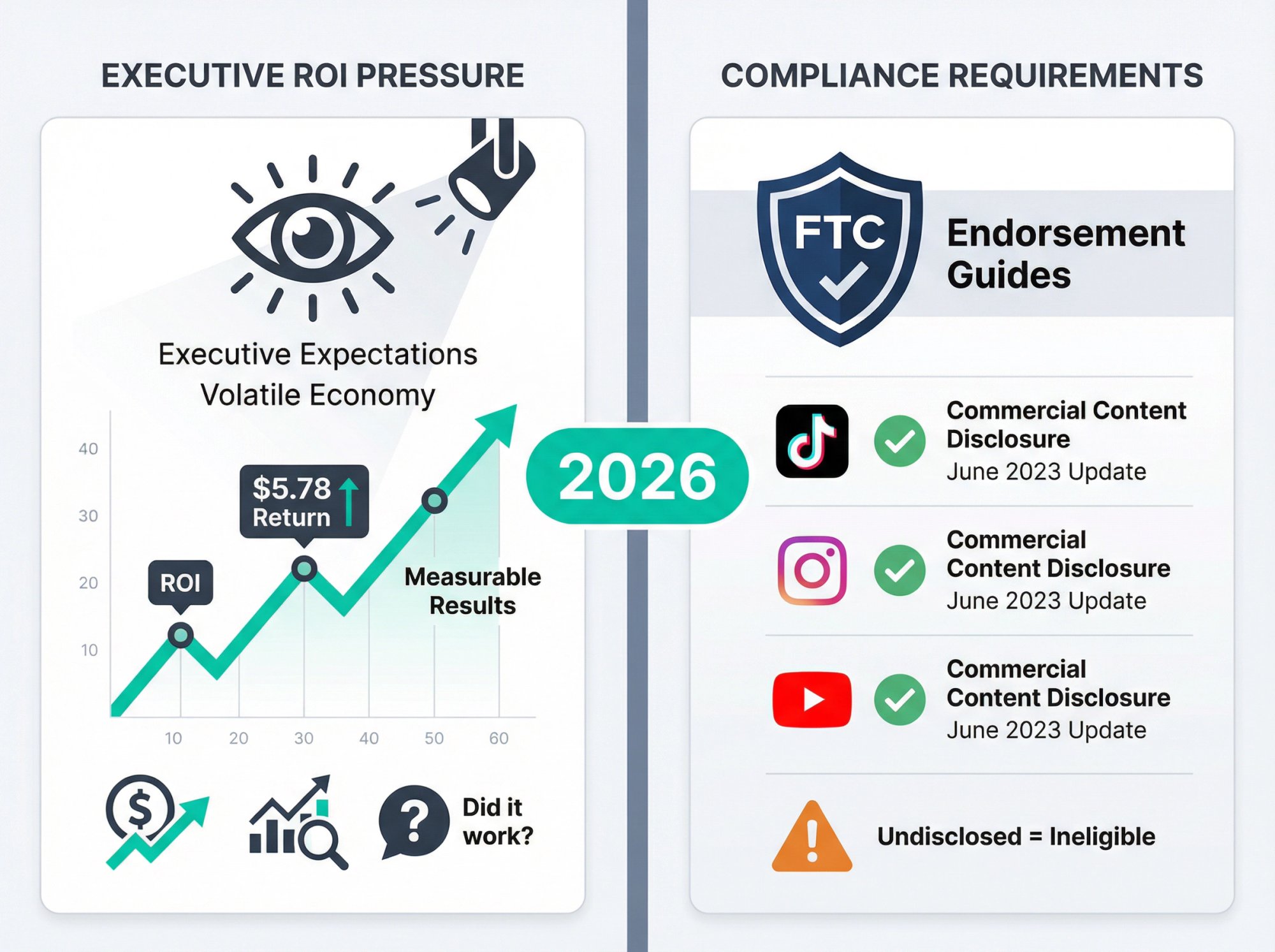
Executives now expect ROI from creator marketing. Industry research shows that in a volatile economy, brands are shifting strategy toward increased focus on measurable ROI. Translation: you'll be asked "did it work?" earlier than you think.
Compliance is getting stricter. The FTC updated its endorsement guides in June 2023 and explicitly calls out influencer monitoring expectations. TikTok's business help center says you must turn on the commercial content disclosure setting for promotional content, and undisclosed content can become ineligible for For You feed distribution if not fixed in time (last updated September 2025). If your strategy doesn't include disclosure, contracts, and monitoring, it's not edgy. It's fragile.
Step 1: How to Set Clear Influencer Marketing Goals
Most influencer programs fail because they're trying to hit five outcomes with one post.
Choose one primary goal per campaign. You can still track secondary metrics, but you need clarity on what success actually looks like.
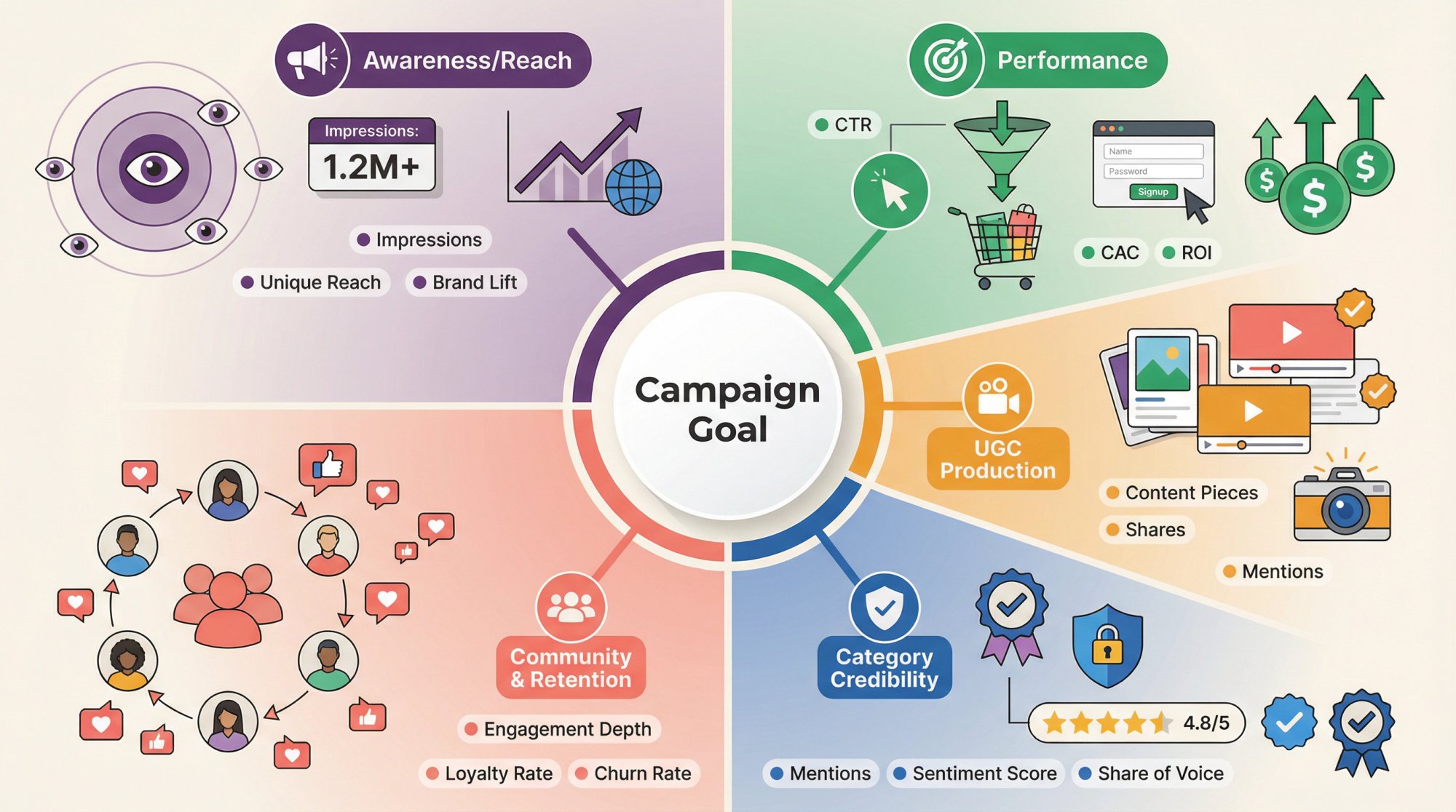
Influencer Marketing Goal Options
Awareness/Reach: You're buying attention and memory. Measure impressions, reach, video views, and share of voice.
Performance: Signups, installs, purchases. Track click-through rates, conversion counts, and cost per acquisition.
UGC Production: You're buying assets for ads and social proof. Measure usable content pieces that pass your ad testing thresholds.
Category Credibility: You're borrowing trust from experts. Track brand sentiment, expert endorsements, and category association metrics.
Community & Retention: You're building long-term ambassadors. Monitor engagement depth, repeat mentions, and community growth.
Your success definition needs to be one sentence that includes a number plus timeframe. Examples:
• "Drive 2,000 trial signups in 30 days at under $25 blended CAC from creator traffic"
• "Generate 40 paid-usable UGC videos this month with 30% passing our ad testing thresholds"
• "Increase share of voice in our niche by 20% on short-form within 60 days"
Step 2: How to Find the Right Influencers for Your Brand
You're not hiring creators for their follower number. You're hiring them for:
→ Audience match (the right people)
→ Attention quality (do people actually watch?)
→ Trust (does the audience believe them?)
→ Creative translation (can they sell without sounding like an ad?)
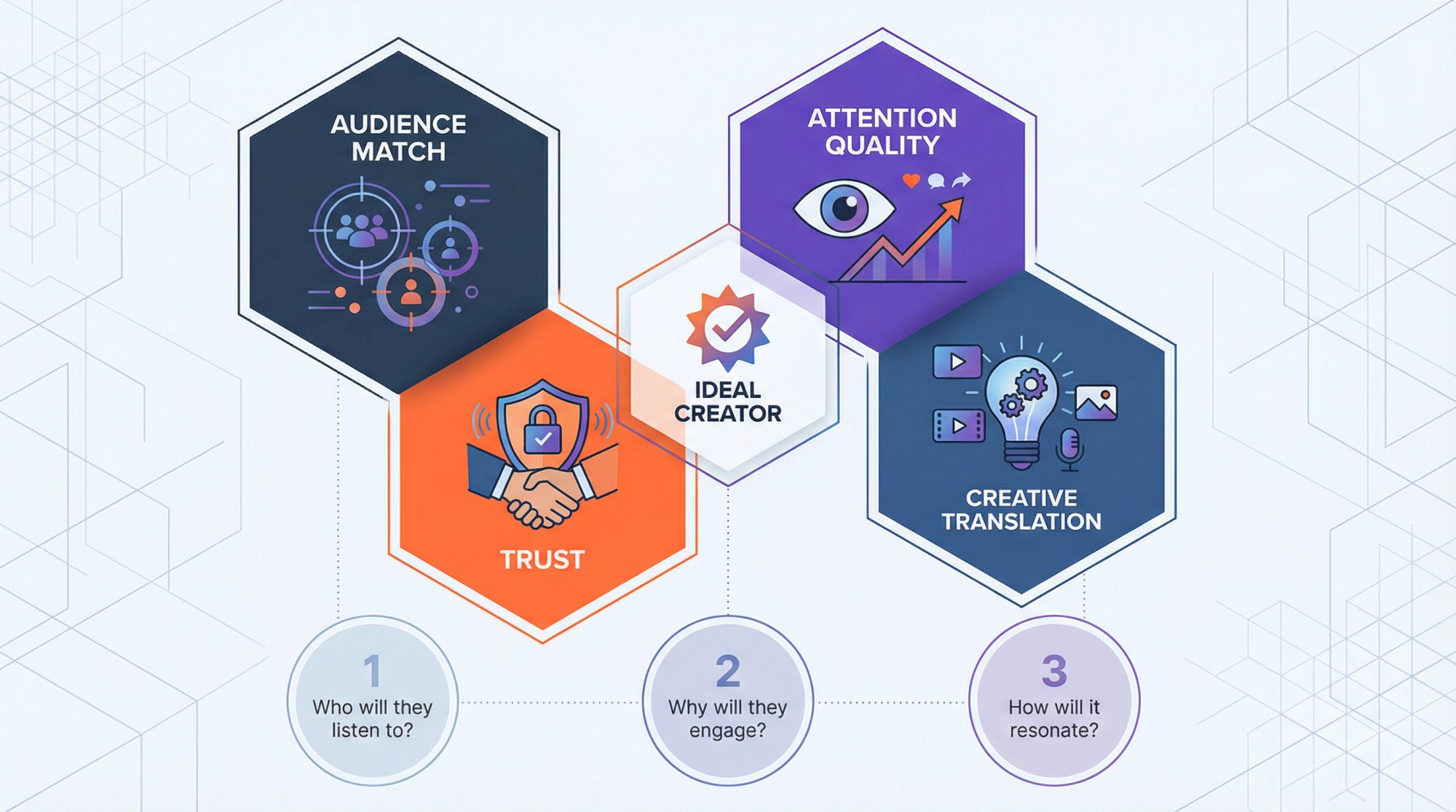
3 Questions to Define Your Target Creator
① Who is the viewer?
Be specific. Not "Gen Z" but "Gen Z college students who care about sustainable fashion."
② What problem are they trying to solve?
Identify the job-to-be-done, not just demographics.
③ What content format already solves it?
Review, tutorial, storytime, comparison, before/after? Match your brief to proven formats.
If you can't answer these questions, you'll end up buying "pretty content" that doesn't convert.
Step 3: Which Social Media Platforms to Use for Influencer Marketing
Different platforms cater to different demographics and content formats. Here's what you need to know:
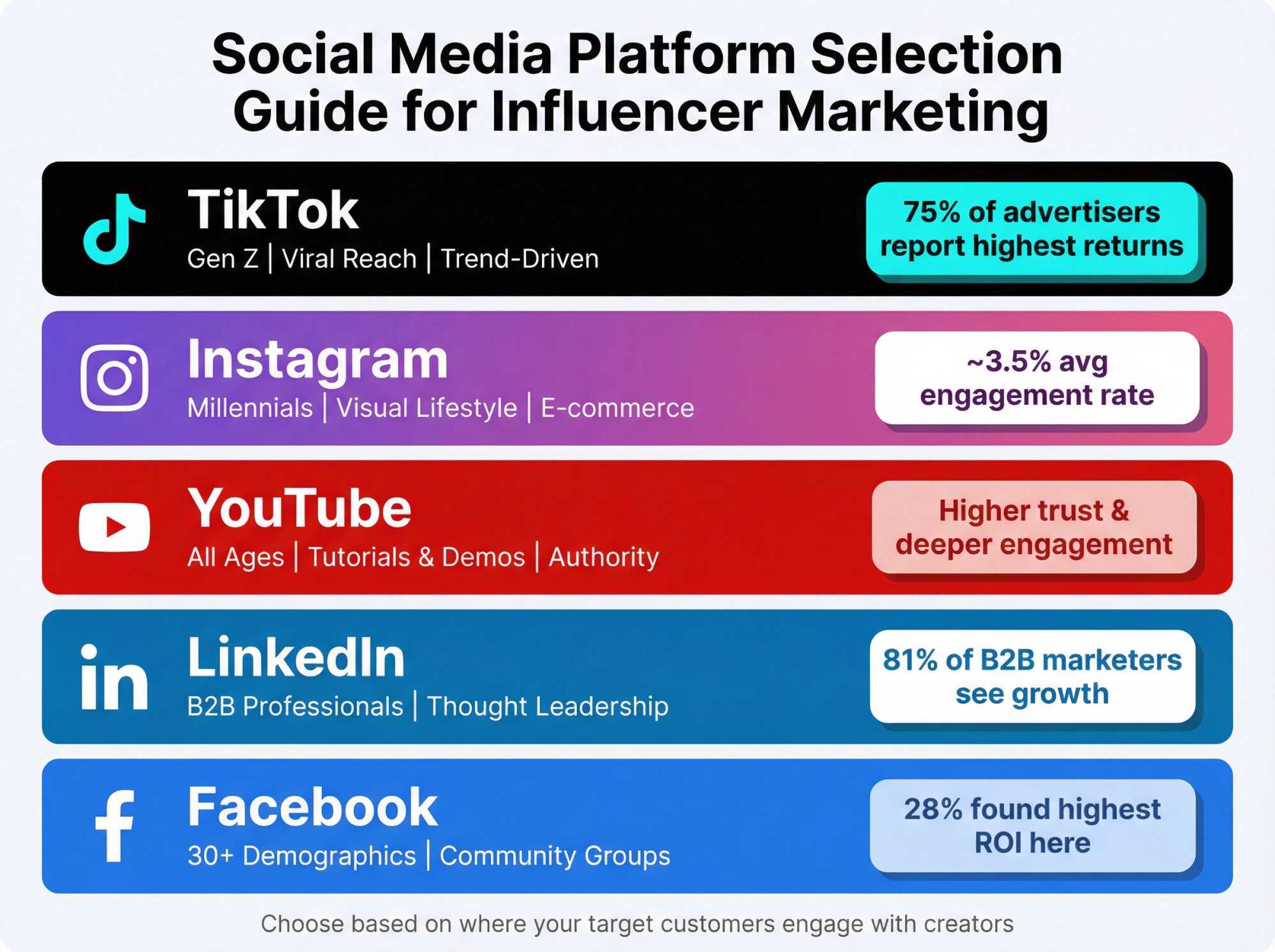
| Platform | Best For | Key Stats |
|---|---|---|
| TikTok | Gen Z, viral reach, trend-driven content | Research shows 75% of advertisers report TikTok influencers produced their highest returns |
| Millennials, visual lifestyle content | ~3.5% average engagement rate; strong for e-commerce | |
| YouTube | All ages, long-form tutorials and demos | Higher production effort but deeper trust and authority |
| B2B professionals, thought leadership | Industry data shows 81% of B2B marketers say influencer marketing is growing | |
| 30+ demographics, community groups | Surveys indicate 28% of marketers found Facebook influencers delivered highest ROI |
Choose platforms based on where your target customers hang out and engage with creators. If you're a small team or new to this, it's better to focus on one or two platforms where you can do a great job, rather than stretching across five with mediocre execution.
A fashion brand will likely prioritize Instagram and TikTok (visual inspiration and viral trends), whereas a productivity app might do better with YouTube explainers and LinkedIn thought-leadership posts.
Step 4: How to Build an Influencer Portfolio Strategy
A creator program is a portfolio game, not a "pick one winner" game.
How to Choose Influencer Tiers
Nano creators (small, high trust): Great for authenticity and cost efficiency
Micro creators (still trusted, better reach): Often the best value. Research shows 73% of brands prefer working with micro-influencers due to their strong engagement relative to cost.
Mid-tier (more reach, more variance): Needs stronger creative and offer to work
Macro/mega (scale): Usually requires paid amplification to be worth it
Don't optimize for "biggest." Optimize for expected value:
Expected value = (probability of success) × (upside) − (cost + risk)
Micro creators often win because probability is higher and cost is lower.
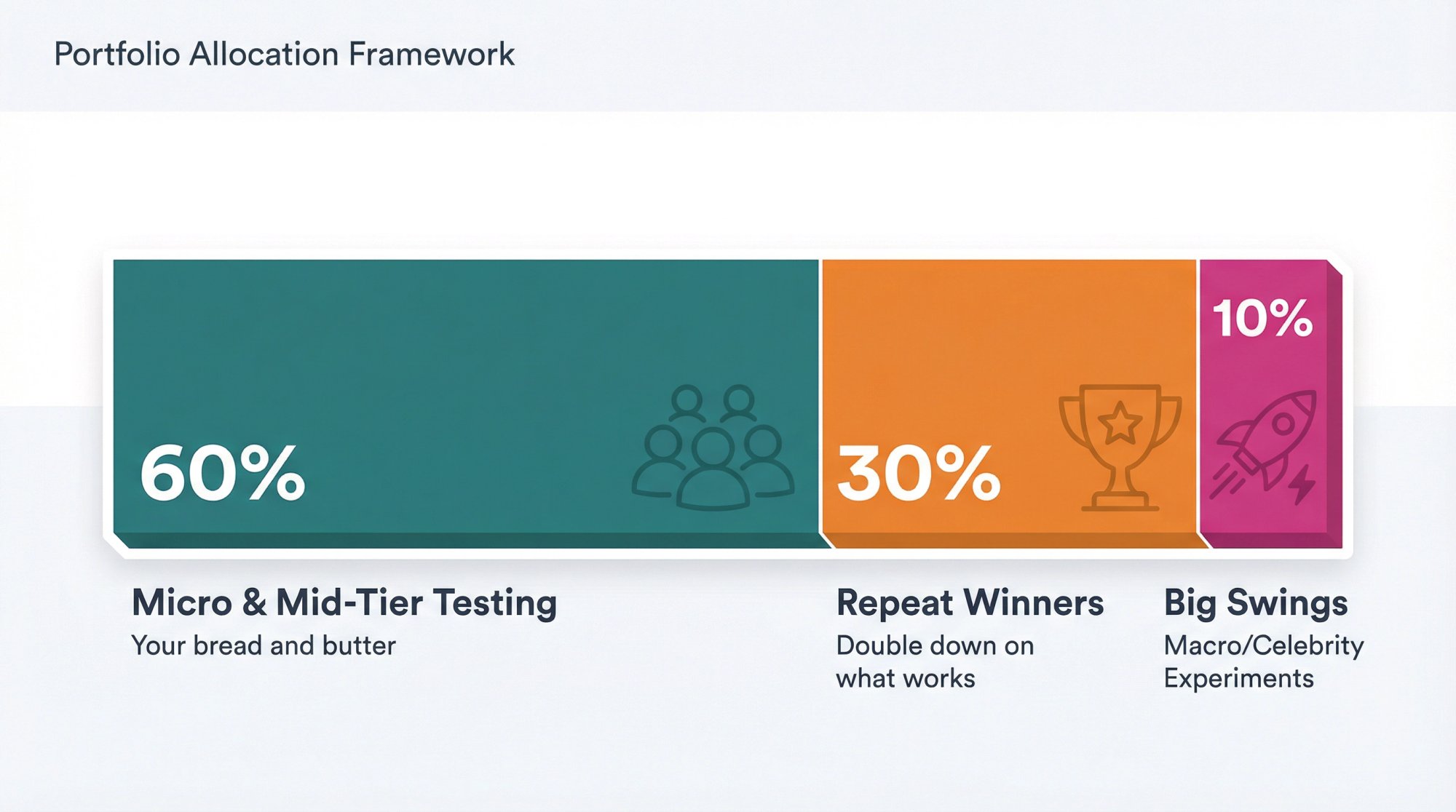
A Simple Portfolio Allocation
• 60% budget: Micro and mid-tier testing (your bread and butter)
• 30% budget: Repeat winners (double down on what works)
• 10% budget: Big swings (macro/celebrity or experimental formats)
Step 5: How Much Does Influencer Marketing Cost?
Influencer pricing is messy because you're buying a bundle: creation time, distribution, sometimes usage rights, sometimes exclusivity, sometimes whitelisting permissions.
The Only Pricing Metric That Actually Matters
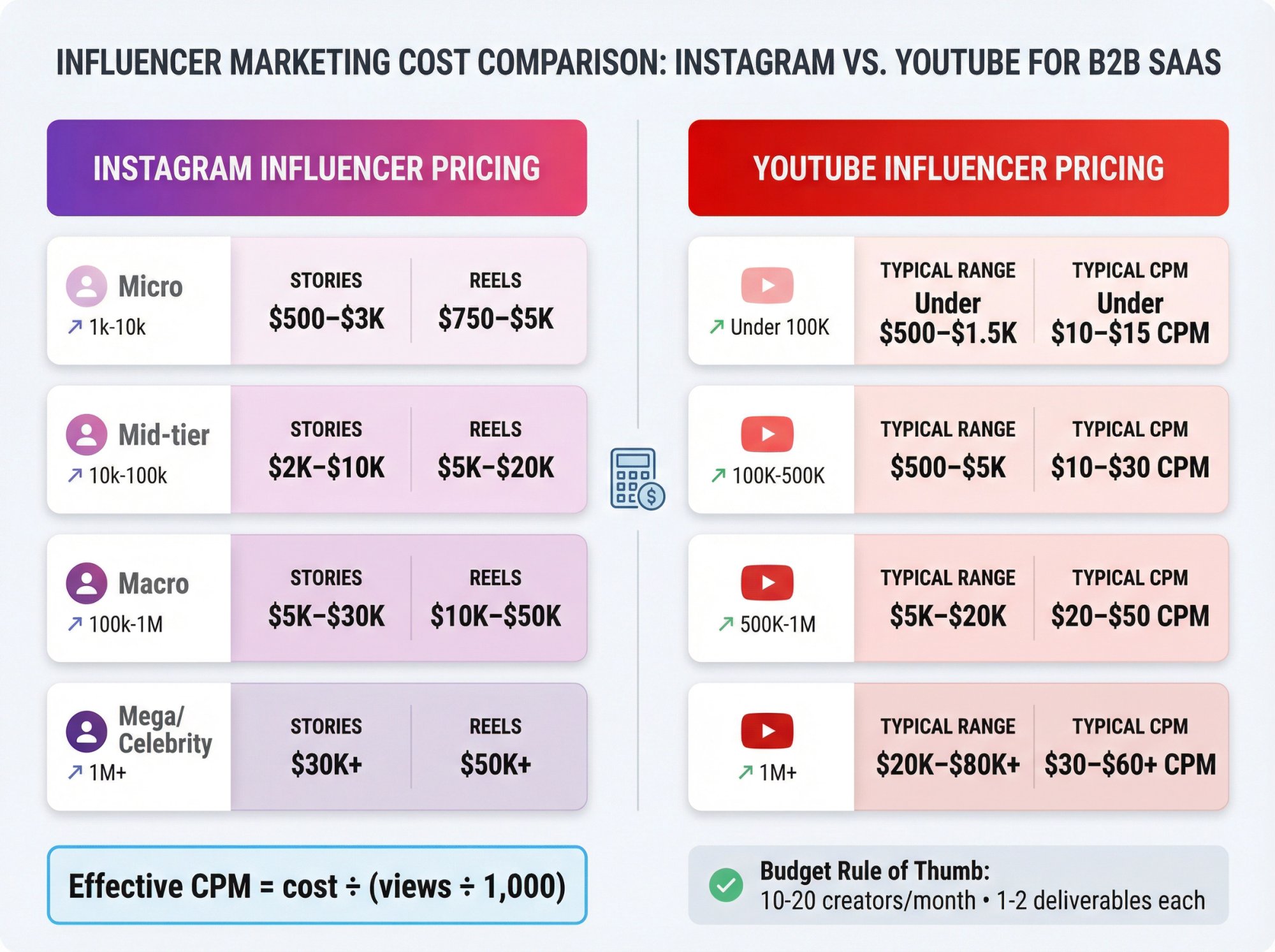
Effective CPM = cost ÷ (views ÷ 1,000)
Why this works: short-form is view-driven. Follower count is just a rough proxy.
Instagram Pricing Benchmarks (US-focused, Dec 2024)
Industry research provides ballpark ranges, with the warning that they're highly variable:
| Tier | Stories | Reels |
|---|---|---|
| Micro | $500–$3,000 | $750–$5,000 |
| Mid-tier | $2,000–$10,000 | $5,000–$20,000 |
| Macro | $5,000–$30,000 | $10,000–$50,000 |
| Mega/Celebrity | $30,000+ | $50,000+ |
YouTube Integration Pricing (July 2025)
Research shows broad ranges per integration:
| Subscriber Count | Typical Range | Typical CPM |
|---|---|---|
| Under 100k | Under $500–$1.5k | Under $10–$15 |
| 100k–500k | $500–$5k | $10–$30 |
| 500k–1M | $5k–$20k | $20–$50 |
| 1M+ | $20k–$80k+ | $30–$60+ |
Budget Rule of Thumb
For a real learning cycle, you need enough volume to see patterns. A practical minimum:
• 10–20 creators per month (mix of micro/mid)
• 1–2 deliverables each
• Track across platforms, not just one post
If your budget can't support that, focus on UGC production plus paid amplification first. You'll still get creator-led performance, just via ads.
Step 6: How to Find and Vet Influencers
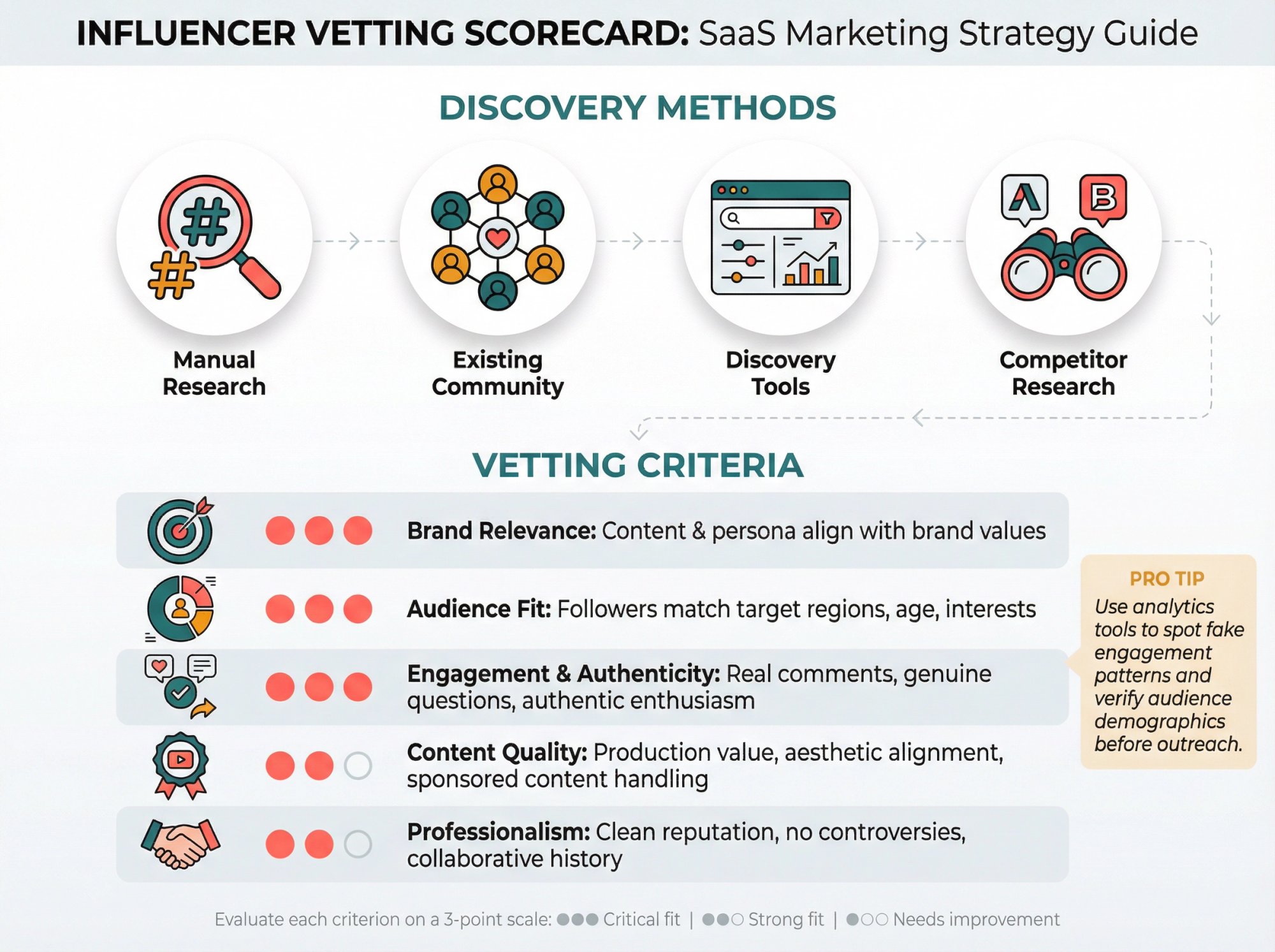
How to Find Potential Influencers
Manual research: Search platforms for keywords and hashtags related to your niche. If you sell vegan snacks, search Instagram for #vegansnack or look on TikTok's Discover for vegan food trends.
Use your existing community: Start looking for influencers who are already customers. Nothing is as authentic as someone who already knows and loves your product.
Discovery tools: Platforms like Aspire, #paid, Upfluence, TikTok Creator Marketplace, YouTube BrandConnect, and Instagram's Brand Collabs Manager let you filter creators by topic, follower count, audience demographics, and engagement rate.
Competitor research: See which influencers competitors use. If they've worked with brands similar to yours (and it's not a direct competitor), they might be open to working with you. You can use social media monitoring tools to track when competitors post and identify which creators they're working with.
Vetting Criteria
Relevance to your brand: Does this influencer's content and persona align with your brand values and target market? The best partnerships feel natural.
Audience fit: Dig into demographics if possible. Are their followers in regions you sell to? In your target age range and interests?
Engagement and authenticity: Check engagement rate (likes and comments relative to followers). More importantly, read the comments. Do people ask genuine questions and show enthusiasm? Or are comments generic and spammy? Tools that analyze TikTok account performance can help you spot fake engagement patterns.
Content quality: Review their actual content. Is it well-produced? Does it align with your aesthetic? How do they handle sponsored content?
Professionalism: Check if they have any publicly known issues. Have they been involved in controversies? Do they have a history of being difficult to work with?
Step 7: How to Create Influencer Partnership Offers
Creators aren't "ad inventory." They're entrepreneurs protecting their audience trust.
The 5 Levers That Increase Yes-Rate Without Just Paying More
① Clarity: Exact deliverables, dates, and what "done" means
② Freedom: Give angles and guardrails, not scripts (unless legally required)
③ Proof: Show examples of posts you liked from their own feed
④ Upside: Performance bonus, longer-term relationship, affiliate kicker
⑤ Respect: Fast payment, simple approvals, no endless revisions
At Shortimize, we explicitly mention automated creator payments in our pricing plans, which can be a real advantage for trust and speed.
Compensation Models
Product gifting (in-kind): You send free product. Many nano-influencers will do shoutouts in exchange for products they genuinely like.
Flat fee: You pay a set cash fee for specific deliverables. Common for mid-tier and up influencers.
Affiliate/Commission: The influencer gets a unique referral link or discount code, and you pay commission based on sales generated. Many brands combine a flat fee with a 10–20% commission to align incentives.
Long-term ambassadorship: Formalize an influencer as a brand ambassador who promotes regularly over several months for a monthly retainer.
Step 8: How to Write an Influencer Marketing Brief
A good brief prevents 80% of failures. A bad brief creates generic content, compliance issues, endless revisions, and "it didn't perform" surprises.
The 1-Page Creator Brief Template
Campaign goal (one sentence):
Primary KPI:
Secondary KPIs:

Who we're targeting:
- Persona:
- Problem they have:
- What they've tried already:

The content job:
- What should the viewer feel/do after watching?

Deliverables:
- Platform(s):
- Format(s): reel / tiktok / short
- Duration:
- Due dates:
- Posting date/time window:

Creative direction (give options, not a script):
- 3 hook ideas:
- 3 angles to choose from:
- 3 proof points:
- 1 clear call to action:

Must-include (non-negotiables):
- Key claim(s) we can substantiate:
- Brand/product name:
- Correct pronunciation:
- Disclosure requirement: #ad + platform tool

Must-avoid:
- Restricted claims:
- Competitor mention rules:
- Prohibited words/topics:

Tracking:
- Link / UTM:
- Promo code:
- Pinned comment instructions:
- Bio link instructions:

Usage rights:
- Can we repost organically? yes/no
- Can we use in paid ads? yes/no
- Duration:
- Platforms:

Approval process:
- Drafts required? yes/no
- Max revision rounds:
- Who approves:
Step 9: Influencer Marketing Compliance and FTC Requirements
FTC Requirements (US)
The FTC's disclosures guide explains that a "material connection" includes payments or free/discounted products, and disclosures are the influencer's responsibility. The FTC updated endorsement guides in June 2023, emphasizing clear disclosure and brand monitoring.
Platform Disclosure Tools
TikTok (last updated September 2025): You must turn on commercial content disclosure. Undisclosed commercial content may become ineligible for For You feed distribution if not addressed after notification.
Instagram: Branded content must use the branded content tool/paid partnership label.
YouTube: If content has paid product placement/sponsorship, you need to tell YouTube so it can help with disclosures.
UK/EU Requirements
The UK ASA guidance on recognizing ads in influencer marketing was updated Sept 26, 2025 and emphasizes clear ad disclosure. The UK government guidance for content creators (updated Sept 3, 2025) covers transparency with followers.
Put disclosure requirements in 3 places:
Contract
Brief
Final checklist before posting
Step 10: How to Track Influencer Marketing Performance
Influencer results look "great" when you only track likes. Then finance asks about revenue.
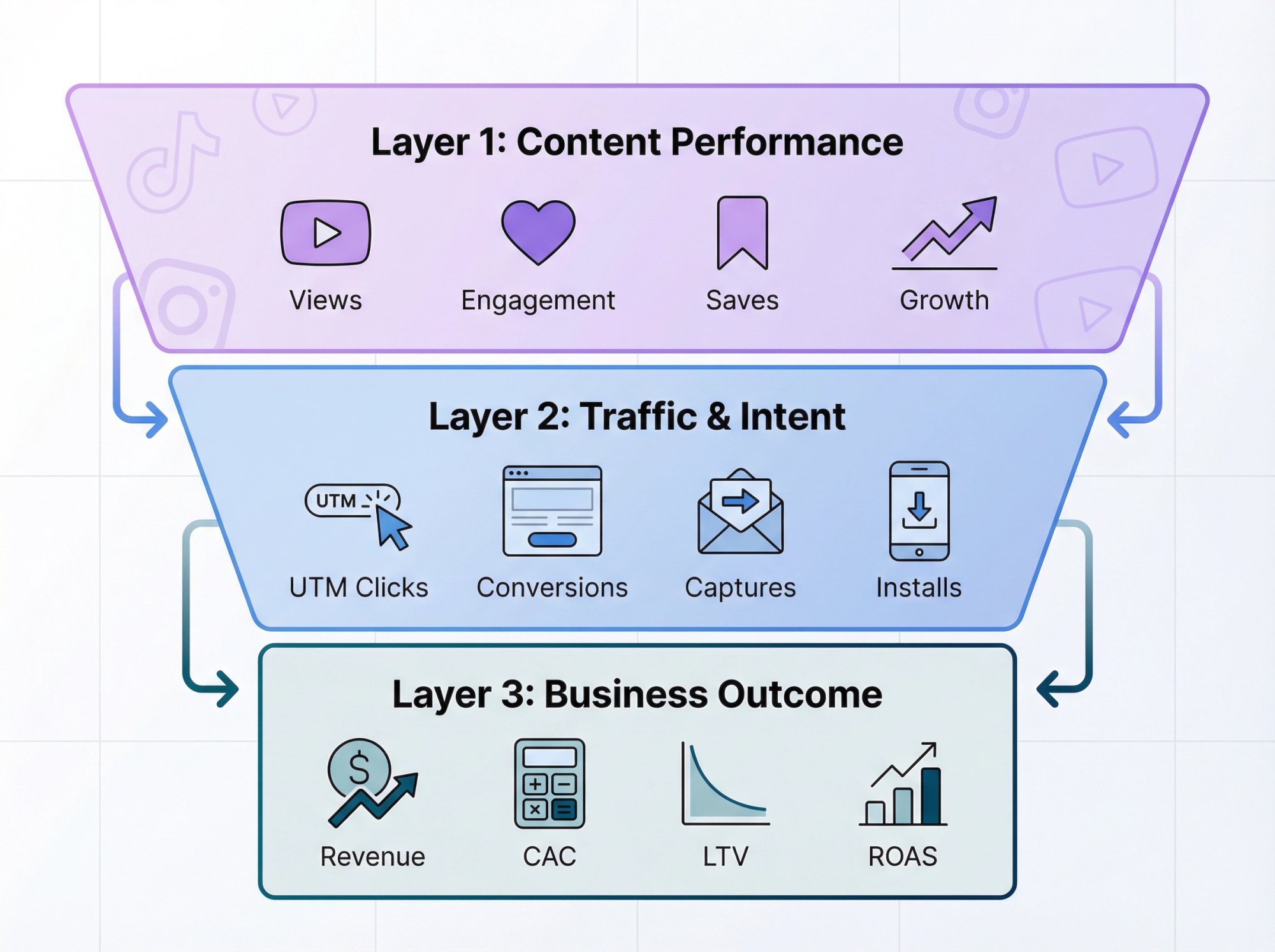
You need a measurement stack with three layers:
Layer 1: Content Performance (Platform-Native)
• Views, watch time proxies, completion rate
• Engagement rate (likes/comments/shares)
• Saves, profile visits
• Follower growth (secondary)
Use tools to analyze Instagram Reels account performance and YouTube Shorts account metrics to understand what's driving results at the platform level.
Layer 2: Traffic & Intent (What People Do After Watching)
• Link clicks (UTM)
• Landing page conversion rate
• Email capture / trial start
• App store page views / installs
Layer 3: Business Outcome (What You Actually Care About)
• Activated users
• Retained users
• Purchases / subscriptions
• CAC and payback
The Minimum Viable Tracking Setup
→ Unique UTM per creator (and per platform if possible)
→ Unique promo code per creator (especially for mobile and offline attribution)
→ A dedicated landing page variant for influencer traffic (message match)
→ "Creator" as a dimension in your analytics events
Shortimize positions itself as a way to analyze short-form performance from accounts you don't own in a structured dashboard, which is exactly what you need for creator program reporting. Our plans list integrations with tools like Mixpanel, Amplitude, and Posthog, which can help connect creator content performance to product analytics outcomes.
Step 11: How to Amplify Influencer Content with Paid Ads
Organic posts are volatile. If you want predictable outcomes, you need optionality:
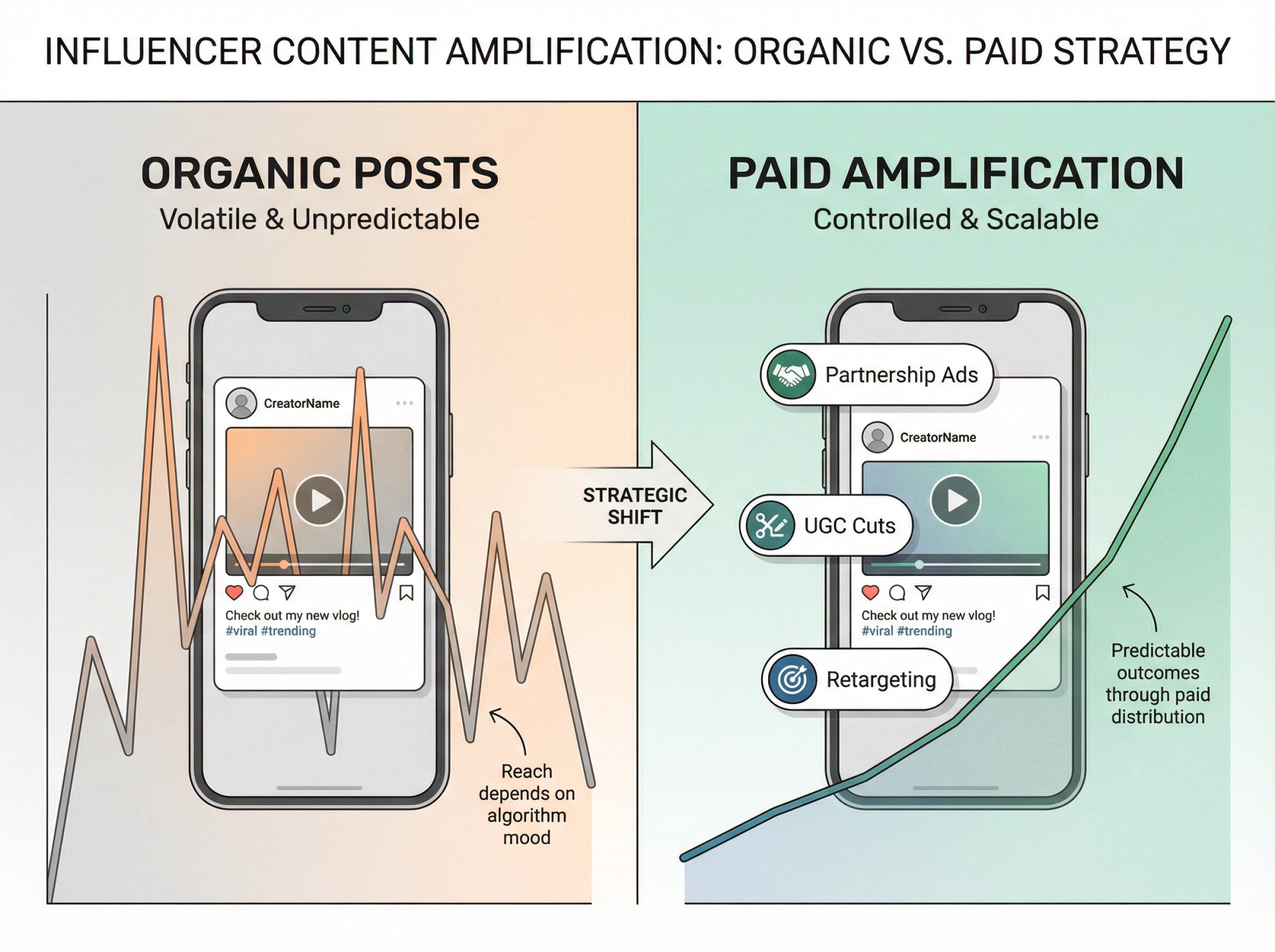
• Run the creator post as an ad (whitelisting / partnership ads)
• Run edited cuts as paid ads (UGC-style)
• Retarget viewers who engaged with creator content
This is how "creator marketing" becomes performance marketing.
Your contract must include:
→ Usage rights (where, how long)
→ Whether paid amplification is allowed
→ Whether creator handle can be used in ads (platform-specific permissions)
Step 12: How to Create an Influencer Marketing Workflow
This rhythm is how you stop doing random campaigns and start building a machine.
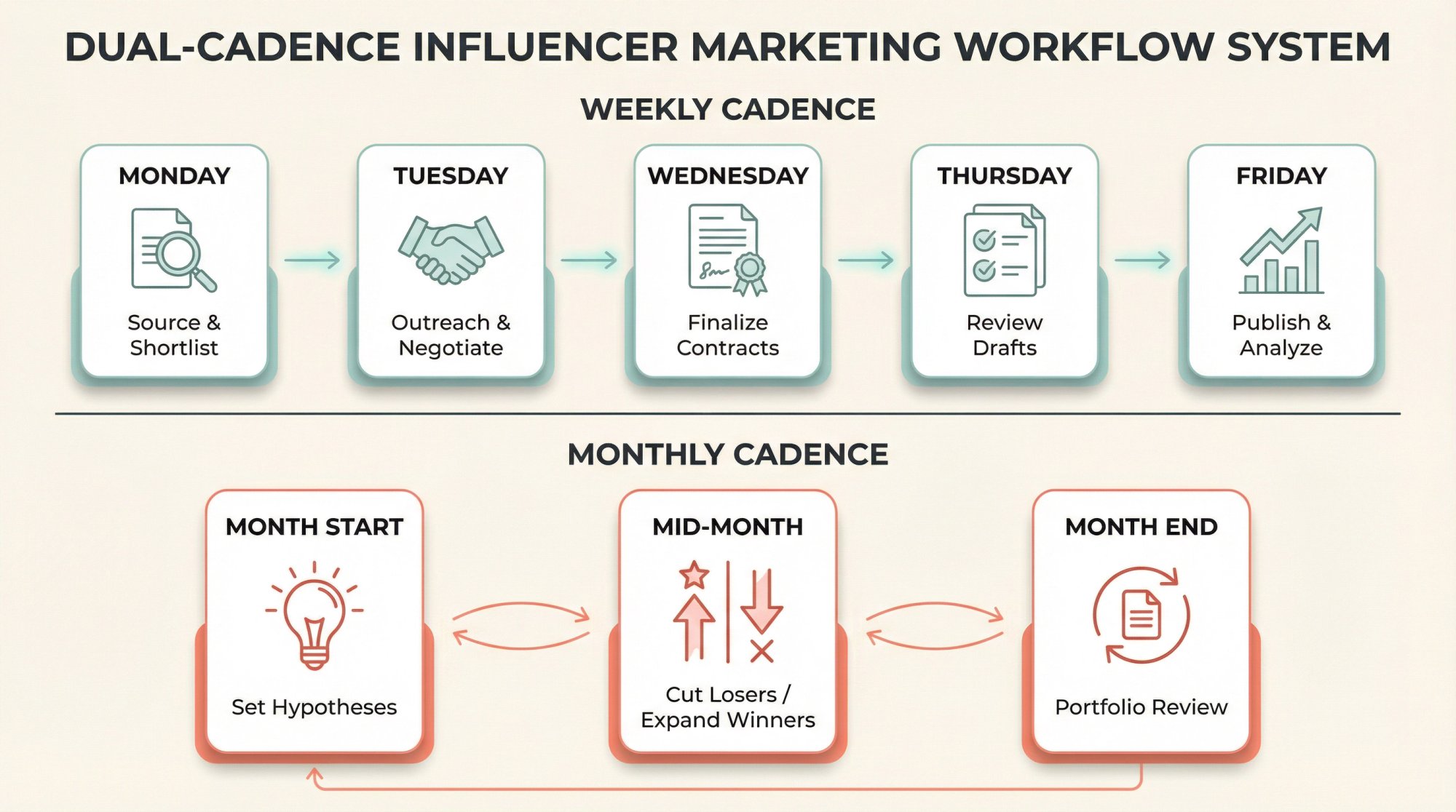
Weekly Cadence
Monday: Source and shortlist creators (new plus replacements)
Tuesday: Outreach and negotiate
Wednesday: Finalize contracts and briefs
Thursday: Review drafts (batch approvals)
Friday: Publish, log results, and pick winners/losers
Monthly Cadence
Month start: Set hypotheses (hooks/angles/offers)
Mid-month: Cut losers, expand winners
Month end: Portfolio review (who becomes repeat partner)
How to Track Influencer Campaigns with Shortimize
Shortimize is built around tracking and analyzing short-form performance across platforms, including creators and competitors you don't own.
1. Build "Collections" for Your Creator Portfolio
Create a collection per campaign, niche, or funnel stage:
• "Micro creators: productivity apps"
• "UGC creators: ad testing pool"
• "Competitor creators: watchlist"
Shortimize emphasizes tracking any account and monitoring creators and competitors across platforms.
2. Track Cross-Posting Automatically
Creators often repost the same asset across TikTok/Reels/Shorts. Use Shortimize's cross-platform view to track:
• Same creator across platforms
• The same creative pattern repeated across creators
• Which platform is producing the best "effective CPV" for your niche
Shortimize also highlights outlier detection for view spikes, which is useful for spotting breakout posts fast.
3. Set Alerts for "Breakouts" So You Can Amplify in Time
Short-form is time-sensitive. When something spikes, you want to:
• Request usage rights if you don't have them yet
• Cut variants for ads
• Launch whitelisting/partnership ads quickly
Shortimize explicitly mentions automatic notifications to Slack and Discord for when videos go viral.
4. Connect Creator Performance to Your Product Analytics
Shortimize's pricing page lists integrations (including product analytics tools) and options like API and webhooks on higher tiers.
That unlocks:
• Creator → landing page → signup → activation tracking
• Cohort analysis by creator source
• Identifying creators who drive not just installs, but retention
5. Export Reporting That Stakeholders Trust
Shortimize's core pitch is a structured dashboard and reporting layer for short-form performance. Use exports to produce a weekly "creator P&L":
• Cost, views, clicks, signups, activations, revenue
• CPV, CPA, ROAS (if applicable)
• Keep a "repeat winners" list and a "do not work with again" list
Bonus: Use our educational content internally. We have a post specifically about tracking influencer marketing across multiple platforms, and our "analyze TikTok account" page describes account-level insights and virality-style analysis, which maps well to creator vetting.
Common Influencer Marketing Mistakes to Avoid
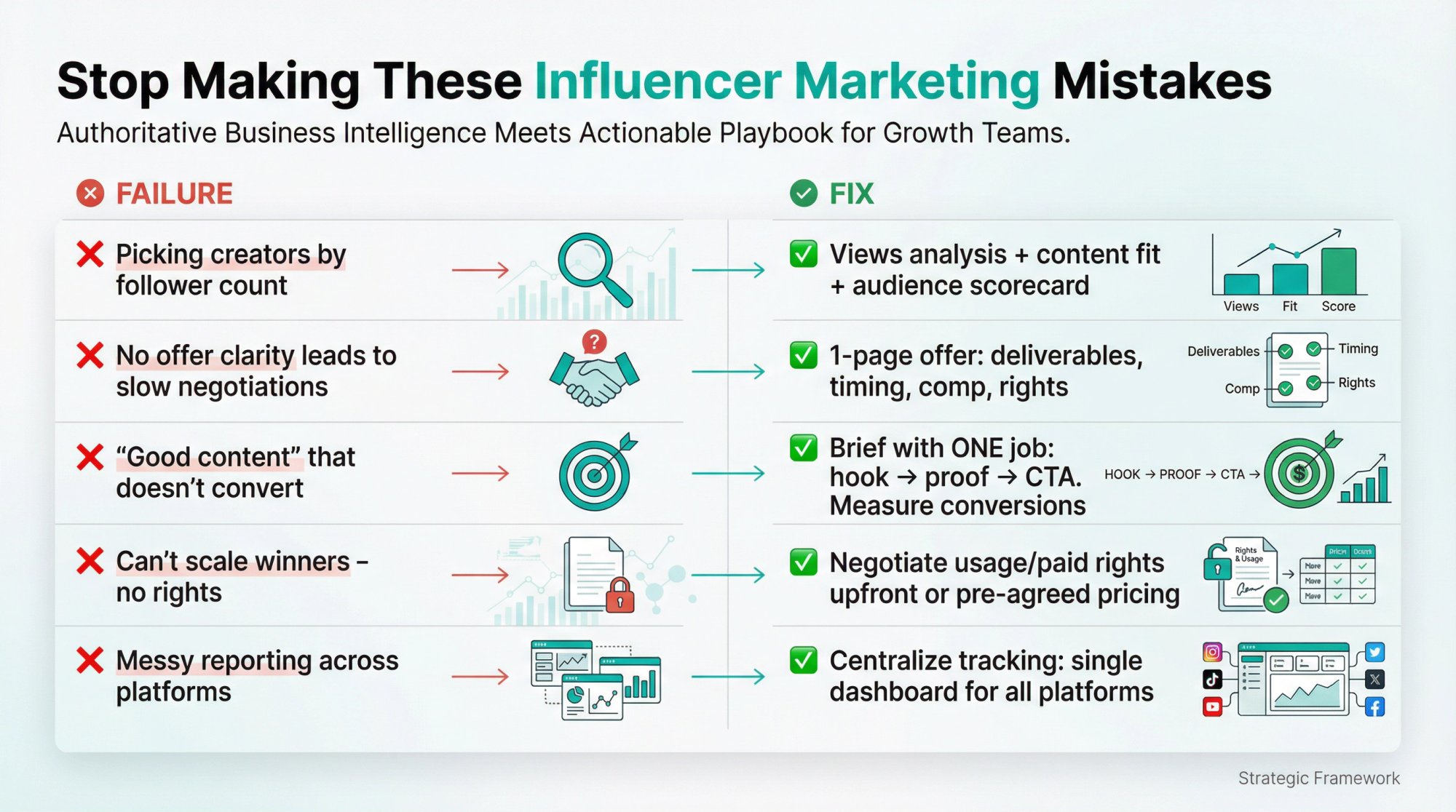
| Failure | Fix |
|---|---|
| Picking creators by follower count | Use average views analysis + content fit + audience match scorecard |
| No offer clarity leads to slow negotiations | Send a 1-page offer with deliverables, timing, comp, usage rights |
| "Good content" that doesn't convert | Brief with one job: hook → proof → one CTA. Measure clicks + conversions |
| Can't scale winners because you don't have rights | Negotiate usage/paid rights upfront (or have a pre-agreed price) |
| Messy reporting across platforms | Centralize tracking. Shortimize is designed to be a single dashboard for short-form |
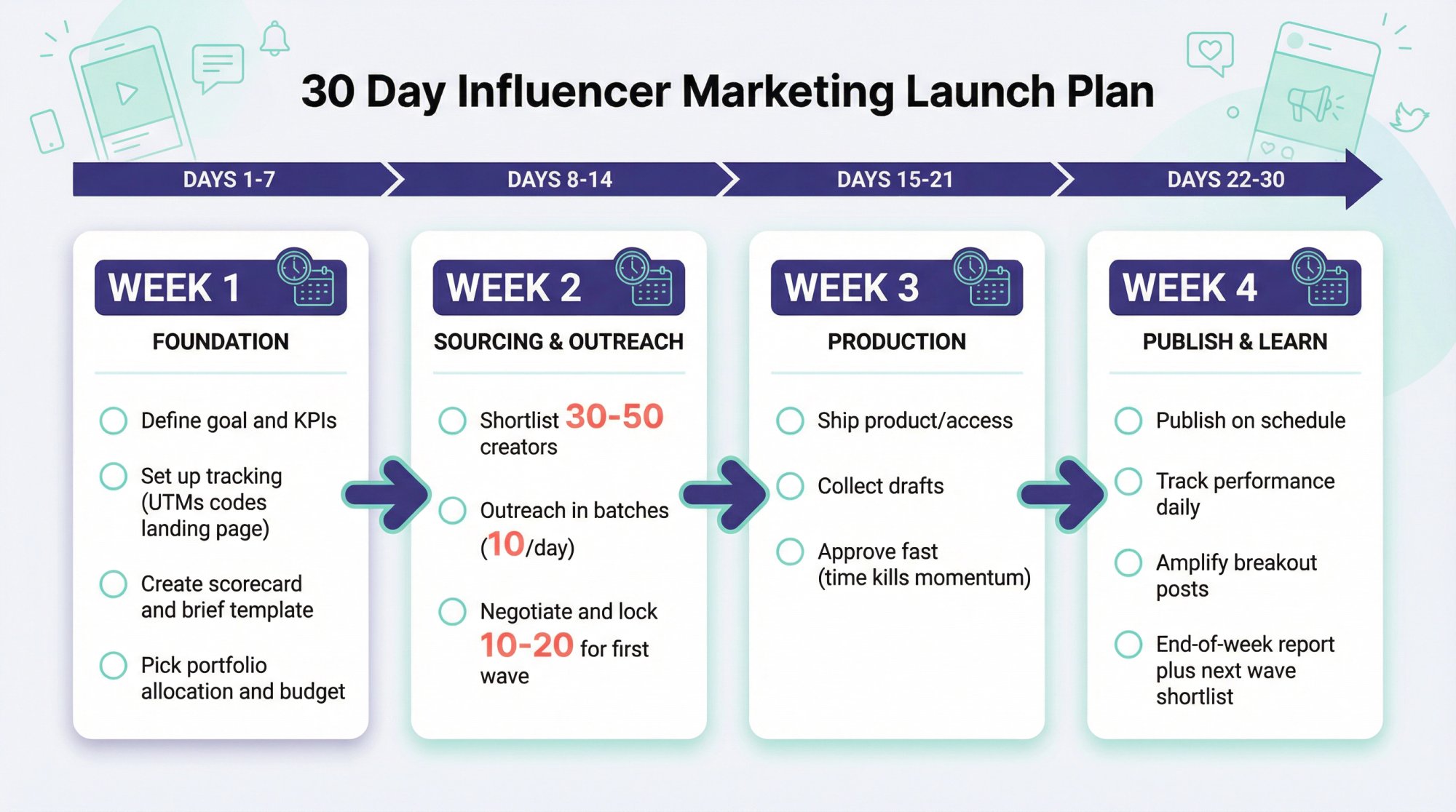
30-Day Influencer Marketing Launch Plan
Week 1: Foundation
• Define goal and KPIs
• Set up tracking (UTMs, codes, landing page)
• Create scorecard and brief template
• Pick portfolio allocation and budget
Week 2: Sourcing & Outreach
• Shortlist 30–50 creators
• Outreach in batches (10/day)
• Negotiate and lock 10–20 for first wave
Week 3: Production
• Ship product/access
• Collect drafts
• Approve fast (time kills momentum)
Week 4: Publish & Learn
• Publish on schedule
• Track performance daily using influencer tracking tools
• Amplify breakout posts
• End-of-week report plus next wave shortlist
Shortimize offers a 7-day free trial and is built for tracking accounts you don't own, which can make Week 4 (measurement) dramatically less painful.
Building a Scalable Influencer Marketing Program
Creating a social media influencer strategy is a journey that combines strategic planning, relationship building, and data-driven optimization.
The key steps:
Set clear goals and KPIs. Know exactly what you want from influencer campaigns and define how you'll measure success. This clarity guides all your decisions.
Understand your audience and platforms. Go where your customers are. Each platform has strengths. TikTok excels at viral reach, Instagram delivers consistent engagement and clicks.
Find the right influencers. Do your homework to identify creators who authentically align with your niche and have the audience you want. Use influencer analytics tools to evaluate performance data. The right partners will amplify your message far more effectively than a random big name.
Structure a win-win collaboration. Negotiate fair compensation, ensure both sides agree on deliverables and timelines. Provide guidance with a brief, but allow creative freedom to be genuine. Always insist on transparency with proper #ad disclosures.
Launch and monitor closely. Keep track of how things are going using social media monitoring to catch issues early. Support the posts with engagement from your side and be ready to adjust if needed.
Measure results and learn. Calculate ROI or cost per result, and see if you met your goals. Identify which influencers and content types worked best. Use these insights to refine your strategy for next time.
Influencer marketing is as much an art as a science. It thrives on human connection (the authentic voices of creators) but it also demands the rigor of marketing science (goals, metrics, and optimization). By using a strategy with both in mind, you set the stage for campaigns that not only reach people but also move them to action.
One of the biggest benefits of a well-run influencer strategy is the long-term impact. It's not just about a spike in sales today. It's about building brand credibility and community. When an influencer genuinely advocates for your brand, they transfer some of the trust and rapport they've built with their audience onto you. That's invaluable and compounds over time, especially if you cultivate ongoing relationships with the best creators.
By following the steps in this guide, you're not just doing one-off influencer deals. You're building a scalable influencer program. Over time, you'll amass a roster of trusted influencers, a library of high-performing content, and a trove of data on what makes your audience tick. That becomes a competitive advantage in your marketing.
In the end, the heart of an influencer strategy is relationships. Between brand and creator, creator and audience, and brand and audience. When done thoughtfully, all three win: the influencer gets great content and compensation, their audience gets value or entertainment, and your brand earns awareness, trust, and results. It's a symbiotic ecosystem.
With this strategic framework, you're well on your way to making influencer marketing one of the most powerful and rewarding parts of your growth playbook.