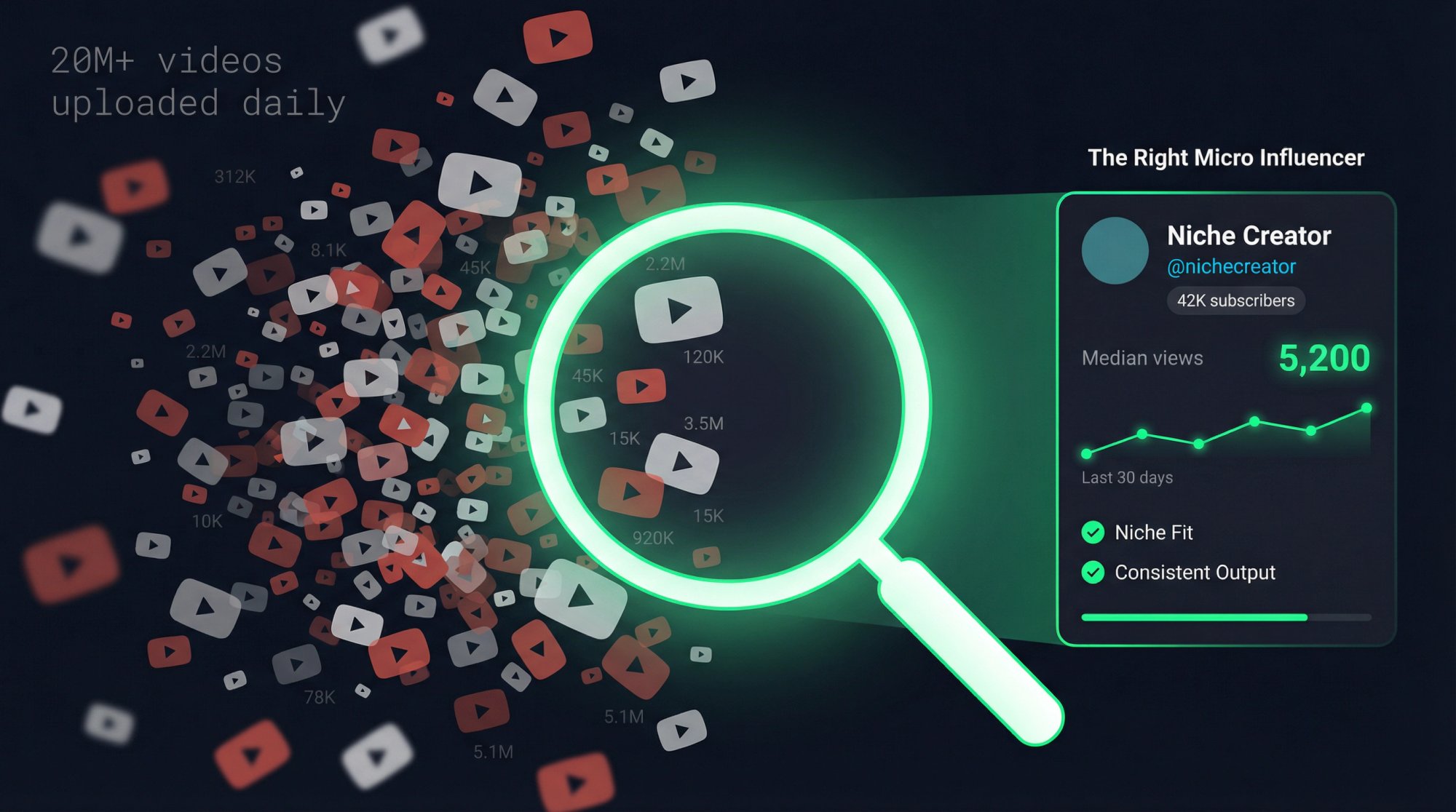
YouTube has more than 20 million videos uploaded every day and Shorts alone are pulling over 200 billion daily views. That's an absurd amount of content, and somewhere inside it are creators who could genuinely move your business. More installs, more trials, more trust, more sales. But finding the right micro influencers on YouTube in 2026 isn't a matter of scrolling through lists or plugging a category into a database. It takes a system.
We've spent years building Shortimize to help teams track and analyze short-form video across TikTok, YouTube, and Instagram. One thing we've learned: the teams who get the best results from creator partnerships aren't the ones who find the most influencers. They're the ones who find the right ones, then monitor them over time before committing budget.
This guide walks through the full process: how to define what "micro" actually means for your goals, how to use YouTube's native discovery tools (including newer ones most guides skip), how to shortlist creators based on real performance instead of vanity metrics, and how to track your shortlist so you know exactly when to reach out.
The short version? Start from audience intent, not influencer databases. Research in a clean browsing environment. Use YouTube's search filters, channel pages, Hype, and Trending Charts to find candidates. If you qualify, tap into Creator Partnerships and Insights Finder. Then score creators on median recent performance rather than subscriber count. That's how you build a pipeline that actually works.
What Counts as a YouTube Micro Influencer in 2026?
There's no official YouTube definition that says "micro starts here and ends there." In practice, most current marketing guides still use roughly 10,000 to 100,000 subscribers as the working range, though some newer 2026 pricing guidance now breaks 50,000 to 500,000 into a separate mid-tier category. So "micro" is best treated as useful shorthand, not a hard rule.
And that distinction matters because subscriber count is only a proxy. The real questions are harder and more important:
Does this creator attract the exact audience you want?
Do their recent videos consistently get watched?
Do viewers trust them enough to act on a recommendation?
Are they professional enough to work with a brand without creating problems?
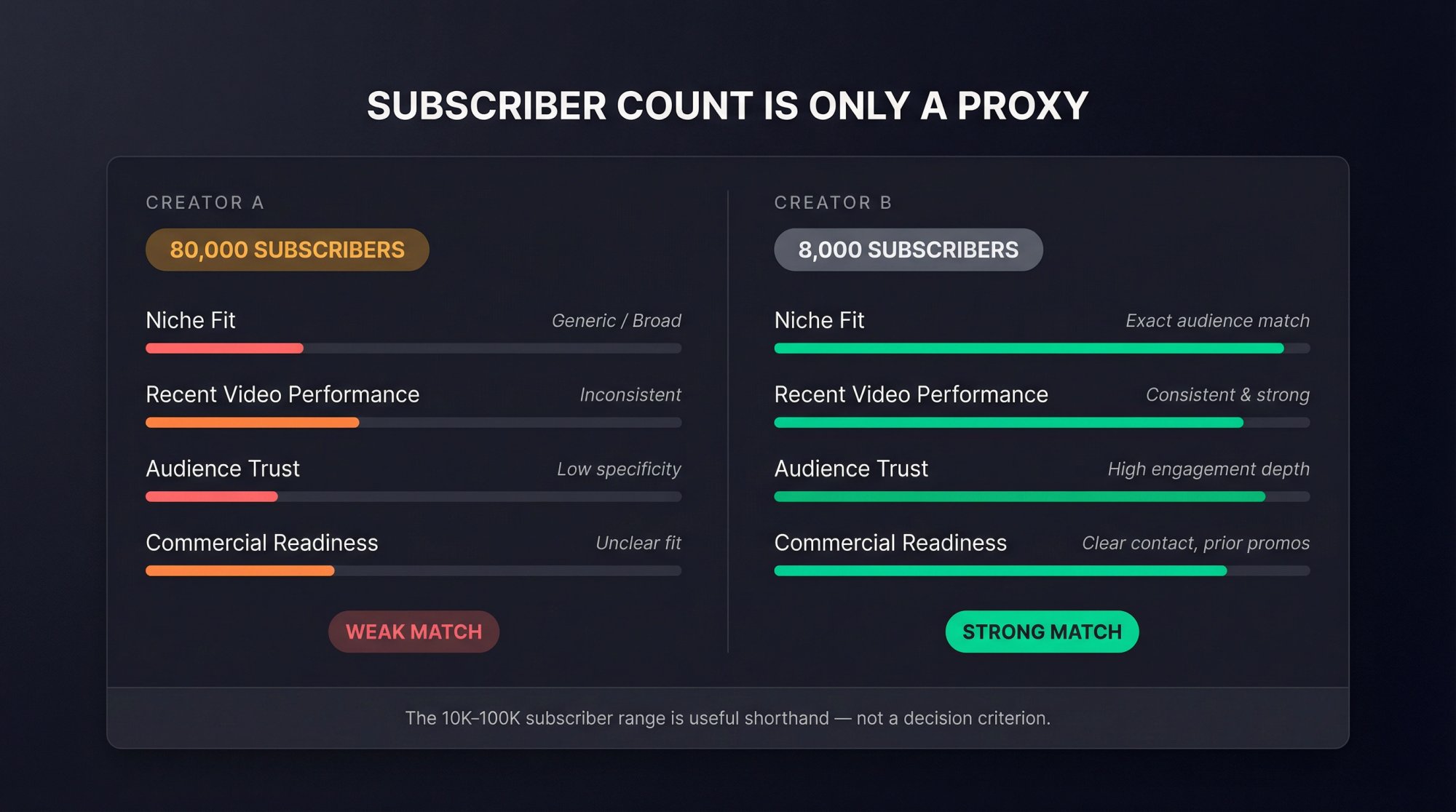
A creator with 8,000 subscribers and strong niche trust can outperform a creator with 80,000 generic subscribers. The goal of this guide isn't to help you find creators in the usual numeric band. It's to help you find the right kind of micro, the ones who actually produce results. That's exactly why we built Shortimize's influencer tracking to go beyond subscriber counts. It surfaces the performance signals that actually predict outcomes.
Are YouTube Micro Influencers Worth It in 2026?
YouTube isn't just another social feed. It's a hybrid: part search engine, part recommendation system, part subscription platform, part Shorts feed, part live video system, and increasingly a creator storefront. That hybrid nature fundamentally changes how discovery works. YouTube's own search system says results are shaped by relevance, engagement, and quality, while recommendations factor in viewer history. In plain terms, a creator can win because they're useful, because viewers stick around, and because YouTube learns that people who care about a topic genuinely enjoy their content.
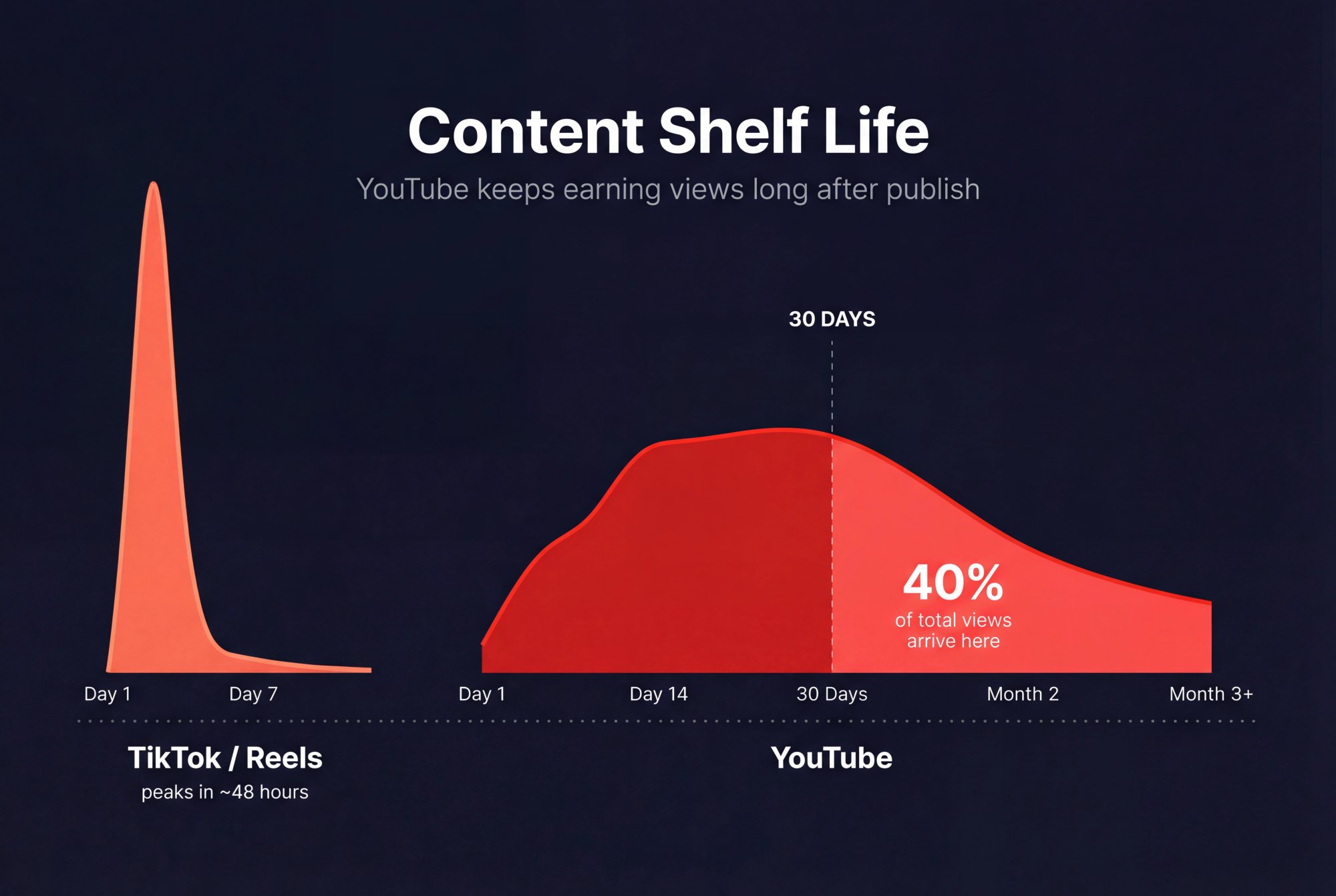
Content shelf life is the part most brands underestimate. YouTube has said that 40% of a video's views happen more than a month after it goes live. That's a massive deal for influencer selection. You're not just buying a one-day burst of distribution. In many cases, you're partnering with a creator whose video keeps generating views, search traffic, and conversions for weeks or even months. Compare that to a TikTok or Reel that peaks in 48 hours, and you start to see why YouTube creator partnerships deserve a different evaluation framework.
The format landscape has shifted, too. YouTube now allows Shorts up to three minutes long, and vertical or square videos uploaded after October 15, 2024 can be categorized as Shorts if they hit that duration threshold. So when you evaluate creators, treat long-form and Shorts as distinct formats, but don't assume Shorts still means "tiny throwaway clip." For a deeper look at how Shorts metrics differ from long-form, our guide on YouTube Shorts retention rates breaks down what strong performance actually looks like.
Watch out for this hidden comparison trap: On March 31, 2025, YouTube changed how Shorts views are counted. The newer metric counts the number of times a Short starts to play or replay, with no minimum watch time requirement. The old methodology still shows up as "Engaged views" in analytics. If you're comparing creator screenshots from different time periods, you could be looking at numbers measured under completely different rules. Two creators might show "views" that mean very different things.
This is exactly why we built Shortimize to normalize performance data across platforms and time periods. When you're tracking creators in our system, you're comparing apples to apples, not screenshots from two different measurement eras. Our analyze YouTube Shorts account feature gives you a consistent, normalized view of any creator's Shorts output.
The Biggest Mistake Brands Make When Searching for Influencers
Most brands think the job is "find influencers." It isn't.
The real job breaks down into three parts:
Find creators who sit inside the exact audience problem you care about.
Eliminate false positives.
Keep a living shortlist you can activate when timing is right.
That sounds obvious, but most teams skip straight to browsing creator lists. That leads to weak matches, vanity metrics, and creators who look great on paper but don't actually move buyers. Our guide on how to tell if an influencer has fake engagement walks through exactly how to spot these false positives before they cost you budget.
There's another problem almost nobody talks about. Your YouTube research is probably contaminated by your own behavior. YouTube's help documentation confirms that search results and recommendations are influenced by watch history, search history, and broader Google Account activity. Channel home pages even include a personalized "For you" section based on your viewing habits. So if you're doing creator research while signed into your everyday account, you're not seeing a neutral picture of the market. You're seeing your version of YouTube.
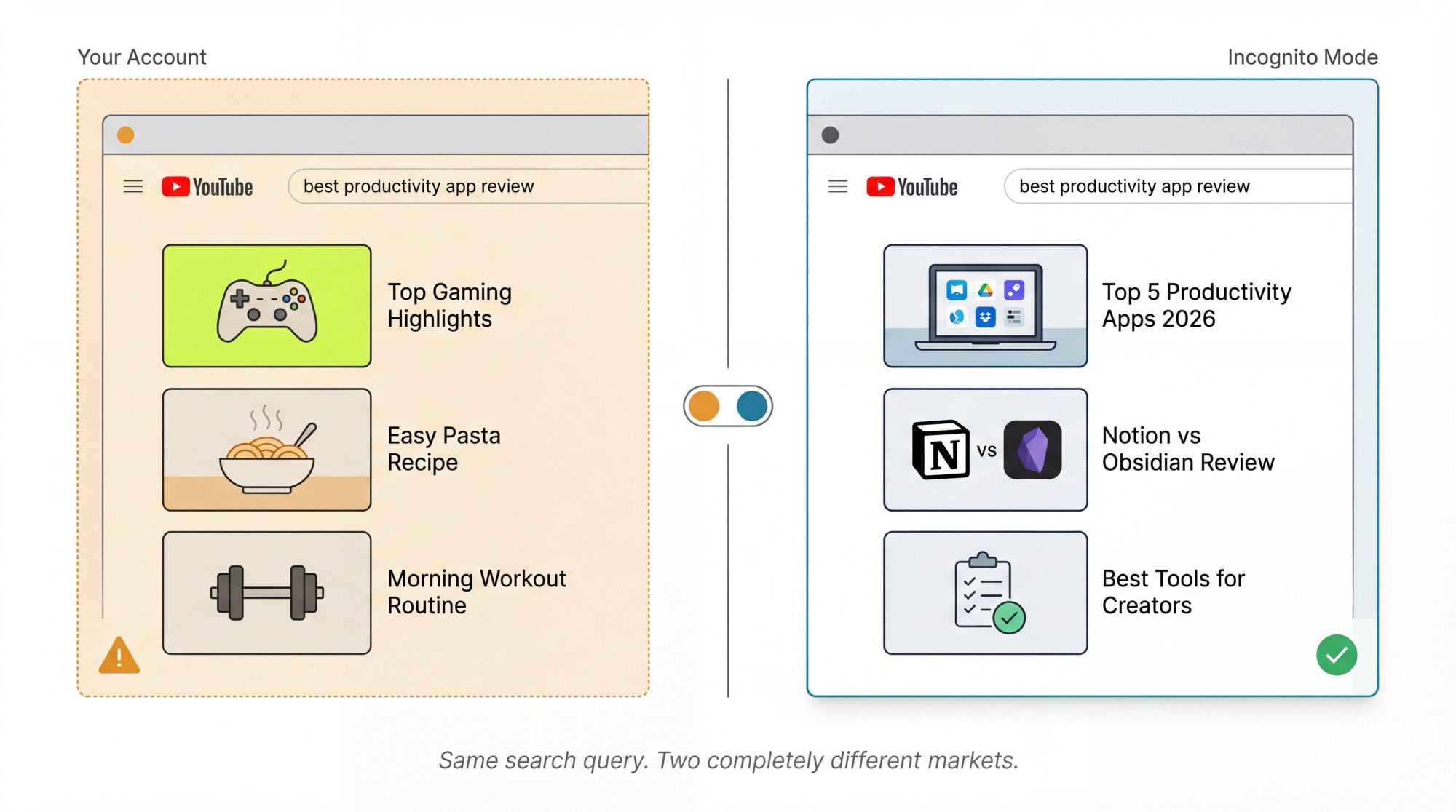
The fix is simple and worth doing every single time. Research in Incognito mode or with paused watch and search history. YouTube explicitly says turning off history is useful when you're researching a topic you're not personally interested in, and searches in Incognito mode aren't saved. That one habit alone will improve your creator discovery quality.
Finding YouTube Micro Influencers: A Proven 4-Step Process
Step 1: Research Your Audience Before Searching for Influencers
Don't begin by asking, "Which creators are popular in my category?"
Start by asking, "What does my buyer search, watch, compare, and worry about?"
This is the first-principles approach, because YouTube's search system ranks videos by relevance, engagement, and quality. It looks at how well titles, descriptions, tags, and actual video content match a search query, and it factors in how viewers engage with results for that query. The creators you want are often already winning the searches your buyers use when they're trying to solve a problem, compare products, or learn a skill.
A better way to build your keyword list is to write down the actual jobs your buyer is trying to get done. Then turn those into searches. For example:
"best [category] for [use case]"
"[competitor] review"
"[competitor A] vs [competitor B]"
"how to [job to be done]"
"[problem] explained"
"[industry] mistakes"
"[product] tutorial"
"[topic] for beginners"
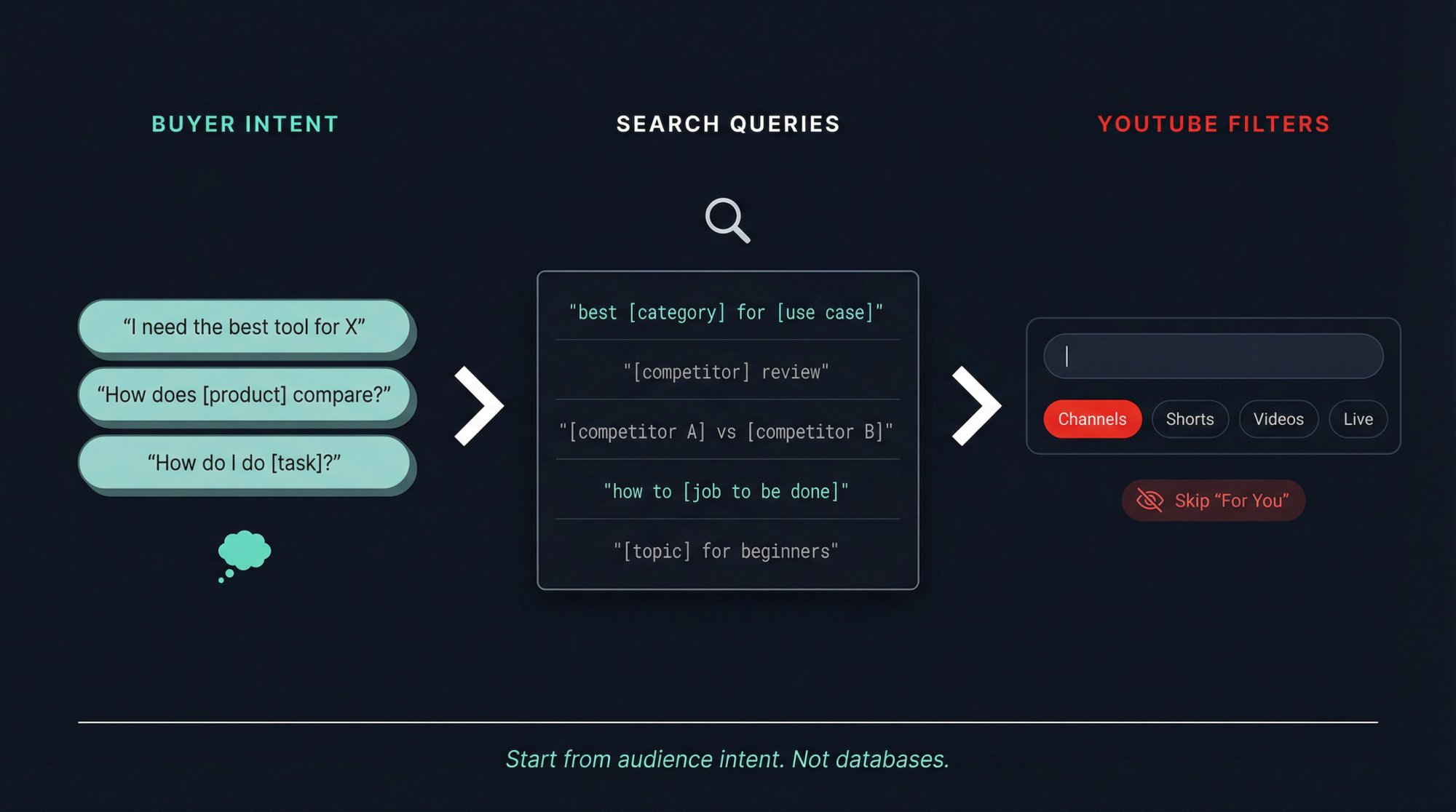
This feels simple because it is simple. But it forces you to find creators embedded in real decision-making, not just creators with pretty vanity numbers. Once you have your creator candidates, using a dedicated influencer analytics tool helps you move from guesswork to evidence-based shortlisting.
Step 2: How to Use YouTube Search to Find Micro Influencers
YouTube gives you more discovery power than most people realize. After you search, you can filter by result type, including video, short, playlist, and channel. You can also search directly for channels by category, keyword, creator name, or handle (those unique @ identifiers). And hashtags are searchable too, either from the search bar or by clicking a hashtag in a title or description.
Here's a practical workflow that covers your bases:
First, search a problem keyword and filter to Channels. This surfaces creators whose entire brand revolves around the topic.
Then, run the same keyword and filter to Shorts. This finds faster, punchier creators who may be strong at awareness-level or hook-based content.
Next, search exact competitor names, product names, and comparison phrases. Creators who consistently make reviews, tutorials, "vs" videos, or reaction content inside your niche are often better commercial partners than generic lifestyle creators. Our YouTube competitive analysis guide explains how to map these creator-competitive overlaps systematically.
Finally, search the same topic using hashtags and handles. Hashtag results help identify clusters of creators around a niche or trend, while handle search becomes useful once you start spotting creator networks.
When you land on a creator's channel page, skip the "For you" area entirely. That section is personalized to your viewing history and will mislead you. Go straight to the Videos, Shorts, and Live tabs to see actual publishing behavior and format mix.
Step 3: Find Rising Creators with YouTube Hype and Trending Charts
Most blog posts about finding YouTube influencers stop at "use search." In 2026, that's incomplete. Two public surfaces deserve your attention.
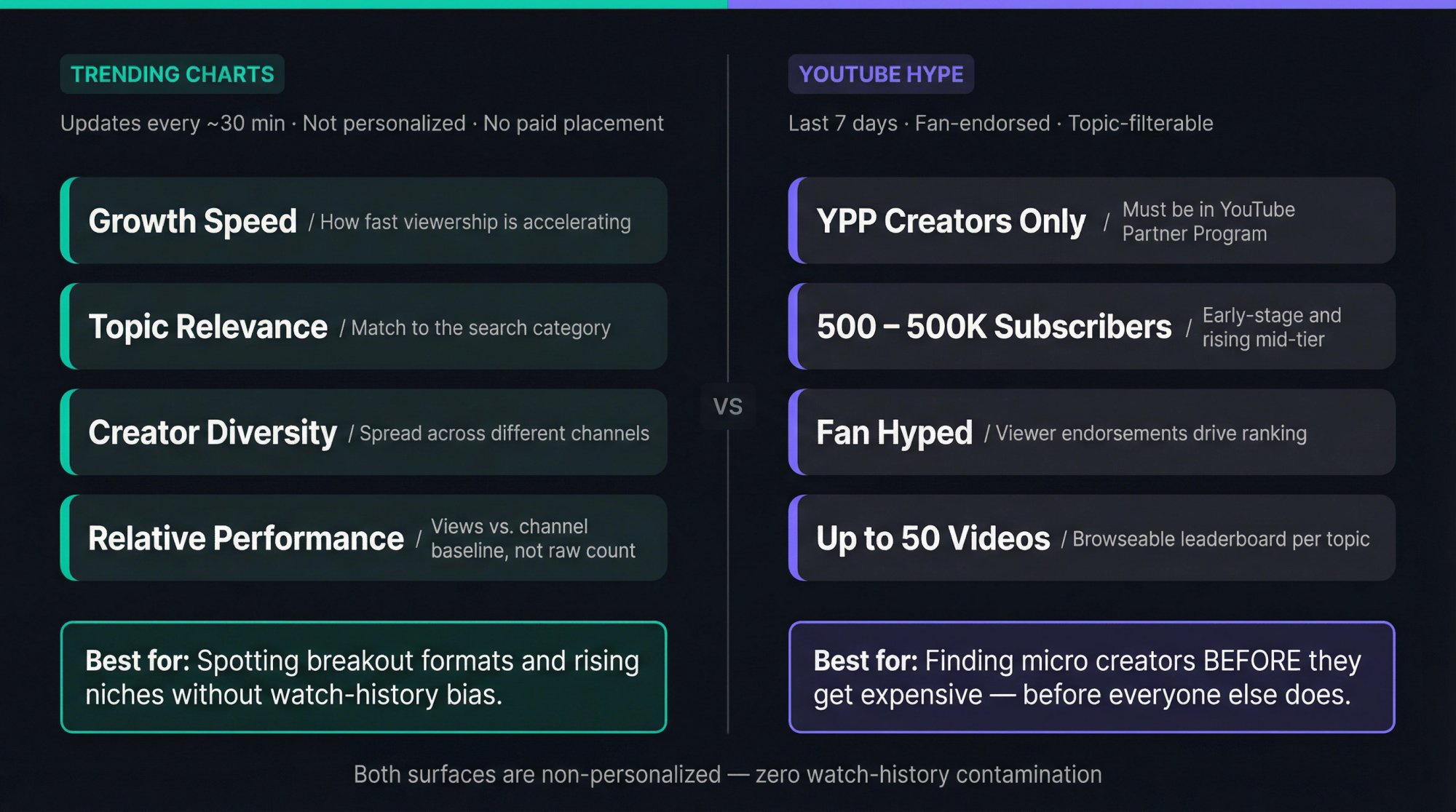
Trending Charts
YouTube's Trending Charts are not personalized. They update roughly every 30 minutes and use a mix of signals: growth speed, topic relevance, diversity of creators, and performance relative to the channel (not just raw views). YouTube also says it does not accept payment for chart placement. This makes Charts useful for spotting breakout creators and formats in a niche without your own history bias getting in the way. Looking for patterns across trending creators? Our guide to finding viral video patterns in your niche helps you decode what's actually driving momentum.
Hype
This might be the most overlooked discovery tool in 2026. YouTube's Hype leaderboard shows videos from up-and-coming YouTube Partner Program creators with 500 to 500,000 subscribers, uploaded within the last 7 days, and endorsed by fans. It's not personalized, it's topic-filterable, and viewers can discover up to 50 top hyped videos. This is exactly the surface you use when you want rising micro creators before they get expensive. Just note that Hype is only available in certain countries, so check whether your research market is covered.
If your category overlaps with creator-first product discovery, also pay attention to how creators show up in public paid-promotion examples. Not because "sponsored" is bad, but because prior brand work tells you whether a creator can integrate products naturally and whether they're already comfortable with brand workflows. YouTube supports paid promotion disclosures inside videos, Shorts, descriptions, and other surfaces, which makes this easier to audit than it used to be.
Step 4: YouTube Creator Partnerships and Insights Finder (If You Qualify)
The biggest platform shift since older influencer-finding guides were written is YouTube Creator Partnerships.
YouTube's 2026 NewFront material says Creator Partnerships is the new centralized system for brand and creator collaborations, replacing the older BrandConnect framing and integrating directly into YouTube Studio for creators and Google Ads for advertisers. YouTube says advertisers can access more than 3 million creators in the YouTube Partner Program through it.
Inside the Creator Search tab, Google Ads documentation says advertisers can search with one to three keywords or an @handle and apply filters like audience demographics, subscriber count, creator location, and engagement. For creators who opt in, profiles can include richer non-public data. That's a completely different level of discovery from guessing based on public view counts alone.
There's a significant catch, though. Creator Search is only available in select markets and requires an assigned Google sales team plus more than $1,000 USD in Demand Gen or YouTube spend in the previous year. The Management tab adds more requirements, including advertiser verification. So this is real infrastructure, but it's not universally open.
If you do have access, the upside is substantial. Google's Analytics tab for Creator Partnerships provides a unified view of organic and paid performance for linked creator videos. That includes views, watch time, likes, comments, shares, and engagement rate, with segmentation by time, device, and organic versus paid traffic. It makes it much easier to separate creators who are merely entertaining from creators who are commercially useful.
| Feature | What It Does | Access Requirements |
|---|---|---|
| Creator Search | Keyword and handle-based creator discovery with demographic filters | $1K+ YouTube/Demand Gen spend, assigned Google sales team |
| Analytics Tab | Unified organic + paid performance view for linked creators | Same as Creator Search |
| Open Call | Brands publish briefs, creators submit proposals | Select advertisers; limited U.S. creator pilot |
| Insights Finder | Surfaces trending creators by topic/audience in 20+ markets | Google Ads access in supported markets |
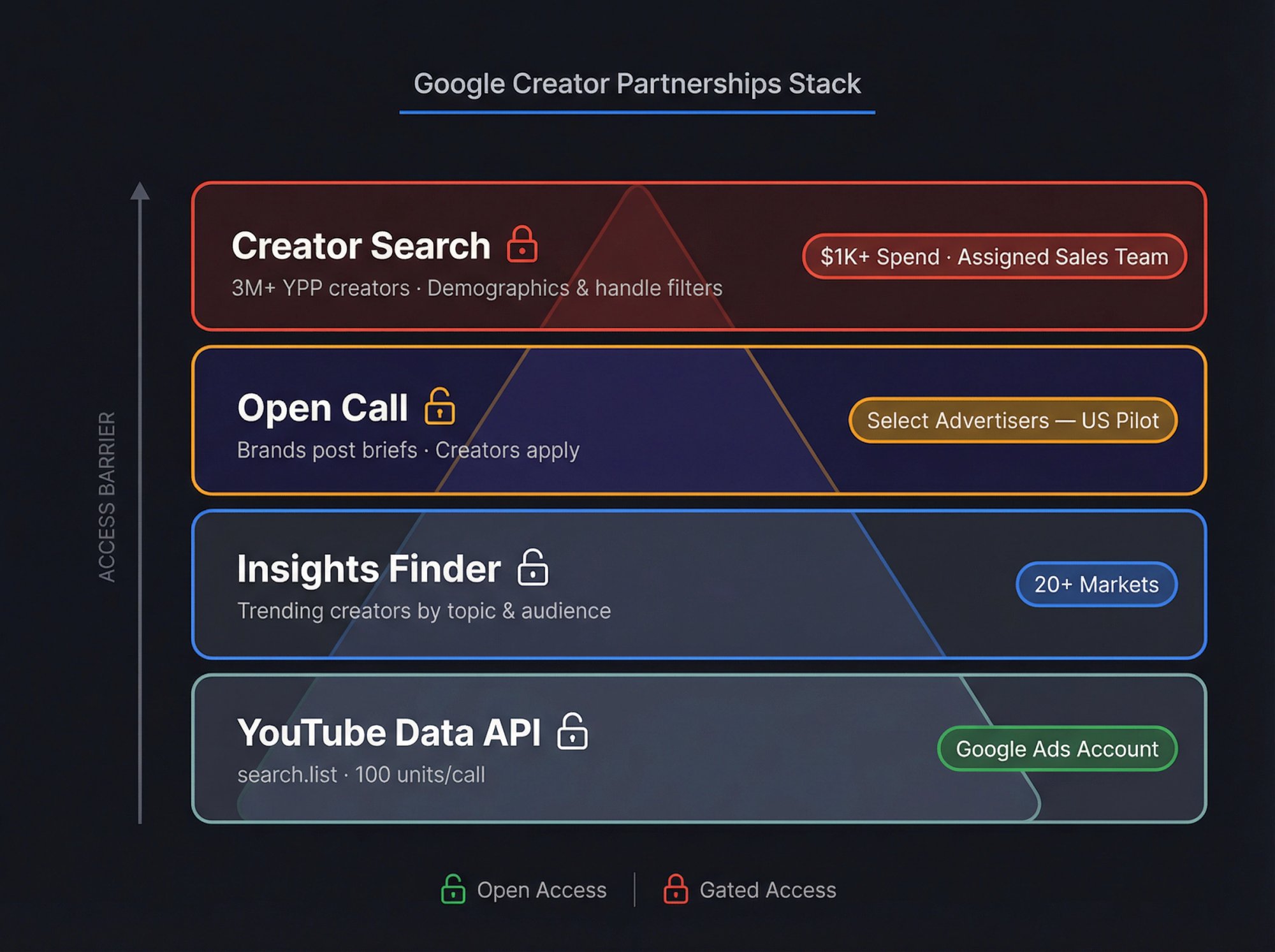
For teams who don't qualify for Creator Partnerships yet, don't worry. Everything in Steps 1 through 3 still works extremely well for manual discovery. The official stack just accelerates what you'd already be doing. If you're managing this across TikTok and Instagram at the same time, Shortimize's influencer tracking gives you a single dashboard so nothing falls through the cracks.
Advanced: How to Build a Creator Discovery Tool with the YouTube API
If you're building internal discovery tooling, Google's ecosystem has more moving parts than many teams realize.
The public YouTube Data API is still useful, but search.list costs 100 units per call. Google's own docs note that if you already know which channel you want, lower-cost patterns (like fetching channel details and then pulling the upload playlist) are far more efficient. Brute-forcing YouTube search via API gets expensive fast. Shortimize also exposes a social media analytics API for teams that want to pull normalized performance data programmatically rather than building their own ingestion layer from scratch.
Google also has a YouTube creator insights capability in the Google Ads API, but the developer docs say it's currently in beta and available only to developers on an allowlist. The documentation describes discoverability, brand insights, creator insights, and trending insights, but this isn't something most brands can turn on instantly.
How to Score and Shortlist YouTube Micro Influencers
Once you've found a pool of candidates, the question changes. You're no longer asking, "Who exists?" You're asking, "Who deserves budget?"
The cleanest way to answer that is to score each creator on six dimensions:
→ Niche fit: Do they speak to the exact buyer, problem, or category?
→ Format fit: Are they strong in Shorts, long-form, or both?
→ Median recent performance: What does a typical recent upload do, not the best one?
→ Consistency: How often do recent uploads clear your minimum threshold?
→ Commercial readiness: Do they have clear contact paths and signs they can work with brands?
→ Compliance: Do they disclose paid work properly and behave like a reliable business partner?
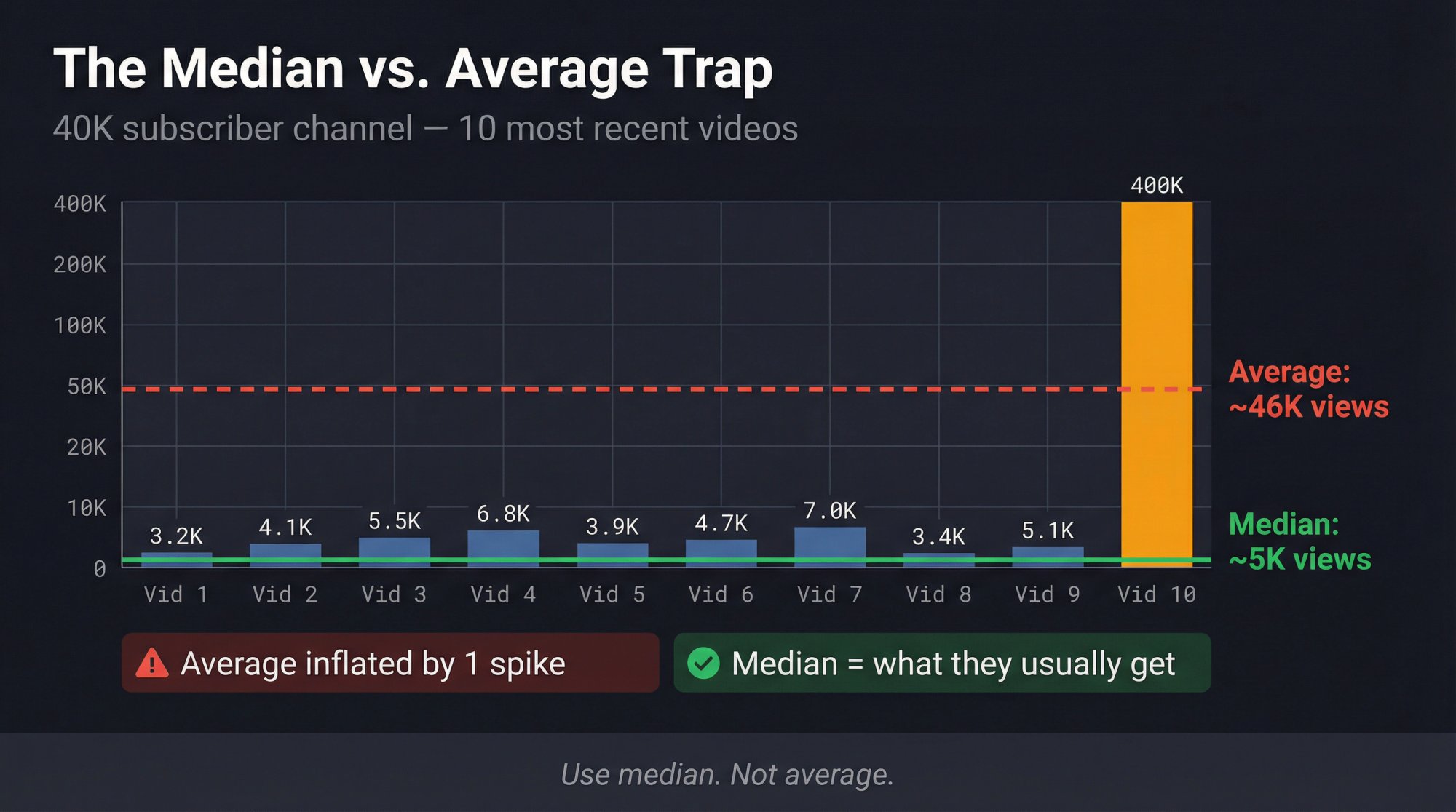
The biggest mindset shift here is median, not average.
Average views are easy to distort with one or two viral hits. Median recent views tell you what a creator usually does. That's the number you can plan against.
The median vs. average trap in practice: A creator has 40,000 subscribers. Nine of their last ten videos got between 3,000 and 7,000 views, while one hit 400,000. The average: ~46,000 views per video. The median: around 5,000. The correct conclusion isn't "this creator gets 46,000 views per video." It's "this creator usually gets low thousands and occasionally spikes." Those are completely different investment cases.
For a full framework on profiling creators before you reach out, our guide to auditing an influencer profile covers every metric that matters.
Also, never blend Shorts and long-form into one performance number. Shorts and long-form serve different purposes, reach viewers differently, and behave differently in terms of engagement patterns, even though they're now closer in maximum duration. If you're considering a creator for a Shorts brief, evaluate their recent Shorts medians. If you want a dedicated review or tutorial, use their recent long-form medians. Mixing the two will make your forecasting worse, not better. Our analysis guide for YouTube Shorts accounts shows how to benchmark Shorts performance cleanly so you're always working with format-accurate data.
This is where a tool like Shortimize becomes genuinely useful. Instead of manually pulling metrics from each creator's channel and trying to calculate medians in a spreadsheet, you can track creators inside Shortimize, organize them into Collections, and let the platform surface performance patterns over time. It's the difference between a snapshot and a continuous read. Teams that need to manage influencer campaigns at scale find this especially valuable. You can monitor dozens of creators simultaneously without losing the depth of your evaluation.
Finally, inspect comments like a detective, not a fan. You're looking for specific trust signals:
Are viewers asking buying questions?
Are they mentioning the exact problem your product solves?
Are comments specific and detailed, or just generic praise?
Does the creator reply thoughtfully?
Do you see phrases like "I bought this because of you" or "your tutorial helped me choose"?
That comment layer often reveals more commercial value than subscriber count ever will. Our social media engagement tracking guide digs deeper into how to read engagement signals that actually predict commercial impact.
How to Contact YouTube Micro Influencers
For manual outreach, the most direct route is usually the Business Inquiry Email on the creator's channel. YouTube says you can find it in the channel's About section if the creator has provided one. If you have access to Creator Partnerships, Google's Management tab can also help track inquiries and surface creator contact paths.
Your first message needs to do four things:
Prove you actually know their work.
Explain why their audience is a fit.
Say exactly what kind of collaboration you want.
Make it easy for them to respond.
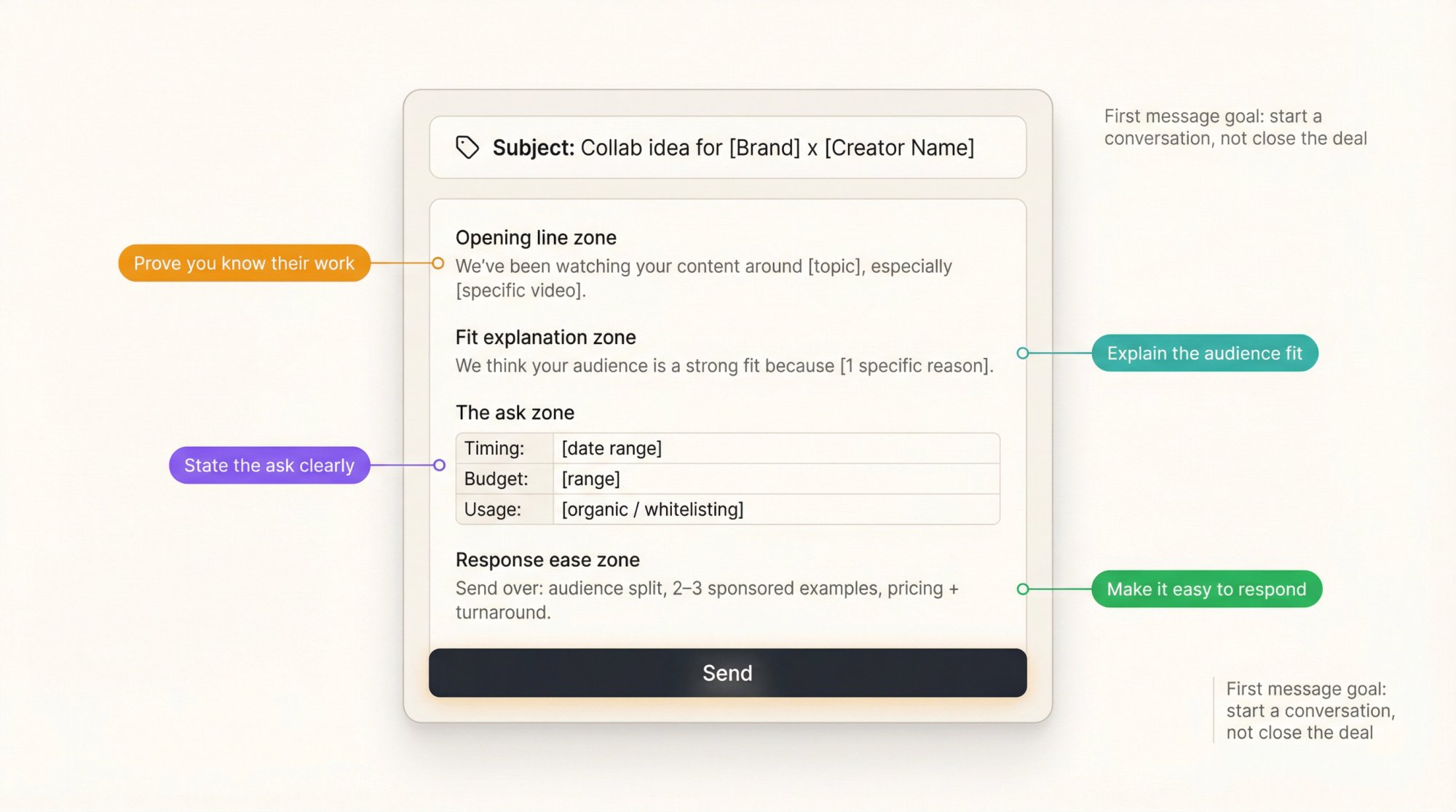
Here's a template that works better than the typical rambling brand email:
Subject: Collab idea for [Brand] x [Creator Name]

Hi [Name],

I'm with [Brand]. We've been watching your content around [topic],
especially [specific video or Short].

We think your audience is a strong fit because [1 specific reason].

We're exploring a partnership around [1 Short / 1 dedicated video /
1 integration / UGC-style asset].
Timing: [date range]
Budget: [range or "paid partnership"]
Usage needs: [organic only / whitelisting / paid usage / creator
partnerships boost]

If you're interested, send over:

- your audience split if available

- 2 to 3 recent sponsored examples

- your usual pricing and turnaround

Thanks,
[Name]
That template is short on purpose. The goal of the first message isn't to close the deal. It's to start a serious conversation. Once a partnership is signed, our guide to optimizing influencer campaigns walks through how to squeeze the most value out of each creator relationship.
YouTube Influencer Marketing Mistakes to Avoid in 2026
Even teams that follow a solid discovery process tend to trip over a few recurring problems.
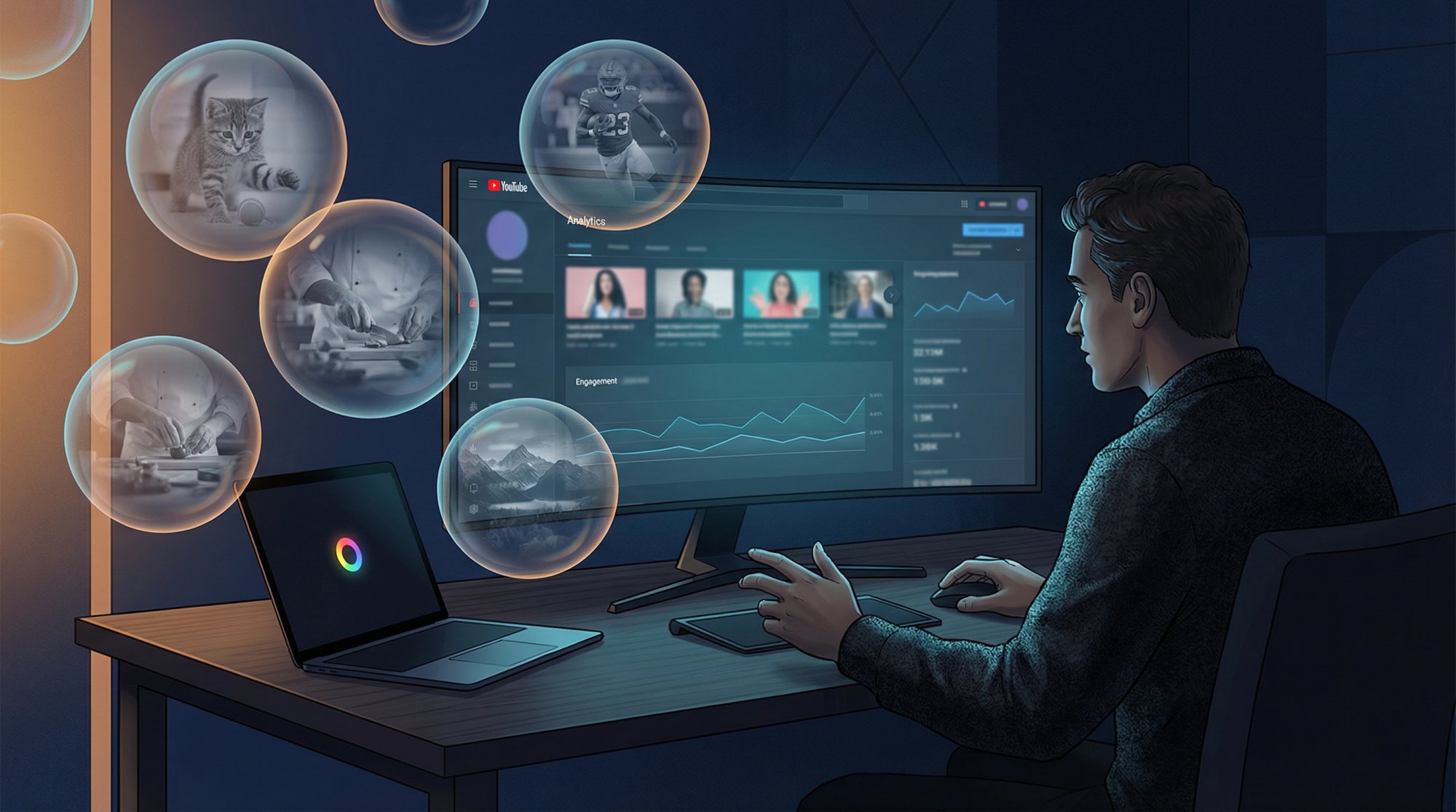
They research while signed into their personal account. YouTube confirms that search results and recommendations are influenced by your watch history and Google Account activity. If you don't research in Incognito or with paused history, you're working with biased data from minute one.
They optimize for subscribers. Subscriber count is the laziest filter available. It tells you nothing about what a creator's recent videos actually do, whether their audience trusts them, or whether they can integrate a product naturally. Use Shortimize to look at actual performance data instead.
They judge creators from one breakout hit. One viral spike can hide weak baseline performance. Always look at the median of recent uploads, not the peak.
They mix Shorts and long-form performance together. This hides real format strengths and makes any projection unreliable. Evaluate them separately, every time.
They forget about disclosure and usage rights. YouTube requires paid promotion disclosure, and FTC guidance still makes clear that disclosure isn't optional just because audiences "probably know" creators get paid. Skipping this creates legal risk and damages credibility.
The long-tail reality: If 40% of a video's views can happen after the first month, then creator evaluation should be ongoing, not frozen on the day you first found them.
They treat discovery as a one-time project. On YouTube, that's a strategic mistake. Creator value changes over time, and content keeps earning after it's published. Our post on post-campaign optimization shows how to turn performance data into decisions for your next round of creator investment.
They don't track competitors' creator partnerships. Knowing which creators are working with your competitors, and what those results look like, is one of the most underused edges in influencer strategy. Our guide on how to spy on your competitors' influencer strategy covers exactly how to do this without guesswork.
How to Track YouTube Micro Influencers Over Time
This is the part most "how to find influencers" articles skip entirely: discovery is only half the work. Once you've identified 25, 50, or 100 promising creators, the real pain becomes monitoring them over time. Are they still posting consistently? Is their performance holding steady or declining? Are they working with competitors? Did their audience shift?
Checking all of this manually, across multiple creators and multiple platforms, isn't sustainable. That's why we built Shortimize.
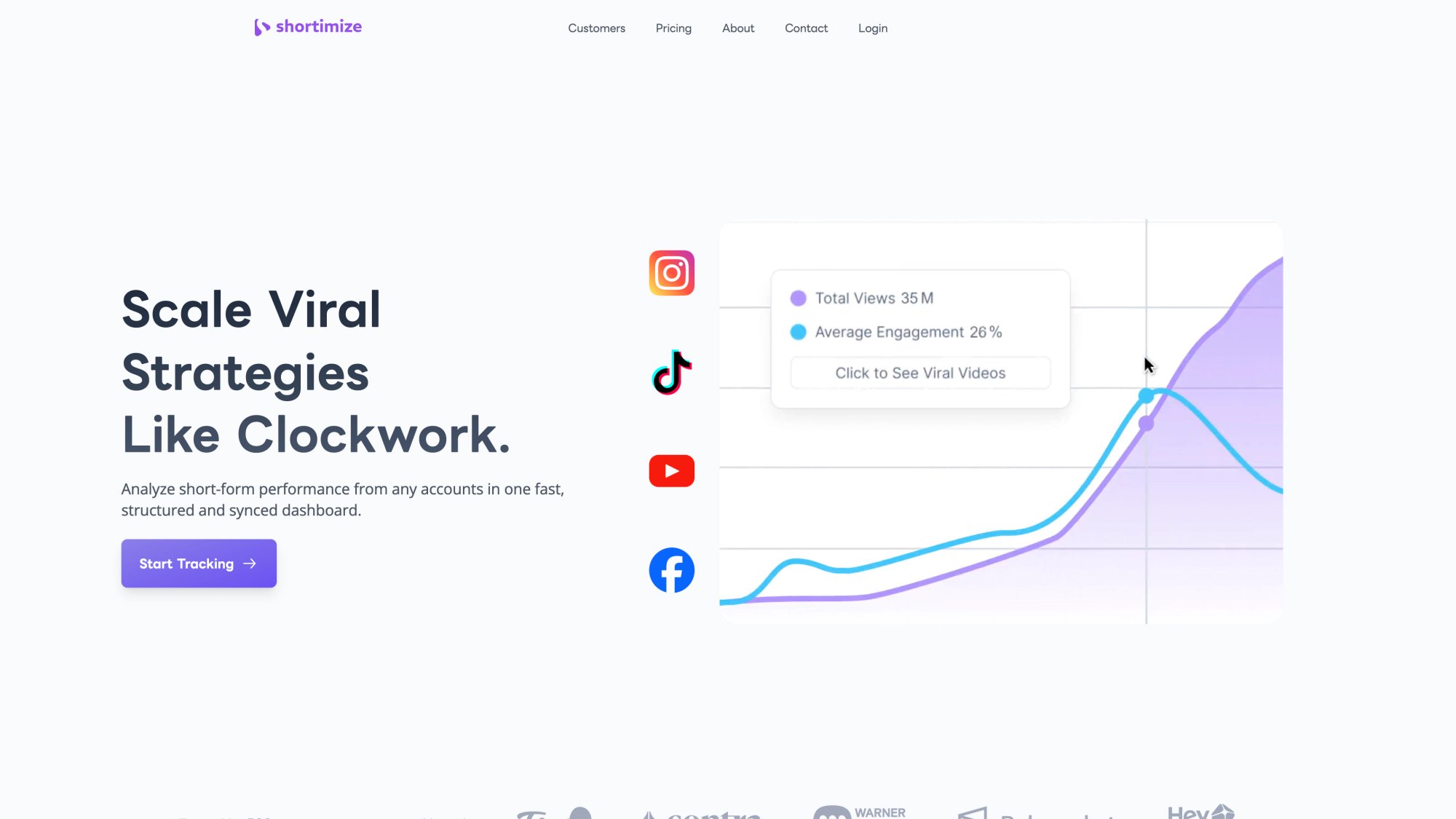
Here's the practical workflow we recommend:
① Discover creators using the manual methods and official tools outlined above.
② Build your shortlist inside Shortimize using Collections. Group creators by niche, campaign type, platform, or whatever organizing principle makes sense for your team.
③ Track their output for 30 to 90 days before committing budget. Shortimize continuously collects and updates performance data, so you can watch posting cadence, median performance, and engagement trends over time without manually checking each channel. Our social media monitoring features are specifically designed for this kind of ongoing creator surveillance.
④ Compare across platforms. If your team also works with creators on TikTok and Instagram Reels, Shortimize lets you compare the same creator's performance across all three platforms side by side. That's critical for deciding whether a creator who's great on YouTube Shorts is also strong on TikTok, or whether you should negotiate platform-specific deals. Our guide on cross-analyzing influencers on TikTok, Reels, and Shorts explains how to set this up using normalized data rather than native platform numbers.
⑤ Activate when the data says it's time. Instead of making outreach decisions based on a single snapshot, you'll have weeks or months of normalized performance data to back up your pitch and your budget. When you're ready to scale, our influencer tracking software overview covers the full stack of what a production-grade tracking setup looks like.
Our blog has deeper guides on each piece of this process:
Guide to auditing an influencer profile for a detailed screening framework
Full guide to optimizing influencer campaigns for what happens after you've signed a creator
YouTube Shorts analysis guide for tracking shortlisted creators' Shorts performance specifically
Guide to finding viral video patterns in your niche for reverse-engineering winning formats once you know which creators matter
YouTube Micro Influencer FAQs
How Many Subscribers Is a YouTube Micro Influencer in 2026?
There's no official platform threshold. The most common working definition is still around 10,000 to 100,000 subscribers, though some newer 2026 pricing guides split creators above 50,000 into a separate mid-tier category. Use it as a rough shortcut, not your main decision criterion. Median recent video performance matters far more than the subscriber number on the channel page. See our best influencer marketing tools roundup for a breakdown of how different evaluation approaches compare.
Can I Find YouTube Micro Influencers Without Paying for a Tool?
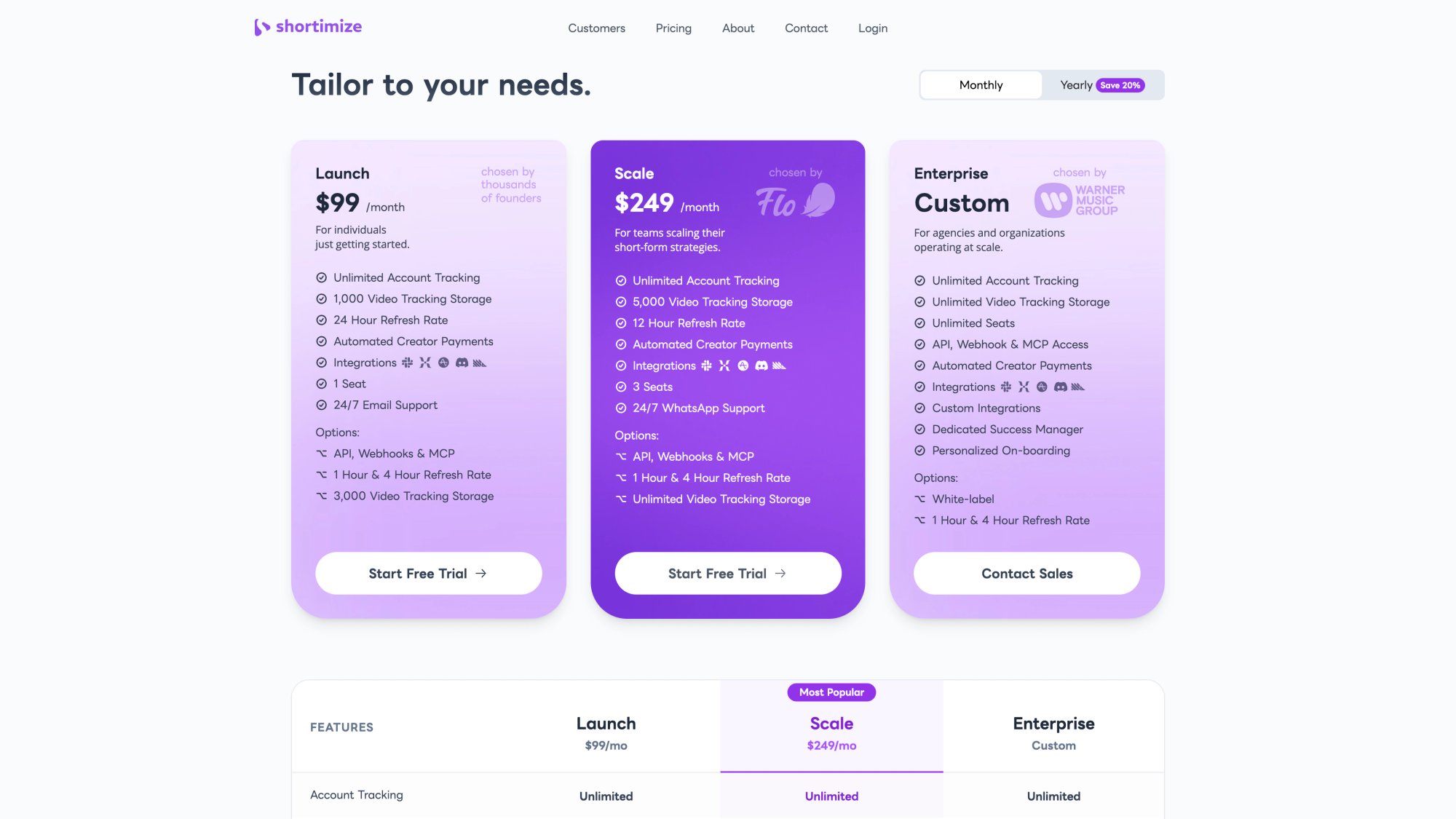
Yes. You can accomplish a lot with clean YouTube search, filters, channel pages, handles, hashtags, Hype, Trending Charts, and Business Inquiry Emails. Paid tools become most useful when your shortlist grows large and you need ongoing tracking rather than one-time discovery. If you're starting to scale, Shortimize's pricing starts at $99/month and includes unlimited account tracking, making it one of the more accessible options for teams moving from manual to systematic.
What Is the Best Google Tool for YouTube Creator Discovery?
If you qualify, Creator Partnerships is the strongest official option because it combines discovery, outreach workflow, and performance analysis. Insights Finder is also useful for topic-based and audience-based creator discovery in supported markets. Open Call is promising but still limited in availability.
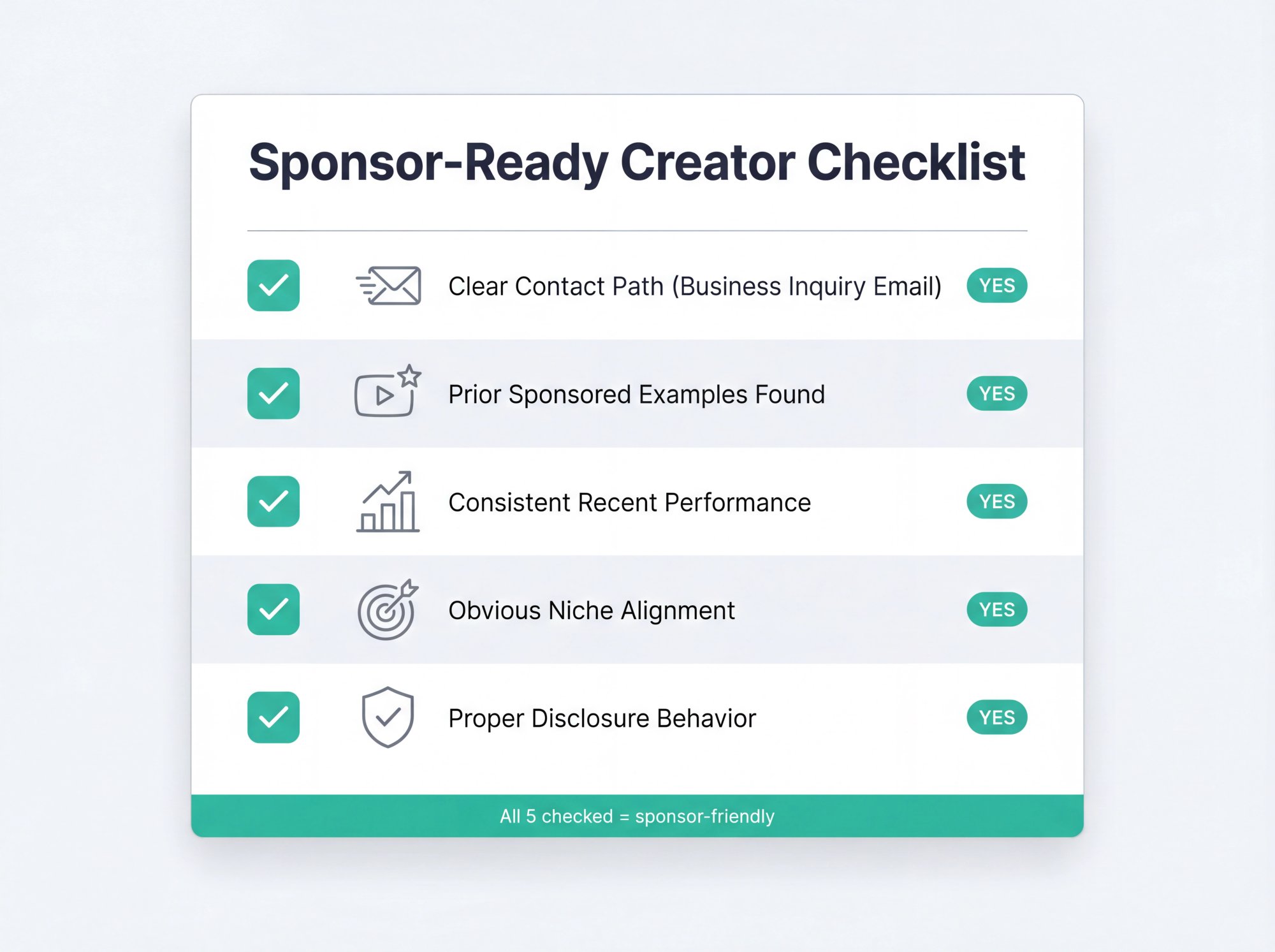
How Do I Know Whether a Creator Is Actually Sponsor-Friendly?
Look for a clear contact path (like a Business Inquiry Email), prior sponsored examples, consistent recent performance, obvious niche alignment, and proper disclosure behavior. YouTube requires paid promotion disclosure, and FTC guidance still expects both creators and advertisers to disclose material relationships clearly. Our guide to how to audit an influencer profile gives you a scoring rubric for exactly this evaluation.
How to Build a Scalable YouTube Micro Influencer System
Finding YouTube micro influencers in 2026 isn't about searching harder. It's about building a system.
Start with the audience problem. Research in a clean environment. Use search, filters, channel pages, handles, hashtags, Hype, and Trending Charts to generate candidates. Tap into Creator Partnerships and Insights Finder if you have access. Then stop thinking like a scavenger and start thinking like an investor: shortlist creators based on median recent performance, format fit, audience trust, and commercial readiness.
Discovery gets you the names. But tracking gets you the confidence to spend. That's why we built Shortimize to close that gap, giving teams the ability to monitor creators across YouTube, TikTok, and Instagram in one place, compare performance over time, and make data-backed decisions about who deserves budget.
That's how you find creators who aren't just visible, but useful.
This guide is based primarily on official YouTube and Google sources from 2025 and 2026, including YouTube's January 2026 CEO letter, the 2026 Creator Partnerships rollout materials, current Google Ads Help documentation live in March 2026, YouTube Help pages for search, Hype, Shorts, and disclosures, plus current FTC disclosure guidance.